Sri Lanka sailing in troubled waters – Wion

Pressure politics, if used wisely, can be a powerful tool. The best example is Sri Lanka. In April last year, the country introduced a new rule. All coronavirus victims would be cremated and no burials.

There was no scientific explanation for it. A few Buddhist monks claimed burying the victims would contaminate the ground and the government agreed. A classic case of appeasement politics but they probably didn’t anticipate the backlash. Rights groups and community leaders were appalled.

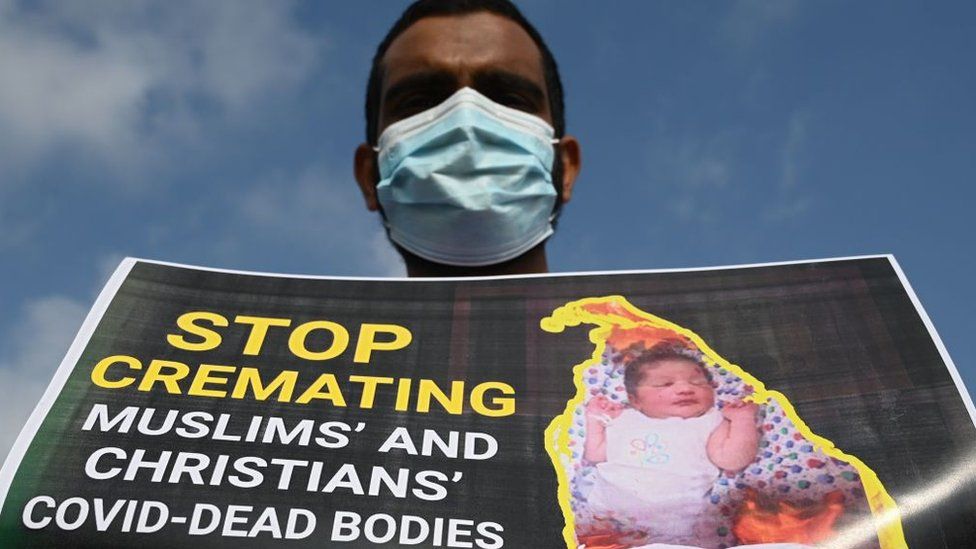
The organisation of Islamic cooperation expressed concern that Muslims on the island were being denied dignity in death. In December, 19 bodies were forcefully cremated, including that of a baby.

The world community turned on Colombo. The Lankan Government had backed itself into a corner. Now, the order has been revoked and there are no more forced cremations. Muslims are free to bury their relatives. The pressure campaign worked but there’s more to this story than activism.

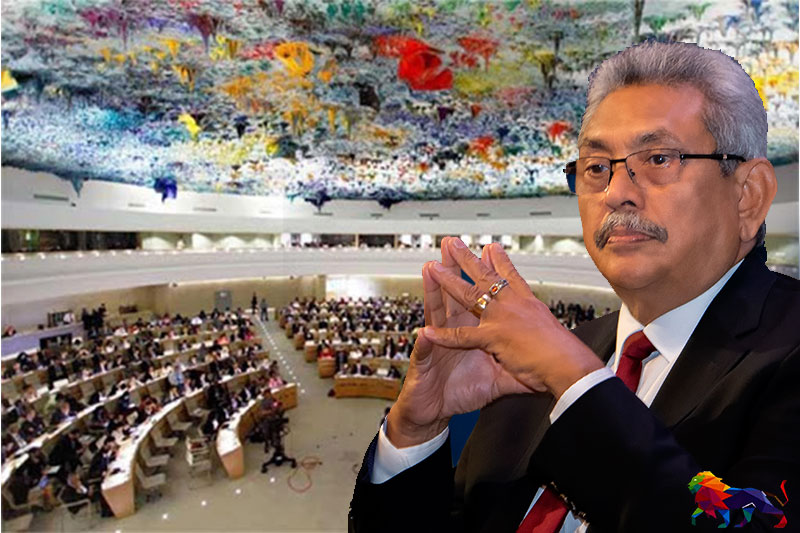
Sri Lanka is facing a stern test at the UN Human Rights Council. There’s a new resolution doing the rounds that slams the country for its dismal reconciliation efforts.

It’s been 12 years since the civil war ended. The Tamils are still awaiting justice. Far from punishing the war criminals, the government is rewarding them. Several former generals accused of war crimes have been appointed to government jobs to avoid being indicted at the UN, Sri Lanka needs help. It needs to gather enough votes to kill the resolution by reversing the burial ban, Colombo is wooing Islamic nations. Many of whom have a seat at the council. So while the global outcry definitely helped political convenience too played a part.

Here’s another reason why we can’t call this a change of heart. The Lankan government is considering a controversial law, one that would ban burqas in public. The cabinet has been consulted and with their permission, this proposal could make its way to the Parliament.

It’s one step forward and two steps back. Sri Lanka’s justification for the burqa ban is a time-tested one.

This has become the norm under President Gotabaya Rajapaksa. Stigmatisation has been used as a state policy while the government drums up anti-minority sentiments.

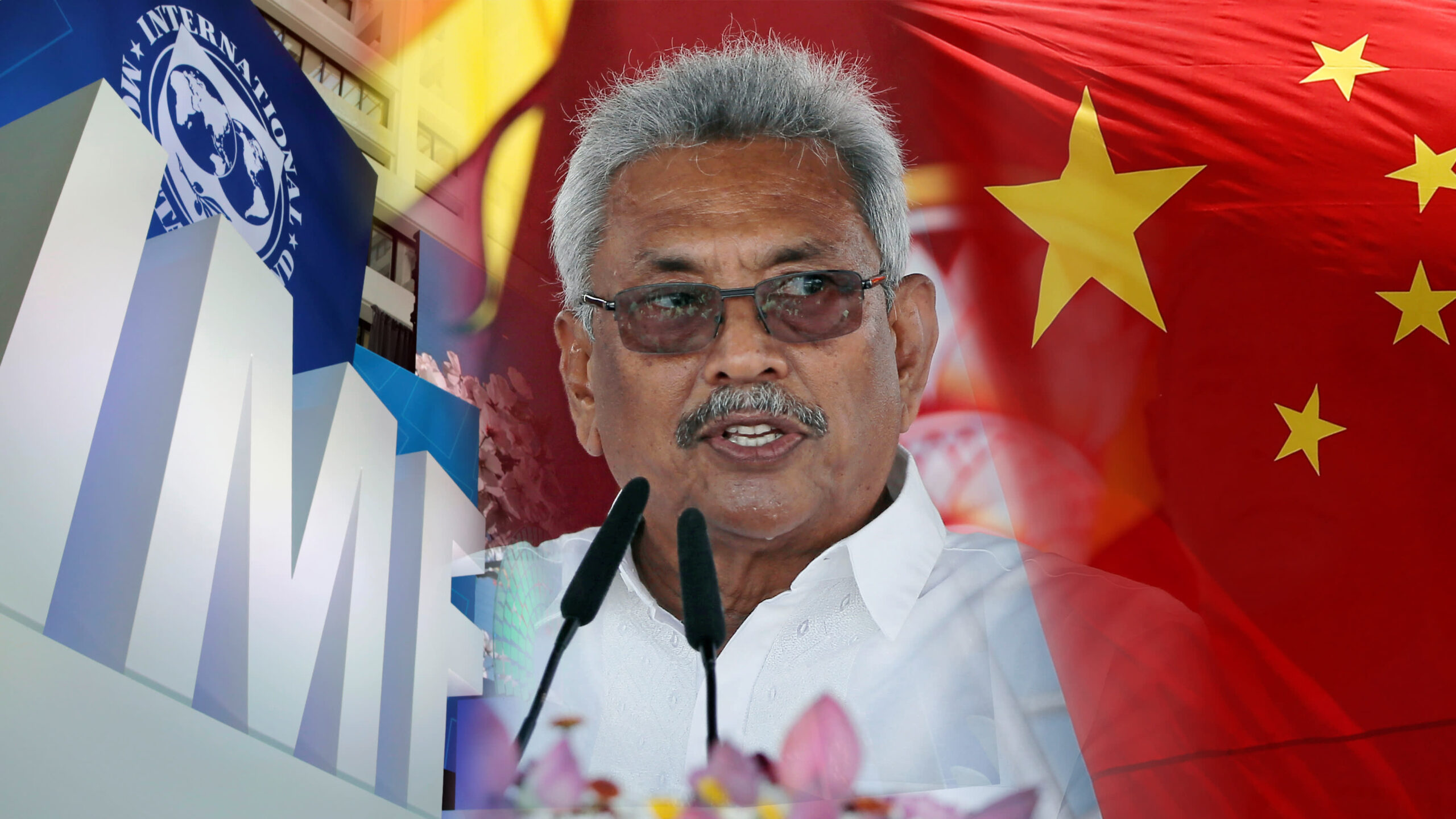
It seems oblivious to real issues like China’s expanding debt trap and Sri Lanka’s finances are in a shambles. The treasury is almost drained. Sri Lanka’s solution is to borrow from China. The country is seeking $ 2.2 billion dollars from Chinese banks.

Borrowing from China is never a good idea as it invariably ends with Beijing taking over strategic assets. Sri Lanka should know this because it’s happened to them already.

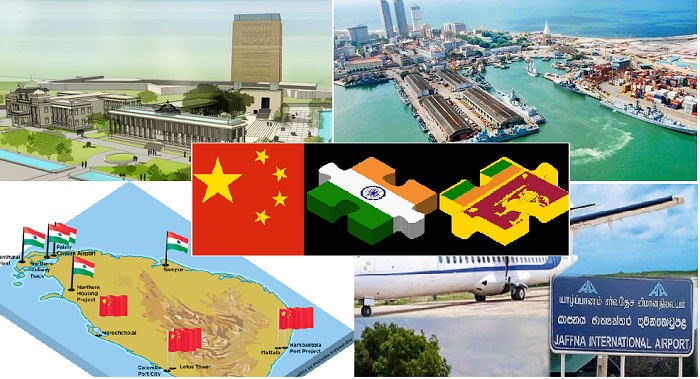
The Hambantota fiasco where China holds a 99-year lease on the strategic port and if reports are true, there is an option to extend it by another 99 years. Colombo wants to renegotiate the deal but Beijing isn’t interested. Every time, there is a new project in Sri Lanka. Chinese companies are first-off the block as they secure contracts with exorbitant bids and set up strategic Chinese presence all over the island. This is exactly what’s happening in northern Sri Lanka. Three islands are being developed as clean energy hubs. The contracts have been given to Chinese firms but here’s where it gets interesting.

These islands are just 48 kilometres from mainland India. How convenient that China’s strategic and economic interests converge so seamlessly! Right now, Sri Lanka finds itself in a vulnerable spot. It needs diplomatic backing at the United Nations and financial support to keep the country running.

It’s not an ideal situation for any sovereign nation but then again, that’s where misplaced priorities get you.

Why the reversal of Sri Lanka’s Covid-19 burial ban holds geopolitical significance

Sri Lanka on Friday reversed its controversial order banning the burial of bodies of those who died of Covid-19.

The reversal has come in the same week when Pakistan Prime Minister Imran Khan visited Sri Lanka on a two-day visit on 23-24 February, and after months of international pressure and protests by Muslim groups.

The order, which had been in force since April last year, had been criticised for targeting minorities.

The controversial burial ban

Soon after the coronavirus pandemic spread across continents, the Sri Lankan government in April passed an order that banned burials of Covid-19 victims in the country. It came amid concerns by influential Buddhist monks that burials could contaminate groundwater– claims that several experts dismissed as baseless. Under the order, burials were strictly not allowed, and all bodies were to be cremated.

The move was criticised by rights groups, including the United Nations Human Rights Council (UNHRC), as well as by Muslim, Catholic and some Buddhist community leaders. The World Health Organisation (WHO) also said that there was no risk of contamination, and recommended both the burial and cremation of those who died of Covid-19.

The Islamic world was appalled, as Muslims traditionally bury their dead facing the holy city of Mecca. Community leaders in Sri Lanka accused the move as being an extension of the state’s persecution of Muslims. The 57-member Organisation of Islamic Cooperation also expressed concern.

The order was criticised globally in December when Sri Lankan authorities ordered the forced cremation of at least 19 Muslim victims of the virus, including a baby, after families did not claim their bodies from the morgue, an AFP news report said.

The Muslim community, whose numbers are about 11 per cent of Sri Lanka’s 2.1 crore population, has had tense relations with the state and with the Sinhala Buddhist majority for much of the last decade, with riots shattering the calm once every few years. But the tensions have spiked after the synchronised Easter suicide bombings by a group of men and women who proclaimed themselves to be members of ISIS.

Pakistan PM Imran Khan’s visit

When Sri Lankan Prime Minister Mahinda Rajapaksa indicated in Parliament recently that Muslim burials would be allowed, Imran Khan tweeted his praise. “We welcome Sri Lankan PM Mahinda Rajapaksa’s assurance given in Sri Lankan Parliament today allowing Muslims to bury those who died from COVID-19,” Khan tweeted, although the government was yet to act upon that assurance.

International Human Rights watchdog Amnesty International had also urged Khan to take up the issue with Sri Lanka during his visit to the country this week. Sri Lankan media reports speculated that this could have been one reason why the visiting Prime Minister’s planned Parliament address was cancelled by the hosts.

On Tuesday, the first day of Khan’s visit, Muslim protesters in capital Colombo carried a mock jenazah, or coffin, criticising the government’s burial policy. A day later, Muslim parliamentarians asked Khan to take up the issue with Sri Lanka’s leaders. On Friday, the Sri Lankan government lifted the ban.

According to the BBC, Sri Lanka now expects Pakistan’s support at the 46th regular session of the UNHRC, which is currently taking place virtually and lasts until March 23. Five years ago, Sri Lanka had committed at the UNHRC to conduct a time-bound investigation of war crimes that took place during the military campaign against the Liberation Tigers of Tamil Eelam (LTTE). Sri Lanka now faces another resolution at the current session.

The draft resolution is based on a damning report by the Office of the High Commissioner for Human Rights (UN Human Rights) that was submitted to the Human Rights Council on January 27.

Source:The Indian Express

Posted in Uncategorized

EU concerned over intensified surveillance in Sri Lanka

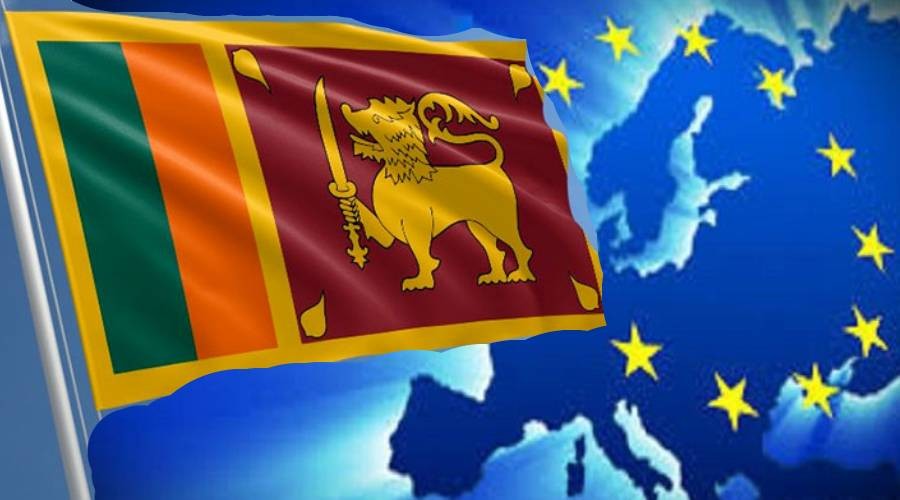
The European Union (EU) is concerned over intensified surveillance in Sri Lanka.

The EU also said that it attaches great importance to the assessment by the UN High Commissioner for Human Rights Michelle Bachelet on possible avenues for advancing accountability and to end impunity in Sri Lanka.

In a statement made at the UN Human Rights Council during the ongoing 46th Session, the EU reaffirmed its commitment to Human Rights, reconciliation and accountability in Sri Lanka.

“We regret that the Government of Sri Lanka no longer supports the comprehensive HRC process after 2015. We are concerned about a set back of the important gains made in recent years,” the EU said.

The EU noted that it is key to preserve achievements like the Office of Missing Persons and the Office for Reparation, safeguard their independence and provide them with sufficient resources.

“We share the concern of the High Commissioner about the warning signs of a deteriorating human rights situation, mainly the erosion of democratic checks and balances and the rise of exclusionary rhetoric. We are particularly worried about intensified surveillance and intimidation of CSOs, human rights defenders and victims,” the EU said.

The EU said it was also concerned about the ongoing impunity for past gross human rights violations and serious violations of international humanitarian law, including torture and ill-treatment.

“Though the HRC has for many years stressed the need for accountability, domestic processes did not deliver. We therefore attach great importance to the High Commissioner’s assessments on possible avenues for advancing accountability and end impunity,” the EU said.

The EU hopes that the Government of Sri Lanka will remain committed to promoting reconciliation and accountability in the country.

Posted in Uncategorized

Sri Lanka: End of forced cremations for coronavirus victims restores dignity for Muslim burials

Responding to the Sri Lankan authorities’ decision to end the practice of forced cremations for victims of COVID-19, Yamini Mishra, Amnesty International’s South Asia Director, said:

“This is a long overdue but welcome move by the Sri Lankan authorities. Forced cremations, which should never have been carried out in the first place, have denied the Muslim community the right to say goodbye to loved ones in accordance with their religious beliefs.

“The ending of this cruel practice, which has not been scientifically proven to prevent the spread of the virus, allows Sri Lanka’s Muslim minority a dignified burial in line with Islamic burial rites.

“The decision is a testament to the tireless struggle of families of victims, activists, and members of the Muslim community.”

Amnesty had previously called for religious minorities in Sri Lanka to have their final rites respected in the midst of the COVID-19 pandemic.

UN to act on report despite objections

The Office of the UN High Commissioner for Human Rights (OHCHR) is to implement recommendations in a report tabled at the UN Human Rights Council, despite objections raised by Sri Lanka.

The United Nations Deputy High Commissioner for Human Rights Nada Al-nashif said that the report by the High Commissioner for Human Rights Michelle Bachelet, which was formally tabled at the Council on Wednesday, was amended to include changes after talks with the Sri Lankan Government.

She said that the final document was delayed by three weeks after Sri Lanka had raised some concerns and proposed changes.

Nada Al-nashif said that several models will be looked at to implement some of the mechanisms proposed in the report on Sri Lanka.

She said that existing systems like those implemented on Syria, Myanmar or North Korea or an entirely new configuration can be considered when dealing with Sri Lanka.

“This is entirely up to the Council to see what is the best fit for the discharge of specific accountability functions,” she said.

Nada Al-nashif said that the OHCHR has huge amount of material and evidence collected over the years.

The Deputy High Commissioner said the OHCHR enjoys a very open and frank relationship with the Government of Sri Lanka (GOSL).

She also expressed hope that Sri Lanka will continue to engage with the UN Human Rights Council.

Foreign Minister Dinesh Gunawardena told the Council on Wednesday that Sri Lanka rejects the recommendations made by Bachelet in her report.

He said the call for asset freezes, travel bans, references to the ICC and the exercise of universal jurisdiction by individual States points to a distinct and imminent danger which the international community as a whole need to take note of.

Posted in Uncategorized

UN rights body should ensure international accountability for grave crimes in Sri Lanka -HRW

It is 11 years since tens of thousands of civilians were killed in the final months of Sri Lanka’s civil war. Both parties to the conflict committed war crimes and other abuses for which no one has been held to account.

For nearly a decade this Council has engaged Sri Lanka, including landmark consensus resolutions since 2015 to support a national process of accountability and reconciliation. Last year, soon after Gotabaya Rajapaksa was elected president, the Sri Lankan government renounced those commitments. It has repeatedly shown bad faith, appointing those implicated in war crimes to positions of authority. It has pardoned one of the only few soldiers ever convicted by a national court for the massacre of civilians. It has denied security force intimidation of victim groups and activists bravely engaging with this Council, and adopted discriminatory policies against the Tamil and Muslim minority communities. Among those are the cruel and medically unjustified policy of forced cremation of Muslims, contrary to their religious practice, who die with Covid-19.

Sri Lanka has announced yet another commission of inquiry in an apparent attempt to mislead the Council that a viable domestic process exists. Seventeen Special Procedures recently pointed out that Sri Lanka has a long history of commissions of inquiry “established to deflect international pressure, …[which] have been strongly criticized for their weak mandates, lack of independence, lack of resources, procedural opacity, poor collaboration from the government, … and the overall lack of implementation of their recommendations.”

Just this week, the Foreign Minister addressed the Council, denying international crimes, rejecting the Council’s resolutions, and dismissing the High Commissioner’s report as a “propaganda campaign.” No-one can seriously believe the government has any intention of pursuing justice.

The High Commissioner, in her devastating report, rightly characterized Sri Lanka as being “in a state of denial,” unable and unwilling to address its past, with direct impact on its present and future.

Now activists, victim families, even those Sri Lankan officials who have sought justice, are at risk. Lawyers have been arbitrarily detained. Protesters calling for this Council to take action have been summoned by the police.

The Council should give effect to the High Commissioner’s recommendations by advancing international accountability for grave crimes and acting to prevent further abuses. As the High Commissioner states, the international community failed the people of Sri Lanka in the past; it cannot afford to do so again.

Posted in Uncategorized

Sri Lanka seeks $2.2 bn from China as reserves shrink

Sri Lanka is seeking $2.2 billion from Chinese banks, the government said Thursday, in echoes of a borrowing binge more than a decade ago that resulted in the country having to give up a strategic port to China.

Money and capital markets minister Nivard Cabraal said the government was hopeful of finalising a $1.5-billion swap facility with China’s central bank.

“Within the next two weeks we should be able to finalise it,” Cabraal told reporters in Colombo while maintaining that the funds would be used as a “buffer” to meet the government’s foreign currency needs.

Official figures show Sri Lanka’s foreign reserves plummeted to $4.8 billion at the end of January, the lowest since September 2009 when they fell to $4.2 billion.

Officials said Sri Lanka was also in talks with China Development Bank for a $700-million loan that would include the equivalent of $200 million being drawn in Chinese currency.

Under former president Mahinda Rajapaksa between 2005-15, Colombo borrowed billions from China, accumulating a mountain of debt for expensive infrastructure projects.

This sparked Western and Indian concerns that the strategically located Indian Ocean nation was falling victim to a Chinese debt trap.

Mahinda Rajapaksa returned to power as prime minister in 2019 after his brother Gotabaya Rajapaksa as elected president.

Sri Lanka was forced to hand over its strategic Hambantota port on a 99-year lease to a Chinese company in 2017 after Colombo said it was unable to service the $1.4-billion debt from Beijing used to build it.

Three top international rating agencies downgraded Sri Lanka’s creditworthiness late last year after raising doubts over Colombo’s ability to service its foreign debt.

The South Asian nation’s economy is reeling from the twin impacts of the deadly 2019 Easter bombings that killed 279 and devastated the tourism sector as well as the fallout from the pandemic.

Cabraal insisted Thursday that Sri Lanka would maintain its record of repaying debt on time and said the credit downgrades by international agencies were “unwarranted.”

He said Sri Lanka had already repaid $500 million this year out of its $3.7 billion debt servicing commitment for calendar 2021.

He said the government imposed a ban on luxury imports and several other commodities in a bid to conserve foreign exchange so that the country could have sufficient foreign currency to repay its debt.

Sri Lanka’s economy contracted by a record 3.9 percent last year.

However, Cabraal said economic activity was picking up and the country estimated foreign inflows of $32 billion against outflows of $27.6 billion this year leaving a surplus of $4.4 billion.

Source – AFP

Posted in Uncategorized

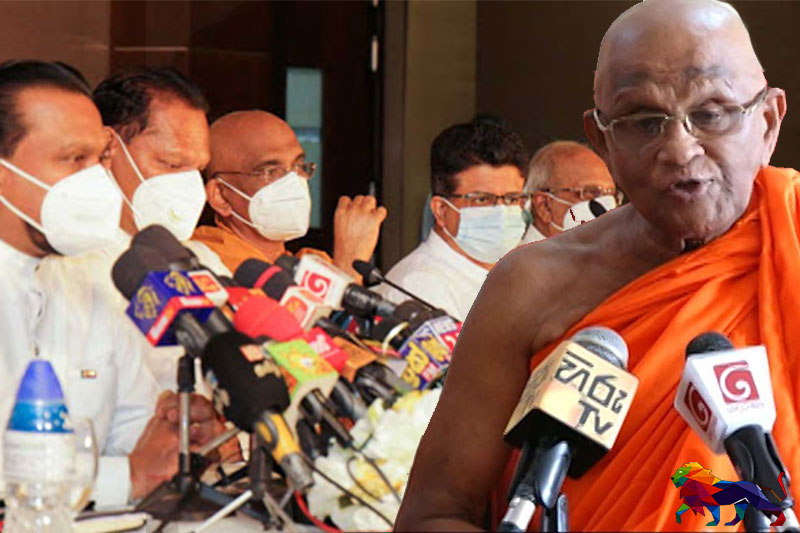
8 parties affiliated to the government summoned to Abhayarama Temple

Pro-government monks have stressed the need to consolidate political power around President Gotabaya Rajapaksa.

The Maha Sangha reiterated this stance at a meeting held with a group of party leaders led by Industries Minister Wimal Weerawansa. The party leaders were summoned for a meeting at the Abhayarama Temple on Wednesday (24).

Speaking to reporters after the meeting, Energy Minister Udaya Gammanpila said that political analysts have revealed how certain external elements have created challenges pertaining to the internal affairs of the government.

He said that the President should be supported at all times to ensure that the government can face these challenges head on.

“Leaders of 8 parties convened at the Abhayarama Temple under the patronage of Venerable Muruththettuwe Ananda Thero together with a group of Nayaka Theros. They discussed the challenges the current government is facing. It was an open dialogue where we discussed our future course of action. These are internal matters,” he said.

Minister Wimal Weerawansa said that the Maha Sangha had pointed out the importance of politically empowering the President as the Head of State.

Minister Vasudeva Nanayakkara speaking to reporters after the meeting said: “the Chief Incumbent of the Abhayarama Temple Venerable Muruththettuwe Ananda Thero sent me a message asking me to come to the temple in the evening. I didn’t ask why. After we arrived, he inquired about the current state of affairs of the government. It was just a query.”

Posted in Uncategorized

Background to Lanka’s decision to lift ban on burying COVID dead

Late on Thursday, February 25, the Sri Lankan Health Minister Pavithra Wanniarachchi issued a gazette extraordinary lifting the year-old ban on burying COVID-19 dead. The Gazette amended the earlier ordinance by putting the words “cremation or burial” in place of the single word “cremation”.

“In the case of burial, the corpse of such person shall be buried in accordance with the directions issued by the Director General of Health Services at a cemetery or place approved by the proper authority under the supervision of such authority,” the gazette said.

The government’s decision brought the curtains down on an issue which deeply agitated the minority Muslims for whom burial is mandated by Islam and therefore inviolable.

Over the past year, the Muslims, who are about 10% of the Sri Lankan population, had brought into play an international expert in virology, to challenge the government’s expert committee’s contention that burying the COVID dead would contaminate ground water and be a public health hazard. Prof. Malik Peiris of the University of Hong Kong said in a widely circulated video: “If the body is wrapped in water-resistant material and chemicals are used to expedite the process of decay, the possibility of even a residual amount of the COVID-19 infection seeping through the soil and contaminating water is an entirely non-scientific argument. That is a major reason why the World Health Organization and many countries in the world have no problem with burials.”

In April 2020, Muslim leaders proposed that a Muslim dying of COVID be wrapped in a body bag and put in a concrete grave which will have one and a half feet of soil in it. A chemical could be sprayed on the body bag to let it and the body inside de-compose in a week or so. The Muslims had also submitted a design for the concrete grave. They suggested that the mourners might stand 50 meters away from the grave after spending three minutes beside it to say the customary prayer. The community would help indigent families bear the expenses involved in constructing the concrete grave and in getting a coffin if a coffin is made mandatory, they added.

The government appeared to be open to this suggestion but was hesitating to take a decision. Frustrated, some leading Muslims appealed to foreign leaders like Mohamed Nasheed, Speaker of the Maldivian parliament, Pakistan Prime Minister Imran Khan, and the Malaysian Prime Minister to intercede with the powers-that-be in Colombo. Nasheed sounded Lankan President Gotabaya Rajapaksa about the idea of sending Muslim bodies to the Maldives. The Lankan President made a formal request this his Maldivian counterpart, Ibrahim Solih, who responded favorably. But this idea of airlifting bodies to the Maldives was found to be impractical.

At the Muslims’ insistence Prime Minister Mahinda Rajapaksa set up a second committee of experts in virology, which challenged the contentions of the earlier experts’ committee and recommended burial as well as cremation as sanctioned by the WHO. But the first committee, which apparently had the backing of President Gotabaya Rajapaksa, stuck to its guns and threw the recommendation of the second committee out.

However, the Muslims did not lose heart. They took the issue to the Organization of Islamic Cooperation (OIC). The OIC issued a statement om December 10, 2020 which said: “The General Secretariat of the OIC expresses concern over reports of Sri Lankan authorities insisting on cremation for COVID-19 Muslim victims. Against this practice, inconsistent with Islamic precepts, the OIC calls for respect to the burial ritual in the Muslim faith.”

The Muslims’ cause began to be taken up by Lankans of other faiths also and their plight became the subject matter of articles in leading Western dailies. Sri Lankans were appalled by the forced cremation of a 20-day old baby Shykh in the absence of his parents, who had stayed away in protest. People tied white cloth on the gates and iron railings of the main crematorium in Colombo even though the police kept removing them.

While the government kept talking about an ‘expert committee’ which had said that COVID-19 bodies would pollute the soil and ground water, a section of the ruling Sri Lanka Podujana Peramuna (SLPP) led by Prime Minister Mahinda Rajapaksa and Basil Rajapaksa, had thought it fit to strike a deal with the Muslims. They planned to get the ban lifted in return for votes to pass the controversial 20 th.Constitutional Amendment (20A) with the required two-thirds majority. The 20A was meant to arm the Executive President (Gotabaya Rajapaksa) with enhanced powers which he had been seeking. Six MPs did cross over from the opposition to vote for the 20A as part of the deal but the SLPP did not keep its part of the bargain.

At this stage, an influential factor appeared on the scene: a UN Human Rights Council (UNHRC) session where there was to be a resolution condemning Sri Lanka for alleged human rights violations and war crimes and failing to implement earlier resolutions calling for accountability mechanisms. Government feared that apart from the already hostile Western bloc, Muslim countries would also turn against Sri Lanka in the Council. The Muslim burial issue was sure to be on the top of the litany of complaints against Sri Lanka.

Prime Minister Mahinda Rajapaksa, who always wanted the ban lifted in order to get the Muslim’s political support, announced in parliament that burials would be allowed after a Minister said that the first expert committee had changed its opinion and said that burial will not pollute ground water. But no action followed because government said that the experts’ committee had not given a ruling.

Meanwhile, international pressure was mounting. Apart from the OIC which called for the lifting of theban, it was feared that Sri Lanka’s time tested friend, Pakistan, would also join the chorus against the ban on burial. The vote of the Muslim countries and Pakistan’s lobbying were crucial to beat the expected hostile resolution against Sri Lanka in the UNHRC in March.

Pakistan Prime Minister Imran Khan was to come to Sri Lanka and address the Lankan parliament. It was feared that he could touch upon the subject in his speech (apart from touching upon Kashmir to embarrass India).

On the excuse that COVID 19 might prevent full attendance of MPs, the Speaker of the parliament asked government to cancel the speech. Imran agreed to call off the speech.

Unfazed, Lankan Muslim leaders continued to urge Pakistan to take up the matter with the powers-that-be. The Pakistanis told the Lankan Muslim interlocutors that while the issue could not be part of the official talks, it could figure in informal interactions. Perhaps it did. In an oblique reference to the issue, the Joint Communique issued at the end of Imran’s visit said: “Both sides underlined the importance of inter-religious dialogue and harmony as a key to promote cultural diversity, peaceful co-existence and mutual empathy.”

When Muslim MPs met Imran before his departure from Colombo to find out if indeed he took up the issue at the talks, he said he did and added that the “response was positive.” Sure enough, a day after Imran’s departure, the government issued a gazette lifting the ban on burial.

UK Tells UNHRC Srilanka increase surveillance and harassment of civil society actors and militarisation of civilian governmental functions

The Human Rights Council must continue to consider the situation in Sri Lanka and press for progress on justice, reconciliation and accountability, and improved respect for human rights, the UK said at the 46th UNHRC sessions.

“Enhanced monitoring by the Office of the High Commissioner is critical to support this. Together with our Core Group partners, we will present a new resolution to continue the Council’s engagement on these important issues, and have indicated our desire to work with the Government of Sri Lanka in support of accountability and lasting reconciliation for all communities,” the UK said.

UK’s Minister for the UN and Human Rights Lord (Tariq) Ahmad of Wimbledon said this delivering his statement during the Interactive Dialogue with the High Commissioner for Human Rights on Sri Lanka.The United Kingdom welcomes the High Commissioner’s detailed and most comprehensive report on Sri Lanka.

The full statement

Thank you, Madam President.

The United Kingdom welcomes the High Commissioner’s detailed and most comprehensive report on Sri Lanka.

We share the concerns regarding the reversal of progress on issues of accountability, and also the current human rights situation, and the risk and recurrence of past violations.

We are also concerned at the increase in surveillance and indeed harassment of civil society actors, the militarisation of these civilian governmental functions, and the impact of the government’s forced cremation policy on different communities in Sri Lanka, particularly the Muslim community, who continue to face persecution.

We also regret the Government of Sri Lanka’s decision to withdraw support for resolution 30/1, and note that previous domestic initiatives have all failed regrettably to deliver meaningful accountability. The appointment of senior military officials allegedly implicated in war crimes and crimes against humanity also calls into question Sri Lanka’s commitment to accountability and justice.

Therefore the Human Rights Council must continue to consider the situation in Sri Lanka and press for progress on justice, reconciliation and accountability, and improved respect for human rights. Enhanced monitoring by the Office of the High Commissioner is critical to support this. Together with our Core Group partners, we will present a new resolution to continue the Council’s engagement on these important issues, and have indicated our desire to work with the Government of Sri Lanka in support of accountability and lasting reconciliation for all communities.