

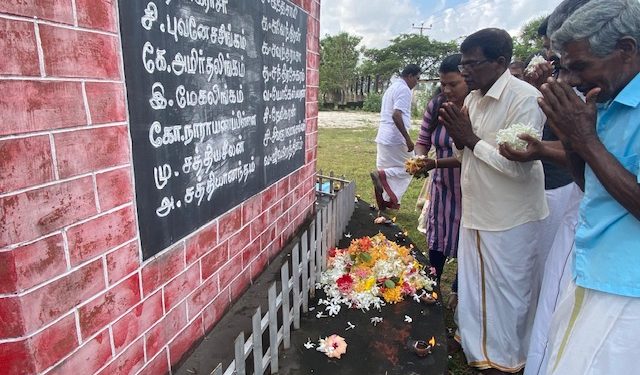
On January 28, survivors and activists gathered in the Eastern Province to commemorate the 39th anniversary of a mass killing that claimed the lives of over 200 unarmed Tamil civilians, including children.
The solemn ceremony was held at the monument in Mahiladithivu, Kokkadichcholai, where the names of the 230 victims are inscribed.
The event served as a stark reminder of one of the most violent chapters of the nation’s civil conflict, for which state security forces have long faced allegations of responsibility.
Addressing the media at the memorial, Ilankai Tamil Arasu Kachchi (ITAK) Batticaloa District MP G. Srineshan voiced the persistent frustration of the victimised community, noting that nearly four decades have passed without legal accountability.
“Countless governments have changed, and several presidents have held office, yet their eyes remain closed to the pursuit of justice. With President Anura Kumara Dissanayake now in power, we hold a profound hope that the victims might finally see justice during his tenure,” he said.
Srineshan also said that the identities of the victims and the perpetrators are well-documented within historical and local records.
“Those killed were innocent. It is a clear and established fact that military special units were responsible for this massacre. The state knows exactly who was deployed here at that time and who bears responsibility for these actions. If the current administration truly stands for the rule of law and equality, it must deliver justice for those who were lost,” he added.
A bloody January in 1987
The village of Kokkadicholai, nestled in the heart of the Batticaloa District, has long been a sanctuary for those whose lives are intertwined with the land and sea—communities of farmers, fishermen, and prawn cultivators.
However, for the residents here, the name Kokkadicholai remains synonymous with a three-day siege that began on January 29, 1987.
According to local accounts, the village was subjected to a relentless barrage of gunfire from government forces that marked the beginning of one of the region’s darkest chapters.
Witnesses recall a coordinated assault involving ground troops from the Kondavattuvan, Kaluwanchikudy, Vellavely, and Kallady camps.
Supported by helicopters and heavy trucks, security forces moved into the village, effectively sealing off the area.
In the ensuing chaos, soldiers reportedly rounded up male residents between the ages of 14 and 40.
Families of the victims allege that many of those seized were summarily executed, leaving a legacy of grief and a decades-long demand for accountability that persists to this day.