Sri Lanka to get 15 more Bailey Bridges from India to connect Cyclone hit highways

India will build 15 Bailey Bridges to through a 450 million dollar cyclone recovery package to reconstruct Sri Lanka’s damaged infrastructure, the Indian High Commission in Colombo said.

A 100 foot Bailey Bridge was on the B-492 Highway along the Kandy–Ragala Road, was inaugurated on January 10 by High Commissioner of India Santosh Jha, and Deputy Minister of Transport and Highways, Prasanna Gunasena.

The bridge was installed by the 19 Engineer Regiment of the Indian Army and was begun within three weeks of announcing a 450 million dollar aid package.

“The newly commissioned Bailey Bridge has significantly improved access and mobility for communities in this affected area, particularly in the difficult hilly terrain,” the Indian High Commissions aid.

The re-building is carried out with the Sri Lankan Army and the Road Development Authority.

India will install another Bailey Bridget along the Kandy Ragala road.

“In the next phase, over 15 additional Bailey Bridges will be constructed over the coming weeks, ensuring comprehensive restoration of connectivity across all affected areas,” the statement said.

“Projects in other areas will also be launched in the coming days.”

India is expected to re-build damaged railway tracks and also provide housing and other areas as required by Sri Lanka.

India has airlifted 228 tonnes of Bailey Bridge components to build four Baily Bridges.

Posted in Uncategorized

Restoration of Northern Railway Line Launched

Restoration work of the Northern and Talaimannar railway lines was launched today (11).

The official ceremony took place at the Maho Junction Railway Station with the participation of Minister of Transport Bimal Rathnayake and the High Commissioner of India in Sri Lanka, Santosh Jha.

Railway lines were severely damaged following the devastation caused by Cyclone Ditwah.

Restoration activities will take place with the US$ 5 million grant assistance from the government of India, the Ministry of Transport stated.

Modernization work on the railway lines was launched several years ago with the objective of operating trains at a speed of 100 kilometers per hour, the Ministry noted.

The development project also included the construction of five bridges and an underpass to allow wild elephants to cross. However, the project was suspended due to the impact of Cyclone Ditwah last year.

Accordingly, with the grant received from India, the restoration work of the lines was commenced today at the Maho Junction Railway Station, the Ministry of Transport added.

Tamil Nadu Chief Minister writes to Indian PM Modi over Sri Lanka’s proposed constitutional reforms

Tamil Nadu Chief Minister M. K. Stalin has written to Indian Prime Minister Narendra Modi, urging the central government to take proactive and high-level diplomatic steps to protect the welfare, political rights, and constitutional aspirations of Sri Lankan Tamils amid proposed constitutional reforms in Sri Lanka.

In his detailed letter, Stalin said he was drawing the Prime Minister’s attention to what he described as a deeply troubling and sensitive issue concerning the Tamil community in Sri Lanka.

He stressed that Tamil Nadu has always been at the forefront of advocating the rights and aspirations of Sri Lankan Tamils due to strong historical, cultural, and emotional ties.

As Chief Minister, he said it was his duty to convey the serious concerns raised by respected Tamil leaders from both India and Sri Lanka regarding the direction of the proposed new Sri Lankan Constitution.

Stalin noted that he had received extensive representations warning that the ongoing constitutional reform process in Sri Lanka could have grave consequences for the Tamil community.

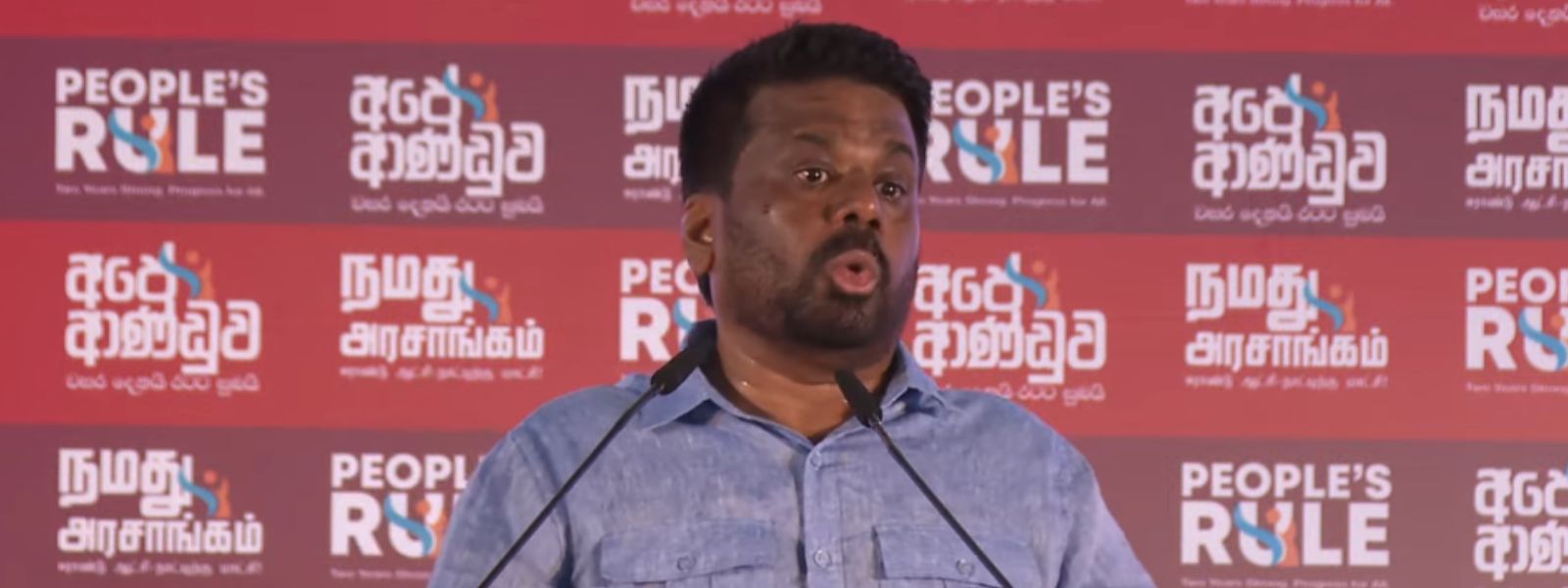
Referring to the present political context, Stalin said the government led by President Anura Kumara Dissanayake, which enjoys a majority in Parliament, appears to be accelerating efforts to introduce a new constitution.

He warned that the proposed framework seems to further strengthen a unitary “one-nation” model, ignoring the aspirations of Tamils for political autonomy and pushing them further to the margins.

In this context, the Tamil Nadu Chief Minister urged the Prime Minister to engage Sri Lankan authorities at the highest diplomatic level to ensure a genuine constitutional process that meaningfully addresses Tamil grievances.

Expressing confidence in PM Modi’s leadership, Stalin said he firmly believes India will take the lead in safeguarding the rights of Sri Lankan Tamils and help pave the way for a just, durable, and lasting solution.

Source: IANS

Draconian PTA: Reborn in disguise -Editorial The Morning

What is unfolding in Sri Lanka today is not a dramatic invasion or an overt loss of sovereignty, but something far subtler and therefore more dangerous: a renewed form of imperial influence advancing quietly through the language of reform, stability, and modernisation. This phenomenon is not new to the Global South, but its present intensity and the ease with which it appears to be gaining ground right before our eyes should give serious pause. The troubling reality is that this occurrence has coincided with a regime that seems inexperienced in the craft of statecraft and ill-equipped to distinguish between genuine assistance and predatory intervention. That vulnerability is now being exploited with alarming effectiveness.

Taken in isolation, each piece of ‘reform’ pushed onto the national agenda may appear defensible, even benign. But when viewed as a whole, the pattern is unmistakable. Education reforms funded and guided by multilateral agencies seek to reshape curricula and values in ways that provoke deep social unease. Economic restructuring demanded by the IMF prioritises fiscal orthodoxy and short-term stability while offering little credible pathway to growth, industrial renewal, or social protection.

Now, layered onto this is the quiet drafting of a new anti-terror law that threatens to curtail basic freedoms and place Sri Lanka’s democratic credentials – and even its trading future – at risk. Together, these developments suggest not a confident sovereign state charting its own course, but a regime stumbling in the dark, overly eager to appease external actors whose interests are not necessarily aligned with those of the Sri Lankan people.

The most disturbing feature of what is taking place is the apparent unawareness of the powers that be, and to make matters worse, even the collective Opposition. As far as the Government is concerned, it seems oblivious to the political and moral pits it is digging for itself in the name of reform. External entities, cloaked as benevolent benefactors, are treated as neutral advisers rather than as actors with their own strategic and ideological agendas. The inability or unwillingness of the regime to distinguish between genuine partnership and disguised coercion points to the deeper problem of an acute lack of experience in statecraft. That deficiency is now being exploited in ways that earlier governments, for all their faults, often resisted or at least navigated with greater caution.

This deference has reached almost theatrical proportions. The Government appears willing to bend over backwards to accommodate the demands and expectations of these modern imperialists, even when doing so contradicts its own stated principles and electoral promises. Nowhere is this more evident than in the ongoing attempt to introduce a new anti-terror law to replace the much-maligned Prevention of Terrorism Act (PTA). While the public discourse is saturated with distractions and emotionally charged side issues, the real danger is being quietly prepared in the background, inching its way through the legislative process with minimal scrutiny.

This tactic is hardly new. Governments across time and ideology have mastered the art of diversion. When controversial legislation threatens to provoke resistance, attention is deliberately drawn elsewhere. Populist controversies are amplified, cultural flashpoints are inflamed, and media cycles are consumed by issues that, while not unimportant, serve conveniently to distract from what truly matters. The public, as expected, takes the bait. So does the opposition. Meanwhile, the serious business of expanding state power over citizens proceeds largely unchallenged.

What makes the present silence over the proposed Protection of the State from Terrorism Act (PSTA) particularly galling is the identity of those now in power. No political force protested the PTA more vociferously than the JVP, now rebranded as the NPP. For decades, it mobilised against the act, paralysed cities, disrupted daily life, and rightly condemned the PTA as a draconian instrument used to stifle dissent under the pretext of national security. If one were to tally the hours spent protesting against the PTA, the cumulative loss in productivity would likely amount not to days or months, but to years. Yet today, at the very moment when a new and potentially more dangerous law is being readied, that same moral fervour is conspicuously absent.

If there was ever a time for principled resistance to legislation that threatens fundamental freedoms, it is now. And yet, the Opposition – fragmented, distracted, and perhaps out-manoeuvred – has largely fallen silent. By falling for and chasing diversionary controversies, it risks rendering itself irrelevant at a time when relevance is most urgently needed. If the Opposition hopes to retain any credibility, it must urgently wake up to the looming danger and alert the public to the freedoms they are about to lose, quietly and perhaps permanently.

The NPP’s own record makes this state of affairs even more consequential. It did not merely promise to reform the PTA; it pledged to abolish it entirely. The act was described, unequivocally, as incompatible with democracy and justice. Yet instead of abolition, what has emerged is a replacement law that, according to the latest draft, appears more expansive, more ambiguous, and more prone to abuse than the PTA itself. As this legislation edges closer to becoming law, it stands poised to become yet another broken promise in a growing catalogue that has already begun to erode public trust in the Government.

At its core, this legislative exercise misses the very point that the JVP/NPP consistently made with such clarity from the Opposition benches. The problem with the PTA was never merely its technical deficiencies, but the philosophy underpinning it; the elevation of State power over individual liberty, justified by an elastic notion of national security. Abolition was demanded because reform could not cure a law so fundamentally flawed.

Yet power has a way of changing perceptions. Once in office, confronted with waning popularity and the temptations of control, the same party now appears to seek what previous regimes hesitated to pursue: an even sharper instrument of repression. Where others clung to the ‘known devil,’ this Government seems intent on forging a new one.

The metaphor writes itself. For decades, dissent in Sri Lanka was cut down with a saw. The promise was to discard the tool altogether. Instead, it is now being replaced with a chainsaw – more powerful, more efficient, and far more destructive – while the media and Opposition alike remain mesmerised by carefully staged distractions. The tragedy is not only the betrayal of principle, but the normalisation of it.

None of this is to deny that modern states require legal frameworks to address genuine security threats in an evolving global landscape. Terrorism is real, and the State has a duty to protect its citizens. But security cannot be built on the systematic erosion of liberty. Sri Lanka has already paid a heavy price for decades of abuse under the PTA: lives disrupted, dissent criminalised, and trust in institutions corroded. What the people do not need is a PTA version 2.0, repackaged and legitimised under a new name.

Ultimately, this is a test not only of governance, but of sovereignty. A regime that allows itself to become a pawn in the hands of external powers – however benevolently those powers present themselves – risks forfeiting both its legitimacy and its future. The sooner this Government learns to see through the disguise of modern imperialism, the better it will be for its own survival and for the democratic health of the nation. History, after all, has never been kind to those who surrendered their principles in exchange for the illusion of stability.

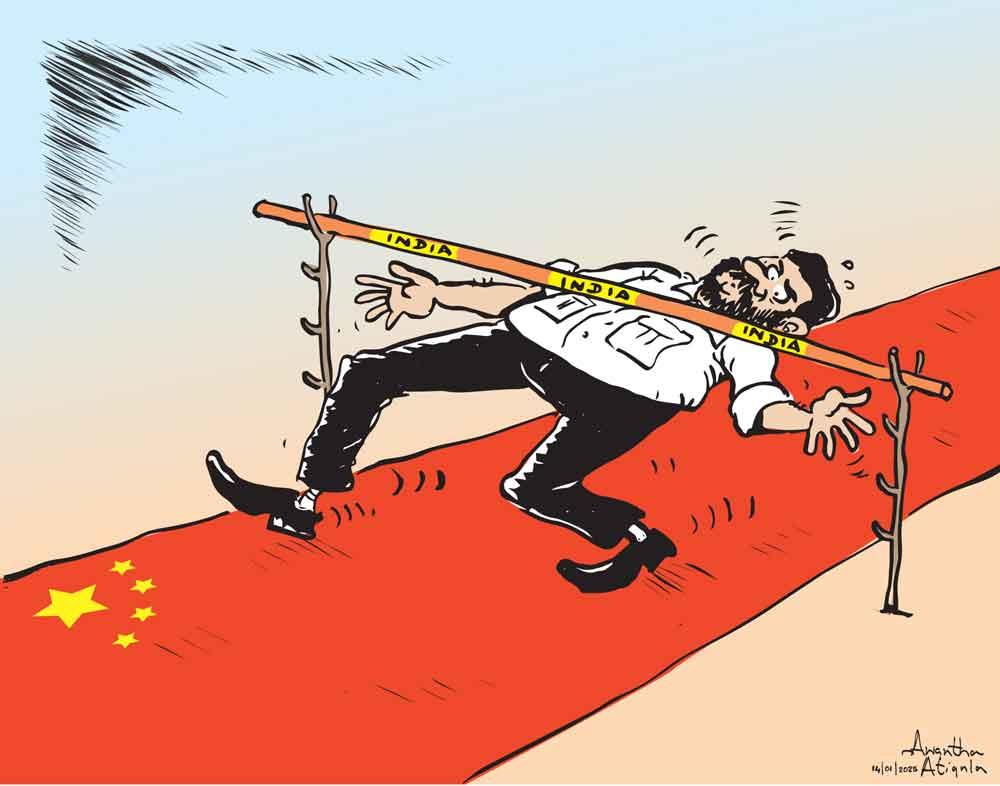
India awaits Sri Lanka’s response to detailed project report request on land connectivity between the two countries

India awaits Sri Lanka’s response to the proposal for a detailed project report on land connectivity between the two countries, an official said yesterday.

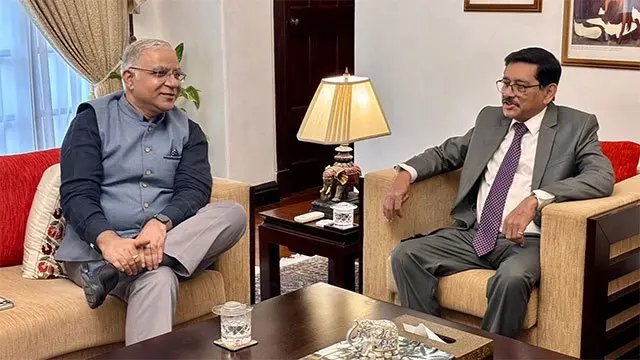
Indian High Commissioner Santosh Jha, in an interactive session with journalists, said that the land connectivity project was actually a proposal that originated from Sri Lanka

“Our proposal to the government of Sri Lanka still is there to conduct a detailed project report to initiate that. We are waiting for the government of Sri Lanka to respond to that. I think it is important to recall that land connectivity project was actually a Sri Lankan proposal, not an Indian one,” he said in response to a question in this regard.

He added that India is going along with the proposed project.

Responding to a question on the proposed project for connectivity of two power grids, he said meetings had been conducted and technical details taken up.

He said they are currently working on the financial framework for implementation but acknowledged that some constraints could arise due to the focus on the cyclone response.

“When the External Affairs Minister came, the only issue that was discussed was related to the cyclone response. We will at some point revive this conversation to get into the financial modalities of how to implement it,” he said.

“There is a very strong commitment on the part of the Sri Lankan government to implement it, as there are clear gains to be made for the country. On the proposal to develop the grid as an energy hub, we have already held one meeting and are currently exchanging details on what each side believes should be done and the manner in which it should be implemented,” he said.

In his opening remarks to the press, the High Commissioner dealt with India’s extensive assistance in the wake of Cyclone Ditwah. He said that India had shifted focus to reconstruction and rebuilding to support the efforts and packages announced by the Sri Lankan government.

“This is a demonstration of Sri Lanka’s key place in India’s Neighbourhood First and MAHASAGAR policies. It is this policy that is reflected in India stepping forward with a package of US $ 450 million. This package responds to the needs as assessed by various Ministries of the government of Sri Lanka. The assistance package proposed includes US $ 350 million in concessional Lines of Credit and US $ 100 million of grants. The assistance will be multi-pronged, assisting Sri Lanka in sectors that were most badly hit.

The five broad categories of support are:

rehabilitation and restoration of road, railway and bridge connectivity;
support for construction of houses fully destroyed and partially damaged;
support for health and education systems, in particular, those that have been damaged by the cyclone;
agriculture, including to address possible shortages in the short and medium term, and
working towards better disaster response and preparedness ,” he said.
“Over the coming week, we are looking at inaugurating two bridges constructed under this package. We will also commence the restoration work on the Northern Railway line. The bridge construction is proposed to be covered under a grant of nearly US $ 30 million. Our estimates suggest that this should suffice for restoration of all bridges impacted by Ditwah. The repair of the Northern Railway line will also be funded under grant,” he said.

He said that the agenda for the coming weeks includes the installation of nearly 200 RO water purification plants in locations identified by the government.

Another priority is the supply of temporary shelter materials for those who lost their homes to Cyclone Ditwah. Proposals are also being finalized to support the repair of partially and fully damaged houses through a USD 50 million grant, according to him.

He added that efforts are underway to finalize the modalities for several projects, including the terms of the INR-denominated lines of credit. These LoCs will facilitate the rebuilding of damaged roads and railways, as well as the procurement of food, medicines, medical equipment, fertilizers, livestock and other essential items currently in short supply.

Posted in Uncategorized

US Bolsters Sri Lanka’s Air Force with TH-57 Fleet

The United States has announced a major step to strengthen Sri Lanka’s disaster response capabilities, following lessons learned from recent crises like Cyclone Ditwah.

In a move hailed as a game-changer for emergency preparedness, the U.S. Embassy in Colombo confirmed the transfer of ten U.S. Navy TH-57 helicopters to the Sri Lanka Air Force (SLAF) under the Excess Defense Articles Program.

The TH-57 helicopters—Bell 206 Sea Rangers, manufactured in Texas and renowned for their reliability—are expected to arrive in Sri Lanka in early 2026. These aircraft will significantly enhance SLAF’s fleet and pilot training capacity, ensuring faster and more effective search-and-rescue operations during natural disasters.

On 18th November 2025, speaking during the debate on allocations for the Ministry of Defence and Public Security, Sri Lankan President Anura Kumara detailed a series of agreements with global partners aimed at upgrading the country’s defense capabilities.

“The United States will supply 10 TH57 helicopters,” he said.

Posted in Uncategorized

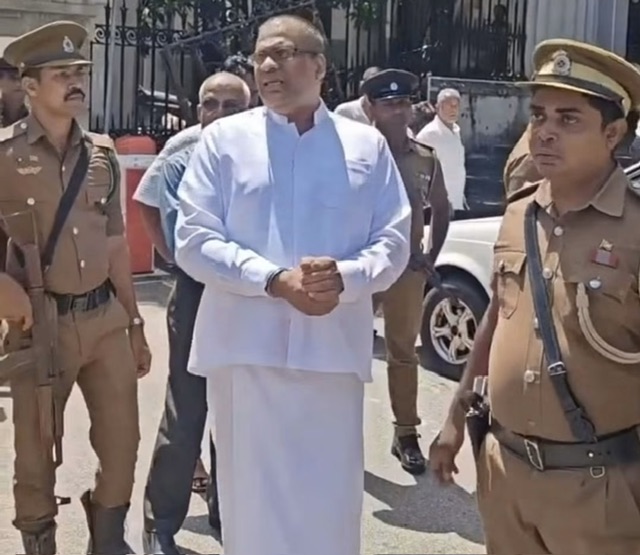
Ex-Minister Douglas Devananda granted bail

Former Minister Douglas Devananda, who was arrested and remanded, has been granted bail by the Gampaha Magistrate’s Court.

After being produced before Gampaha Magistrate Shilani Perera, Devananda was granted bail under two personal bonds of Rs. 2 million each.

The court ordered that the guarantors must be two close relatives of the defendant and imposed an overseas travel ban on the former minister.

The case is scheduled for further hearing on 27 March.

A legal team representing the former minister, including President’s Counsel Saliya Pieris, appeared before the court.

On December 30, Devananda was admitted to the Mahara Prison Hospital following doctors’ recommendations after assessing his health condition.

He was initially arrested by the Criminal Investigation Department (CID) on December 26 in connection with a firearms-related incident. Devananda was subsequently produced before the Gampaha Magistrate and remanded until January 9, 2026.

Devananda was taken into custody on Friday by CID officers in connection with an incident in which his personal firearm reportedly fell into the hands of members of an organized criminal gang.

It is reported that the former minister was arrested in connection with an investigation into an incident in which a firearm, which was provided to then minister Devananda by the Sri Lanka Army for his personal use in 2001, was later recovered following the interrogation of organised criminal figure ‘Makandure Madush’ in 2019.

Upon inspection of the serial number of the weapon, it was revealed that the firearm in question had been issued to Devananda.

The former minister’s pistol was subsequently found concealed in a forested area near a culvert in Weliweriya.

Following this, the CID obtained a 72-hour detention order to further question Devananda. Police also stated that the CID has launched investigations into additional firearms issued to him by the Sri Lanka Army, totaling 19 more weapons.

Sri Lanka to get US$350mn equivalent cyclone aid in Indian rupees

ndia will disburse around 350 million dollar equivalent of 450 million dollars of aid committed for cyclone recovery to Sri Lanka in Indian rupees, High Commissioner Satosh Jha said.

India is giving 100 million dollars of the of the reconstruction aid in grants.

“The assistance will be multi-pronged, assisting Sri Lanka in sectors that are the worst hit,” High Commissioner Jha told reporters in Colombo.

“The five categories of support are rehabilitation and restoration of road, railway and bridge connectivity, support for construction of houses fully destroyed and partially damaged.

“Support for health and education systems, in particular those that have been damaged by the cyclone, support for agriculture, including to address possible shortages in the short and medium term, working towards better disaster response and preparedness.”

A joint monitoring and coordination of EM’s representatives across ministries has been set up.

The first meeting co-chaired by High Commissioner Jha Minister Anil Jayantha had been held in the last week of December.

India will re-build damaged bridges for which close to 30 million dollars had been allocated.

India will also help with re-building rail tracks. Sri Lanka officials have said that reconstructing rail tracks would cost more than 330 million US dollars with upcountry tracks most heavily damaged.

India will immediately start reconstructing the Northern Railway track, High Commissioner Jha said.

The restoration is expected to cost around 5 million US dollars.

India’s IRCON, a state engineering firm, built the Northern track with welded rails and a strengthened base, which is capable of running trains at 100 kilometres per hour.

Some of Sri Lanka’s other tracks including have delapidated tracks where trains are run at slow speeds of around 20 kmph to prevent de-railing.

About 350 million dollar-equivalent of the 450 million dollar aid package would be denominated in Indian rupees, High Commissioner Jha said.

India previously gave a billion US dollar equivalent credit line through the State Bank of India in Indian rupees to Sri Lanka after the island’s central bank created severe forex shortages through inflationary open market operations making it difficult to pay for imports via the domestic banking system.

As long as Indian suppliers are willing to accept Indian rupees in payment, Sri Lanka can easily use credit lines or grants in Indian rupees.

Countries like Japan have funded large projects in Sri Lanka through yen loans for decades. China has also given Sri Lanka Yuan denominated loans.

Sri Lankan garment exports gain tariff-free access to UK from 1 January

Sri Lankan garment manufacturers have now gained unprecedented access to UK markets under liberalised trade rules.

The changes allow manufacturers to source up to 100% of inputs for garments from any country worldwide whilst maintaining tariff-free access to the UK market. Fewer processing requirements now apply, removing the previous rule that two significant manufacturing processes must take place in Sri Lanka.

The liberalised rules also include the creation of an Asia Regional Cumulation Group of 18 countries applicable to all other exports from Sri Lanka. This enables Sri Lankan manufacturers to source materials from regional partners whilst maintaining preferential tariff benefits.

British High Commissioner Andrew Patrick said: “The reforms that are now in force demonstrate the UK’s commitment to creating shared prosperity through trade partnerships. By simplifying rules of origin, we are supporting Sri Lanka’s economic growth by improving market access to the UK and helping to further diversify exports. We recognise the Sri Lankan Government’s ambition for export growth and continue to advocate for improved utilisation of the scheme. Therefore, I invite exporters to explore how they can benefit from these reforms and access the zero tariffs that the Developing Countries Trading Scheme (DCTS) offers.”

Joint Apparel Association Forum (JAAF) Secretary General Yohan Lawrence said: “The reforms to the UK’s DCTS remove previous restrictions requiring materials to be sourced regionally. Sri Lankan manufacturers can now compete equally by accessing global supply chains. The garment sector accounts for over 60% of Sri Lanka’s exports to the UK and supports 1 million livelihoods across the country. It is a significant boost for our export potential to an important market, and we are excited to work with buyers and manufacturers in creating significant growth from this opportunity.”

Council for Business with Britain (CBB) President Mark Surgenor said: “We are excited for the potential that the reforms will bring in enhancing the UK-Sri Lanka trade relationship. The most significant boost is to the garment sector. But with over 90% of products eligible for zero tariffs under the UK’s DCTS, we hope exports from other sectors will also seize the benefits arising from the creation of a larger number of regional countries from whom they can now source inputs. We are keen to see greater utilisation of the DCTS. This will form part of the CBB’s ongoing information sessions aimed at supporting Sri Lankan businesses in growing their trade with the UK.”

The changes respond to requests from many businesses and countries, including the Sri Lankan Government and the JAAF. The UK is Sri Lanka’s second largest garment export market at approximately $ 675 million in value, with exports expected to increase significantly under the new arrangements.

Posted in Uncategorized

Namal stresses India’s role in ensuring long‑term peace in South Asia

Sri Lanka Podujana Peramuna (SLPP) MP Namal Rajapaksa has emphasized the urgent need for stronger regional cooperation in South Asia, highlighting India’s central role in ensuring long‑term peace and stability.

Speaking on recent global and regional security developments, Rajapaksa noted that political turmoil in Bangladesh, Nepal, and Sri Lanka, often fueled by extremist elements, underscores the importance of collective action.

“In recent years, Bangladesh, Nepal and Sri Lanka have experienced periods of political turmoil, marked by public unrest and changes in government. At times, these disruptions have been supported and promoted by extremist elements. Addressing these challenges requires a collective commitment to counter extremism, prevent political violence, and safeguard minority rights. As such, South Asia requires greater regional coherence to withstand emerging crises and respond collectively to shared challenges. In this context, India’s leadership is central to maintaining long-term peace and stability in the region,” he said in a statement on ‘X’.

Rajapaksa added that upcoming elections in Bangladesh and Nepal offer an opportunity to reaffirm democratic legitimacy, strengthen regional security, and project South Asia’s influence internationally through unity and shared goals of growth and stability.

“With aligned goals focused on growth and stability, South Asia as a whole can project greater influence internationally, and in that process, regional unity remains crucial for long-term peace and coherence. The upcoming elections in Bangladesh and Nepal present a hopeful opportunity to reaffirm democratic legitimacy through free and fair elections that will contribute to further strengthening regional security,” he added.