

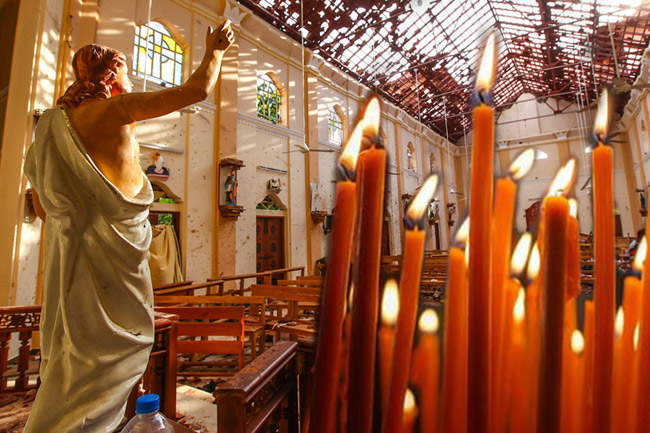
As Easter Sunday approaches this year, it is time to take stock of the developments following the series of bomb blasts on April 21, 2019 that ripped through churches and luxury hotels in Sri Lanka, killing over 250 people and injuring hundreds.
The explosions targeted Christians at Easter Sunday church services in Colombo, Negombo and Batticaloa, and tourists staying in luxury hotels in the capital. The toll puts the attacks on par with the deadliest atrocities since the 9/11 attacks in the United States Throughout the morning and afternoon, in and around the capital, Colombo, Negombo, and in the eastern city of Batticaloa, the bombs went off at churches and upscale hotels.
The world watched the mayhem unfolding in the Indian Ocean island, which was still recuperating from the 26 years of bloodshed and violence during the civil war. The attack was claimed by the Islamic State of Iraq and Levant (ISIL).
The Easter Sunday attacks exposed multiple gaps in Sri Lanka’s security architecture.
Shortly after the attacks, the Sri Lankan government admitted that it failed to act on multiple warnings from intelligence agencies, including from India and the United States.
In February, an investigation into the 2019 Easter Sunday bombings in Sri Lanka called for the country’s former President Maithripala Sirisena as well as senior police and intelligence officials to be prosecuted.
The commission of inquiry said that “criminal proceedings” should be brought against former President Maithripala Sirisena, who left office in November 2019, for “criminal liability on his part” over the attacks.
In March, the Sri Lankan parliament held a three-day debate on the inquiry.
Here is a timeline of the investigation into the gruesome attacks that shook the nation and the world.
April 21, 2019: A wave of deadly blasts hit Sri Lanka on Easter Sunday. Nine suicide bombers launched a coordinated series of attacks on three Catholic churches and three luxury hotels across Sri Lanka. Over 250 people died and many suffered injuries.
April 22, 2019: Then-President Maithripala Sirisena of Sri Lanka appointed a three-member committee headed by a retired Supreme Court judge to investigate the Easter Sunday bombings.
April 22, 2019: Sirisena declared a nationwide emergency, giving the military a wider berth to detain and arrest suspects – powers that were used during the civil war, but withdrawn when it ended.
April 23, 2019: Sri Lankan then-Defence Minister Ruwan Wijewardene said in parliament that the government believed the attack was in retaliation for the Christchurch mosque shootings on March 15, 2019.
He accused National Thowheed Jamath (NTJ), an extremist group, for the bombings. Wijewardene said that along with NTJ, another local group, Jammiyathul Millathu Ibrahim (JMI) was also believed to be involved in the attacks. “It was done by National Thowheed Jamath along with JMI,” he said.
April 24, 2019: Sirisena asked security officials—the defence secretary and the national police chief–to step down.
Sirisena moved to replace then-defence secretary Hemasiri Fernando and then-national police chief Pujith Jayasundara after security forces failed to act on warnings before the Easter suicide bombings.
April 25, 2019: Hemasiri Fernando, then Sri Lanka’s defence secretary, resigned following the security forces’ failure to stop the deadly church and hotel attacks on Easter Sunday.
April 25, 2019: The Criminal Investigation Department (CID) released names and photos of six suspects wanted in connection over the Easter Sunday bombings, seeking public assistance.
On April 26, 2019: the Sri Lanka Army and the Special Task Force (STF) carried out a search operation in Sainthamaruthu town where three explosions and a shootout occurred when they attempted to raid a suspected hideout following a tip-off.
Three suicide bombers blew themselves up, killing nine of their family members, including three women and six children, while three other terrorists were shot dead by the soldiers. One civilian was caught in the crossfire and died, according to police, while a wounded woman and child were taken to hospital.
April 26, 2019: Sirisena said Pujith Jayasundara has resigned over failures that led to the deadly bomb attacks.
April 26, 2019: Sirisena admitted “a serious lapse” on the part of the country’s defence secretary and top police official, who failed to inform him about an April 4 letter from a “friendly foreign country” warning about a possible attack.
April 27, 2019: Jayasundara refused a request by Sirisena to step down over the failure to thwart the Easter Sunday attacks. Sirisena earlier claimed that Jayasundara has resigned.
April 27, 2019: Sirisena banned two groups linked to the Easter bombings – NTJ and Jammiyathul Millathu Ibrahim (JMI) – under emergency powers.