

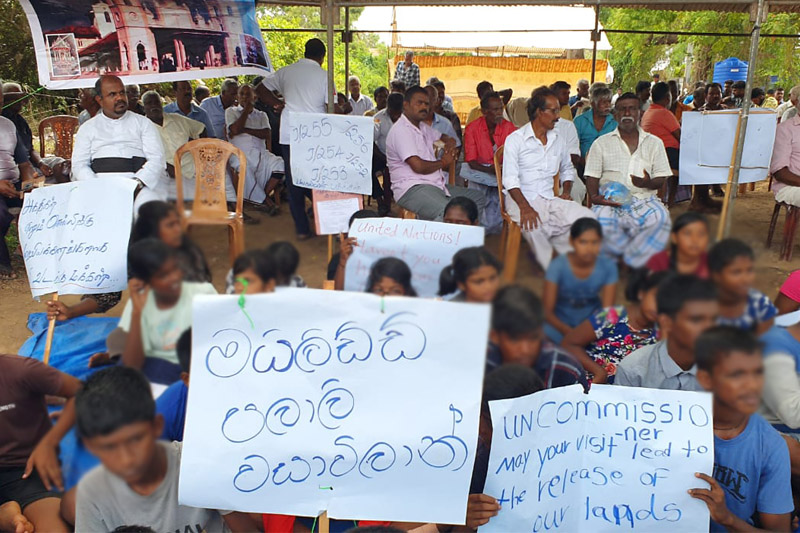
A peaceful protest calling for the release of 2,400 acres of Tamil-owned land in Valikamam North entered its second day on Sunday, with displaced residents gathering at Myliddy junction to press for the return of lands that have remained under military occupation for more than 30 years.
The protest, led by local families displaced during the early 1990s military operations in the Jaffna peninsula, began on Saturday and is set to continue through June 25.
Many of the protestors have been denied access to their ancestral lands since their displacement and continue to live in temporary housing or in a state of protracted displacement.
Demonstrators held placards reading, “UN Commissioner, may your visit lead to the release of our lands,” and “Is economic development meant for the people or the Sri Lankan military?”
Slogans were chanted throughout the day, drawing attention to the long-standing military presence and the continued deprivation of livelihoods and basic rights in the region.
The demonstration comes in advance of a four-day official visit to Sri Lanka by United Nations High Commissioner for Human Rights, Volker Türk, who is expected to visit Jaffna as part of his itinerary.
Protestors have called on Türk to visit Valikamam North, urging him to advocate for demilitarisation and the return of occupied lands to their rightful civilian owners.
Despite repeated commitments by successive Sri Lankan governments to release lands in the Northern and Eastern Provinces, thousands of acres remain under military control.
Valikamam North, encompassing areas such as Keerimalai, Mayliddy, and Palaly, remains one of the most heavily militarised regions in the North.
Large tracts of land have been converted into military camps and commercial ventures, including resorts operated by the armed forces, drawing criticism from Tamil civil society organisations and international human rights groups.
Previous UN human rights chiefs have also expressed concern over continued militarisation in post-war Sri Lanka.
With the High Commissioner’s arrival yesterday, protestors say they are determined to maintain pressure on both the Sri Lankan government and the international community, hoping that their decades-long call for justice and resettlement will finally be heard.