

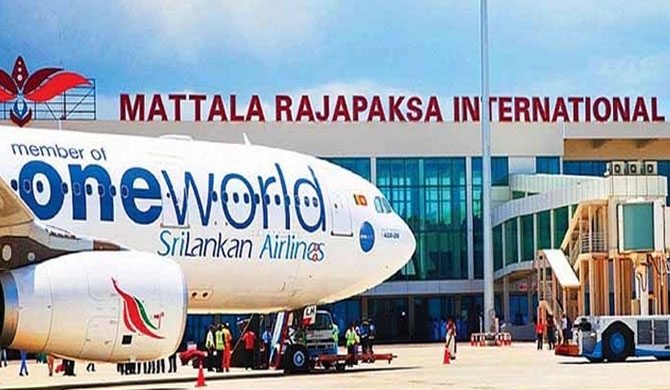
Mattala Rajapaksa International Airport (MRIA) has accumulated a staggering Rs.39.3 billion in net losses over the past six years, a recent audit revealed, as the government moves to scrap a previously arranged management handover to an India-Russia joint venture, in favour of a new public-private partnership (PPP) model.
The state-run airport, often criticised for its severe underutilisation, recorded an operating loss of Rs.3.36 billion for the financial year 2024 alone, with expenditure outstripping revenue by nearly 15 times.
According to the 2024 annual report of Airport and Aviation Services (Sri Lanka) (Private) Limited, MRIA generated a meagre operating income of Rs.242.2 million, against the operating costs of Rs.3.6 billion.
The Auditor General’s review flagged that despite a massive capital injection of over Rs.36.5 billion for its construction, the airport has failed to meet its feasibility targets. While the facility was projected to handle one million passengers annually, it has recorded a cumulative total of only 321,577 passengers over the last six years.
The financial burden is further aggravated by an annual interest cost of approximately Rs.2.05 billion on foreign loans, which continues to be accounted for, despite the government’s suspension of external debt servicing.
Amidst this financial gloom, the government has signalled a major policy shift regarding the airport’s future management. In late December 2025, the Ports and Civil Aviation Ministry announced a proposal to invite fresh Expressions of Interest to manage specific commercial activities at the airport, under a PPP framework. This move effectively sidelines the previous administration’s plan to hand over the airport’s management to a consortium comprising India’s Shaurya Aeronautics and Russia’s Airports of Regions Management Company. The new strategy aims to retain the core aviation functions such as air traffic control and security under state purview, while opening up areas like cargo handling, aircraft maintenance and hospitality to private sector investment.
Despite the heavy losses, the airport has seen a spark of activity during the current winter season. The 2025/2026 winter schedule has attracted charter operations from airlines targeting the tourism sector. Russian carrier Red Wings Airlines commenced six weekly flights in late 2025, while Belarus’ national carrier Belavia has been operating weekly flights since October. Additionally, Ukrainian carrier SkyUp Airlines was scheduled to launch charter operations from December 2025. However, these seasonal spikes in traffic are yet to translate into the consistent revenue stream needed to offset the airport’s massive operational overheads and debt obligations.
The audit also brought to light the legacy infrastructure issues that remain unresolved. A security building complex project, which began construction in 2013, with an initial expenditure of Rs.18.7 million, remained incomplete at end- 2024, over a decade later. As the government seeks to restructure the airport’s business model through the proposed PPP, the focus will likely be on stopping the financial bleeding that has seen the southern gateway cost the taxpayer billions annually, while struggling to shed its ‘white elephant’ tag.