

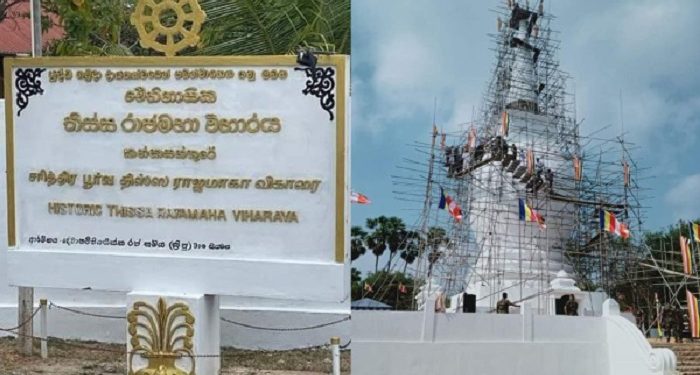
Last Saturday (3), a group of Sinhala Nationalists tried to organise a march carrying a Buddha statue from Kankesanthurai (KKS) railway station to the highly contested Tissa Raja Maha Vihara premises situated about half a kilometre away.
The organisers – prominent Sri Lanka Podujana Peramuna (SLPP) social media activists, publicised the event mostly via Facebook and Whatsapp. Their flyers and videos called on a “pilgrimage to reestablish the Sinhalese authority over the region”.
On Friday (2) the same social media pages shared video footage of organisers travelling to KKS aboard the Yaal Devi train, encouraging people to join the march. Local Catholic priests, activists and residents also organised a protest in front of the Tissa Raja Maha Vihara the same day to protest against the march as a part of an ongoing demonstration calling on the Government to release the private lands occupied by the Tissa Raja Maha Vihara.
KKS police told the Sunday Observer that the Security Forces in the area were reportedly mobilised in the early hours to prevent any form of confrontation between the two groups. But the march itself did not take place. The local residents, however, carried out the protest under heavy police presence.
History of Tissa
The Sinhalese chronicle of the Mahawamsa records of a temple being built in honour of King Devanampiyatissa to mark the event of receiving a sapling of the Sri Maha Bodhi tree from Emperor Asoka at Dambakolapatuna, a few miles to the West of the Tissa Raja Maha Vihara. Facing multiple invasions and periodic destruction over the millenia, the vihara was buried in the sands of time.
In the mid-1940s, two bhikkhus from the South arrived in the area in search of the ruins and settled in an area suspected to be where the original temple was. With a small plot of land (1.5 acres) donated by a Sinhalese land owner in the area, a small temple shrine was constructed. This area has also been marked as “temple land” in both the English and the Tamil versions of the 1959 revision of the Jaffna one-inch map (1:63,360) published by the Survey Department. With the establishment of the State cement factory in KKS, many Sinhalese workers who worked in the factory venerated a shrine near a Bo tree that had been where the current temple is located.
According to the documentation provided by the Nagadeepa Vihara Chief prelate Ven. Navandagala Padumakiththi Thera, the shrine was on a plot of land that belonged to the Nagadeepa Temple. However, rising tensions between the Sinhalese and the Tamil communities in the early 1960s later spilled into a civil war, so the humble shrine faded into the forest thicket over the next few decades.
Yet local residents, the majority of whom are Hindus, said that even during the time of the LTTE, local residents used to light lamps near the Bodhi tree out of habit and it was fondly called the “Buddhist Kovil”.
Private land
Following the end of the civil war, large swathes of private land were taken under the control of the military over a myriad of reasons ranging from demining, High Security Zones and for national security. Despite thousands of locals being denied their right to return home, and clear legal documentation that proves the land’s private ownership, the construction of the Tissa Vihara began under the patronage of President Gotabaya Rajapaksa’s Government.
Despite the political turmoil in Colombo, the vihara was constructed on seven-acres of private land, with the help of the Sri Lanka Army only a few months before President Ranil Wickremesinghe vacated the office, complicating the existing demilitarisation issues in the North.
Following long discussions both within Parliament and across Opposition parties, in April last year the Presidential Secretariat directed the Jaffna Divisional Secretariat to release the private land around Tissa Vihara to the local land owners by May 2025.
The Chief Incumbent of the Tissa Vihara now lays claim to 15 acres surrounding the temple claiming it is an archeological site. However, the remains of houses are scattered across the 15 acres of land, abandoned during the war. These are far older than the newly constructed Tissa Vihara.
The Sunday Observer learns that the Department of Archaeology has not carried out archaeological surveys nor found any archaeological evidence proving the site to be the original location of the fabled Tissa Vihara.
A leading Sinhalese archaeologist who has led excavations in some of the most prominent archaeological sites in the past few years and wishes to remain anonymous told the Sunday Observer that he believes that the actual archaeological site of the Tissa Vihara is believed to be located a few kilometres towards Dambakolapatuna. He said previous Governments nor the Archaeology Department has shown any interest in excavating the suspected area.
“Having a claim over the current temple premises complicates and prolongs the need to release these lands. There are powerful forces that are probably trying to hide something. If they really wanted to find the real temple, then why are we hesitating to unearth it?” asked the archaeologist.
“Bend the law”
Many locals said that certain high-ranking police officers constantly “bend the law” to satisfy the chief prelate of the Tissa Vihara, the Sunday Observer learns. On Saturday, the police refused to allow journalists, both State and private, from entering the temple premises wrongfully referring to a court order which they claim does not permit journalists in. Despite the Deputy Inspector General of Jaffna ordering the Officer-in-Charge of the Kankesanthurai Division , SSP P.M.R. Ambeypitiya to escort the journalist into the temple, journalists were barred from entering the temple.
S.S.P Ambeypitiya along with the OIC of Tellipalai CI W.M. Udayapala and the OIC of Ilavalai CI S.A.C. Jayanath later told the journalists that Ven. Ginthota Nandarama Thera was mentally stressed due to the media pressure and has asked to not allow any journalists into the temple.
Whether they take orders from the DIG of Jaffna or the chief prelate of the Tissa Vihara is a mystery. Many locals said that this is common with regard to the temple, with some locals even saying that on certain days crowds are dispersed by the police at the request of the chief bhikkhu.
Recently, Vali North Pradeshiya Sabha personnel had arrived at the temple to demarcate the temple boundary and put up a board separating the private land. A Pradeshiya Sabha official who wished to remain anonymous told the Sunday Observer that the police had asked them to go back.