

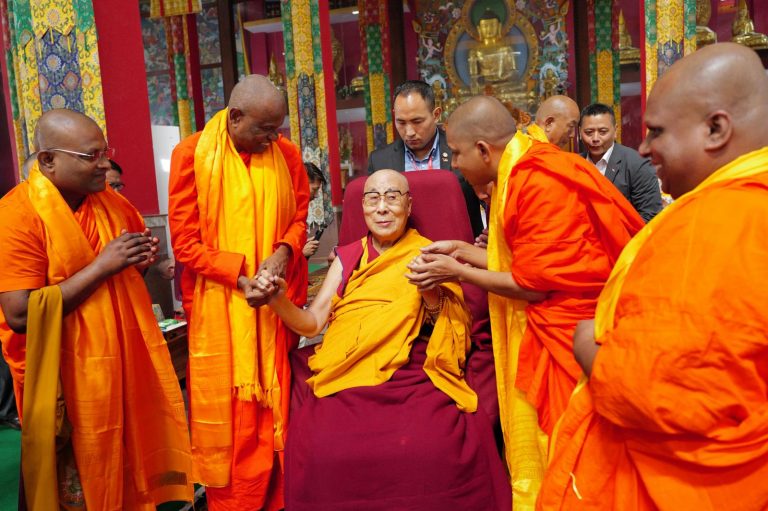
In a landmark moment for global Buddhism, a historic meeting took place today between the Most Venerable Dr. Pallegama Hemarathana Nayake Thero, the Atamasthanadhipathi of Sri Lanka, and 14th Dalai Lama, the world-renowned spiritual leader and symbol of universal compassion.
The encounter marks a watershed in the centuries-old relationship between Indo-Tibetan and Sri Lankan Buddhist traditions. It is the first recorded instance in which the spiritual heads of these two pre-eminent lineages have met in such a significant capacity, drawing wide attention across the global Buddhist community.
The position of Atamasthanadhipathi carries exceptional prestige within the Buddhist world. By ancient royal decree, Sri Lanka recognises three supreme pillars of Buddhist heritage: the Temple of the Sacred Tooth Relic, Sri Pada, and the Jaya Sri Maha Bodhi. As custodian of the Eight Sacred Places (Atamasthana) in Anuradhapura, the Atamasthanadhipathi exercises profound spiritual and legal authority over some of Buddhism’s most revered sites.
The meeting between the guardian of Sri Lanka’s most ancient living heritage and the spiritual leader of the Tibetan people symbolised a powerful convergence of the Pali and Sanskrit Buddhist traditions.
Adding deep emotional significance to the occasion, the Most Venerable Thero presented His Holiness with a sacred sapling of the Jaya Sri Maha Bodhi. For decades, the Dalai Lama has expressed a desire to undertake a pilgrimage to the Jaya Sri Maha Bodhi—the world’s oldest historically documented living tree, grown from a branch of the original Bodhi tree under which the Buddha attained Enlightenment. While circumstances had previously prevented such a visit, the presentation of the sapling is seen as symbolically fulfilling that long-held aspiration.
The sapling is scheduled to be planted tomorrow, 21 January, at the Buddhist University within the Gaden Jangtse Monastery complex, during a ceremony to be conducted with full monastic honours. Tens of thousands of Tibetan monastics and devotees from across India and overseas are expected to attend.
The initiative—described by organisers as an act of “green diplomacy”—is being viewed as a reaffirmation of the enduring spiritual and cultural bonds between Sri Lanka and India, underscoring a shared commitment to ensuring the continuity and growth of the Dhamma for generations to come.
(Satipattana Magazine)