

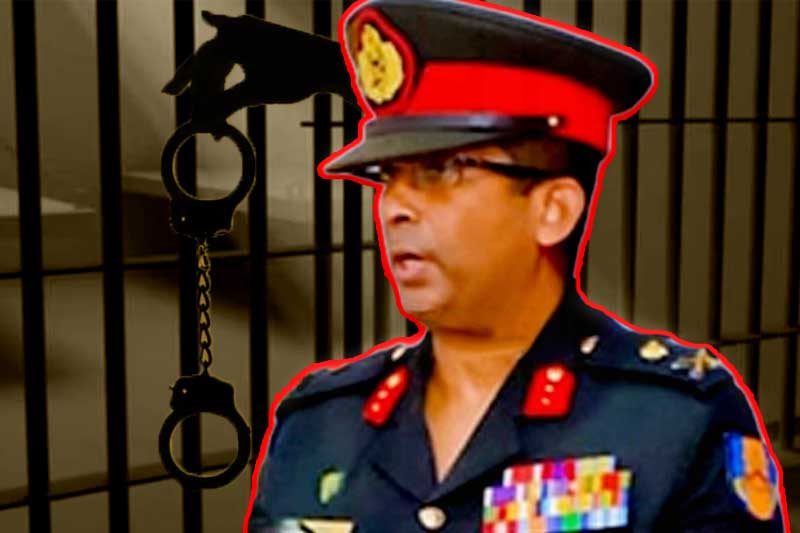
A group of lawyers say they will challenge in court the legality of a 90-day detention of Sri Lanka’s former top intelligence official under the Prevention of Terrorism Act (PTA), following his arrest in an investigation linked to the 2019 Easter Sunday bombings.
Major General Suresh Sallay (Rtd), who served as director of state intelligence under former President Gotabaya Rajapaksa, was arrested last week in Peliyagoda by the Criminal Investigation Department (CID).
A lawyer representing the group, speaking on the condition of anonymity, described the arrest as unlawful and said an appeal would be filed before a higher court.
Police say the arrest follows more than a year of investigations stemming from a complaint lodged with the secretary to the ministry of public security shortly after the National People’s Power (NPP) government assumed office.
The complaint was based on allegations aired in a September 2023 investigative program by Britain’s Channel 4 television network about the Easter bombings.
A senior Catholic priest, who holds a leadership role in a church-affiliated communications department, confirmed that a magistrate’s inquiry is underway into a complaint submitted in October 2024 to public security secretary Ravi Seneviratne.
Police have confirmed that on November 11, 2024, the CID reported facts to the Fort magistrate’s court based on a complaint filed by a Catholic organisation seeking an investigation into the Channel 4 allegations.
At the time, then-police spokesman, Deputy Inspector General Nihal Thalduwa, said former Eastern province chief minister Sivanesathurai Chandrakanthan, also known as Pillayan, had been summoned for questioning. Chandrakanthan was later arrested and detained for an extended period.
In the Channel 4 broadcast, Azad Maulana, media secretary to Chandrakanthan, alleged that in January 2018 he facilitated a meeting between Sallay and members of the extremist group National Thowheed Jamaat, some of whom later carried out the coordinated suicide attacks on churches and hotels.
Maulana also claimed that a secret meeting took place in Karadipuwal in the northwestern district of Puttalam involving Zaharan Hashim, identified as the alleged mastermind of the bombings, his associate Sainy Mowlavi and others.
He alleged the purpose was to create instability in the country to enable the Rajapaksas’ return to power.
Two days after the Easter attacks, Gotabaya Rajapaksa announced his candidacy for president and later won the election.
Sallay is also the chief prosecution witness in an ongoing special three-judge High Court trial involving 25 defendants accused in connection with the Easter attacks. The trial is being heard five days a week.
Police spokesman, ASP F. Wootler, told the media last week that Sallay’s arrest was based on clear evidence uncovered during investigations into the attacks.
However, authorities have not publicly detailed the specific grounds for the detention.
Senior deputy inspector general Sajeewa Medawatte said lengthy investigations were needed and indicated that detention orders would be used as part of that process.
Following submissions by the CID, the Fort Magistrate’s Court imposed a foreign travel ban on six individuals, including Sallay.
The group includes two civilians and four serving military officers.
One of them, former army intelligence officer Col. Kelum Maddumage, has petitioned the court of appeal seeking to prevent his arrest. He is represented by president’s counsel Ali Sabry, a former justice minister and close political ally of Rajapaksa, who has strongly objected to Sallay’s arrest.
At the time of his arrest, Sallay was reportedly traveling to attend an event organised by the Pathfinder Foundation, a Colombo-based think tank chaired by former minister Milinda Moragoda.
Sallay is the most senior armed forces officer to be detained under the PTA, a law long criticised by local and international human rights groups who say it allows prolonged detention without adequate judicial oversight.
His lawyers allege that authorities acted arbitrarily and denied him access to legal counsel and close family members, including his wife and father, for two days after his arrest.
They say access was granted only after the detention order was formally obtained.
Rights advocates have repeatedly raised concerns about the use of the PTA, particularly provisions that allow suspects to be held without immediate access to lawyers or relatives, noting that such restrictions undermine fundamental rights and due process.