

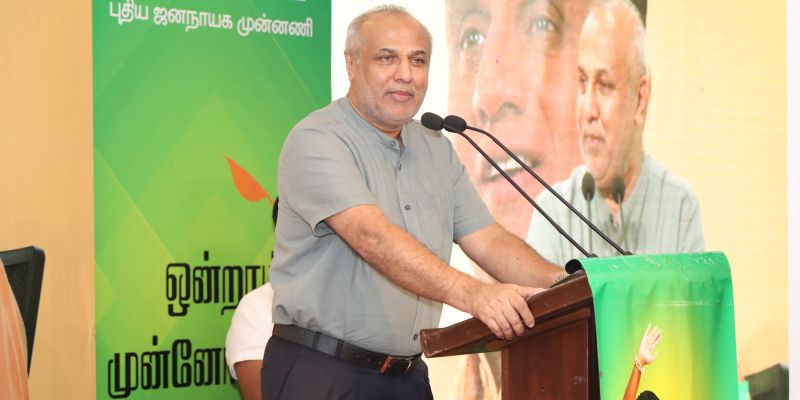
The leader of the Sri Lanka Muslim Congress (SLMC) has called for a presidential commission to investigate killings and crimes committed against journalists from all ethnic communities in Sri Lanka.
Speaking at a memorial event for Tamil journalist Bharathi Rajanayagam, SLMC leader MP Rauff Hakeem said the role played by journalists in the struggle for the rights of Tamil-speaking communities should not be forgotten, especially in light of the many media workers who were killed.
Hakeem said that while numerous commissions of inquiry had been appointed in the past concerning media institutions and political actors, there had been no dedicated mechanism to investigate crimes committed against journalists.
“The contribution of journalists to the journey toward the liberation of the Tamil-speaking community cannot be overlooked,” he said. “At the same time, when we think of the many journalists who were unjustly killed, there is only one thing we can say on their behalf at this moment. Many commissions have been appointed for media institutions and politicians. But we need a commission specifically to investigate crimes committed against journalists. Separate attention must be given to victims from all ethnic communities.”
Hakeem described the killing of journalists as one of the most serious crimes linked to Sri Lanka’s long-running ethnic conflict.
Bharathi, who died in February 2025 at the age of 63 after a period of ill health, spent four decades in journalism. He began his career with the Jaffna-based newspaper Eelamurasu before later working with several Tamil-language publications including Murasoli and Eelanadu.
Over the course of his career he also served as editor of the Tamil newspapers Thinakkural and Virakesari. At the time of his death, he was heading the Jaffna office of the Virakesari newspaper.
Bharathi was widely known as a journalist who advocated for media freedom during the years of Sri Lanka’s civil war, campaigning against the disappearance, killing and intimidation of journalists and civilians in both the Northern and Eastern provinces as well as in the capital, Colombo.
44 journalists
According to a report compiled by the media rights organisation Journalists for Democracy in Sri Lanka, at least 44 journalists in the country were subjected to killings, abductions or other forms of persecution during the period when Gotabaya Rajapaksa served as defence secretary.
Many of those targeted were Tamil journalists working in the north of the country, and none of the cases have so far resulted in justice for the victims, the report notes.
Hakeem said the appointment of a presidential commission to investigate the killing of journalists over the past half century could help expose the conspiracies behind those crimes and contribute to a fuller historical record.
“Today we see even senior intelligence officials being arrested, and investigations are underway into the conspiracies behind incidents such as the Easter Sunday attacks. In the same way, a commission must be appointed to investigate the journalists who were killed over the last four or five decades. That would allow an important chapter of history to be written and the conspiracies behind these killings to be revealed,” he said.
Several high-profile cases involving attacks on journalists remain under investigation.
In October 2024, responding to a question from a journalist, the then cabinet spokesman Vijitha Herath said that a number of so-called “emblematic cases” were being examined, including the murder of Lasantha Wickrematunge and the disappearance of journalist Prageeth Eknaligoda. However, local authorities, including the government, the police and other state investigative bodies, have yet to publicly disclose progress in those investigations.