

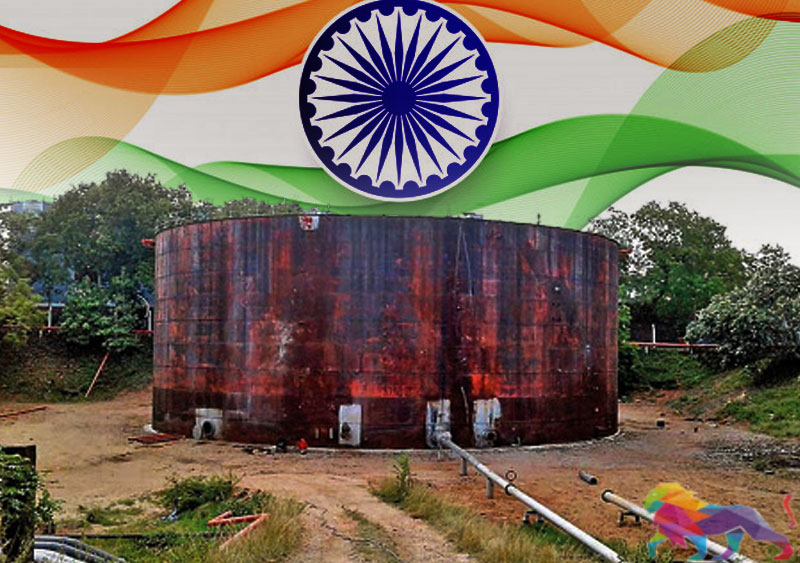
As the Middle East conflict disrupts global energy markets, the long-dormant Trincomalee Oil Tank Farm project has shifted from a conceptual strategic goal to an urgent national security priority. Following high-level talks during Indian Vice President C.P. Radhakrishnan’s visit, officials emphasized that “no further time can be lost” on the 99-tank complex. The proposed India-Sri Lanka-UAE pipeline and grid integration now represent a critical transition from traditional aid-based relations to a modern, investment-driven energy partnership.
Trincomalee has been identified as a nodal point of cooperation between India and Sri Lanka in the field of energy security. The 1987 Indo–Sri Lanka Accord marked the first formal reference to Indian involvement in the development of the Trincomalee oil tank farm. Trincomalee has been identified as a strategic location because of its deep-sea port.
Later, during the 2002–2004 period, India and Sri Lanka signed agreements allowing Indian Oil Corporation (IOC) involvement in fuel sales and distribution in Sri Lanka. However, this did not lead to the full development of the 99 tanks in the farm. Once again, in 2015, talks were launched for the revival of the project, with plans for expansion. When Indian Prime Minister Narendra Modi addressed the Sri Lankan Parliament during an official visit in 2015, he referred to plans for the development of Trincomalee as a petroleum hub.
Seven years down the line, in 2023, the project took shape when Sri Lanka and India signed a formal agreement to jointly redevelop the Trincomalee Oil Tank Complex. A joint venture company, Trinco Petroleum Terminal Ltd (TPTL), was created.
In it, the Ceylon Petroleum Corporation holds 51 percent and Lanka IOC (a subsidiary of Indian Oil Corporation) holds 49 percent. The agreement covers 61 tanks out of 99 for joint development.
In 2024 and 2025, the project took a new turn when India, Sri Lanka, and the United Arab Emirates (UAE) signed an agreement to lay a pipeline linking Trincomalee with the southern part of India. The project is still in limbo, with little or no tangible progress on the ground.
Now, with Sri Lanka dealing with the fallout of the Middle East war, the country’s energy security has once again come into focus, and the pressing need for the implementation of the Trincomalee petroleum project in a meaningful way is being felt across the board. During the recent visit of Indian Vice President C.P. Radhakrishnan, the matter was discussed.
Indian Foreign Secretary Vikram Misri, who accompanied the Vice President, told a post-discussion press conference on Sunday evening that there was no time to lose on a strategic project such as this, but no timeline could be fixed for its conclusion given its complexity and significant financial requirements.
His remarks came in response to a question in this regard. “It’s a significant project. It’s something you are aware of. We have shared a considerable amount of information on this with Sri Lankan authorities. I can tell you that this was the subject of fairly detailed conversations, even today, between the two delegations at different levels.
One of the points that was made was that progress on this project would have stood in good stead, especially at a time like this when both energy prices and energy availability are becoming difficult issues for several countries around the world, especially in this region,” he said.
“Clearly, there is no further time to lose in making progress on strategic projects such as these. We have not yet established a timeline on this project, but discussions continue, given the fact that it is a complex project with significant financial outlays. It will take some time to finalise all the details,” he added.
He was quick to add that both sides had the opportunity to underline the importance of the project, its strategic nature, and the urgency behind it.
“We very much look forward to working with our Sri Lankan colleagues to take this idea further,” he said.
India and Sri Lanka have seen a transformation in bilateral relations in recent years, with a greater focus on connectivity and integration. Energy connectivity, including the interconnection of the two power grids, is a major component in this regard.
The Indian Foreign Secretary, who once served in Sri Lanka as Deputy High Commissioner, said that India has been emphasizing a shift from the traditional model of partnership between the two countries, dominated by aid and credit-tied assistance, to an investment-driven partnership.
“We have tried to encourage Indian business entities and commercial entities to look at opportunities in Sri Lanka. On that front, I think there has been one significant development recently, which is the investment in Colombo Dockyard,” he said.
It is an investment in a highly strategic sector, given the geographic positioning of Sri Lanka and India.
During the delegation-level talks during the Vice President’s visit, the two sides reviewed ongoing bilateral initiatives, including progress on various development cooperation projects undertaken by India in Sri Lanka. The proposed energy pipeline was also discussed once again.
Energy sector cooperation between India and Sri Lanka is ongoing. India assisted Sri Lanka financially during the economic crisis to secure fuel supplies and has also assured fuel support during the current challenges. The two sides are yet to finalise the commercial model for the execution of the project.
The Trincomalee tank farm was constructed in the 1930s to supply the British Navy across the Indian Ocean and beyond. The facility houses 99 storage tanks. A pipeline that once connected the tanks with the jetty existed in the past, but no trace of it remains today. A feasibility study is needed to locate it.
Proponents of India–Sri Lanka energy connectivity argue that a multi-purpose pipeline will help reduce energy costs for Sri Lanka and strengthen regional energy security.
The Trincomalee energy hub is no longer a matter of strategic vision. It is fast becoming an urgency for execution.