

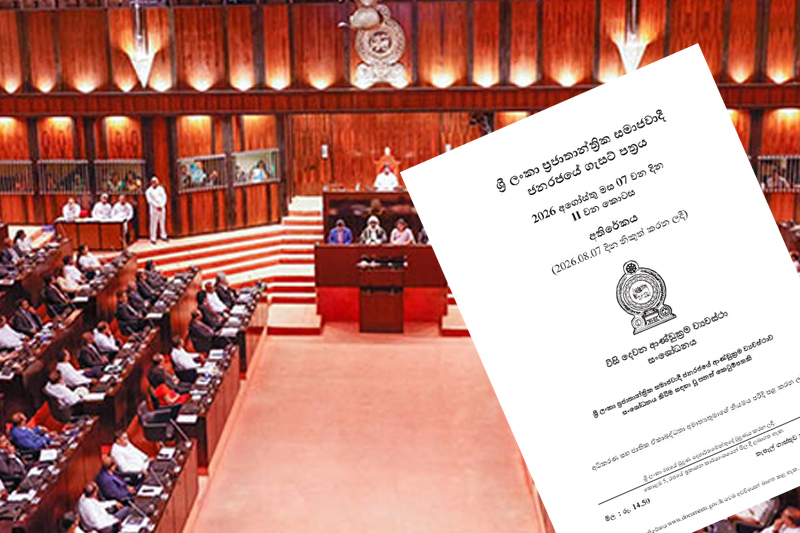
Sri Lanka’s Supreme Court has ruled that the 22nd Amendment to the country’s Constitution does not require approval of the people through a referendum and can be passed by a Parliament majority.
The court’s decision was read out by Speaker Jagath Wickramaratne at the start of the day’s session.
“I wish to announce that I have received the determination of the Supreme Court in respect of the Bill titled ’22nd Amendment to the Constitution’ and the ‘Judicature Amendment’, which were challenged in the Supreme Court under Article 121(1) of the Constitution.
“The Supreme Court has determined that the provisions of the 22nd Amendment to the Constitution Bill or any part thereof does not require approval by the people at a referendum by virtue of the provisions of Article 83 of the Constitution.
“In the proviso appearing in Clause 2 of the 22nd Amendment to the Constitution Bill, the phrase ‘the date reaching sixty-seven’ (හැට හතට එළඹෙන දිනය) appearing therein shall be replaced with the phrase ‘the date completing sixty-seven’ (හැට හත සම්පූර්ණ කල දිනය).
“The following to be added as the second proviso to Clause 2 of the 22nd Amendment to the Constitution Bill:
> ‘Provided further that the term limit of six years set out in the first proviso will not apply to any person holding the office of the Chief Justice as at the date of coming into operation of this Act.’
>
“The Supreme Court has further determined that the provisions of the Judicature Amendment Bill are not inconsistent with the Constitution and may be passed by the simple majority of the Parliament.
I order that the full determination of the Supreme Court to be printed in the Official Report of today’s proceedings.”
The president has said the government will move forward swiftly with passing the amendment, with a 2-day parliamentary debate scheduled for this week.
The Bar Association of Sri Lanka, opposition legislators and civil society members went to court against the amendment which seeks to extend the retirement age of Supreme Court judges, including the Chief Justice, and Appeals Court judges, among other things.
Judiciary concerns could hurt Sri Lanka’s foreign investments: Opposition leader
International law associations have expressed concerns over the proposed 22nd Amendment to the Constitution of Sri Lanka, primarily regarding its impact on judicial independence and the procedural integrity of the hearings.
The National People’s Power government claims that the constitutional amendment was introduced not to benefit a specific individual in the judiciary, insisting instead that the legislative changes are to clear the backlog of cases and improve efficiency across the judicial system.