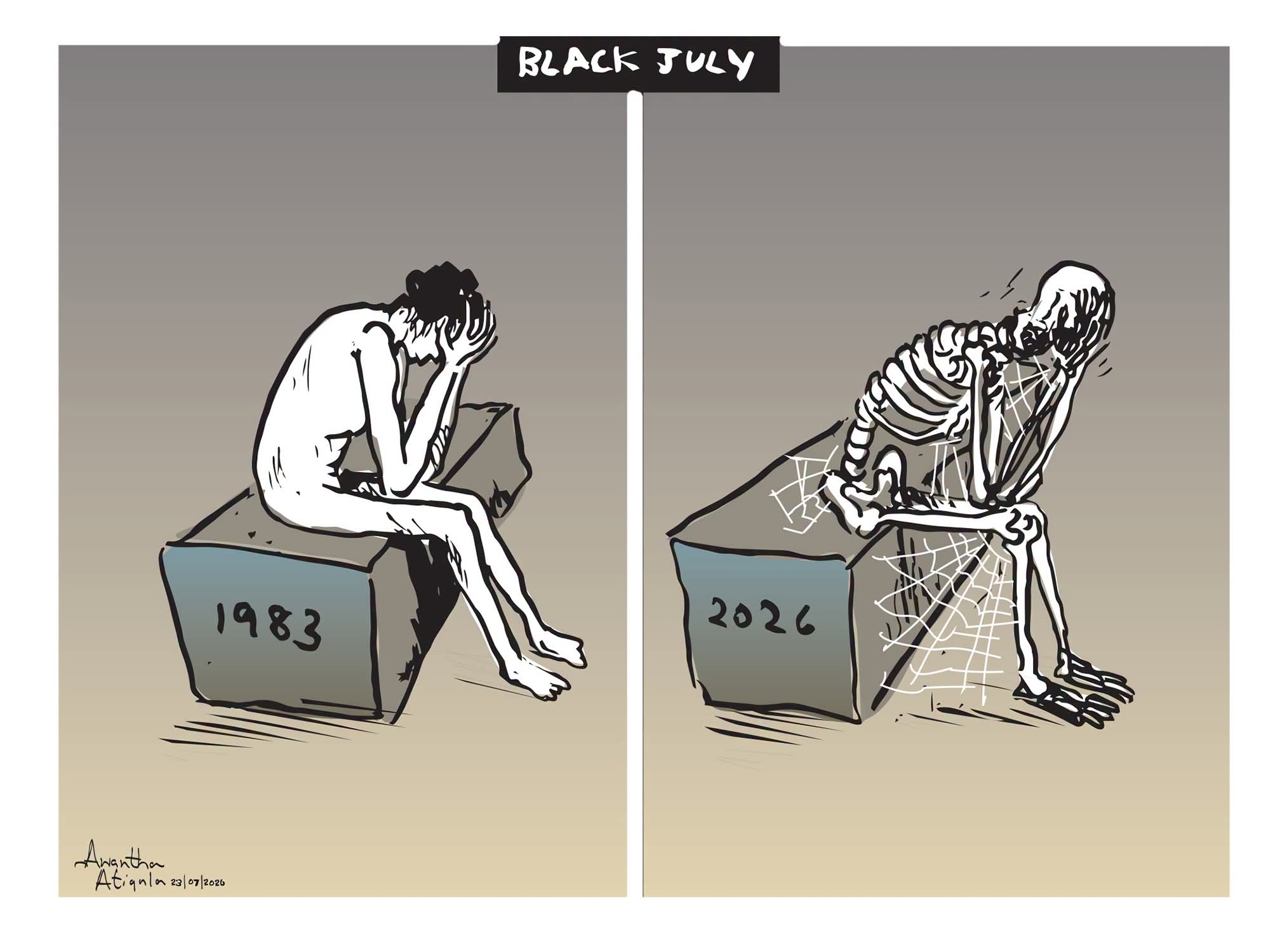
More than four decades after the Anti-Tamil pogrom of July 1983 which is considered as one of the darkest periods in Sri Lanka’s post-independence history, a proposal to investigate the violence through a Parliamentary Select Committee was presented to the Speaker last week.
Signed and moved by 51 Members of Parliament representing the National People’s Power (NPP) Government, the proposed committee is to examine the events surrounding Black July and its background, identify the consequences and the measures required to strengthen national reconciliation, and provide relief to those affected.
The move came amid a disagreement over the appropriate mechanism to investigate the violence. While the Government favours a Parliamentary Select Committee, some Opposition politicians argue that a Presidential Commission of Inquiry would have greater authority.
In October, TELO Leader and Democratic Tamil National Alliance (DTNA) Vanni District MP Selvam Adaikalanathan presented a Private Member’s Motion calling for a Presidential Commission of Inquiry to establish the truth about Black July ethnic violence.
The Government opposed appointing a Presidential Commission, instead indicating its preference for a Parliamentary Select Committee. Justice and National Integration Minister Harshana Nanayakkara said a Parliamentary mechanism would allow elected representatives from different political parties to participate in examining the issue.
However, while the new proposal has brought the Black July crimes into spotlight once again, different parties have mixed reactions to the latest development with some casting doubts on its usefulness.
Violence that changed the course of a nation
Black July refers to the anti-Tamil violence that swept across Sri Lanka in July 1983, leaving hundreds dead and causing widespread destruction of Tamil homes and businesses. The exact death toll remains disputed.
The killing of 13 Sri Lankan Army soldiers by the Liberation Tigers of Tamil Eelam (LTTE) in an ambush at Thirunelveli, near Jaffna, on the night of July 23, 1983, was the trigger behind these incidents. The killed were serving in a military patrol when they were attacked.
Their bodies were brought to Colombo for a mass funeral at the Borella General Cemetery. As tensions rose following news of the killings, anti-Tamil violence erupted in Colombo and subsequently spread to other parts of the country such as Kandy, Nuwara Eliya, Matale and Badulla.
From July 24 onwards, Tamil residents were attacked in several neighbourhoods of Colombo, including Borella, Wellawatte, Bambalapitiya and Dehiwala. Homes, shops, factories and other businesses owned by Tamils were looted and set on fire. People were assaulted on roads and in public places because of their ethnicity, while families were forced to flee their homes to escape the violence.
There were reports that mobs used electoral registers and other lists to identify Tamil households and businesses. Fifty-three Tamil prisoners including prominent Tamil political prisoners held at Welikada Prison in Colombo were also killed between July 25 and 27, 1983.
The conflict subsequently escalated into a civil war that lasted 26 years, ending in May 2009 with the military defeat of the LTTE. The war resulted in tens of thousands of deaths, widespread displacement and extensive destruction, particularly in the Northern and Eastern provinces.
A legacy of displacement, loss and unresolved questions
The consequences of Black July extended beyond the days of violence. Apart from deaths, another 100,000 to 200,000 were estimated displaced. The destruction of Tamil-owned businesses also had a lasting economic impact. Families lost their properties and livelihoods built over generations. Professionals, entrepreneurs and skilled workers left the country and others sought refuge overseas contributing to the growth of a Sri Lankan Tamil Diaspora in countries like Canada, the United Kingdom, Australia, India and the Europe.
Black July also had major political consequences. In August 1983, Parliament adopted the Sixth Amendment to the Constitution, which prohibited the advocacy of a separate State and required specified public officeholders, including Members of Parliament, to take an oath rejecting support for a separate State. The amendment affected Tamil political representatives who refused to take the oath and further complicated the relationship between Tamil political parties and Parliament.
Four decades later, questions remain about the individuals and institutions responsible for violence, the failure to protect civilians and the absence of a comprehensive process to establish the truth.
For victims and their families, the issue is not simply about remembering what happened, but about receiving official recognition and knowing whether those responsible were ever held accountable. It is against this background that the proposed Parliamentary committee has created both hope and scepticism.
Opposition MP Mano Ganesan, who represents the upcountry Tamil community, welcomed the proposal, describing Black July as an event that darkened Sri Lanka’s history and of which consequences continue to be felt.
However, he believes that an investigation should not examine Black July as an isolated incident. In his view, it was one event in a longer chain of developments that contributed to the country’s ethnic conflict. He said an inquiry should examine the circumstances that led to the violence rather than confine itself to the events of July 1983.
MP Ganesan identified three main objectives for the proposed committee: identifying those responsible and examining the possibility of punishment, providing compensation to victims, and investigating the root causes of the violence.
Addressing the root causes
He acknowledged that securing compensation and pursuing those responsible would not be straightforward after more than four decades. Many victims may have died or migrated, while those who could be held responsible may also no longer be available to face legal proceedings.
Nevertheless, he believes that examining and addressing the root causes remains particularly important. “The war is over, but I firmly believe that the root causes that caused the war are still very much alive. If they are not addressed, they need to be addressed,” he said.
Ganesan also highlighted that the committee should not be used to assign collective blame to an entire ethnic community or political group. He said political leaders and ethnic representatives from different sides should be prepared to acknowledge mistakes made throughout the country’s history.
The purpose of examining past mistakes, he said, should be to learn lessons and prevent their recurrence. He believes a Parliamentary Select Committee could be an initial step because Parliament has the authority to summon individuals, including former Presidents, former Prime Ministers, politicians and public officials, to provide information. He said the committee could submit a report that could subsequently be used in considering legal action.
However, Ganesan insisted that the committee must be inclusive. If it is made up exclusively of Government MPs, he said, opposition parties would not accept it. He also said the Government had not discussed the proposal with his side, adding that a committee should include representatives of all political parties.
Presidential Commission or Parliamentary Select Committee?
Batticaloa District opposition MP Shanakiyan Rasamanickam questioned the Government’s decision to favour a Parliamentary Select Committee over a Presidential Commission of Inquiry.
He said the demand for an investigation had gained momentum following MP Adaikalanathan’s Private Member’s Motion seeking the appointment of a Presidential Commission. The Government’s response, he said, was to propose a Parliamentary Committee instead.
“We wanted a Presidential Commission, but they are trying to come up with a Parliamentary Committee,” Rasamanickam said. He believes that the Presidential Commission would be a more appropriate mechanism to investigate as it has greater powers even to prosecute. He also highlighted that the Government had made little progress on accountability and justice mechanisms during its two years in office.
Calling it a ‘cover up job’, Rasamanickam said the proposed Select Committee could become another exercise that produces a report without results. In his view, a Parliamentary Select Committee would not have the same powers as a Presidential Commission, and he questioned what additional outcome it could deliver.
Rasamanickam also pointed to other Parliamentary Select Committees that, in his view, had failed to produce timely results. He cited committees appointed to examine the holding of Provincial Council elections and Ditwah tragedy, adding that the experience of such mechanisms gave him little reason to expect a different outcome.
He said the central problem was not merely finding out what happened but ensuring that those responsible were held accountable. He referred to previous Commissions and initiatives, including the commission appointed during former President Chandrika Bandaranaike Kumaratunga’s tenure and her public apology in 2004 on behalf of the Government for the violence. While acknowledging that such steps had taken place, he argued that those responsible had not been brought to justice.
He said he would participate if invited but remained doubtful about the Government’s intentions. For Rasamanickam, the key issue is the political will. Without a genuine commitment to accountability, he added that changing the name or structure of an investigative mechanism would not produce justice.
Independence, evidence and the danger of political agendas
Prof. Chandragupta Thenuwara who has long featured the period in his art work raised questions about the purpose, independence and practical value of establishing another Commission or Parliamentary Committee 40 years after the violence.
He noted that Sri Lanka has appointed several Presidential and Parliamentary Commissions over the years, but the implementation of their recommendations has often remained uncertain. For him, the central question is therefore not simply whether a new committee should be appointed, but what is expected to achieve.
He said it was important to identify whether the proposed committee would examine previous commission reports and recommendations and investigate why they had not been implemented or only target particular individuals or groups for political purposes.
An inquiry, he said, must function independently and impartially. Otherwise, it could create a culture of blame rather than contribute to an understanding of events. Instead of blaming Sinhalese or Tamil communities collectively, he said, the investigation should establish what actually happened and identify the circumstances that enabled the violence.
He also added that the inquiry should not focus exclusively on deaths and physical destruction. The economic damage suffered by individuals, families and businesses should also be examined. He also warned that a new inquiry could be exploited by political or nationalist groups to advance their own agendas. If politicians use the process to target particular communities or individuals, it could create fresh tensions rather than promote reconciliation.
He therefore called for proper preparation, public awareness and a clear mandate before establishing a new committee. For Prof. Thenuwara, the objective should be reconciliation and the easing of tensions, rather than revenge or the creation of another political platform.
An official record of the truth
Researcher and writer of Kalu Juliye Dina Hathak (Seven days in Black July) Nandana Weeraratna believes that appointing a Select Committee would be an important step towards addressing the absence of accountability for the violence.
He said those responsible for the attacks had largely escaped legal consequences. Weeraratna added that the violence destroyed not only residential and commercial buildings but also important assets, including cinemas and film studios.
He also called for an investigation into the circumstances surrounding the decision to bring the bodies of the 13 soldiers killed in Jaffna to Colombo for the funeral and how information about the killings was reported at the time.
He believes the inquiry should examine the role of political leaders and other individuals who may have organised, facilitated or supported the attacks. He made allegations about the involvement of political figures and religious leaders, which would need to be independently established through evidence.
Weeraratna also referred to the killings of Tamil prisoners at Welikada Prison during riots and said those were perpetrated by the then Government. Acknowledging that a Parliamentary Select Committee would not have the power to impose criminal punishment, he nevertheless believes it should identify and officially record the individuals responsible, where evidence permits.
He highlighted that the absence of punishment for past crimes has contributed to a culture in which perpetrators believe they can escape accountability. Referring to the burning of the Jaffna Public Library and other attacks in 1981, he said the failure to investigate earlier incidents had also contributed to this problem.
“We cannot turn back the Black July crime now. But a Government-appointed official committee report can at least report the truth to history,” he said. He also believes that an official investigation could provide victims with an opportunity to speak about what happened to them and have their experiences formally recognised. Such a process, he said, could provide a measure of psychological relief and recognition to those who have lived with the consequences for decades.
Weeraratna said that establishing the truth would help distinguish those who committed the crimes from the wider Sinhalese community. He said the violence should not be treated as the responsibility of an entire ethnic group but investigated to identify the individuals and political forces involved.
Government’s decision welcomed
MP Adaikalanathan, who initially called for a Presidential Commission of Inquiry into the matter said he welcomed the Government’s decision to proceed with a Parliamentary Select Committee, although he acknowledged that a Presidential Commission would have had greater powers.
He noted that commissions had, on some occasions, delayed the resolution of issues, with inquiries continuing for years without reaching meaningful conclusions. His Private Member’s Motion called for an investigation not only into the anti-Tamil violence of July 1983 but also into the killings of Tamil prisoners at Welikada Prison during the same period.
He said he had made the request because the present Government, unlike previous administrations that had been in power at the time of the violence, was in a position to examine the events without having a direct connection to them.
More than four decades later, many questions surrounding the killings remain unanswered, he said. These include the identities of those responsible, the whereabouts of the victims’ remains and what happened to the bodies of civilians killed during the violence. He also questioned how many of those involved in the incidents were still alive.
Referring to the Welikada Prison killings during President J. R. Jayewardene’s administration, Adaikalanathan alleged that the prison was breached and outside groups were allowed to enter and attack Tamil prisoners. He highlighted the killing of political prisoner Kuttimani, including the reported destruction of his eyes, as a particularly grave human rights violation.
Although he acknowledged that a Presidential Commission would have been a stronger mechanism, with wider powers, he described the proposed Parliamentary inquiry as an historically significant step. However, he said it was too early to determine how far such a committee could go in delivering justice.
“We have to wait and see what happens next. We have no other option,” he said, adding that he took some satisfaction from the prospect of an official investigation being initiated as a result of the motion he had presented in Parliament.
Source:https:sundayobserver.lk