

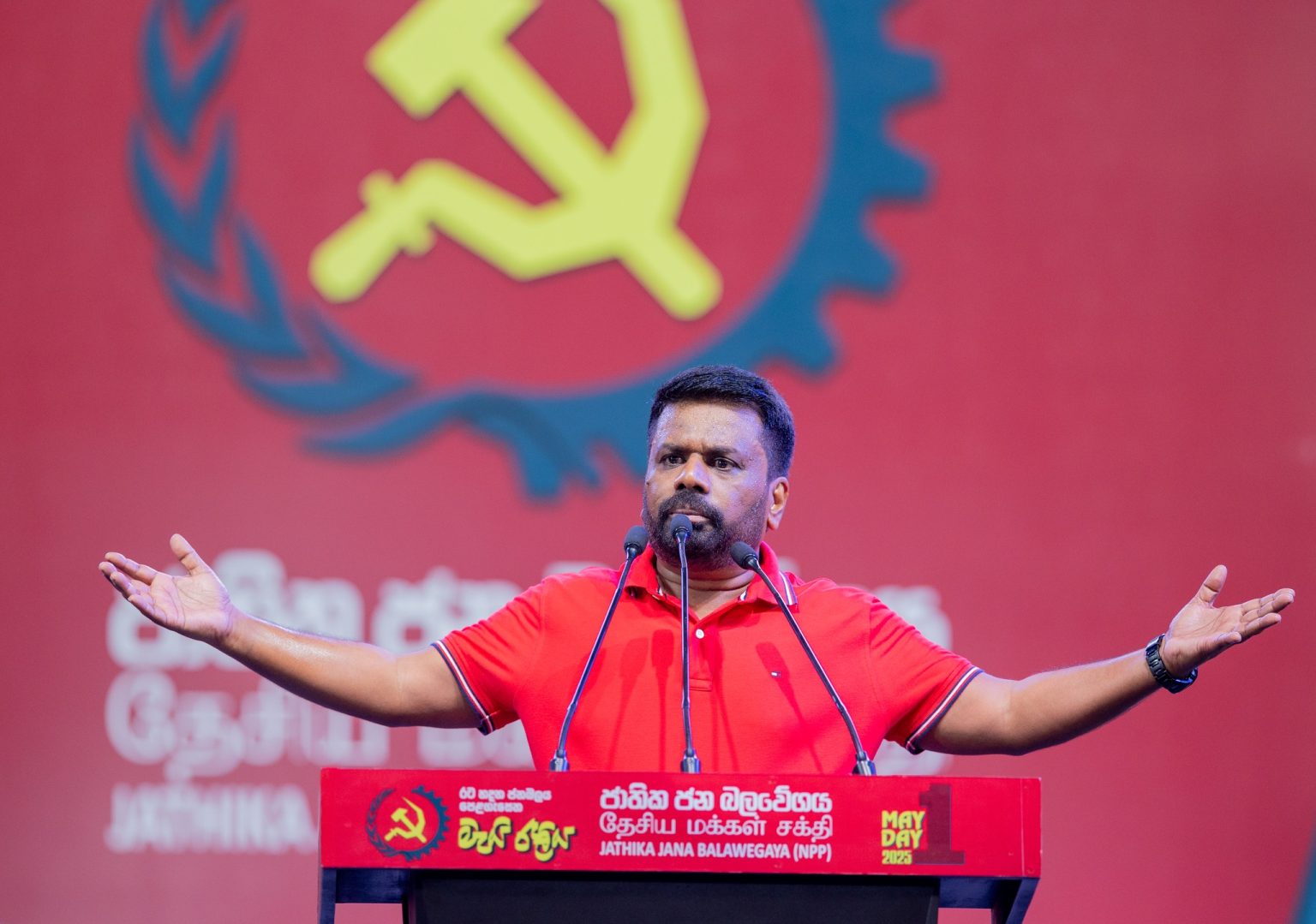
Despite Cyclone Ditwah’s departure from the country after causing much destruction to human lives and property weeks ago, Sri Lanka continues to be in the eye of a socioeconomic and political storm in Ditwah’s aftermath. President Anura Kumara Dissanayake (AKD) seems to be shouldering the heavy burden of rebuilding the country, with a majority of the Janatha Vimukthi Peramuna (JVP)-led National People’s Power (NPP) Government engaged in verbal clashes with members of the Opposition.
The arduous and mostly costly task of rebuilding the country following the recent disaster is expected to take time, with even senior Government members stating that it will take close to two years for the completion of the complete rebuilding programme. While a final estimation of the total damage caused and the cost for rebuilding is yet to be announced, officials believe that the cost could amount to around $ 7–8 billion.
However, the announcement by the International Monetary Fund (IMF) on Friday (19) evening that its Executive Board had approved emergency financing for Sri Lanka under the Rapid Financing Instrument (RFI) that would provide the country with around $ 206 million undoubtedly provided some reprieve to President AKD and his Government.
Meanwhile, persons affected by the disaster as well as Opposition politicians continue to point out to the Government the delay in distributing the cash grants that were announced by the President on 5 December in Parliament.
Responding to these statements, Public Security Minister Ananda Wijepala told Parliament last week that the initial grant of Rs. 25,000 paid for flood-affected families to clean their houses had so far been distributed among 257,000 families out of the total of 493,000 entitled to the payment. He also stated that out of the 610,000 families affected by the cyclone, 493,000 families were eligible to receive the initial grant of Rs. 25,000 and that Rs. 6.4 billion had been paid out of the total allocation of Rs. 17.6 billion.
The President last week also outlined more relief packages to businesses that were affected by the recent cyclone. He also rejected claims that the proposed Rs. 500 billion supplementary allocation would lead to national bankruptcy by April 2026.
President AKD noted in Parliament on Friday (19), at the conclusion of the debate on the Rs. 500 billion supplementary estimate that was presented to Parliament, that Sri Lanka would use a Rs. 1,200 billion cash buffer in the Treasury for cyclone relief and recovery.
“For a long time, the Treasury account was in overdraft. In 2018, it was Rs. 180 billion, in 2019 Rs. 244 billion, in 2020 Rs. 575 billion, and in 2021 it rose to Rs. 821 billion,” the President said. “In contrast, by November 2025, under our Government, the Treasury account showed a positive balance of Rs. 1,202 billion – a Rs. 2 trillion improvement,” he said.
“If we did not have the cash buffer we would have had to look for other ways to finance the spending,” he added.
AKD firmly dismissed claims by some members of the Opposition that the relief package announced by the Government would result in the country being pulled back into another economic crisis by April next year. He explained that the decisions regarding Government expenditure were being made after cautious consideration.
Seeking a PSC
Meanwhile, a group of Opposition Members of Parliament (MPs) handed over a letter to the Speaker of Parliament to appoint a Parliamentary Select Committee (PSC) to probe the reason for the delay by relevant authorities in communicating to the public regarding the cyclone that hit the country late last month and the allegation that early warnings by the relevant State institutions had not been heeded by the authorities.
Led by Opposition Leader Sajith Premadasa, the Opposition MPs had noted in the proposal that weather warnings had been issued in advance by the Department of Meteorology and international media outlets, with interpretations made available prior to landfall, and that despite this, relevant authorities had failed to take adequate preparatory measures.
The MPs had stated that this lack of preparedness was deeply regrettable and asserted that many lives could have been saved if timely action had been taken. They had also drawn parallels to past crises – the Easter Sunday attacks and the economic collapse – during which special parliamentary committees were appointed.
The proposal had also requested that the committee consist of 30 members, with proportional representation from both Government and Opposition parties, and include members from all 22 districts affected by the cyclone.
Scrapping a key ministry
While the Opposition sought the appointment of a PSC to probe the failures during the recent disaster, the Frontline Socialist Party (FSP), a splinter group of the JVP, made some interesting revelations last week.
FSP Politburo member Pubudu Jayagoda claimed that the Disaster Management Ministry, which is a key ministry, had been scrapped in 2020 during President Gotabaya Rajapaksa’s (GR) presidency. He explained that GR had not included a Disaster Management Ministry in his Cabinet and had taken steps to assign the Disaster Management Centre (DMC), Meteorology Department, National Building Research Organisation (NBRO), and other institutions relevant for managing disasters under the Defence Ministry and the military.
The scrapping of the Disaster Management Ministry was therefore deemed to be the main reason for the failure to have a centralised mechanism to address disaster situations. “It is this reason that had caused the failure to activate the centralised operations system that earlier operated on early warnings issued by the relevant departments,” Jayagoda explained, adding that GR had believed that the military was efficient enough to handle disasters as well.
A highly-placed source noted that once the ministry had been done away with and the institutions had been assigned to the Defence Ministry to operate mostly under military purview, there had been no proper reviews of the systems within the disaster preparedness and mitigation apparatus to be on par with global technological advancements.
Jayagoda claimed that some members of the Opposition, especially the Rajapaksas and the Sri Lanka Podujana Peramuna (SLPP), should understand that they were the cause of this disaster since they were responsible for dismantling the system to prepare and mitigate disasters.
Once the ministry was done away under GR’s Government, the Ranil Wickremesinghe Government had also followed the same path as GR. However, the fault of the incumbent JVP/NPP Government is that it had followed the path set by GR and continued by Wickremesinghe without realising the importance of a Disaster Management Ministry, especially given the increasing impact of climate risks.
Harini rejects ex-Presidents
Meanwhile, a statement made by Prime Minister Harini Amarasuriya in Parliament on Friday (19) that the Government would not seek the support of former leaders who were involved in corruption through disasters in raising funds to rebuild the country following the recent disaster gathered criticism from Opposition parties. Several members of the Opposition claimed that the Government was agreeable to accept millions given by a former President but continued to insult them afterwards.
Amarasuriya had noted that the people and international communities had offered to support Sri Lanka due to the trust placed in the good governance practices of the incumbent Government and that it was better not to involve leaders who had lost public trust.
The Prime Minister had made these remarks in response to a statement by Opposition MP Rauff Hakeem that the Government must seek the support of former Presidents in appealing for international support in the recovery effort.
JVP General Secretary Tilvin Silva meanwhile had also made a similar statement while explaining the reason for the inflow of foreign assistance to aid in relief and rehabilitation work following the recent cyclone. He has said that foreign assistance was flowing in because of the international community’s firm belief that the JVP/NPP Government did not swindle funds.
According to him, assistance is flowing in significantly from other countries for the people affected by the natural disaster and aid will continue to flow in.
TPA writes to AKD
Meanwhile, Tamil Progressive Alliance (TPA) Leader Mano Ganesan has written to President AKD requesting a meeting to discuss the challenges faced by the Malaiyaha (up-country) community following Cyclone Ditwah.
Ganesan has noted: “At the outset, we wish to acknowledge and appreciate your decisive leadership during this exceptionally challenging period of national crisis.”
He has further stated that residents of the hill country, particularly the Districts of Kandy, Nuwara Eliya, Badulla, and Matale, as well as the surrounding areas, have been among the worst affected by the recent Ditwah disaster.
“The Malaiyaha community, which continues to register comparatively low and, in some sectors, negative human development indicators – especially in land ownership, housing, education, health, and poverty alleviation – requires a differentiated and targeted approach in the recovery and speeding up rebuilding phase.
“In this context, we respectfully request an urgent meeting with you involving political and civil representatives of the Malaiyaha community to deliberate on a coordinated and sustainable framework to address these unique challenges,” Ganesan has added.
Udaya accuses AKD
Former Minister Udaya Gammanpila meanwhile has accused President AKD of criminal negligence over the recent disaster that claimed hundreds of lives and has threatened to pursue legal action once the President leaves office.
Gammanpila has claimed before the media that criminal charges will be filed against AKD after he completes his presidential term in 2029. “When you step down from the presidency in 2029, we will file criminal negligence cases against you without fail,” the former Minister has said, adding that evidence had already been gathered to support the allegations.
According to Gammanpila, the maximum penalty under the law for such an offence is five years’ imprisonment.
Harin’s prediction
Meanwhile, United National Party (UNP) Deputy General Secretary Harin Fernando, who stirred the pot at last month’s joint Opposition rally in Nugegoda by referring to the SLPP’s Namal Rajapaksa as the ‘Prince of the Stage,’ has this time around predicted yet another economic crisis in the country by April next year. He noted that Sri Lanka could face a major economic crisis by April 2026 if the fallout from the Cyclone Ditwah disaster was not managed properly.
“If there is no proper plan, programme, or projection, Sri Lanka will move towards a massive economic collapse by the Sinhala and Tamil New Year,” Fernando claimed at a media briefing in Colombo on Monday (15), adding: “Write down today’s date. We warned you.”
He further warned that it would be important to look at the positioning of the US Dollar against the Sri Lankan Rupee by 15 April and “look at what kind of economic contraction the country will face. I do not want that to happen, but it will if this situation is not managed properly.”
Losing LG budgets
Meanwhile, the ruling JVP/NPP that controls the Galle Municipal Council, which is one of the key Local Government (LG) bodies in the Southern Province, witnessed the defeat of its maiden budget on Monday (15) by two votes. The 36-member council had recorded 17 votes in favour of the budget and 19 votes against it.
The Opposition had objected to the 2026 budget presented by the ruling party, stating that there was not much of a difference between the latest proposals and those presented in last year’s budget.
Opposition councillors in the council had blown red balloons and burst them as a mark of protest while voting against the budget.
The JVP/NPP also lost the inaugural 2026 budget of the Balapitiya Pradeshiya Sabha on Tuesday (16). The budget was rejected by a narrow margin of one vote, with 17 councillors voting against it and 16 voting in favour.
Meanwhile, the JVP/NPP’s 2026 budgets were defeated in the Peliyagoda Urban Council and the Ratnapura Municipal Council. In Peliyagoda, eight JVP/NPP councillors had voted in favour of the budget while nine councillors representing all parties in the Opposition had voted against. In Ratnapura, the JVP/NPP’s budget had received 13 votes in favour and 14 votes against.
NPP MP criticises Minister
Meanwhile, trouble faced by the ruling JVP/NPP seems to now go beyond the defeats experienced by the party at many Local Government bodies, with an incident recently being reported of a ruling party MP criticising a Minister of the Government led by his own party.
The incident had taken place when JVP/NPP Kurunegala District MP Dharmapriya Dissanayake had criticised the conduct of the Trade Ministry under the purview of Minister Wasantha Samarasinghe over the destruction of a State-owned building in the Kurunegala area. He has noted that the destruction of the building had been carried out on land belonging to the Trade Ministry without any form of coordination. “This is just crazy. Although I’m an MP of the governing party, these incidents should not be allowed,” the MP has stated.
Dissanayake has claimed that he opposed the actions of the ministry since he did not approve of the destruction of State-owned buildings, especially without the knowledge of the divisional or district secretaries or even the grama niladhari. A video clip posted on social media shows him explaining the destruction caused to the building and even taking a telephone call to an official in a State institution under Samarasinghe’s purview.
The de facto magistrate
While a JVP/NPP MP openly opposed and criticised the conduct of Minister Samarasinghe’s ministry, the ruling party’s Mayor of the Kaduwela Municipal Council Ranjan Jayalal seems to have assumed the role of de facto magistrate.
An audio recording of a person said to be Jayalal reprimanding a group of individuals including a lawyer who had met him to discuss some issues, claiming he was the Mayor and that he therefore possessed the powers of a magistrate, was shared on social media last Wednesday (17). The voice said to be of Jayalal is heard stating that no one can try to intimidate him since he is the de facto magistrate as the Mayor.
In the recording, it is also heard how the individuals who had arrived at the Mayor’s Office to resolve some issues are shouted at and chased out by the voice said to be Jayalal’s.
The Bar Association of Sri Lanka (BASL) meanwhile has issued a statement condemning Jayalal’s conduct, especially the way he had addressed a lawyer, and has urged the President to take action against the member of his party.
PSC for PCs
Amidst these developments, the Government continues to face pressure on holding the delayed Provincial Council (PC) Elections, especially with Opposition parties continuing to claim that the ruling party is delaying the polls due to the knowledge that it would be defeated when the elections are held.
However, it is learnt that the Government is looking at a proposal that has been submitted by the ruling party to appoint a PSC to study and make recommendations to the House on amendments required to be made to the electoral system for Provincial Councils in order to enable the holding of the delayed polls to the provinces.
The proposal presented by the Leader of the House has reportedly been included in the new Order Book that has been prepared following the conclusion of the Budget process.
The proposal has also stated that there needs to be a broader and in-depth discussion on the country’s electoral system and that this discussion should include topics like making female representation compulsory, youth representation, campaign finance limits, a mixed electoral system of first-past-the-post and proportional representation, the ability to cast early votes, and ensuring voting rights of migrant workers.
The report of the PSC is expected in three months from the first meeting of the committee or at the end of an extension period if such is granted by the House.
Addressing Parliament last week, Prime Minister Amarasuriya reiterated the Government’s commitment to hold the PC Elections as soon as the legal impediments to holding the polls were cleared, adding that the Government had already taken measures to allocate the necessary funds to hold the polls in next year’s Budget.
“The inability to hold PC Elections thus far is due to the fact that the delimitation process required under the provisions of the Provincial Councils Elections (Amendment) Act No.17 dated 2017 has not yet been completed. Accordingly, a study is currently being conducted to determine whether the elections should be held after completing the delimitation process, or whether amendments should be introduced to the provisions of Act No.17 of 2017 in order to proceed with the elections,” she said.
SJB proposal
While the Government talks of holding the delayed PC Polls next year, Opposition parties are continuing to explore the possibilities of forming broader alliances. The Samagi Jana Balawegaya (SJB) and the UNP are two of the main Opposition parties that are looking at forming an alliance by first working on a common work plan.
A team led by UNP Deputy Leader Ruwan Wijewardene was appointed by the UNP side to discuss an initial agreement between the two parties.
However, it is learnt that the SJB side has continuously called for an alliance between the two parties under a leadership other than that of UNP Leader, former President Ranil Wickremesinghe. When both parties, the SJB and UNP, decided to officially discuss entering a common work programme, SJB seniors had urged SJB Leader Premadasa that the leadership of an alliance with the UNP should be held by him (Premadasa) and that the UNP side in the new endeavour should be led by a party senior other than Wickremesinghe.
It is learnt that the SJB side has already communicated to the UNP side that an alliance between the SJB and UNP should be led by the SJB Leader since the party is the main Opposition in Parliament. In the event the two parties form an alliance under Premadasa’s leadership, Wickremesinghe would then have to resign from the UNP leadership and be appointed to a senior post like senior adviser or senior patron.
RW’s response
It is in such a backdrop that Wickremesinghe had stated last week at the UNP Management Committee meeting held at the Party Headquarters, Sirikotha, that he was prepared to step down from the party leadership to make way for the SJB-UNP alliance.
During the meeting, Wickremesinghe had asked for a progress report on the talks between the UNP and SJB, saying that he had not yet received an official report on the talks. He had also stressed to the Executive Committee that the discussions must be concluded swiftly as there was no time to waste, since from next year Opposition parties should unite to build a strong people’s force against the Government.
Wickremesinghe had then urged that the ongoing talks be expedited.
When the former President had been informed of the SJB’s proposals, he had told the committee that if a consensus was reached between the UNP and SJB to merge, and if the UNP Executive Committee proposed that Premadasa or another individual should take over leadership, he would have no objection since he supported the merger of the two parties.
“I have been the Party Leader for a long time. I became the country’s President. I have reached the highest position possible. At the most difficult moment for the country, I took responsibility and worked to lift it up. Therefore, stepping aside is not a problem for me. But this must be concluded quickly,” Wickremesinghe was quoted as telling the committee in media reports.
Soon after the meeting, pro-Wickremesinghe groups started to inform the media of Wickremesinghe’s preparedness to step down from the party leadership.
No takers
However, those who are well aware of Wickremesinghe’s antics know very well how he operates. This is not the first time he has expressed preparedness to step down from the party leadership.
Whenever there has been any dissension growing within the UNP in the past and currently as seen in the push for the UNP to align with the SJB as well as for a change in leadership, Wickremesinghe has stated he was either going to take a backseat to allow a fresh lead to be given to the party or that he was prepared to move out of the party leadership.
In every instance in the past when he has spoken of taking a backseat or moving out, he has initiated a two-pronged approach. The first is to put pressure on the other side, in this case the SJB, by making it public that he (Wickremesinghe) is supportive of the alliance and is prepared to even give up the UNP leadership. Through this move, the onus falls on the SJB to act on the statement.
The next move is to get his loyalists in the UNP to publicise Wickremesinghe’s magnanimous nature and to blame the SJB for delaying the process while another group of loyalists, especially two senior party members despised by a majority of UNPers, engage in internal processes to block the SJB from confidently forming the alliance.
Once these actions are put in motion, the SJB, realising that Wickremesinghe is back to his old antics, will become hesitant to align with the UNP, resulting in the former President’s loyalists then making public statements naming the SJB leadership as the truant.
All these moves would result in some SJBers, who are engaged in talks with the UNP and rooting for an alliance between the two parties, becoming disgruntled and Wickremesinghe will then get his loyalists to try and poach these SJBers to the UNP.
It is also no secret that Wickremesinghe, since 2022, has been sympathetic towards some SLPPers with whom the SJB has already expressed displeasure over potentially being aligned with, and is also comfortable working with these SLPPers. Wickremesinghe would work on getting these SLPPers to the UNP fold due to the belief that with the SJB and SLPP defectors, he could once again strengthen the UNP and rule the party for many more years to come.
Being a master in the policy of divide and rule, Wickremesinghe most often acts with an ulterior motive.
Therefore, the statement claimed to have been made by the former President about his preparedness to step down from the party leadership to pave the way for an alliance between the SJB and UNP was not taken seriously by many Opposition politicians, including many UNPers as well.
SLFP makes changes
Meanwhile, the Sri Lanka Freedom Party (SLFP), which is on a path to unite all divided factions and reform the party, has made significant changes to the party’s Constitution during a special meeting of its Executive Committee and All-Island Working Committee last Sunday (14) at the Party Headquarters on Darley Road in Colombo.
Party Leader, former Minister Nimal Siripala de Silva headed the meeting that was attended by all party seniors and members of the two key decision-making bodies.
Apart from endorsing several new appointments to key party positions, the party Constitution was also subjected to significant changes, which party seniors stated would further strengthen internal party democracy. A senior party member noted that while many political parties had party leaders with excessive powers who had decision-making powers mostly vested with them, the SLFP had decided to reduce the powers vested with the party leader.
Accordingly, the SLFP leader will no longer be vested with the power of removing a party member since such a move would now have to be made with the approval of the Politburo. While the party leader can appoint or remove a member of the party, it will now have to be done with the approval of the Politburo.
The other key change introduced was in relation to the appointment of members to the Politburo. Earlier, it was the party leader who had the power to appoint all 15 members of the SLFP Politburo. However, this has now been changed to permit the party leader to appoint seven members to the Politburo and that too should be done in consultation with the senior office bearers. The remaining eight members of the Politburo will be ex officio members like the general secretary, national organiser, treasurer, etc.
These changes to the party Constitution, it is learnt, are aimed at preventing the party leader from removing or expelling members who oppose the party leadership.
The SLFP has also reduced the minimum age for party membership from 18 years to 16 years.
New appointments
Meanwhile, Opposition MP Chamara Sampath Dasanayake was appointed as the SLFP National Organiser at last Sunday’s meeting.
The decision to appoint Dasanayake as the SLFP National Organiser was made at the party’s Executive Committee meeting held last Sunday (14). He was also appointed as the SLFP’s Parliamentary Leader.
The SLFP has been making appointments to key internal positions as part of the party’s reorganising programmes. Former Minister Wijeyadasa Rajapakshe, who joined the party recently, was also appointed to several key positions.
However, prior to appointing Dasanayake as the SLFP National Organiser, the post was offered to former General Secretary of the SLFP Dayasiri Jayasekara, who is currently in litigation challenging his ouster from the party post.
Dasanayake himself noted that the post of national organiser was first marked for Jayasekara and that he was appointed to the post since Jayasekara had declined it. Dasanayake also claimed that he had been appointed as the party’s Parliamentary Leader since Jayasekara represented the SJB in Parliament.
However, he further noted that he was prepared to move out of the national organiser post and make way for Jayasekara to assume the post if the latter decided to return to the party fold.
Dayasiri hits out
Jayasekeara meanwhile hit out at the meeting of the SLFP’s Executive Committee and the All-Island Working Committee by issuing a letter to SLFP members on an SLFP letterhead signed by him as the general secretary of the party.
Jayasekara has claimed in the letter that the meeting convened by Nimal Siripala de Silva and his group has violated the party Constitution yet again. He has also noted that the Election Commission did not accept the SLFP due to the ongoing legal cases.
Explaining further, Jayasekara has stated that the Election Commission would officially recognise the party only after the conclusion of the ongoing legal cases and upon the commission being informed of the final decision and the party’s stance. Until such time, Jayasekara has said that party members were being misled by one group through temporary moves.
Jayasekara has gone on to point out that the crisis in the SLFP had started when the 14 SLFP MPs in Parliament during the Gotabaya Rajapaksa administration had decided to resign from the Government in May 2022, as well as by nine of the SLFP MPs deciding to join the Ranil Wickremesinghe Government by assuming ministerial positions afterwards.
Referring to the statement made by Dasanayake that he (Jayasekara) was representing the SJB in Parliament, Jayasekara has clarified that he had not joined the SJB and that he had contested after reaching an agreement with the SJB-led alliance that he would contest under the alliance as a member of the SLFP and that SJB General Secretary Ranjith Madduma Bandara had accepted this and informed the Election Commission about it.
Jayasekara has also questioned how Dasanayake could be appointed as the Parliamentary Leader of the SLFP when he was given nominations by the General Secretary of the New Democratic Front (NDF) under the ‘gas cylinder’ symbol and not by the SLFP.
According to Jayasekara, the cases filed by him before the Colombo District Court challenging the allegedly illegal way in which he was removed from the post of party general secretary and the manner in which de Silva had assumed the post of party leader were up for their final verdict on Thursday (18).
Displeasure over changes
It is also learnt that the latest changes being made within the SLFP have not gone down well with some party members, especially the SLFP member who had earlier led the party in the Colombo District.
The SLFP’s Faiszer Musthapha, PC also entered Parliament following the last Presidential Election through the NDF National List while Dasanayake was elected to the House from the Badulla District.
However, it is learnt that Musthapha is currently disgruntled that Rajapakshe has been appointed as the SLFP’s Colombo District Leader while Dasanayake has been appointed as the party’s Parliamentary Leader.
Maithri’s poetry
While the SLFP is travelling on a potholed path towards rebuilding the party following the many breakaways and factions, former Leader of the SLFP and former President Maithripala Sirisena was recently seen reciting a poem at the launch of a book of poetry in Colombo where he was the Chief Guest.
The poetry book contains poems about several former politicians. Former Prime Minister Dinesh Gunawardena had also attended the event.
When invited to address the gathering, Sirisena had gone to the podium and commenced his speech with a poem.
GL’s book
Meanwhile, former Minister G.L. Peiris is set to launch a book written by him – ‘The Sri Lanka Peace Process: An Inside View’ – containing details of the processes launched by several governments during the period of the war.
Peiris played a key role in the peace processes initiated by former President Chandrika Bandaranaike Kumaratunga (CBK) and former President Ranil Wickremesinghe as the Prime Minister of the 2001–2004 Government.
Meeting Namal
An interesting meeting had recently taken place between the SLPP’s Namal Rajapaksa and several JVP/NPP MPs. This meeting had taken place at the event organised to mark 52 years since the ordination of Ven. Kotapitiye Rahula Thera that was held at the Galgoda Purana Viharaya in Panadura.
Photographs of the event, especially ones where the ruling party MPs are seen exchanging pleasantries with Namal, were being widely shared on social media while some were reposted as memes. A video clip on lighting the ceremonial oil lamp at the outset of the event shows ruling party MP Nilanthi Kottahachchi awkwardly looking at Namal as he was standing next to her to light the oil lamp and she had to hand over the candle to him.
Former Speaker Karu Jayasuriya and former Minister Rajitha Senaratne were also among the attendees at the event.
However, the ruling party MPs had left the event prior to its conclusion.
MR returns to Colombo
Meanwhile, former President Mahinda Rajapaksa (MR) has returned to live in Colombo after spending several months at Carlton House in Tangalle, it is learnt.
It is further learnt that MR had arrived at the new residence in Colombo recently and had conducted the traditional rituals when moving into a new house, which is located in the Narahenpita area.
CIABOC after Arjuna
Meanwhile, the Commission to Investigate Allegations of Bribery or Corruption (CIABOC) last Monday (15) had informed court that it would arrest and produce former Minister Arjuna Ranatunga in connection with an ongoing investigation into an alleged financial loss of nearly Rs. 800 million to the Ceylon Petroleum Corporation (CPC).
Earlier that day, the CIABOC had arrested Ranatunga’s brother, Dhammika Ranatunga, who had served as Chairman of the CPC during the period under investigation.
According to the CIABOC, Dhammika has been named as a suspect in a case involving irregular fuel tenders awarded at inflated prices, which investigators allege caused significant losses to the State-owned petroleum entity.
However, as the week concluded, Arjuna was not arrested.
Source: The Morning