Two parliamentarians – Nalin Bandara Jayamaha (Kurunegala District) and Wasantha Yapa Bandara (Kandy District) – were suspended for the day’s sittings from Parliament on Tuesday by Speaker Mahinda Yapa Abeywardena.
It fell on the Serjeant-at-arms, Narendra Fernando, who is tasked to carry out the orders of the Speaker, to make sure they left the precincts of Parliament. He was walking with them out of the chamber and had to pass a location where the MPs were usually served Kola Kenda (a traditional herbal congee). The duo wanted to savour the health drink. He waited till they finished before escorting them out of the premises.
Other than that, a more serious event on Friday was the decision to place before the House Ethics and Privileges Committee the matter concerning Puttalam District MP, Ali Sabri Raheem. As exclusively revealed in these columns last week, an official report from Customs Director General P.B.S.C. Nonis to the Speaker has prompted the move. (See story on this page).
For opposition political parties represented in Parliament, the preoccupation appears to be preparing for a parliamentary election. Though there is no formal indication from President Ranil Wickremesinghe, their leaders do not want to take any chances. That it would take months rather than weeks is clear from President Wickremesinghe’s decision to implement the 13th Amendment to the Constitution. Except for the Janatha Vimukthi Peramuna (JVP), all other political parties have made proposals. They are now being tabulated at the Presidential Secretariat for scrutiny by the cabinet of ministers. It will thereafter be presented in Parliament for all political parties to agree on a common format.
The 13th Amendment which deals with Provincial Councils came about due to India’s intervention in July 1987 as a solution to the ethnic conflict. Thus, the principal beneficiaries in the north and east were the Tamil political parties. On August 15, parliamentarian C.V. Wigneswaran, a former Supreme Court Judge, told a meeting chaired by President Wickremesinghe: “I have already made available to His Excellency a letter signed by the Leaders of seven of the 13 registered parties in the North and East asking for the full implementation of the 13th Amendment for the moment. Of the six remaining, a party in Government has supported our efforts but declined to sign on a protocol basis. The Tamil Congress feels two in the bush is better than one in hand. The other four registered parties have refused to sign the document for reasons best known to them.” He noted that the Provincial Council elections have not been held for the past ten years.
The latest round of talks came between the Freedom People’s Congress (FPC) led by Dullas Allahapperuma and the Uttara Lanka Sabhagaya (ULS) led by Wimal Weerawansa. The two sides met at the Communist Party office to discuss whether they could reach common ground. That was not good news for the Samagi Jana Balavegaya (SJB) which had hoped to wrap up an alliance with the FPC, as revealed in these columns last week.
The two sides reached a broader understanding on holding a further round of talks. They will centre on economic policy, foreign policy including regional power balance, political reforms including the proposed implementation of the 13th Amendment to the Constitution and the creation of a social democratic structure. Representing the FPC were G.L. Peiris, Dilan Perera, Nalaka Godahewa, Charitha Herath and Channa Jayasumana. The Uttara Lanka Sabhagaya team was led by Wimal Weerawansa and included Udaya Gammanpila, D.E.W. Gunasekera, Vasudeva Nanayakkara, G. Weerasinghe (General Secretary of the Communist Party) and Gevindu Kumarasinghe. The two sides are yet to agree on a date for the next round of talks.
Wooing JVP
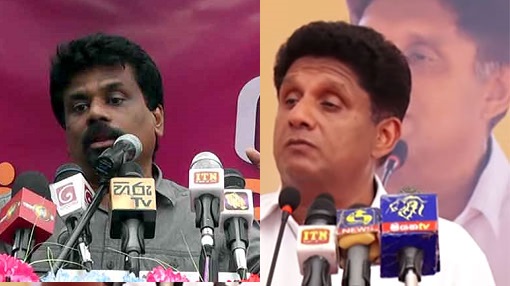
The same FPC delegation had talks with the JVP at its office in Battaramulla on Friday. They are not seeking a tie-up but exploring the prospects of the two sides joining together on a common platform on key issues. JVP leader Anura Kumara Dissanayake, Vijitha Herath and K.D. Lalkantha attended the talks.
A sizeable section of the FPC are opposed to an early tie-up with the main opposition SJB. It came to light this week that they want to first end their dialogue with all opposition political parties before reaching finality. A key member who is opposed to an early tie-up with the SJB spoke on grounds of anonymity. He said, “They want to rope us in early for two main reasons. One is the support they will receive for the candidature of their leader Sajith Premadasa. The other is by doing so, they want to prevent a possible erosion of their ranks to the United National Party.”
The same member said that one of the major stumbling blocks for an early tie-up with the SJB was its economic policy. The SJB came out earlier with a blueprint that was authored by Harsha de Silva. Now, it has improved on this same programme which makes clear that its policies are no different to those of the UNP or albeit the ruling disposition, the member said. “We will want the SJB to agree on a new economic policy if we are to support it,” the member said.
Highlights of the Executive Summary of the SJB blueprint:
“Sri Lanka’s economic crisis is not unexpected. Decades of short-sighted policies and half-hearted reforms weakened our foundation. Sudden global crises pushed us to the brink. Appalling mismanagement took us over the edge. Today, the state is bankrupt, inflation is rampant, the economy is faltering, and our socio-political order is in crisis. Yet we can still recover, we can regain our ground, reform our economy, and rebuild our country.
“Blueprint 2.0 tells us how. Anti-corruption and transparency laws are the bedrock of true, lasting change; and their rigorous implementation is essential to build a society that is just, equitable, and free from corruption. We must obtain bridge financing for our debt crisis and productively engage with the International Monetary Fund while restructuring our debt. We must maintain financial system stability as we do so. Carefully floating the exchange rate to market levels and raising interest rates will control inflation and restore the economy’s international competitiveness.
“Monetary policy reform will ensure that we do not backslide into crisis. Fiscal reform, including sustainable tax revenue increase, expenditure rationalisation, and reform of state-owned enterprises, is also critical. As we stabilise, we must also grow. It is essential that we promote trade, industry, agriculture, and services by unshackling markets, increasing competitiveness and productivity, promoting exports and investment, and integrating with global production networks. Transforming the public sector into a productive, efficient, digitally enabled workforce that serves the needs of Sri Lanka’s citizens, is also vital for growth. Reforms in the energy and utilities sectors are particularly important.
“Land and labour market reform will enable and amplify this growth.
“Targeted, means-tested cash transfers within a strong, transparent, effective social safety net must safeguard those who need it most. These reforms will enable more citizens to access the opportunities stemming from growth. This will not be an easy path, but it is our only route out of debt and towards sustainable inclusive development.
“This document is prepared by Harsha de Silva, a member of the Samagi Jana Balawegaya (SJB)’s Economic Policy Unit consisting of the author, Kabir
Hashim, MP and Eran Wickremeratna, MP; and is endorsed by SJB Leader Sajith Premadasa, MP. Valuable advice and commentary from Professor Premachandra Athukorala and several economists are acknowledged with gratitude.
“This document also incorporates, in tables, the short-medium term action plan detailed in the ‘Common Minimum Programme’ compiled mid-2022 by the
National Movement for Social Justice (NMSJ) using proposals from Advocata Institute, Bar Association of Sri Lanka (BASL), Elle Gunawansa Thera, independent economists’ group,
“This document focuses solely on economic stabilization and growth: it does not include in-depth views of the author, the SJB, or any others on reforms in
critical areas such as education, health, justice, reconciliation, environment, or any other aspects. It is not a comprehensive manifesto.”
Clues in President’s plans
However, the opposition political parties are still not sure when President Wickremesinghe will call for either presidential or parliamentary elections. Consequently, they are surmising every step he takes as a possible prelude to a poll. Upon his return from a short visit to Singapore, Wickremesinghe pitched camp in Trincomalee to direct a string of development projects. This was much like what he did earlier when he operated on from Nuwara Eliya. From Trincomalee, he travelled to Arugam Bay in the Ampara District. His Media Division said:
“Reflecting on the previous year, our nation faced an economic collapse that led us into a state of indebtedness. Thanks to well-executed government initiatives, we managed to avert bankruptcy this year, but the responsibility of repaying these debts remains. Additionally, foreign exchange is pivotal for propelling the country’s progress. Hence, maintaining a favourable trade balance is imperative; otherwise, we risk encountering another economic crisis in a decade due to escalating debt. To counter this potential scenario, we have devised a novel programme. Notably, substantial focus has been directed towards the Eastern Province, with a particular emphasis on the Trincomalee district’s development. In this endeavor, we have secured support from India for advancing the Trincomalee district.
“Our plan encompasses harnessing the land portion of the left bank of the Mahaweli zone to facilitate development activities. This includes the establishment of a sizable investment zone spanning approximately a thousand acres. It’s crucial to highlight that, concurrent with the tourism industry’s advancement, an agricultural modernization scheme and a development project for the fishing industry are being formulated to elevate these industries’ prospects. Moreover, a primary objective is to enhance the living standards of the people in the Ampara district, a region inhabited by poor people. This has been a key focus, driving the modernization of both the fishing and agricultural sectors in Ampara. The target of achieving a rice yield of at least 7 to 8 metric tons per hectare is set, with corresponding initiatives in animal husbandry being enacted in the province as well.
“In the forthcoming decade, a concerted effort is being directed towards elevating the annual tourist influx from 2.5 million to 5 million initially, followed by a subsequent surge to 10 million In line with this, a robust initiative seeks to attract no less than 10-20 million tourists annually to this region. The formulation of a comprehensive strategy to levy fees of $300 or $500 per day per tourist is in progress, aimed at materializing this goal within the Eastern Province.
Presently, the landscape of tourism exhibits distinctive features. A segment of tourists gravitates towards these provinces. Nurturing activities such as water skiing, which holds substantial tourist allure, becomes pivotal…..”
It is the breakaway groups from the Sri Lanka Podujana Peramuna (SLPP) that are keen to forge tie-ups with other opposition political parties. That it has emaciated the SLPP is no secret. Fresh moves are now being made to widen their support base among MPs. This is by being critical of the implementation of the 13A. The SJB which remains less than active but confident of victory at the polls is keen to shore up its support base. It is no easy task for it. It is known that the SJB’s key members have formulated their own publicity machinery in the absence of a voice from the party. The result has been a campaign by media promoters of SJB leader, Sajith Premadasa, to have his lengthy speeches in Parliament publicised. Other than that, the absence of cohesive media machinery has prevented the SJB from speaking out in one voice over national issues. That may cost the grouping considerably though some of its stalwarts keep complaining that they do not have the funds for a full-fledged media operation. Their woes will continue.