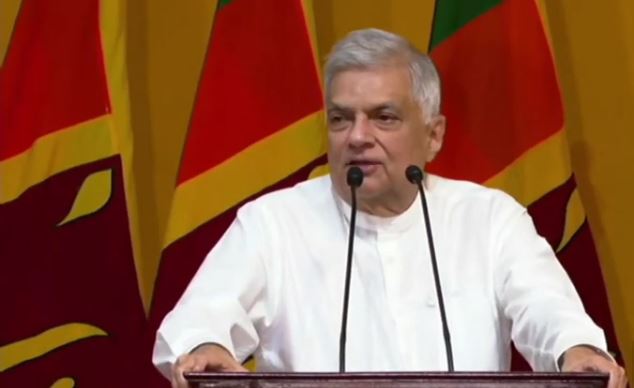
Four months after ensconcing himself constitutionally as the President of Sri Lanka, Ranil Wickremesinghe finds himself at the helm of many a change, both politically and otherwise.
This week, he refused to place his signature on Detention Orders under the Prevention of Terrorism Act (PTA) on two student leaders. They were Wasantha Mudalige, Convenor of the Inter-University Students Federation (IUSF), and Ven. Galwewa Siridhamma Thera, Convenor of the Inter-University Bhikku Students Federation. They were detained under the PTA, and the orders lapsed on Friday. On the same day, members of the Inter-University Students Federation (IUSF) staged a protest outside the United Nations Office in Bambalapitiya demanding their release. Police were forced to use tear gas and water cannons after they broke security cordons as they tried to march towards the Welikade Prisons.
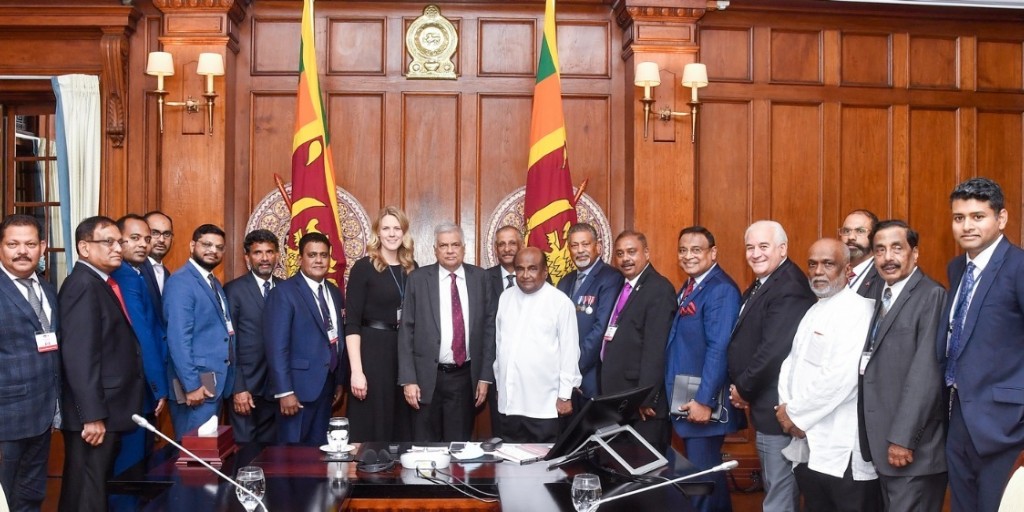
The previous orders under the PTA had been signed by Defence Secretary, retired Major General Kamal Gunaratne. However, he was away this week in Pakistan leading a military delegation from Sri Lanka. That included the Commander of the Army, Lt. Gen. Vikum Liyanage, Chief of Staff of the Sri Lanka Navy, Rear Admiral U.V.M.P. Perera and Chief of Staff of the Sri Lanka Air Force, Air Vice Marshal R.A.U.P. Rajapaksa. They have since returned.
Asked how cases related to the PTA would now be handled, a government source said it would be under the normal laws of the country. The move, the source said, made clear the government would veer away from the use of provisions of the PTA in the future. This is particularly in view of criticism, both in Sri Lanka and abroad, that such a controversial law should not be used but rescinded. Making the situation worse was the fact that the arrest of the two student leaders was over the protests, both at the Galle Face Green and outside Temple Trees. They were seeking the ouster of the then President Gotabaya Rajapaksa. These protests forced him to flee Sri Lanka. He, however, returned within weeks after efforts to obtain asylum abroad failed. He is now awaiting a response to an appeal made to the US for the reinstatement of his citizenship which he renounced to contest the presidential elections in 2019. It has been made through his lawyers in the US.
Ex-President Rajapaksa was in a bind this week after Uttara Lanka Sabhagaya leader Wimal Weerawansa made some disturbing disclosures about an alleged attempt on the former President’s life. It was during a talk show on a television programme and had been based on revelations made to him when Rajapaksa was serving as President. Of importance in the accusation is the alleged involvement of a Colombo-based diplomat, a charge which a source in the mission concerned dismissed as “absolute rubbish.” In the morning that followed the airing of the programme, Gotabaya Rajapaksa, a source in the know said, utilised the good offices of a friend, a minister, to appeal to Weerawansa not to repeat those assertions. He explained that such matters had happened during his term of office, and he did not wish to talk about them now. Or was it a case of misreading the situation? After all, he has then personally granted a string of appointments to the diplomat concerned.
On the subject of PTA, at the 51st sessions of the UN Human Rights Council in Geneva, the latest resolution on Sri Lanka noted that “the introduction in March 2022 of amendments to the Prevention of Terrorism Act, that detentions under that law continue, and the expressed intention of the Government of Sri Lanka in this regard to introduce new legislation on combatting terrorism, and encourages the Government to engage in consultations with civil society, the Office of the High Commissioner and relevant special procedure mandate holders in the preparation of new legislation, in order to ensure that any legislation on combating terrorism complies fully with the State’s obligations arising from international human rights law and international humanitarian law.”
Added to this are fears about the future of the GSP plus tariff concessions from the European Union. A focal point of criticism has been the continued use of the PTA. This is one of the reasons why Justice Minister Wijeyadasa Rajapakshe is giving priority to a new counter-terrorism law.
Meeting with world leaders
Within the short span of just four months, President Wickremesinghe has not only presented a budget but also met with several world leaders. This feat, it is interesting to note, was not matched by his predecessors within that time frame. First was the visit to the UK for the funeral of Queen Elizabeth II. It was followed by the visit to Tokyo for the official funeral of one-time Japanese Prime Minister, Shinzo Abe. Immediately thereafter, he flew from there to Manila and took part in the meeting of the Board of Governors of the Asian Development Bank as Minister of Finance. Then came the visit to Egypt for the COP27 environment conference.
This week, South African Prime Minister, Cyril Ramaphosa, broke journey in Colombo twice – first on his way to Bali (Indonesia) for the G-20 summit of world leaders. He had more time on his return to stop en route home. President Wickremesinghe entertained him to dinner at the Sri Lanka Air Force base that adjoins the Bandaranaike International Airport. There was an array of Sri Lankan food including hoppers. An SLAF troupe gave a live performance to President Ramaphosa and members of his entourage. The surprise came when President Wickremesinghe had a cake waiting for him. It was President Ramaphosas’ 70th birthday (born on November 17, 1952). The South African leader, cut a piece and fed it first to President Wickremesinghe. At the talks, he offered Sri Lanka assistance in the sphere of economic and cultural matters. He also offered assistance to Sri Lanka to set up a Truth and Reconciliation Commission. President Wickremesinghe’s new initiative to reach an ethnic reconciliation package was held in Mannar yesterday. He met Tamil groups and leading personalities in the area to hear their views. A similar meeting also take place in Vavuniya.
Also celebrating his 77th birthday was one-time President Mahinda Rajapaksa. He was born on November 18, 1945. The first to telephone him to extend birthday wishes early Friday morning was President Wickremesinghe. After a brief exchange of pleasantries, they chatted for a short while. On Friday, Rajapaksa was in Tangalle where the Sri Lanka Podujana Peramuna (SLPP), which he leads, held a series of religious ceremonies including all night pirith. A busload of SLPP parliamentarians travelled to Tangalle to greet him.
President Wickremesinghe added another record to his political gains when he presented the budget on November 14. Earlier, he had only presented an interim budget but the latest, which the Parliament is now debating, is for 2023 and is significant. He said: “A glimmer of hope on emerging from the economic abyss is currently visible because of the strenuous and difficult actions we have adopted during the past few months. After the era of waiting in queues for days and protesting in various occupied places, our sufferings have been eased to some extent and we have reached an era where our peace of mind is much settled.” There are those who do not agree with this assertion. They argue that the worst is yet to come. Some have voiced their dissenting views to these expressions in speeches in Parliament. As it often happens, others have voiced their own views on issues, to say the least, that appear extraneous and not directly relevant.
One issue that remains uppermost is when the International Monetary Fund’s Extended Fund Facility would arrive. That facility was set up to aid countries experiencing serious payment imbalances because of structural impediments or slow growth and an inherently weak balance-of-payments position. The IMF has committed US$ 2.9 billion over a 48-month period reportedly subject to pending fiscal measures the government would adopt. President Wickremesinghe said, “Talks with the IMF are currently in progress. We are in dialogue with India and China on debt restructuring. We are confident that these discussions will lead to positive outcomes.” The remarks make clear there is no conclusive outcome yet. In that light, there is more than an element of apprehension when it would. A segment also raises the question whether it would at all and, if so, by when.
Different views apart, there is little doubt that the budget would be passed when the final vote (third reading) is taken up on December 8. One binding factor towards this is the different groups within the Sri Lanka Podujana Peramuna (SLPP), some now functioning differently, do not want to bring about a dangerous situation for themselves. That is the conduct of parliamentary elections, one that would be necessitated by defeating the budget. They are not prepared for such an eventuality and do not want to risk a situation since the SLPP would be on a losing streak. It is to avert such a situation that sections within propose a link with the United National Party (UNP).
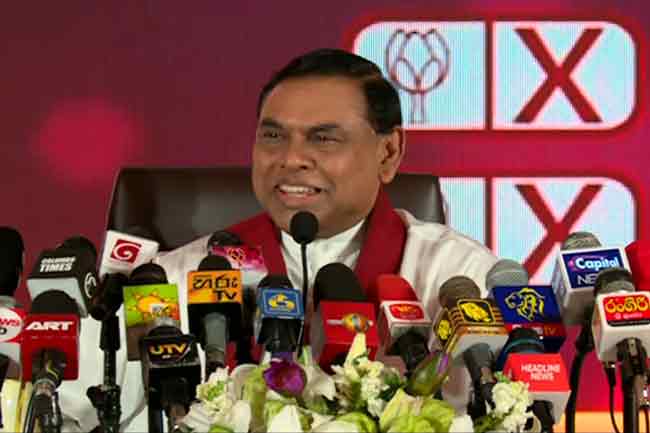
Basil Rajapaksa returns
However, the return of SLPP ideologue Basil Rajapaksa has an entirely different reason. He has told his backers that he is booked on Emirates flight EK 0650 departing Dubai at 2.40 a.m. and will arrive in Colombo at 8.25 a.m. on Sunday (today). SLPP General Secretary Sagara Kariyawasam confirmed to the Sunday Times “this was his (Basil Rajapaksa’s) itinerary and he had no plans to be in Colombo earlier.” Kariyawasam said his party was preparing for the local council elections. Ahead of his arrival, Basil Rajapaksa has been talking to his close supporters about launching a media campaign for the SLPP for the local council elections. This is both in the print and electronic media.
This is bound to give rise to friction. Prime Minister Dinesh Gunawardena has appointed Mahinda Deshapriya, a former chairman of the Election Commission, to head a Delimitation Commission. The other members, according to a Gazette extraordinary, are Jayalath R. V. Dissanayake, W.M.M.R. Adikari, K. Thavalingam and I.A. Hameed. Earlier, President Wickremesinghe also declared that he wanted to halve the membership of those in local councils from 8,000 to 4,000.
Last Tuesday, all opposition parties collectively met Election Commission Chairman Nimal G. Punchihewa. They requested that elections be held in such a way that these local councils could be established by March 20 next year. One of the prime movers in this regard is Sajith Premadasa, leader of the Samagi Jana Balavegaya (SJB). Punchihewa told the Sunday Times, “there is no obstacle to conducting the elections on schedule and we are going ahead with the necessary preparations. The local council elections should take place 65 days prior to March 19.”
He added: “There have been various public comments that the Delimitation Committee process can delay the election, and some ministers have been saying that the government lacks funds for the conduct of the elections. Some have been saying that the process of reducing the number of local council members would take time and therefore the election process could be delayed. Whatever the reasons given, the fact is that none of these processes does hinder the conduct of the elections. Even if the Cabinet gives us reasons it will not affect us.
“However, if Parliament passes a resolution citing reasons for a postponement such as the Delimitation Committee needing more time, lack of funds or requiring time for amendments, the Elections Commission will be compelled to accept that position. Therefore, as it stands now, we are making preparations for the conduct of the elections.”
There is also an element of uncertainty over Punchihewa’s office as Chairman of the Election Commission. In terms of the 21st amendment to the Constitution, heads of independent commissions (including the Election Commission) are to be named by the new Constitutional Council once it is fully constituted. In such an event, would a successor cause a delay in the local council polls remains a question.
Tuesday’s meeting with the Elections Commission chief was attended by Opposition Leader Sajith Premadasa, Prof G.L. Peiris (SLPP), Dayasiri Jayasekara (SLFP), Ranjith Madduma Bandara (SJB), Anura Priyadharshana Yapa (SLPP), Chandima Weerakkody (SLPP), Vasudeva Nanayakkara (Democratic Left Front), Ashoka Abeysinghe (SJB) and Dilan Perera (SLPP). Chandima Weerakkody who represented opposition parties handed over a document to the Elections Commission Chief calling him to conduct the local government elections on schedule. He said that as it appears there was no reason for the Government to postpone the local elections and the term of the councils had already been extended by year. He said that going by the meeting with the Elections Commission members they were expecting the Commission to announce the Local Government elections by mid-December.
Prime Minister Dinesh Gunawardena, however, told Parliament on Thursday, “Yesterday I responded to the statement made by Harsha de Silva. In our constitution, there is provision for the President to dissolve Parliament. As the Opposition Leader said there is provision to pass a resolution and dissolve parliament. But not as in the US constitution. That is very clear. This is what I told Dr. Harsha de Silva not to mislead the country and the house. Eran Wickremaratne too acknowledged it. You’ll say you want a parliamentary election to test the mandate of the people.
“Those are two different things. I replied to what Harsha de Silva mentioned on the interpretation of the constitution. I read the constitution repeatedly. I know that the leader of the opposition would have read the constitution but there is no provision as in the US constitution and the US electoral system for us to have midterm election so let us not get excited. We are standing for the sake of the country. There has to be unity and a working arrangement. We must stick to that.”
Opposition Leader Premadasa: Today the demand from the people is to give an opportunity to test the mandate of the people. The Prime Minister is speaking of the US Constitution, but they are not bankrupt. Your government has ruined the country. Under those circumstances, I am asking if you can give an assurance that you would not interfere in the process of having free elections in manner that the Local Councils could be established by March 20. Can you answer that?”
Prime Minister Gunawardena: See how the Opposition Leader changed the question within few minutes. He earlier said something else and when I answered Dr Harsha de Silva about the US Constitution, he now says something else. The Elections Commission is an independent body. It will act according to its mandate.
Basil Rajapaksa has told his backers in Colombo on the telephone that by contesting an election, he wants to demonstrate that the SLPP could be a political party that would be stronger than even the Janatha Vimukthi Peramuna (JVP). That is even if they are forced into the opposition ranks. However, how many within the current SLPP government could Basil Rajapaksa muster? It is no secret that the number of his supporters dwindled after the vote on the 21st Amendment to the constitution. They are now said to be below 25 parliamentarians and his first task, if he is to rebuild his party, would be to shore up the numbers. That appears no easy task. One of the reasons why they have split is over disapproval of his actions in the past. Already 14 MPs have left the party fold, eight to the government ranks and six to the opposition.
This week, a group of MPs who belonged to the SLPP peeled away from the party further when they chose to come under the umbrella of the Samagi Jana Sandhanaya (SJS). The group is led by Anura Priyadarshana Yapa, one-time Cabinet minister and senior member from the Kurunegala District. He told the Sunday Times, “We have been in the opposition for quite sometime now. Regrettably we get only five minutes to air our views in Parliament. We talked to the SJB for weeks and realised that there is a similarity in our policies on economic issues. Thus, we will function under the SJS umbrella. This does not mean we will join the SJB. We will continue to remain as an independent body.”
Yapa said, “We cannot allow our people to continue to suffer. This reality has now dawned on even other groups who are sitting as independents. There is an urgent need to improve the living conditions of the people. I must also make it clear that the SJB has not asked us to join it. Like some of the other parties, we are partners sharing the same ideals. There have been wrong reports about one of our members, Sudarshini Fernandopulle that she had joined the SJB. “
The once strong SLPP has splintered into different groups. Here is a lineup of the new sides they are on:
On the Government side: Nimal Siripala, Mahinda Amaraweera, Ranjith Siyambalapitiya, Jagath Pushpakumara, Lasantha Alagiyawanna, Shantha Bandara, Suren Raghavan and Chamara Sampath Dasanayake
Sitting in the Opposition benches: Maithripala Sirisena, Dayasiri Jayasekara, Angajan Ramanathan, Shan Wijayalal De Silva, Sarathi Dushmantha and Duminda Dissanayake from the Sri Lanka Freedom Party (SLFP).
SLPP (Dullas Group) that is functioning independently has 13 MPs. They identify themselves as the “Nidahasa Jathika Sabhawa.” The members are: Prof. G.L. Peiris (SLPP Chairman), Dullas Alahapperuma (SLPP Treasurer), Prof. Charitha Herath, Dilan Perera, Dr. Nalaka Godahewa, Prof. Channa Jayasumana, Dr. Upul Galappatti, Dr. Thilak Rajapaksha, Lalith Ellawala, K.P.S. Kumarasiri, Wasantha Yapa Bandara, Gunapala Rathnasekera and Udayana Kirindigoda.
SLPP (Wimal Group): 12 MPs sitting as an independent group with the opposition. Known as the “Uththara Lanka Sabhagaya (ULS)”. Members are: Wimal Weerawansa (Chairman), Ven. Athuraliye Rathana Thera, Vasudeva Nanayakkara, Udaya Gammanpila, Prof. Tissa Vitharana, Gevindu Kumaratunga, Jayantha Samaraweera, Mohamed Muzammil, Weerasumana Weerasinghe, Gamini Waleboda, Uddika Premaratne and Nimal Piyatissa.
Former members of this coalition, namely Tiran Alles, Asanka Nawarathna and A.L.M. Athaullah are now with the government.
SLPP (Anura Yapa Group): 06 MPs sitting as an independent group. Members –Anura Priyadarshana Yapa, John Seneviratne, Chandima Weerakkody, Dr. Sudarshani Fernadopulle, Jayarathna Herath and Priyankara Jayaratne.
The SJB’s Harin Fernando and Manusha Nanayakkara are in the Government as ministers.
SJB’s Diana Gamage and Aravindh Kumar are also supporting the government. They defected during the vote on the 20th Amendment in 2020.
SJB MPs Patali Champika Ranawaka and Kumara Welgama are functioning as Independents
The Uttara Lanka Sabhaghaya led by Wimal Weerawansa will hold its convention today at the Sugathadasa stadium. The new group is set to adopt twelve resolutions. They refer to the floating of the dollar negligently, the announcement that the country is bankrupt, large-scale corruption, government parties’ silence over the bad financial advice given by officials of the Presidential Secretariat, the Central Bank and the Treasury causing discontent among the people. This challenges the trust in the government as well as the existence of the government. Therefore, the twelve conditions imposed on the government not to allow the crisis to become a disaster will be taken up today.
Tomorrow, they will sit down to select candidates for the local council elections. “We are strongly in favour of the conduct of these elections,” Weerawansa told the Sunday Times.
Local council polls, unless they are thwarted by the ruling leaders for good reasons, will no doubt be the first test of strength for the SLPP government. However, the billion-dollar question is whether it would materialise.