China and Sri Lanka will mark two major diplomatic milestones in 2027, the 70th anniversary of diplomatic relations and the 75th anniversary of the historic Rubber-Rice Pact, with Beijing pledging to further strengthen its strategic partnership with Colombo.
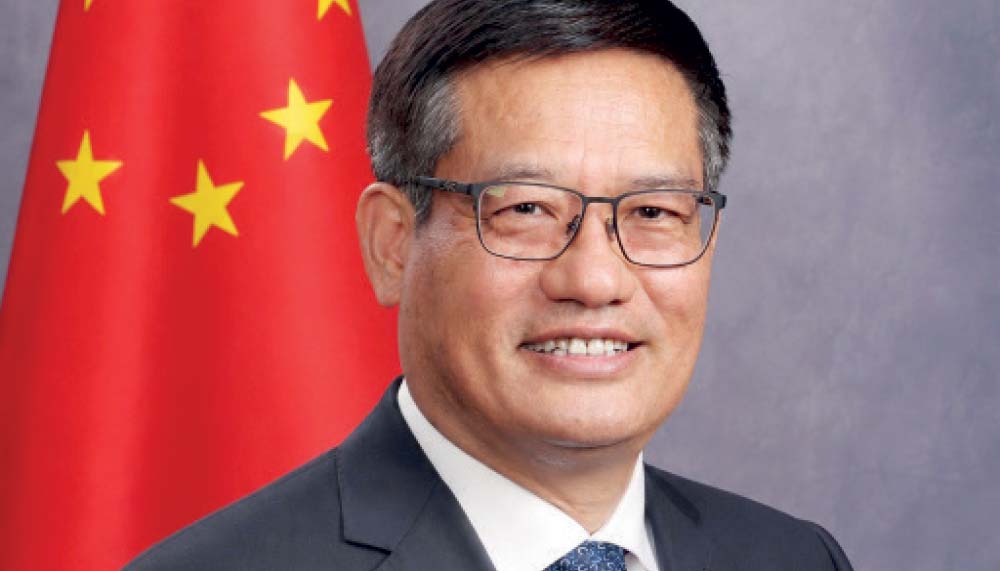
Chinese Ambassador to Sri Lanka Wei Huaxiang said China was ready to work with Sri Lanka to deepen cooperation, implement understandings reached by the leaders of the two countries and further advance what he described as a strategic cooperative partnership based on mutual assistance and longstanding friendship.
The Ambassador made the remarks at a reception held in Colombo on Wednesday (23) to celebrate the 77th anniversary of the founding of the People’s Republic of China.
Reflecting on economic ties, Ambassador Wei highlighted major China-backed projects in Sri Lanka, including Colombo Port City and Hambantota Port, saying cooperation between the two countries under the Belt and Road Initiative had produced tangible results.
He also highlighted China’s assistance to Sri Lanka in areas directly affecting the public, including the China-Sri Lanka Joint Research and Demonstration Centre for Water Technology.
According to the Ambassador, China has donated school uniform materials to Sri Lanka for four consecutive years, benefiting more than 4.4 million students across the country.
The Ambassador also announced that China’s intelligent meteorological early-warning solution, “Mazu”, will be deployed in Sri Lanka to support efforts to address climate change and strengthen disaster prevention and mitigation.
Speaking about the historical relationship between the two countries, Wei pointed to the Rubber-Rice Pact signed more than 70 years ago, describing it as an example of solidarity and mutual support between China and Sri Lanka during difficult periods.
He said China and Sri Lanka had continued to respect and support each other since establishing diplomatic relations, while cooperation under the Belt and Road Initiative and exchanges across various sectors had benefited both countries.
The Ambassador also recalled instances of assistance provided by both countries in recent years. He noted that the Sri Lankan Navy participated in the search and rescue operation for the Chinese fishing vessel Lupeng Yuanyu 028 in 2023, while Sri Lanka provided emergency medical treatment to a crew member of the Chinese research vessel Shiyan 6 in March this year.
He also referred to China’s emergency assistance to Sri Lanka during the COVID-19 pandemic and following Cyclone Ditwah as examples of cooperation between the two countries during challenging periods.
Wei said China was prepared to work with Sri Lanka to uphold multilateralism and international fairness and justice, while noting Sri Lanka’s role as an important founding member of the Non-Aligned Movement.
The Ambassador also spoke about China’s economy, saying the country had become the world’s largest manufacturing nation and second-largest economy, with GDP exceeding approximately US$20 trillion. He said China’s economy recorded 4.7% growth during the first half of 2026.
Full statement:
Remarks by Ambassador Wei Huaxiang at the Reception Celebrating the 77th Anniversary of the Founding of the People’s Republic of China
(23 September, Wednesday, 19:00, Grand Ballroom, Shangri-La Hotel)
Hon. Mr. Anura Karunathilaka,
Distinguished Ministers, Members of Parliament and Members of the diplomatic corps,
Distinguished guests, Ladies and Gentlemen, Friends,
Good evening! Ayubowan! Vanakkam! Assalamu alaykum!
It is a great pleasure to gather with all of you to celebrate the 77th anniversary of the founding of the People’s Republic of China. On behalf of the Chinese Embassy in Sri Lanka, I would like to extend warm welcome to all the distinguished guests, express heartfelt gratitude to friends from all sectors who have long been caring for and supporting China and China-Sri Lanka relations, and convey festive greetings to our compatriots both in China and Sri Lanka.
I am deeply honored to have been appointed by President Xi Jinping as the 23rd Ambassador of the People’s Republic of China to Sri Lanka. Since arriving in Sri Lanka, I have called on Sri Lankan leaders and Ministers, engaged candid and in-depth exchanges with leaders of political parties, travelled to local communities, and visited fields and rural areas to listen to the earnest expectations of people from all walks of life for China-Sri Lanka friendship and cooperation.
At the old book market in Colombo, I searched for old books and bought a copy of The Story of the Rubber-Rice Pact, published in 1953. I would like to thank my bookseller friend, whom I have invited to join us this evening. I also performed a song of friendship together with a street singer at the Galle fishing harbour. I have invited him here this evening as well.
In just over a month, I have had the opportunity to appreciate the picturesque scenery, splendid civilization and warm-hearted people of this ‘Pearl of the Indian Ocean’. I have also felt that China-Sri Lanka friendship has flourished, becoming ever stronger through trials and ever deeper with the passage of time. Looking ahead, the mission is glorious and the responsibility is great. I am ready to work with all friends to carry forward China-Sri Lanka friendship and make it flourish further.
Ladies and Gentlemen,
This year marks the 77th anniversary of the founding of the People’s Republic of China and the 105th anniversary of the founding of the Communist Party of China (CPC). Throughout its magnificent journey of struggle, the CPC has united and led the Chinese people in forging ahead with determination and perseverance, achieving remarkable accomplishments that have attracted worldwide attention. From rebuilding a country devastated by war and poverty to creating a landscape of renewal and vitality, China has undergone profound transformation. Today, the Chinese nation is engaged in the endeavors to build a great country and advance national rejuvenation on all fronts through Chinese modernization, while creating greater opportunities for the world through its own development.
A Prosperous China
Today, China has become the world’s largest manufacturing country and the world’s second-largest economy, with its GDP surpassing approximately US$20 trillion. This year marks the beginning of the 15th Five-Year Plan. In the first half of the year, China’s economy forged ahead, registering 4.7% growth, equivalent to approximately US$530 billion.
In the field of artificial intelligence, numerous innovations are competing to lead the way. The ‘Tau (τ) Scaling Law’, proposed by Huawei in May 2026 as a new guiding principle for the evolution of semiconductors and electronic systems, has emerged as a new breakthrough. China’s space program has achieved both sea-based and land-based rocket recovery, marking further progress in China’s space exploration. Innovative achievements are empowering development and benefiting the world.
China remains committed to the principle of ‘seeking shared interests with the world’. From the voyages of Zheng He across the seas more than 600 years ago to today’s Belt and Road Initiative connecting oceans and continents, and from the grand vision of strategic planning to meticulous implementation, China-Sri Lanka cooperation has yielded fruitful outcomes. Flagship projects such as Colombo Port City and Hambantota Port are thriving along the coast, while Chinese enterprises have risen to challenges and overcome difficulties, contributing to practical cooperation between our two countries.
A Democratic China
China has explored, established and continuously developed Whole-Process People’s Democracy. It ensures that the people run the country through comprehensive institutional procedures and extensive participation. It is democracy in its broadest, most genuine, and most effective form, vividly embodying the principle that ‘the people’s calls are heard and their needs are addressed’. Deputies to the National People’s Congress come from all ethnic groups and all walks of life. The voices of ordinary people from the streets and neighbourhoods can reach the highest levels of national governance.
Whole-Process People’s Democracy has infused Chinese governance with vigorous vitality and created a new form of political civilization for humanity.
The legislative bodies of China and Sri Lanka maintain close exchanges and are continuously strengthening mutual learning and cooperation in legislation, oversight, democracy and other areas through mutual visits by delegations, exchanges among parliamentarians and other forms.
A Civilized China
China carries forward a cultural heritage spanning 5,000 years and continues to write new chapters in the new era. Traditional Chinese aesthetics and culture have become the hottest trend, while Wukong and Nezha, two iconic figures from Chinese mythology, have gained enormous popularity around the world. The ‘China Travel’ boom is sweeping across the globe, and the phrase ‘becoming Chinese’ has become increasingly popular on social media.
Cultural exchanges are an important pillar of China-Sri Lanka relations. The stories of Master Faxian’s journey to seek scriptures and spread the Dharma, and Master Tissara’s eastward voyage to preach Buddhist teachings have become enduring chapters in our shared history. The millennial Buddhist bond between China and Sri Lanka is deeply rooted in the hearts of our peoples. Today, the China Cultural Centre and Confucius Institutes promote Chinese culture and tell the stories of China-Sri Lanka friendship. Cultural events such as the ‘Happy Chinese New Year’ performances, the ‘Chinese Bridge’ Chinese Proficiency Competition for Foreign Students, the ‘Tea for Harmony’ Yaji Salon and the Dragon Boat Culture Festival have been warmly embraced by the Sri Lankan people, greatly promoting mutual enrichment between our two civilizations and bringing our peoples closer together.
A Happy China
China demonstrates its deep commitment to putting the people first and ensuring that every family is cared for. China has established the world’s largest education system, social security system and healthcare system, supporting millions of families. China’s historic battle to eliminate absolute poverty has been etched in history. A moderately prosperous society in all respects has been built and shared by all, giving the people a strong and stable sense of happiness and making every household vibrant with warmth and vitality.
Putting people first is also the warmest underlying theme of China-Sri Lanka friendship. The China-Sri Lanka Joint Research and Demonstration Centre for Water Technology is enabling more Sri Lankan people to enjoy safe and clean drinking water. China has donated school uniform materials for four consecutive years, benefiting more than 4.4 million students across the island. Livelihood assistance has made China-Sri Lanka friendship visible, tangible and deeply felt by the people.
A Beautiful China
China is firmly committed to the principle that ‘lucid waters and lush mountains are invaluable assets’ and strives to achieve harmony between humanity and nature. China has built the world’s largest and fastest-growing renewable energy system, with total installed power generation capacity exceeding 4 billion kilowatts, ranking first in the world. Renewable energy accounts for 61 percent of total installed capacity.
Advanced technologies in solar power, wind power and energy storage are helping many countries turn their dreams of energy transition into reality. ‘Made in China’ is gaining popularity around the world. In the first half of this year, more than two million new energy vehicles were exported overseas, and electric vehicle brands such as BYD are gradually becoming part of the daily lives of ordinary Sri Lankans. China’s intelligent meteorological early-warning solution, ‘Mazu’, will be deployed in Sri Lanka, providing support for addressing climate change and enhancing disaster prevention and mitigation.
A Peaceful China
China shoulders its responsibilities with courage and follows the right path with steadfast commitment. President Xi Jinping has put forward the vision of building a community with a shared future for humanity and the four major initiatives—the Global Development Initiative, the Global Security Initiative, the Global Civilization Initiative, and the Global Governance Initiative, responding to the fundamental question of our times: ‘Where is humanity headed?’ Head-of-state diplomacy has been vibrant and fruitful. President Xi Jinping has travelled to Kyrgyzstan to attend the SCO Summit and to India to attend the BRICS Summit, is paying a state visit to the United States, and will also attend major events including the APEC Economic Leaders’ Meeting in Shenzhen, injecting valuable certainty into the world. In July 2026, the World Artificial Intelligence Cooperation Organization was established in Shanghai. China’s proposals are contributing wisdom and strength to international scientific and technological cooperation and global governance.
Sri Lanka is an important founding member of the Non-Aligned Movement. The Fifth Conference of Heads of State or Government of Non-Aligned Countries, held in Sri Lanka in 1976, was also a landmark moment in Sri Lanka’s diplomatic history. China stands ready to work with Sri Lanka to practise true multilateralism and uphold international fairness and justice.
Ladies and Gentlemen,
China and Sri Lanka enjoy a time-honored traditional friendship, which continues to grow stronger over time. Two thousand years ago, the ancient ‘Silk Road’ witnessed ships sailing to and fro, weaving a splendid chapter of friendly exchanges between our two countries. More than 70 years ago, China and Sri Lanka defied pressure and overcame obstacles to sign the historic Rubber-Rice Pact, which bears witness to our solidarity and mutual support in times of adversity. Multilateralism is a precious legacy gained by humanity through the painful lessons of two world wars. The spirit of the Rubber-Rice Pact is also a valuable historical legacy for China and Sri Lanka, enabling our two countries to resist external interference and extend sincere mutual assistance.
China and Sri Lanka have consistently respected each other, treated each other as equals and stood by each other since the establishment of diplomatic ties. High-quality Belt and Road cooperation and exchanges in various fields have yielded fruitful outcomes and benefited the peoples of both countries.
No matter how the international situation evolves, China and Sri Lanka always remain true friends and good partners, standing together through thick and thin and placing trust in each other. In 2023, the Sri Lankan Navy travelled thousands of miles to assist in the search and rescue operation for the deep-sea fishing vessel Lupeng Yuanyu 028, which was a fishing vessel from my hometown. In March this year, Sri Lanka provided emergency medical treatment to a crew member of the Chinese scientific research vessel Shiyan 6 who suddenly fell ill.
China provided emergency assistance to Sri Lanka during the COVID-19 pandemic and in the aftermath of Cyclone Ditwah. All these are vivid examples of our two countries standing together through difficult times. I would like to express my heartfelt gratitude to our Sri Lankan friends and hope to learn from you with sincerity.
Next year, we will celebrate the 70th anniversary of the establishment of diplomatic ties between China and Sri Lanka and the 75th anniversary of the signing of the Rubber-Rice Pact. In advancing China-Sri Lanka relations in the new era, we need to carry forward our traditions while breaking new ground, and uphold fundamental principles while making innovations. China stands ready to work with Sri Lanka to continue carrying forward the spirit of independence, self-reliance, solidarity and mutual assistance enshrined in the Rubber-Rice Pact, uphold the principles of ‘mutual respect, fairness and justice’, eliminate interference and meet challenges together, and implement the important common understandings reached by the leaders of our two countries with a pragmatic approach. Together, we will continue to advance our strategic cooperative partnership featuring sincere mutual assistance and everlasting friendship and build a China-Sri Lanka community with a shared future.
77 years of glorious endeavour have brought us this far. Let us continue the journey and write new chapters together.
I would like to propose a toast:
To the prosperity and strength of our great motherland,
To the lasting friendship between the peoples of China and Sri Lanka,
To the enduring peace and tranquility of the world,
And to the good health and happiness of all our distinguished guests and your families.
Cheers!