Sri Lanka likely to receive Pakistan’s US$200mn credit line after top level visit

Sri Lanka is likely to receive a 200 million US dollar credit line from Pakistan for essential food, rice, and cement, sources who are aware of the deal said as the island nation is grappling with a severe foreign exchange crisis.

“It is likely to be signed when a Sri Lankan leader visits Pakistan possibly before the end of this year,” a source who is aware of the progress of the deal told EconomyNext.

Sri Lanka has already borrowed 1.5 billion US dollars from People’s Bank of China, 400 million US dollars from Reserve Bank of India (RBI), and 250 million US dollars from Bangladesh Central Bank via swap arrangements to boost its reserves and avoid a possible sovereign debt default.

Pakistan’s credit line talks come as Sri Lanka’s rice crop may fall 30 percent or more after an overnight ban on fertilizer to save foreign exchange and stop agro-chemical use.

A source from Pakistan who is aware of the ongoing discussion over the credit line said the original request, which came in September last year, was only focusing on a credit line for rice and cement.

However, when Sri Lanka’s Trade Minister Bandula Gunawardena visited Islamabad in January, Pakistan was asked to extend the deal also for essential commodities as well.

“In principle, the Pakistan Prime Minister has approved this and it is in process,” he said.

“The deal will be signed when a Sri Lankan leader visits Pakistan.”

Sri Lanka is trying to finance imports of essential commodities including food and medicines through credit lines for this year amid forex shortages as it is facing risk of sovereign debt default.

Sri Lanka has a habit of going for credit lines every time money printing trigger forex shortages. Credit lines allows imports and consumption to take place on credit or a financial account inflow. Central bankers and other policy makers then complain that the external current account has widened.

The island nation has already signed a 500 million credit line with India to buy fuel from India and Sri Lanka expects to start using this credit line from the first week of April.

India also has agreed for a 1 billion US dollar credit line for Sri Lanka to buy foods and medicines.

Sri Lanka also has been in discussion with Australia for another 200 million credit line to buy lentils and essential foods, local media has reported.

Sri Lanka briefs Delhi based diplomatic corps on human rights issue

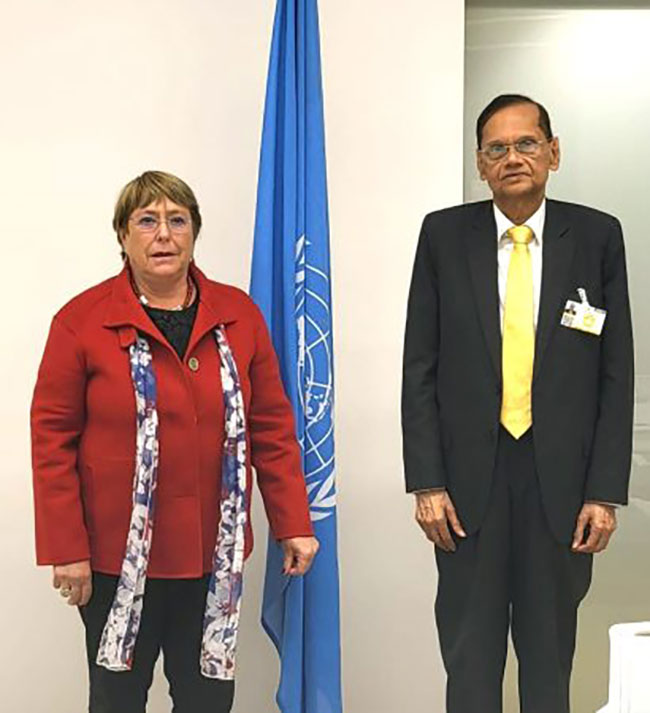
Sri Lanka has briefed the diplomatic corps based in New Delhi on the human rights and reconciliation issue.

Foreign Minister Professor G.L. Peiris addressed the diplomatic corps based in New Delhi virtually. The objective of the briefing was to share information on progress related to human rights and reconciliation as part of the continued engagement ahead of the upcoming 49th Session of the Human Rights Council, which will commence in the last week of February.

Foreign Minister Peiris appreciated the opportunity to brief Heads of Mission accredited to Sri Lanka based in New Delhi as a continuation of the briefings organized by the Ministry to share current developments. 83 envoys participated in the briefing.

The Minister recalled that at the September 2021 Session of the Human Rights Council he had reiterated Sri Lanka’s commitment to the promotion and protection of Human Rights and to remain engaged with the United Nations including the Human Rights Council. In this context, the Minister referred to the constructive engagement with the international community in a spirit of cooperation and dialogue.

Foreign Minister Peiris said the Government of Sri Lanka has undertaken substantial steps with a view to accountability, restorative justice and meaningful reconciliation which were efforts due to the work of domestic institutions namely the Office for Reparations (OR), Office for National Unity and Reconciliation (ONUR), Office of Missing Persons (OMP), the Human Rights Commission of Sri Lanka (HRCSL) and the Sustainable Development Council (SDC).

The Minister was particularly pleased to inform that after 43 years, the Prevention of Terrorism Act is being amended with the objective of bringing it in line with international norms and best practices. The Minister explained that the PTA is being amended after lengthy deliberations over several months and underlined that the proposed amendments are an initial step towards the promulgation of a more comprehensive anti terror legislation.

He added that substantive amendments to the PTA include amendments to the sections on detention orders, restriction orders, expressly recognizing judicial review of orders, expeditious disposal of cases of those charged to avoid long term detention, repealing sections impinging on freedom of expression and introduction of provisions on access by magistrates and judicial medical officers, prevention of maltreatment and torture during the detention period, right to communicate with the family, grant of bail to long term detainees and day to day hearing of cases.

Foreign Minister Peiris also referred to the accountability process which is being addressed through the Commission of Inquiry (COI) headed by Supreme Court Justice Nawaz and informed that while the recommendations in the First Interim Report had been implemented that the Second Interim Report had also been handed over to the President.

The Foreign Minister also referred to the 9 member Expert Committee appointed by the President to make proposals pertaining to drafting a new Constitution. The Minister stated that the Expert Committee has completed their preliminary consultations and that the proposals will be submitted to the President shortly. He said that thereafter broader public consultations based on a democratic process will follow.

The Foreign Minister responded to questions and appreciated the constructive engagement with the New Delhi based envoys and looked forward to continued cooperation at the UN Human Rights Council and other multilateral fora.

Basil Rajapaksa wants local govt polls, Ministers shoot it down amidst crisis

Finance Minister Basil Rajapaksa who has strengthened his power in the present government since taking over his new portfolio has called for local government elections to be held first so that the SLPP could strengthen itself at grassroot level, but his request had been shot down by other senior ministers who said the government is not ready for an election amidst burning issues.

The Daily Mirror learns that amidst talks that a parliamentary election may be held at the end of this year or next year, Basil had said that it was the local government elections that should be held first as this would strengthen the SLPP’S base.

For similar articles, join our Telegram channel for the latest updates. – click here

However senior SLPP ministers who have acknowledged that the country is in turmoil with the forex crisis, high cost of living and the fuel issue say the country is not ready to face any election and this might end by the SLPP weakening itself further.

In fact even the opposition parties including a majority in the SJB have voiced concerns within the parties that they were not ready for an election anytime soon due to uncertainties and splits within political parties, the Daily Mirror learns.

Prime Minister Mahinda Rajapaksa attending the recently held SLPP convention had challenged the opposition to an election to which some

SJB members had vaguely accepted, but senior political sources in the government and opposition said these were mere words and political threats as neither parties were ready for an election anytime soon with some ruling out any election to be held this year.

“If at all the local government elections maybe held next year as this year it seems impossible. The people also need to be ready to vote,” senior political sources said.

In fact the struggles of the parties are widening with new alliances forming from next month within the opposition and government signaling that all major political parties including SLPP, SLFP and SJB were struggling to remain intact.

Posted in Uncategorized

Assaults on journalists have a fairly long history in Sri Lanka

By Sugeeswara Senadhira
Last week a cowardly attack on a leading media personality took place shocking all who believe in freedom of expression, media rights and democracy. The residence of Chamuditha Samarawickrema came under a foul attack by at least three persons who reportedly came in a white car.

Chamuditha told the media that he was unable to name any party as there were scores of persons angered by his reports for Hiru television as well as the popular social media platform ‘Truth with Chamuditha.’

He added that the status of the police investigation into an earlier death threat received by him remained unclear.

“Although, the Police recorded my statement, I really do not know the outcome of the investigation.” Displaying a desire to bring the culprits to book, the Hiru TV offered a reward of Rs. 500,000 to anyone providing information leading to the arrest of those responsible for the attack.

Attempts to control the press in Sri Lanka are not new. During the colonial era, in 1857, prohibitions on publications were enacted in India and Ceylon in the wake of the mutiny of Indian soldiers in the British Indian Army. In the recent past horrendous attacks on media personalities took place during insurgencies spearheaded by the Janatha Vimukthi Peramuna (JVP) and the Tamil Tigers (LTTE).

Disloyalty results in death

The LTTE leadership ordered the assassination of any media persons who exposed the cruelties of the organization and their young cadres carried out the orders. The Human Rights Watch, in its publication, ‘A Culture of Fear: LTTE Intimidation, Threats and Violence’, stated that since the beginning of the ceasefire in 2002, over 200 people, mostly Tamil, have been killed apparently for political reasons, mainly at the hands of the LTTE. Those killed included teachers, journalists, individuals linked with opposition parties, and others perceived as critical of the LTTE. Some apparently have been killed solely for working in educational, social or religious program funded by the Sri Lanka government. For many Tamils in the West with family members remaining in Sri Lanka, the message was that any act of disloyalty may result in death.

Among the media persons killed by the Tigers are Chelvy Thiyagarajah, founder of a feminist journal called Tholi. She had won the prestigious International PEN award in 1992; Balanadaraja Iyer, Sri Lankan Tamil activist, writer and poet; Kethesh Loganathan, former Editorial Consultant of the Weekend Express, Tamil political activist, Human Rights advocate and Deputy Secretary General of the Secretariat for Coordinating the Peace Process (SCOPP); Rajani Thiranagama, University Lecturer, Author, Tamil human rights activist and feminist and Relangi Selvarajah, Tamil broadcaster and actress.

The JVP too was also responsible for many killings of media personnel. Top media personnel killed by the JVP include Thevis Guruge, Chairman of Sri Lanka Broadcasting Corporation (SLBC); Premakeerthi de Alwis, lyricist and radio and television announcer at SLBC; Kulasiri Amaratunge, News Editor of Sri Lanka Rupavahini Corporation (SLRC); Sagarika Gomes, announcer at SLRC and Jinasena Kasthriarachchi, newspaper correspondent.

The 1989-1991 period saw a rise in the killing of media personnel. While the above assassinations were conducted by armed insurgents, there were several murders for which State agencies or politicians were blamed. The most prominent of one, which came under international limelight was the murder of Richard de Zoysa, journalist, actor, television personality and correspondent for Inter Press Service.

On 18 February 1990 Richard de Zoysa was abducted and murdered by an armed gang, believed to be a State sponsored death squad. He was 32 at the time of his death. Richard was posthumously awarded the 1990 IPS International Achievement Award and the IPS Award for Excellence in Independent Journalism was renamed in his honour.

Media intimidation

Richard’s gruesome killing spurred his mother, Dr. Manorani Saravanamuttu, to launch a campaign for justice for the ‘disappeared’ on behalf of the mothers who had lost their sons, wives who had lost their husbands and sisters who had lost their brothers. Dr. Saravanamuttu’s relentless campaign attracted international attention towards the plight of victims who disappeared without a trace during the 1988-90 terror period. In 1996, she was awarded the ‘Weera Mathru’ title.

The intimidation of media persons continued and some of them had to keep changing their residences for safety. Jiffry Yoonus, popular cartoonist of the Communist Party newspaper, ‘Aththa’ edited by the firebrand B.A. Siriwardena was attacked in 1992. His popular cartoons usually triggered controversy among politicians of the day. But despite harassment and intimidation, he continued his work undeterred for over 50 years. Yoonus described the most harrowing experience faced by him in an interview to ‘Illustrating Asia’ a book edited by American author John Lent in 2001.

“One day in August 1992, three vehicles with about 20 thugs came to my house. A minister’s bodyguard shoved a pistol into my mouth, broke a tooth, and then pointed the gun at my head. He threatened to kill me in front of my wife if I did more cartoons against His Excellency (President Ranasinghe Premadasa). The next day they returned, smashed up my furniture and stabbed me. At the hospital, doctors put 16 stitches to treat the wounds,” Yoonus said.

After this incident, Yoonus vacated his house for safety and lived in a small room in the ‘Aththa’ office building on Cotta Road, Borella.

Last week’s attack on Chamuditha’s residence was condemned by Media Minister Dullas Alahapperuma. “This incident only reveals the pathetic nature of a pathetic faction in society. We condemn this attack as it was an assault on the media as well. The government is committed to exposing the criminals who launched this heinous attack who may now be in hiding. As a responsible politician, I am of the view that the four thugs involved in the attack on Chamuditha’s house must be exposed before long,” he stressed.

Alahapperuma, who has always been a stout defender of media freedom, has assured a transparent investigation and said: “It is my responsibility as the Mass Media Minister to create an environment of media freedom.”

Those who believe in democratic values await a fair and transparent probe as promised.

Posted in Uncategorized

Scotland training to continue with Sri Lankan instructors

The Police Scotland officials who had come to Sri Lanka to train Police officers have left in the wake of the Covid-19 pandemic, but the relevant modules will be covered by local instructors, according to the Police Media Unit.

The Sri Lanka Police recently stated that bilateral discussions were ongoing to resume training which had been temporarily halted due to the Covid-19 pandemic.

Accordingly, when contacted by The Morning yesterday to inquire into the progress of the rPoliceelevant training programmes, an official of the Police Media Unit said that the Police Scotland officials who had come to train local Police officers have left the country due to the Covid-19 pandemic.

“The Police Scotland officials have left Sri Lanka. However, the relevant training modules are being covered at Police training schools by local instructors,” he added.

Despite the Chief Constable of Police Scotland being quoted in the Scottish media stating that Police Scotland has stopped training officers of the Sri Lanka Police over human rights-related concerns, the Sri Lanka Police has denied this, stating that bilateral discussions are ongoing to resume training which had been temporarily halted due to the prevalent Covid-19 pandemic situation.

According to Scotland’s The Sunday Post, the demand for a Parliamentary inquiry into the services and international clients of Police Scotland came after Police Scotland Chief Constable Iain Livingstone confirmed that a controversial Sri Lankan training contract would end. The announcement had come after concerns of a leading human rights lawyer, a United Nations (UN) rapporteur, and the testimony of torture victims who had allegedly been raped, beaten, and asphyxiated by the Sri Lankan Police and security forces.

They accused Police Scotland of being naïve in continuing to train Sri Lankan officers despite damning UN reports into human rights abuses in the country. Campaigners claimed that the national force was giving credibility to an administration linked to violence, torture, and disappearances.

However, when contacted at that time, Police Media Spokesman and Senior Superintendent of Police Nihal Thalduwa claimed that the reports that the training given by the Scottish Police to the Sri Lankan Police officers had been stopped were untrue.

“Certain reports that the Scottish Police has halted training programmes for the Sri Lanka Police Department officers are erroneous. We have not been notified of such by the Scottish authorities,” he added.

Thalduwa said that even though such a halt has not taken place due to concerns over the human rights record, the Covid-19 pandemic has resulted in a halt of not only the Scottish training, but many other training programmes. He added that due to the Covid-19 pandemic situation, Sri Lankan Police officers have not left for Scotland since 2020.

Posted in Uncategorized

Mano Ganesan to take Indian Tamils’ issues to Modi

Finalising a document with the political aspirations of Tamils of Indian origin in Sri Lanka, Tamil Progressive Alliance (TPA) Leader and Samagi Jana Balawegeya (SJB) Opposition Parliamentarian Mano Ganesan said that the said document will be first handed over to President Gotabaya Rajapaksa and then sent to Indian Prime Minister Narendra Modi.

“Towards mainstreaming as full citizens in the Sri Lankan polity, the TPA and civil activists have finalised a document with the political aspirations of the Tamil people of Indian origin in Sri Lanka (Malayaha Thamils). The document would be submitted to all stakeholders,” Ganesan said in a Tweet yesterday.

In a statement to the media, Ganesan said: “The political, cultural, economic, and social spheres of our people should be brought into the Sri Lankan political and administrative structure. There are areas where large gaps remain where our people are sidelined, discriminated against, ignored, and disregarded in the national mainstream. This regretful reality should change. We will work with all parties including the Government to achieve our community’s Sri Lankan goal.”

Adding that the document compiles grievances and remedy-related appeals, Ganesan said that it will be submitted to all stakeholders, beginning with President Gotabaya Rajapaksa.

“Thereafter, we will submit it to Modi, as India is the signatory to the first three pacts entered into between the Leaders of Sri Lanka and India in 1954, 1964, and1974, which decided our lives. Further, we will take it up with the Government of the UK, which we believe has a large share in the set of obligations towards Indian-origin Tamil Sri Lankans.”

Furthermore, he said that the TPA will conduct talks with Opposition and Samagi Jana Balawegaya (SJB) Leader Sajith Premadasa, and plans to visit Tamil Nadu to meet its Chief Minister (CM) M.K. Stalin and other political parties.

Meanwhile, seven other Tamil political parties, led by the TNA wrote to Modi last month, requesting him to urge the Government of Sri Lanka to fully implement the 13th Amendment to the Constitution. The TNA further wrote to Stalin last week, where they requested direct engagement with Tamil Nadu in order to ensure that a new constitution in Sri Lanka would not affect the goal of the devolution of power to the Northern and Eastern Provinces.

Posted in Uncategorized

Sri Lanka reports 31 Covid-19 deaths on Tuesday, toll rises to 16,055

Sri Lanka Tuesday reported another 31 deaths due to COVID-19 after the figures were confirmed by the Director General of Health Services on Monday, February 21.

Among the deaths reported today, 19 are of males and 12 of females.

While 24 deaths are of elderly people in the 60 years and above age group, five people in the 30-59 years age group and two people below 30 years of age have also succumbed to the disease.

According to the data reported by the Epidemiology Unit, the total deaths due to Covid-19 since the pandemic began has now risen to 16,055.

Posted in Uncategorized

Security, defense cooperation key component of Pakistan-Sri Lanka relations: PM Imran Khan

Vice Admiral Nishantha Ulugetenne, Commander of the Sri Lanka Navy, called on Pakistani Prime Minister Imran Khan on Tuesday (22).

The prime minister stated that Pakistan attaches immense importance to its relations with Sri Lanka as a reliable friend and partner.

Fondly recalling his visit to Sri Lanka in February 2021, the prime minister reaffirmed the strong fraternal bonds between the two countries and Pakistan’s desire to comprehensively upgrade bilateral relations in all fields.

Imran Khan added that security and defense cooperation had been a key component of Pakistan-Sri Lanka relations and a factor of peace and stability in the region.

He said that he looked forward to the visit of Sri Lankan leadership to Pakistan.

Vice Admiral Nishantha Ulugetenne underlined the close cooperative ties between the two countries and expressed gratitude for Pakistan’s support at international and regional fora. He reaffirmed the commitment to work together for the promotion of shared goals.

Posted in Uncategorized

The 13th Amendment and the Tamil Polity – A pragmatic approach-Dr Nirmala Chandrahasan

There is much speculation in the Tamil political circles as to the usefulness or otherwise of the 13th Amendment to the Constitution and whether the Provincial Council system set up under its aegis gives a measure of power sharing or devolution of powers to the Tamil speaking provinces, or whether it is an ineffective institution which blocks out any greater devolution under the exercise of internal self- determination. This debate has been sparked by the decision of Tamil speaking parties including the TNA, to send a letter to the Prime minister of India Shri Narendra Mody, requesting him to use his good offices to induce the Government of Sri Lanka to implement the 13th Amendment fully, in the context that the 13th Amendment arose out of the provisions of the Indo -Sri Lanka Peace Accord of July 1987, to which treaty India and Sir Lanka are signatories. The letter was duly signed by six Tamil party leaders and handed over to the Indian high Commissioner, triggering some protests by those opposing the 13th Amendment. This debate takes on even greater urgency in the context of the impending new constitutional proposals of the Experts Committee appointed by the Gotabaya Government to be tabled in Parliament shortly.

In order to determine which is the better view we have to take a look at the provisions of the 13th Amendment and the workings of the Provincial Councils set up under them, which have been in operation from 1988 onwards in most parts of the Country. Although the PCs as originally envisaged were intended to be set up for the amalgamated Northern and Eastern provinces, to give expression to the long standing demand of the Tamil speaking people since independence, for devolution and power sharing within a Federal framework, it was extended to the Sinhala majority provinces as well although there had been no demand for them in these provinces.

The first Provincial Council elections were held in April 1988 for the North Central, North Western, Sabragamuva and Uva provinces, and subsequently for the other provinces. In September 1988 the Northern and Eastern provinces were made one administrative unit in accordance with the provisions of the Indo -Sri Lanka Treaty, and in November 1988 elections were held for the North East Provincial Council. In 1990 the PC was dissolved. Thereafter the North East Province was directly administered by the Central government. During the civil war it was not possible to hold PC elections In the northern and eastern parts of the Country. In 2006 pursuant to a Court decision the two provinces were separated.

It was only in May 2008 that the Eastern province, Provincial Council election was held. Subsequently after the termination of the war in the north, the Northern province, Provincial Council election was held on 21st September 2013. We can see that this institution has been operating over a long period of time but during this long period certain sections of the 13th Amendment dealing with the powers conferred on the Provincial Councils, set out in the 3 Appendixes to the 9th Schedule of List 1 Provincial Council List, are yet to be activated and are in abeyance. These Appendixes deal with the following subjects; Appendix 1, law and order which has to do mainly with Police powers and institution of a Provincial Division of the Police Force alongside the National Division of the Force. Appendix 11 Land and land settlement, and Appendix 111 Education.

Apart from the above, the Provincial Council exercises powers in respect of the subjects assigned to it, over which it has both legislative and executive powers. The subjects assigned to the Province and set out in the provincial List, List 1 include interalia Provincial housing and construction, Agriculture and Agrarian services ,Rural development ,health, land, Irrigation, Roads bridges and ferries within the Province, Planning,and Plan implementation of Provincial economic plans ,Educational services, and supervision and administration of Local Government Authorities. The List even includes Ancient and historical monuments other than those declared to be of national importance. I mention this in the context of the Archaeological explorations being made in the northern and eastern provinces by the recently appointed task force on Archeology without any representation from the Tamil and Muslim communities.

There is also a concurrent List , List 111, over which both the Provincial Council and the Centre can exercise powers, these include planning and appraisal of plan implementation strategies at the provincial level, education and educational services, higher education, agriculture and agrarian services, health, irrigation, Tourism etc. In these areas there can be overlapping powers and hence disputes. The Provincial Council can pass statutes and exercise executive powers in respect of the subjects set out in the Provincial and Concurrent Lists. These powers are largely based on the powers conferred on the States in the Indian Constitution part VI. The States in India are running efficiently and providing the people with the services that they need.

Tamil Nadu for example is recognized as having a very efficient administration presently under the Chief -Minister M.K Stalin. The question has to be posed as to why the Provincial Council system in Sri Lanka is generally regarded as a white elephant and as not effective in providing services to the people. For this we must examine the road blocks in the system and make the necessary adjustments, rather than just dismantling the entire system, and throwing the baby away with the bath water so to speak.

An appraisal of the workings show that most of the stumbling blocks to the smooth functioning of the Provincial Councils are as a result of the provisions of the Provincial Councils Act no 42 of 1987, which was passed alongside the 13th Amendment. Under this Act the Governor is given powers over the finances of the PCs and is given control of the Provincial Public service as well as the Provincial Public Service commission. The 13th Amendment provides that the executive power of the Provincial Council is vested in the Governor and he acts through the Board of ministers or through members of the provincial public service. The Chief Minister and the Board of Ministers aid and advise the Governor in the exercise of his functions and the Governor Shall act in accordance with the advice except where he is required under the Constitution to exercise his discretion.

In the Indian Constitution similarly in respect of the States ,the executive power is vested in the Governor but as in the Westminster scheme of governance the Governor acts on the advice of the Chief Ministers and is a nominal head .On the other hand in Sri Lanka we find many instances of Governors exercising these powers like executive heads and not as nominal heads, particularly in the Tamil majority provinces and not so much in the Sinhalese majority provinces.

The Governors stranglehold over the functioning of the PCs is most clearly demonstrated in his power over the finances of the province. To run the PCs money is required and this is where the Councils have been most hamstrung as the Provincial Councils Act gives the Governor controlling power over the finances of the Province. The custody of the Provincial Fund is with the Governor. The PC cannot pass any statute imposing or abolishing taxes without the consent of the Governor. More over the constitutional framework severely limits the revenue raising capacity of the PCS, as pointed out in the Report of the Parliamentary subcommittee on Centre- Periphery relations of November 2016. Hence the PCs have to depend largely on Central grants for their funds.

Another area which needs to be redesigned is the Administrative system. To run the Provincial Councils effectively the Council requires control not only over its funds but also an effective administrative system and defined areas of competence. At present the District Secretary and the Divisional Secretary as well as the Grama Niladaris come under the Central Government These officers perform administrative functions within the territory of the province but without any control from the provincial administration. Also although the Local Authorities are under the supervisory control of the Provincial Councils as per the devolved List, most of the power at the local level remains with the Central Government.

For efficient administration of the province there has to be defined areas of competence. But in effect the Centre has been encroaching on the areas assigned to the provincial administration. The reserved List of the Centre List 11, starts with the Rubric” National policy on all subjects”. This has enabled the Centre to take over subjects which it designates as National. To remedy this, what is National policy or National standards should be laid down through a participatory process with the involvement of the Provinces culminating in framework legislation passed by Parliament to which both Centre and Provinces should adhere. This has been proposed in the Report of the Experts Committee on the Constitution,2006. Another matter which has to be amended is the Concurrent list. Here too it has been recommended that the List be eliminated and the relevant subjects be divided between the Centre and the Province, so that they each have defined areas.

In an article of this nature it is not possible to do a more in depth study but I have outlined what are the important issues to be addressed if the Provincial Councils are to provide meaningful Devolution. Some of the areas which need amendment are as follows. The Governors role has so far tended to be an obstruction to the functioning of the PCs. The Governor should continue as a nominal head and leave the running of PC to the elected representatives. This is also a recommendation of the Parliamentary subcommittee in its 2016 report.

Hence the Governor’s powers have to be pruned and the Provincial Councils Act suitably amended. The revenue raising capacity of the PCs must be enhanced . It is suggested that they be given the power to obtain loans from foreign sources or at least have the power to administer projects financed by foreign aid. Another important issue is to put in place an administrative structure that can carry out the functions of the Provincial Council in services delivery to the people and for this the administration has to be redesigned so as to bring the District Secretary , the Divisional Secretary and the Grama Niladaris, under the Provincial administration while they still carry out agency services for the Centre. Furthermore although local Authorities are under the Authority of the PC, as per the devolved List, this provision is being undermined by the Centre using the Urban Development Authority (UDA), Mahaweli Authority and other Central bodies operating within the Province. Hence it must be mandated that such bodies operate within the Province only with the consent and in conjunction with the Provincial and Local Government Authorities. As for the powers in respect of Law and Order and Police powers contained in Appendix 1 of List 1 the 9th schedule , they could be transferred to those PCs which request them as for example in the case of the Northern Ireland Assembly in the UK , where these powers were initially with the Centre, but there was a provision that allowed them to be released on request. In 2010 they were transferred to the Assembly under the Hillsborough Agreement. Until such time as Appendix 1, comes to be activated other provisions can be put in place, such as a policy of recruiting a percentage of the Police cadre stationed in the northern and eastern provinces from these provinces and mandate that they have an O level pass in the Tamil language so that they could operate efficiently in the Tamil speaking areas. I would suggest some similar provision in respect of some areas in the Central provinces so that the upcountry Malayaha Tamils, are also benefited. It is submitted that the Appendix 11 on land be fully implemented as it is essential for the land security of these provinces that the utilization of state land as well as alienation of such land under Presidential order be done in consultation with, or advise of the Provincial Council . The provision in Appendix 11 on the constitution of a National Land Commission with members being appointed from all 3 communities should be carried out forthwith.

I would suggest that the Tamil parties take up the proposed reforms with the Government of Sri Lanka in a negotiated process. As the Government of India was the other party to the Indo Sri Lanka Treaty, India can legitimately demand that the obligations undertaken in the treaty be carried out and the provisions of 13 A be implemented fully so that meaningful devolution is assured to the Tamil speaking people whom the Treaty specifically denotes as the historical inhabitants of the northern and eastern provinces of Sri Lanka. In line with the UNHCR resolution the Sri Lankan Government should also hold the Provincial Council elections so that these institutions can be functioning and not in abeyance as they have been for some years. The Provincial Councils in the South will also benefit from the reforms proposed as it will provide the citizens of the entire Country a stream lined system which is a service provider to the people. I note that the President in his Budget speech has advised the Tamil parties to look to their peoples’ needs and concentrate on economic development of their areas. This can best be done when there is true democracy and the people are taken into the process of consultation as to the strategies for economic development and this is best done at the local level through the Provincial Councils, and local Government Authorities, rather than through bureaucrats sitting in Colombo who have no knowledge of the local conditions or the needs of the people. In my view the Province remains the best unit of devolution at present to serve the needs of the Tamil speaking people. It gives them some measure of autonomy in their traditional areas of inhabitancy. Similarly in the United kingdom which is a Unitary State, Scotland, Wales and Northern Ireland which are ethnically distinct have their own Legislative Assemblies, in the case of Scotland it is called a Parliament, and exercise similar powers to those set out in the 13th Amendment.

I would like to point out that all the major changes suggested in this article respecting the Governors powers, Financing of the Provincial Councils and the Re-designing of the Administrative system in the Provinces have been recommended in the following Reports: Report of the Experts Committee advising the APRC on Constitutional matters and resolution of the National Question 2006, the Report of the APRC( All party Representative Committee) on a new Home grown Constitution 2010, Report of the Parliamentary sub- committee on Centre -Periphery relations 2016 , presented to the Steering Committee of the Constitutional Assembly which was engaged in producing a new Constitution during the tenure of the previous government. In the circumstances the proposed new Constitution could incorporate these features and there is no need to reinvent the wheel. I would submit that the Provincial Council system can be an efficient and successful system if all the short comings referred to above are eliminated and the necessary amendments made. These changes will not require any major constitutional procedures, and can be accomplished by legislation in Parliament with a simple majority ,and the administrative changes by Presidential gazette notification under the provisions of the 13th Amendment itself.

*The writer was a member of the Experts Committee 2006, and a signatory to the Majority Report of this Committee.

Indian AC rail coach has a successful trial run in Sri Lanka

Officials from the High Commission of India accompanied by representatives from the Indian railway organization RITES and the Sri Lanka Railways travelled aboard an air-conditioned train [AC Diesel Multiple Unit (DMU)] on its successful trial run in Sri Lanka on 18 February 2022.

This AC DMU had been supplied under a US$ 318 million Line of Credit (LoC) from India. The first AC DMU supplied under this LoC was put into operation on 09 January 2022.

The US$ 318 million LoC was finalized in 2014-15 for the supply of railway rolling stock to Sri Lanka, upgrading railway tracks and other mutually agreed projects in accordance with the request and requirements of the Government of Sri Lanka.

Since then, high-quality railway coaches and AC DMUs supplied from India have helped strengthen the railway infrastructure as well as travel experience in Sri Lanka. Various other projects under this LoC including the upgrading of railway tracks are at different stages of implementation.

Lines of Credit from India have contributed to the upgrading of the railway line from Colombo to Matara, track laying on sectors such as Omanthai-Pallai; Madhu Church-Tallaimannar; Medawachchiya-Madhu; and Pallai-Kankesanthurai, installing signalling systems, and supply of rolling stock to Sri Lanka railways.

India looks forward to continue mutually beneficial cooperation in the transport sector, including in railways where India’s world-class capabilities and assistance have contributed significantly to the development of railway infrastructure and facilities, job creation, economic growth, enhanced connectivity and passenger comfort and safety in Sri Lanka.