New COVID-19 guidelines: gyms, spas closed; public events banned

Sri Lanka has imposed new restrictions and guidelines as measures to prevent the spread of the COVID-19 virus within the country.

The measures include closing gyms, spas, children’s parks, swimming pools, and indoor sports halls with immediate effect.

In addition to this, musical events, beach parties, and carnivals have also been banned.

These new restrictions and guidelines will come into effect immediately and last until August 31.

According to the revised guidelines, the shopping malls will remain closed while only one person per household is permitted to go outside unless engaged in essential services.

The public transport is only allowed to transport seated passengers of the bus/train within the provincial limits.

Private sector offices can be operated with a minimum number of staff required while heads can summon employees outside the province.

Besides, the schools, preschools, universities, tuition classes will remain closed while weddings are also not allowed.

Spas are not permitted while children’s parks, carnivals, musical shows and beach parties are also not allowed under the revised guidelines.

However, restaurants can be operated with 50 percent of seating capacity while hotels, rest houses and guest houses are allowed to operate with 25 percent of capacity.

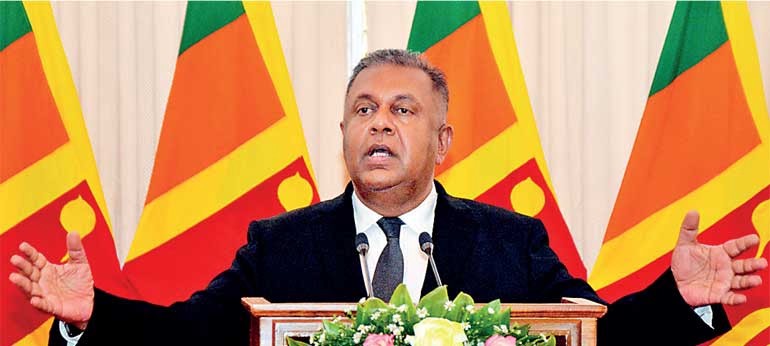
Reports claiming Mangala has succumbed to COVID-19 are false

Social Media reports claiming that former MP Mangala Samaraweera has passed away after battling COVID19 are false, his colleagues confirmed to Daily Mirror a short while ago.

When contacted, SJB party member, Rehaan Jayawickreme said Mangala was responding well to treatment and was not on a ventilator.

Rehaan dismissed all social media reports claiming Mangala was seriously ill and had succumbed to the virus, as false and urged people not to spread fake information

Vatican looking into Easter attacks: Rev. Father Cyril Gamini Fernando

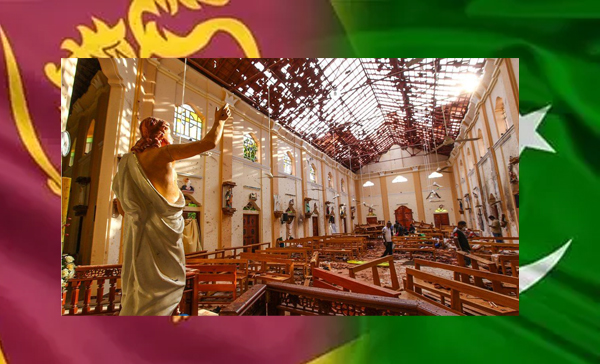
Reverend Father Cyril Gamini Fernando has stated that justice is yet to be served with regard to the Easter Sunday terror attacks of 2019, and that the Vatican is looking into the matter.

“We still do not see the truth about this being revealed. So we are being forced to seek international assistance. We believe that His Holiness and the Vatican’s Commission on Justice and Peace are looking into this,” he said.

He also mentioned that the information revealed by former Attorney General Dappula de Livera on the same must be divulged to the public immediately.

“We hope that the government will continue to implement these investigations, lawsuits, and further investigations, as well as the recommendations of the Presidential Commission on the Easter Attack. It is also important to uncover the conspiracy revealed by former Attorney General Dappula de Livera,” the Reverend Father stated.

Posted in Uncategorized

Sri Lanka to get the initial $50 m tranche of $250m currency swap with Bangladesh Bank this week

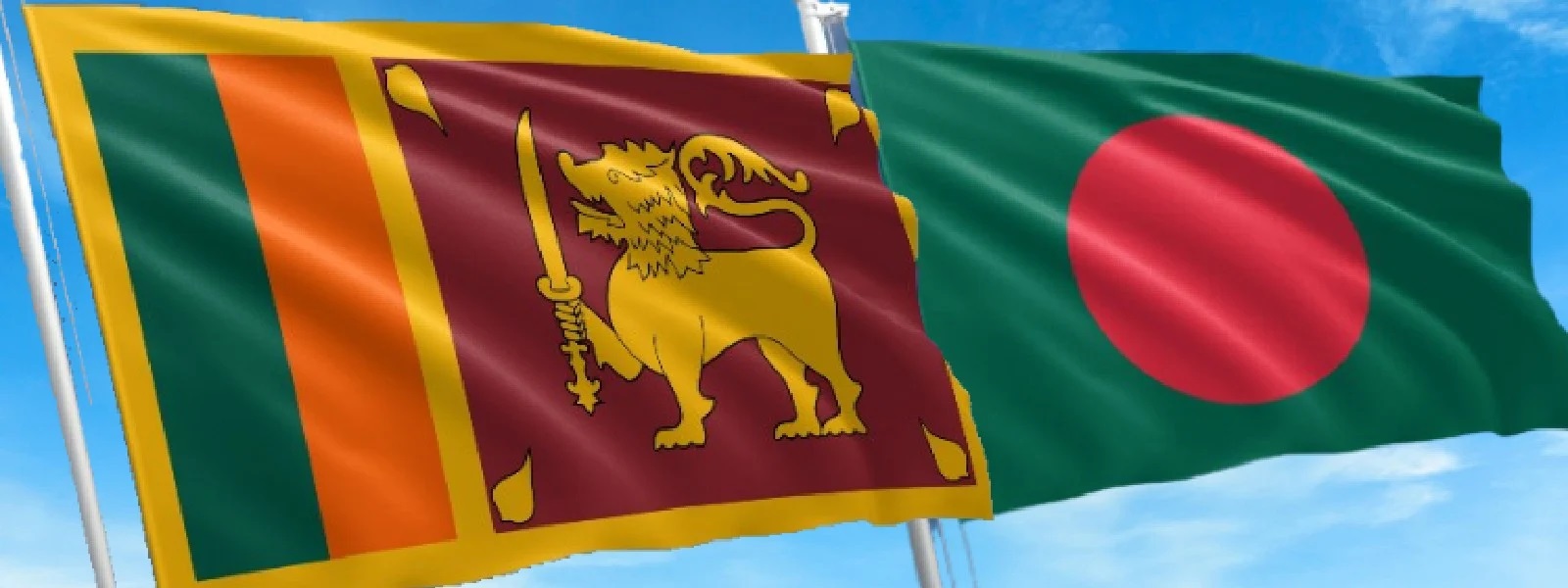
The central bank of Bangladesh (BB) will lend $50 million to under-pressure Sri Lanka this week as part of Bangladesh’s efforts to support the Island nation suffering from a foreign exchange crisis, The Daily Star reported.

The credit under the first-ever loan to any country from Bangladesh will be given under the currency swap agreement inked by the BB and the Central Bank of Sri Lanka (CBSL) on August 3.

As per the deal, the BB will provide a total of $250 million to help prop up the island nation’s fast-depleting foreign reserves and ease pressure on its exchange rate.

The financing will be given in three phases. The first tranche of the loan will be given this week, according to a top official of the central bank.

The remaining two tranches will involve $100 million each.

Seeking anonymity, the BB official said the central bank would give the first tranche for three months.

If the CBSL fails to repay the loan within the deadline, it will get three more months to repay. If it fails to pay back again, it will be given three more months.

The CBSL will return the amount in three months at the interest rate of the London Interbank Offered Rate (Libor) plus 2 per cent. If it can’t honor the deadline, the interest rate will not change.

But if the tenure goes up to six months, the interest rate will be Libor plus 2.5 per cent.

The Libor is the global reference rate for unsecured short-term borrowing in the interbank market and acts as a benchmark for short-term interest rates.

This week, the three-month Libor is 0.14 per cent and the six-month Libor is 0.18 per cent.

If the CBSL fails to return the money, the Sri Lankan government will pay back the loan as per the state guarantee attached in the agreement, the BB official said, adding the outstanding balance limit will never exceed $200 million. He said Bangladesh was not extending the loan for any commercial purpose.

“It is being given to help a friendly SAARC member country which is in trouble. Bangladesh is, however, following the international best practices and maintaining due diligence.”

The decision for the currency swap agreement was set in motion during Sri Lankan Prime Minister Mahinda Rajapaksa’s visit to Bangladesh in March.

As per the deal, the CBSL will hand over an equivalent amount of its currency, which depreciated 6.8 percent against the US dollar this year.

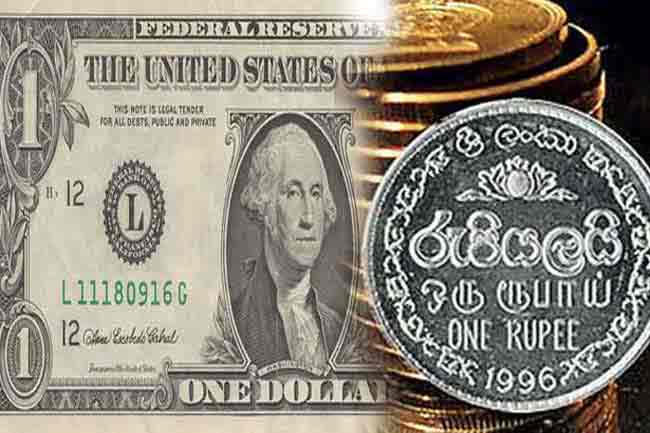
Yesterday, the US dollar traded at 199.52 Sri Lankan rupees.

The BB will open an account with a bank in the South Asian country to keep the sum, which will be around 49.5 billion Lankan rupees, a BB official said earlier. The amount would be used for import payments.

Bangladesh’s import bill with Sri Lanka is $50-55 million a year.

The swap agreement is a good deal for the BB, which has a record $45.9 billion in its coffers as of August 3.

Under the agreement, Sri Lanka will pay more than double Bangladesh gets from all of its investments.

The injection of the American greenback from Bangladesh would be a great relief for Sri Lanka, which has $3.7 billion of foreign debt maturing this year.

It had $2.4 billion in foreign currency reserves at the end of July, down from $4 billion in April.

In 2020, Sri Lanka’s economy contracted 3.6 per cent because of the financial fallout from the coronavirus pandemic.

The country’s $4.5-billion tourism industry, one of its major foreign currency earners, was hit particularly hard, while its exports were down by about 17 per cent last year.

Because of the foreign exchange crisis, the Sri Lankan government imposed an indefinite import ban in March last year to save hard currency, according to the financial newspaper Nikkei Asia.

Posted in Uncategorized

Sri Lanka rupee non-credible peg breaks to 211-215 to US dollar

Sri Lanka rupee’s non-credible peg to the US dollar which was kept to around 203 in the breach with the moral suasion has broken to 211-215 levels with most banks giving up on the earlier, rate, market participants said.

Most domestic banks have started to sell dollars around 211 to the US dollar to importers while foreign banks are selling around 215, market participants said.

On Tuesday Commercial Bank was quoting a rate of 206.50/211.00 for Telegraphic Transfers, Hatton National Bank 206/211, Seylan Bank 204/211.

State-run Bank of Ceylon was still quoting 198.50/203 on their website with a proviso that deals above 7,500 would have to get a quote from the dealing room.

Sri Lanka’s rupee peg is non-credible (or soft) due to liquidity injections and the lack of floating overnight rate to keep the exchange rate fixed (credible peg).

Sri Lanka has been printing large volumes of money to pay state worker salaries and keep interest rates low and turn government debt into reserve money (bank notes or liquidity) at weekly bill and bond auctions which then hit the forex markets.

Two weeks ago a failed bond auction injected 53 billion rupees into money markets only part of was taken out before it disappeared as outflows mostly through government debt.

Unlike in mid 2020, when private credit collapsed, with stronger economic activity and growing private credit, printed money hits the forex market faster as cascading credit takes place.

Weak confidence had also led to capital flight from stock markets where foreign investors benefited from rising stock prices due to liquidity injections and higher profits reported by so-called ‘crony’ import substitution firms before costs and weak demand caught up with them.

Analysts had called for curbs on the domestic operations of the central bank as policy became increasingly activist since 2011 with discretionary policy involving ‘flexible’ exchange rate and ‘flexible’ inflation targeting.

Sri Lanka needs monetary discipline to avoid further downgrades: Bellwether

Bank Treasurers had warned authorities at a meeting on Wednesday that the non-credible peg at 203, which was kept through a moral suasion and informal agreement was not tenable.

Due to bar on outright interbank trading there is no price transparency for the dollar rupee rate in the spot or forward market, leading to banks charging and paying various rates to exporters and importers based on bargaining power.

Another meeting with authorities is due shortly, market participants said.

Sri Lanka’s has fallen victim to Keynesian stimulus, discretionary monetary policy and undermining of Treasuries auctions since the end of the war, critics have said.

Posted in Uncategorized

Sri Lanka signs Rs. 61.5 Bn Term Facility with China Development Bank

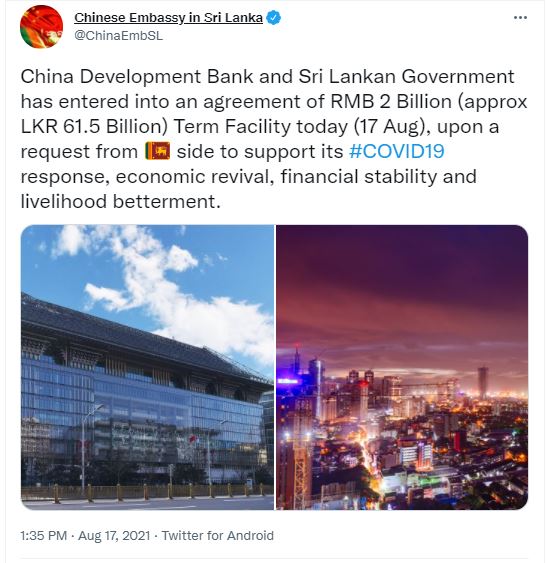
The China Development Bank and Sri Lankan Government entered into an agreement of RMB 2 Billion (approx LKR 61.5 Billion) Term Facility on Tuesday (17).

The Chinese Embassy in Sri Lanka Tweeted that this agreement was signed upon a request from Sri Lanka to support its #COVID-19 response, economic revival, financial stability and livelihood betterment.

Posted in Uncategorized

Daily COVID deaths hit record high with 171 new fatalities

The total number people who fell victim to COVID-19 infection in Sri Lanka soared yet again as a record high of 171 new fatalities were confirmed by the Director-General of Health Services on Monday (August 16).

This marks the ninth consecutive day that the daily count of COVID-19 deaths surpassed 100.

The new development has pushed the official death toll from the virus outbreak in Sri Lanka to 6,434.

According to the data released by the Department of Government Information, the latest victims include 102 males and 69 females.

As many as 134 deaths were reported among the elderly people who are aged above 60 years. In addition, 35 individuals aged between 30-59 years and two males below 30 years have also succumbed to the virus infection.

Posted in Uncategorized

GR-RW meet: President responds positively, but no date fixed for all party meet

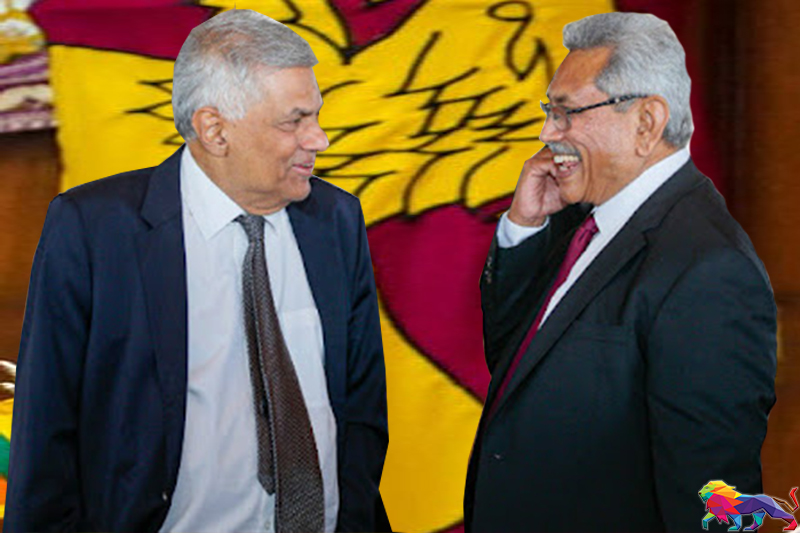
Leader of the United National Party (UNP), Ranil Wickremesinghe has discussed the current Covid 19 situation in the country during the meeting with President Gotabaya Rajapaksa that concluded a short while ago, The Morning learnt.

The meeting took place this morning (17) at the Presidential Secretariat.

Wickremesinghe, who had requested the meeting, asked that an All-Party Leaders meeting be convened, UNP sources said.

He has explained that the political leaders could present proposals on containing the spread of the virus.

The UNP Leader has also added that the UNP has already presented their own set of proposals.

He has further highlighted some of the other issues regarding Covid-19 which have been brought to the Party’s attention.

President had been positive to the request, but no confirmation was given on whether the conference will be called for, UNP sources added.

Posted in Uncategorized

Another web journo grilled by CID

Social media journalist Thushara Wanniarachchi was summoned to the Criminal Investigation Department (CID) yesterday (17) to record a statement in connection with her alleged links to LankaeNews journalist and former Air Force Intelligence Officer Keerthi Ratnayake, who was recently arrested for making claims about a purported attack on an international institution in Colombo.

Earlier, according to Wanniarachchi’s Facebook account, it was revealed that four police officers from the CID had come to search her house on 16 August.

“These officers searched my house and took away old laptops and phones including iPhones, and pen drives for investigation,” she said.

She claimed that the police officers had indicated that she was in possession of a computer and telephone belonging to Ratnayake.

Wanniarachchi has since uploaded a few pictures to her Facebook, showing police officers pulling out her clothes from where they were stored and leaving them in disarray.

Meanwhile, Attorney-at-Law Upul Kumarapperuma has written a letter to Bar Association of Sri Lanka (BASL) President Saliya Pieris PC yesterday, claiming that the Colombo Crimes Division (CCD), which took Ratnayake into custody, has a plan to take him to his home in Kandy and that there is a likelihood of a threat to his life en route.

Upon receipt of the said letter from Kumarapperuma, Pieris has written to Inspector General of Police (IGP) Chandana D. Wickramaratne, requesting to secure Ratnayake’s life. Pieris has also formally informed the Human Rights Commission of Sri Lanka (HRCSL) about this request.

Elsewhere, two CID officers have questioned Dr. Najith Indika, who is attached to the Avissawella Base Hospital, and had previously penned a note on his Facebook account about the condition of the Covid-19 ward of the hospital where he works, saying that “people are dying like flies”.

“I wrote an article about the current state of Covid-19 and put it up on Facebook because I had no other choice but to feel the pain I was feeling at that time,” Dr. Indika mentioned in his Facebook account.

According to his Facebook post, the CID officers had questioned his mental state and had stated that “the relevant Deputy Inspector General of Police (DIG) told us to take a look at the doctor who wrote this and see if he was under stress”.

Speaking to The Morning, Dr. Indika said that he is unable to comment on the incident, adding, however, that he will not stop writing on Facebook since it is his personal choice.

Sri Lanka: Polarizing Center – Analysis

The Sri Lankan President’s office on August 11, 2021, stated that the Government has filed 23,270 charges against 25 people in connection with the April 21, 2019, Easter Sunday suicide bomb attacks on churches and hotels in Colombo and Batticaloa Districts, which killed 262 people. The charges framed under Sri Lanka’s Prevention of Terrorism Act (PTA), included conspiring to murder, aiding and abetting, collecting arms and ammunition, and attempted murder. Attorney General Sanjay Rajaratnam asked Chief Justice Jayantha Jayasuriya to appoint a special three-member High Court bench to hear the cases speedily.

Earlier, on April 5, 2021, the final report of the Cabinet Sub-Committee, appointed to study the Report of the Presidential Commission of Inquiry (PCoI) into the 2019 Easter Sunday bombings, was handed over to President Gotabaya Rajapaksa. The Committee, appointed by the President on February 19, 2021, after studying the PCoI report at length, identified 78 recommendations. The report includes how and by which agencies those recommendations should be implemented.

Meanwhile, Mahinda Rajapaksa, who returned to power in the aftermath of the Easter Sunday attacks, exploiting the public disillusionment with the then incumbent Government, is rapidly tightening the Rajapaksa family’s grip on power in Sri Lanka.

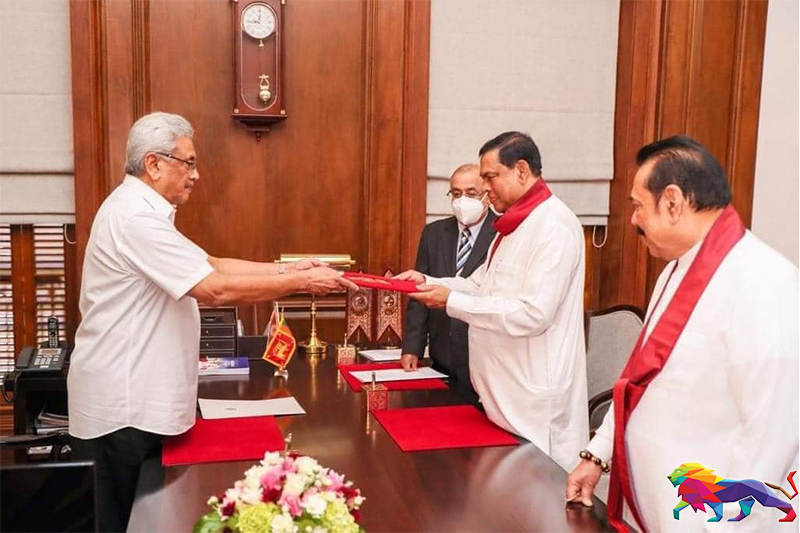
On July 8, 2021, Basil Rajapaksa (70), the younger brother of President Gotabaya Rajapaksa and Prime Minister Mahinda Rajapaksa was sworn as the Finance Minister in Sri Lanka’s Cabinet. With his entry, the Cabinet headed by Gotabaya now has five members of the Rajapaksa family. Elder brother Chamal Rajapaksa is Minister of Irrigation and Mahinda’s son Namal Rajapaksa is the Minister of Digital Technology and Entrepreneur Development.

Other Rajapaksas are also clustered around the power centre. Chamal Rajapaksa’s son Shasheendra Rajapaksa is the State Minister of Organic Fertilizer Production, Supply and Regulation and the Paddy and Grains, Organic Food, Vegetables, Fruits, Chillies, Onion and Potato Cultivation Promotion, Seed Production and Advanced Technology for Agriculture. Nipuna Ranawaka, son of Rajapaksas’ sister Gandini Rajapaksa Ranawaka, is a Member of Parliament. Naval Officer Yoshita Rajapaksa, another son of Mahinda, is the Prime Minister’s Chief of Staff. According to some estimates, about 75 per cent of the total budget of Sri Lanka is directly under the purview of Rajapaksa family Ministers in the Government.

The Rajapaksas were ousted in 2015 when Mahinda lost the Presidential Election, but were back in power after the November 16, 2019, Presidential Elections, which brought Gotabaya to the Presidency. Soon, one by one, the brothers and other family members were back in the business of Government. Further, consolidating their power, the Mahinda Rajapaksa-led Sri Lanka Podujana Peramuna (SLPP, Sri Lanka People’s Front) swept the August 5, 2020, Parliamentary Elections. SLPP received 6,853,693 votes (59.09 percent) and secured 128 electoral seats in a total of 225-member Parliament.

After reassuming power, the Rajapaksa’s have taken several steps to ensure the longevity of their rule.

Indeed, in the very first meeting of the new Cabinet, held on August 19, 2020, the Sri Lanka Government decided to abolish the 19th Amendment and pushed through the 20th Amendment to the Constitution of Sri Lanka, which passed into law on October 22, 2020. The 20th Amendment granted sweeping powers to the Executive President. The Amendment, in essence, advances the democratic backsliding of Sri Lanka by granting the President unfettered powers. The President can summarily appoint or dismiss Ministers, including the Prime Minister, and can modify the number of Ministries, the number of Ministers, and the functions delegated to each Minister whenever he wants. The Amendment also removed the prohibition on the President himself from holding ministerial posts. It also allows the President the power to dissolve Parliament only two and a half years into the new Parliament, compared with the former four-and-a-half-year minimum period mandated by the 19th Amendment.

The Rajapaksa Government also made various institutional changes in the country, in many cases inclining towards militarization. It has placed over 30 agencies, including the Police, under the authority of the Ministry of Defense. Retired and serving military officers have been appointed to numerous key posts previously held by civilians. On June 2, 2020, President Rajapaksa established a Presidential Task Force to build a “Secure Country, Disciplined, Virtuous and Lawful Society,” composed entirely of military and security officials, with loosely defined powers and the authority to issue instructions to all Government officials. On June 4, 2021, President Gotabaya issued a gazette notice naming the Counter Terrorism Investigation Unit (CTIU) as a place of detention. The gazette had been issued as a notification under Section 9 of the Prevention of Terrorism Act (PTA). Section 9 refers to the detention of suspects arrested under the PTA, and empowers the CTIU to use its facility to detain such suspects.

On the other hand, efforts of ethnic reconciliation and trust building with ethnic Tamils have seen no progress even as demonstrations and protests by Tamils have become a regular feature. Most recently, demonstrations were carried out across the country’s North-East on July 24, 2021, to mark the 38th anniversary of Black July (the common name used to refer to the anti-Tamil pogrom that occurred in Sri Lanka from July 24-29, 1983), paying tribute to the thousands of Tamils who lost their lives then. Despite Sri Lankan Security Forces (SFs) banning demonstrations in some places, protests were carried out in multiple Districts, including Jaffna, Amparai, Vavuniya and Mannar. Separately, a group of lawmakers from the Tamil National Alliance (TNA) marked ‘Tamil Genocide Day’ at the Sri Lankan Parliament complex in Colombo on May 18, 2021, before a parliamentary session was due to take place. The parliamentarians dressed in black and lit candles by a red and yellow flag, before holding a moment of silence to commemorate the ‘tens of thousands of Tamil civilians killed at the hands’ of the Sri Lankan state 12 years ago. On February 4, 2021, thousands of Sri Lankan Tamils marched in the northern and eastern regions to demand the release of prisoners and seek information on thousands of Tamils missing since the end of the ethnic war 11 years ago.

Significantly, on March 23, 2021, the United Nations Human Rights Council (UNHRC) in Geneva adopted a resolution on alleged human rights violations by Sri Lanka during the final days of the separatist war. The draft resolution A/HRC/46/L.1/Rev.1, entitled “Promoting Reconciliation, Accountability and Human Rights in Sri Lanka” was adopted by the UNHRC after 22 members out of 47 voted in favour of the resolution at the 46th Session in Geneva. 11 members, including China and Russia, voted against the resolution while 14 countries, including India and Japan, abstained from voting.

Referring to the resolution, Chief Opposition whip Lakshman Kiriella stated, on March 25, 2021, that the UNHRC mainly focused on the anti-democratic governance of President Gotabaya Rajapaksa. He told Parliament that only two-and-a-half pages were focused on the war out of seventeen and a half pages of the resolution. “Many areas in the resolution focused on anti-democratic actions, a threat to media freedom and issues concerning the minority communities,” he said..

Meanwhile, in its latest travel advisory for Sri Lanka, the United Kingdom has noted,

Terrorists are likely to try to carry out attacks in Sri Lanka. Attacks could be indiscriminate, including in places visited by foreigners such as hotels, tourist sites and places of worship. Avoid crowded public places, large gatherings and demonstrations, and follow the advice of local authorities.

While the intelligence on which this advisory is based is not clear, and there appears to be little imminent threat of a major terrorist attack in the country, there is a residual threat from Islamist forces and marginal elements supporting the now defunct Liberation Tigers of Tamil Eelam (LTTE). According to partial data compiled by the South Asia Terrorism Portal (SATP), since the beginning of the current year, 25 former LTTE cadres and sympathizers have been arrested for various plots across the country (data till August 15, 2021). There were four such arrests in 2020. Since the end of Eelam War between the Government forces and the LTTE, which officially ended on May 20, 2009, at least 371 former LTTE cadres and sympathizers have been arrested.

While the state’s counter-terrorism initiatives have been enormously successful, residual threats can be exacerbated by the polarizing politics that has come to characterize the Rajapaksas’ politics. It is essential that the Government ensures that the recommendations of the Cabinet Sub-Committee to study PCoI, are implemented in true spirt. However, given Rajapaksa family’s attempt to further strengthen their hold on Sri Lankan politics, there is a strong possibility of the Government targeting the Opposition, exploiting the adverse comments against Opposition leaders in the PCoI.

It is useful to recall that the PCoI had recorded that friction and a communication breakdown between the then-President Maithripala Sirisena and the then-Prime Minister Ranil Wickremesinghe were blamed for the Government’s failure to act on near-specific foreign intelligence warnings ahead of the Easter Sunday attacks. Raising walls of mistrust and exclusion withing the country will eventually tend to undermine national security.

Source:eurasiareview

*S. Binodkumar Singh, Research Associate, Institute for Conflict Management