The MR-GR-BR triangle and the Gotabaya presidency By Dr.Jegan Jayatilleka

Given the mounting domestic political contradictions of his own creation, and the diplomatic crises which he could have attenuated but has exacerbated, President Gotabaya appears to be plugging the gap by cultivating an unprecedented systemic affinity, if not affiliation, with China’s Leader, Government and ruling Communist Party. This is confirmed in a thought-provoking piece in these pages by China’s Ambassador in Colombo:

“In their recent phone conversation, President Gotabaya expressed once again his strong willingness to learn from Communist Party of China on its governance experience…President Xi Jinping made positive response to his Sri Lankan counterpart and agreed that China and Sri Lanka should learn from each other at the system and governance levels…” (A phone conversation piloting a new voyage | Daily FT – http://www.ft.lk/columns/A-phone-conversation-piloting-a-new-voyage/4-716429)

While the Chinese system and governance experience are impressive and admirable, they are historically evolved (the Chinese Revolution) and have no commonality, proximity or relevance to Sri Lanka because China’s is not a multi-party competitive electoral democracy as is Sri Lanka’s, and the ‘governance experience’ of the Communist Party of China is based on a political monopoly unlike in the case of Sri Lanka’s governing party.

New voyage

So, where is the “new voyage” taking us? Is President GR telegraphing that Sri Lanka on his watch hopes to replace, by evolution, osmosis or dramatic diktat, its democratic multi-party system of governance, the oldest in Asia and indeed Afro-Asia, with one such as that of China, where the ruling party maintains its rulership in permanence?

That this new voyage is well underway is evidenced by the shift in norms and the conversion to the Chinese ideological values, in the discourse of our top officialdom, most transparently in the recent remarks of Secretary/Foreign Affairs, Retd. Admiral Jayanath Colombage, who says:

“…Adm. Colombage also brought up human rights issues, which China has been criticised by the West. “What is the use of human rights when you don’t have right to life? The most important thing that any government should do is to ensure that the right to life is enshrined for people.” He said Xinjiang’s security and development are a great achievement for the region.” (Sri Lankan Foreign Secretary responds to Western criticism on China – CGTN – https://news.cgtn.com/news/2021-04-14/Sri-Lankan-Foreign-Secretary-responds-to-Western-criticism-on-China-ZrCX94tHj2/index.html)

Doesn’t President GR know that a fundamental definitional difference between political systems, one which leads to different classification of types, cannot be mixed up and that such a classic ‘category error’ would, in practice, cause severe dysfunctions leading to systemic crises?

Doesn’t he also know that crossing the systemic firewall could set in motion a process of systemic reclassification of his presidency, the regime and Sri Lanka itself, by the USA, India, NATO, EU, and the Quad?

The Chinese Ambassador to Sri Lanka also reveals that “…the two Presidents had two times of extensive and in-depth phone conversations, reaching broad consensus, and strategically guiding the future development of our bilateral relations.” (Ibid)

Of course, any bilateral relationship cannot be guided unilaterally, and that is more so when there is a yawning asymmetry of power. However, the relationship of any country, including Sri Lanka, with another, can be ‘strategically guided’ only by the given country, based upon its national interest, perceptions of threat etc. Sri Lanka’s strategic calculus, which includes an assessment of how our relations with certain of our friends may affect the relations with certain other friends, must be undertaken by Sri Lanka, not “strategically guided” by conversations with any one of our friends.

Politics and President GR

President Gotabaya Rajapaksa would have been far better off had the “strategic guidance” in all matters of politics and statecraft come from conversations with ex-President Mahinda (than with President Xi).

When Yahapalanaya was riding high and Gotabaya Rajapaksa was at his most vulnerable, Wijeyadasa went on TV and spoke in Parliament defending his refusal to go along with the attempt to jail the decorated war veteran. Thus, the allegedly abusive phone call (hitherto uncontradicted) is ironic as well as instructive in what it reveals.

It is also symptomatic of several things. Firstly, that things are not going well. When they are, such embarrassing explosions do not occur, and certainly not when the person you are berating is someone who stuck his neck out for you when you were in trouble. Secondly, that though President Gotabaya had the unmatched advantage of being Mahinda Rajapaksa’s younger brother when running for office, he has the disadvantage that whatever he does while in office, especially in terms of conduct, interaction and communication, is instantly, spontaneously, even unconsciously compared with Mahinda Rajapaksa.

It is true that President GR feels himself under pressure, but that again is a situation largely of his own making. His problem was not that he sought to be President. That was a perfectly legitimate aspiration. His problem is that every time he came to a crossroads as to what that presidency would be like, he always took the wrong turning when he had a correct one to take.

Gotabaya Rajapaksa’s biggest asset was also the ruling party’s, Basil Rajapaksa’s and the Rajapaksa clan’s biggest asset: Mahinda Rajapaksa. MR’s personality and historic achievement. President GR had the perfect chance to activate that asset, but he blew it, not by accident but by choice. That chance was during the necessary re-set of the flabby 19th Amendment and the introduction of the 20th Amendment. He could have permitted a version of the 20th Amendment which gave a fair share of power to Asia’s most experienced political figure outside of Mahathir Mohamed, but he didn’t, and chose to monopolise power instead.

It is not only Prime Minister Mahinda Rajapaksa he deprived of a measure of political power; it is also the Parliament which is preponderantly comprised of the ruling coalition. If MR had more power he could persuade and manage the MPs, and if the Parliament and Cabinet had more power than they do now, he wouldn’t have had to.

President GR compounded his blunder concerning the specific form and content of the 20th Amendment, by placing his ex-military and ViyathMaga-Eliya cohort in everything from top administrative posts to governorships. With the model unable to deliver at the grassroots, the Government MPs became restive. Patronage alone does not work when they feel the ground begin to shift under them. The Wijeyadasa Rajapakshe affair, or more significantly, the dissent of Ven. Muruththettuwe Ananda Thero, are but symptoms of an avoidable crisis created by President GR.

How did President Gotabaya get to this point? Given the Buddha’s focus on the causative chain, it is necessary to go back a few years.

There was a wartime Gotabaya Rajapaksa who was very different from the GR of the postwar period, especially the MR second term. Here’s the evidence, from August 2008:

“In his nationally televised dialogue with audiences in several areas on Tuesday August 19th, President Mahinda Rajapaksa, speaking in Sinhala to largely Sinhala rural crowds, pledged to hold elections to the Northern Provincial Council within a year of its liberation just as he had held election to the Eastern Provincial Council. He added that he was considering elections to the local authorities in Jaffna very much earlier.

“Gotabaya Rajapaksa, Defence Secretary, had already indicated the goal in his response to The Times online, stressing the need to privilege a common Sri Lankan identity over and above our separate ethnic identities, allowing for devolution of power, and reiterating the President’s commitment to it.” (Dayan Jayatilleka, Defence and Devolution – Groundviews)

Between August 2008 and the war’s end Defence Secretary Gotabaya Rajapaksa had undergone a conversion.

GR’s choices

Gotabaya Rajapaksa had a choice of two types of Presidency, based on two projects of candidacy. This is similar to the choices faced by President Trump: he could either have been a John McCain or the Far-Right ultranationalist with autocratic impulses that he chose to actually became. The same went for candidate GR.

The first GR project was in 2012. Its evidence was the inaccurately entitled book ‘Gota’s War’ by CA Chandraprema. When the book came out at a launch at which Presidential Secretary Lalith Weeratunga was the keynote speaker, I cautioned in my columns and on TV shows that “if it’s Gota’s War, it’ll be Gota’s war crimes”. Sadly, that prediction came true.

Earlier this year, former UN High Commissioner for Human Rights Navi Pillay, wrote in Just Security that GR as Secretary/Defence had gifted a copy of the book to a high-ranking South African Minister, who in turn had passed the copy to Navi Pillay. She wrote that the book and GR’s ownership of it as demonstrated by his gesture proved GR’s responsibility for everything that happened.

What is interesting to the analyst is that Model-1 of the GR candidacy project, that of 2012 (‘Gota’s War’), coincides with the emergence of the Islamophobic Bodu Bala Sena. Eventually, Secretary/Defence GR spoke positively of the BBS and its views, not merely at the opening of the BBS academy but also in an interview given to the Daily Mirror. So, we may term Model-1 of the GR candidacy, that of an Alt-Right personality cult.

The GR candidacy Model-1 was based on exactly the premise that animates the competing pro-BR faction of the ruling party. That premise is that GR or BR – depending on which faction you are talking to, or rather, is trying to convince you—was the real “strategist” and driver of the MR success in wartime and the postwar economic recovery. Also stated already in 2011-2012 by these lobbyists was that MR’s time had come and gone and it was time for succession.

The factional struggle between the siblings was proving dysfunctional as the end of the second term was within sight, which is why MR intervened with the disastrous 18th Amendment which enabled him to run for the third time. He lost, and the Yahapalana reimposition of term limits removed the limits on the ambitions of the GR and BR factions.

With MR knocked out of the presidential race, the Gotabaya Rajapaksa candidacy project arose again, but it wasn’t as the same Alt-Right personality cult of Gota’s War. The concrete situation was one in which Basil Rajapaksa was rightly or wrongly held responsible among the pro-MR MPs for the 2015 defeat; a charge that was assisted by his swift departure for the US. On the other hand, the Alt-Right project was crippled by the firm conviction of the MPs and MR himself, that the Bodu Bala Sena and other similar organisations had wittingly or unwittingly shattered the SLFP’s Muslim support.

GR candidacy Mark-2 arose in this conjuncture. A candidate who could swing the overwhelming bulk of the Sinhala voters was necessary because the minorities had voted for the UNP. With his profile as a war veteran and Secretary/Defence, Gotabaya Rajapaksa was the most logical choice.

However, he was not meant to be, nor needed to be, an Alt-Right candidate. The UNP’s suicidal moves such as the 2015 Geneva resolution and the non-unitary (‘orumittanadu’) Constitution project guaranteed a sufficient Sinhala swing to win comfortably. This was proved by the shattering victory of the newly-emergent SLPP, led by Mahinda Rajapaksa and organised by Basil Rajapaksa, in February 2018. That was on a populist-nationalist platform quite consonant with the SLFP’s traditions and MR’s (very slightly) left-of-centre moderate nationalism. From Nugegoda February 2015 through Galle Face May 2017 to the Local Authorities Election of February 2018 and the MR-MS interlude of late 2018, it was one recognisable populist paradigm.

That was the platform that GR was meant to stand on, and represent. All he had to do was to be to MR what Raul Castro was to Fidel, after the latter was unable to lead because of serious ill-health. GR needed to be a managerial President, with MR deciding the political, ideological and strategic line.

The 20th Amendment wrecked that chance, but that 20th Amendment as it stands is the Constitutional expression of the first model (‘Gota’s War’ 2012) of the GR candidacy. Though the Local Government Elections of February 2018 had proved that an Alt-Right ticket was unnecessary for victory, the Far-Right reasserted itself powerfully somewhere in 2018 and took over the candidacy on a wave of Islamophobia in 2019, which originated in 2012.

In place of a Prime Ministership which would have accorded the correct weightage to MR, we have a BR-GR convergence. If MR expected BR to balance GR while he would himself hold things at the middle and keep things on a pragmatic path, he has been outmanoeuvred.

What BR brings to the table is what Sirisena Cooray brought to the equation with Ranasinghe Premadasa: organisation, management, tactics. GR is military-centric, BR is party-centric, but MR, like Premadasa before him, was always people-centric. Today he cannot contribute by functioning as elder statesman because he has been divested of political real-estate by the 20th Amendment, the shape and form of which was driven by the militarist-ultranationalist GR cult.

The UN High Commissioners for Human Rights used to quote President Mahinda Rajapaksa, but never to condemn him for what he said; only to criticise him for not doing what he said. This time around, there are quotes from President Gotabaya Rajapaksa which are used as evidence against him and Sri Lanka today.

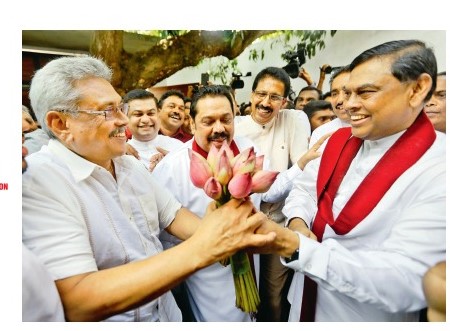
D.B.S. Jeyaraj illustrates a piece on the late Archbishop Rayappu Joseph with several photographs, one of which is of the controversial Archbishop with President Mahinda Rajapaksa and the other with Secretary/Defence Gotabaya Rajapaksa. Everyone is smiling, but the body language in the two pictures is a study in contrasts.

Lessons from China

The success of the Chinese model was because Deng opened up the economy. He did what JRJ and Ronnie de Mel had done in 1977. President Gotabaya is now hoping to do a China by doing exactly the opposite of what Deng Xiaoping (and J.R. Jayewardene before him) did. He is shutting down the Open Economy while displacing it, albeit in an extreme version, to the Port City.

China eliminated extreme poverty and has kept its middle classes in modern consumerism through the Deng model, while the GR administration has heightened poverty and impoverished the middle classes by closing the economy according to the Sirimavo Bandaranaike-N.M. Perera model.

Addressing the Boao summit this week, President Xi rightly warned against economic “de-coupling”. President GR’s import ban is one of decoupling as a general rule, with a solitary exception i.e., decoupling from the rest of the world economy, while recoupling only with China (e.g., the Port City).

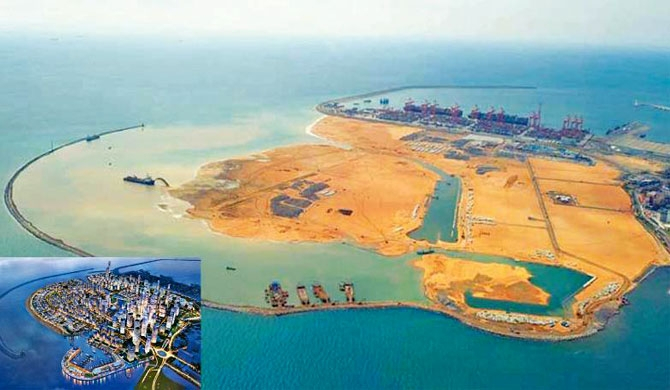
The bitterest irony of them all is that the Port City is exactly the model of ‘foreign concessions’ i.e., concessions to foreign powers in the cities of China, especially on the coast, that caused waves of rebellions, starting with the Boxer Rebellion, moving through the May 4th Movement and culminating in the Communist Party-led Revolution of Mao, who referred to the foreign spheres of influence carved out in China as “semi-colonial”.

President GR’s model has rejected what China adopted, and has adopted what China rejected and rebelled against.
Posted in Uncategorized

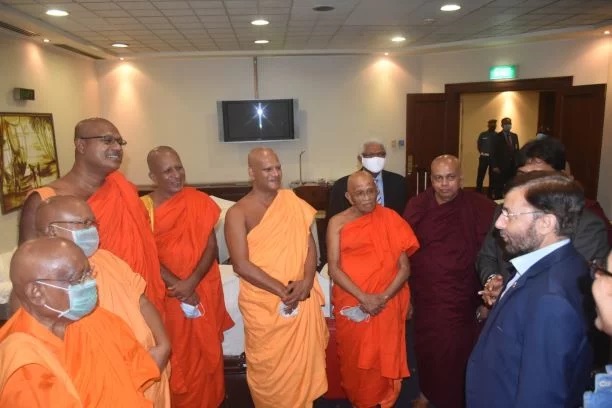
Lankan monks on pilgrimage in Pakistan

A 14-member delegation comprising senior Buddhist monks from Sri Lanka arrived in Lahore on Monday to undertake a tour of various Buddhist heritage sites in Pakistan.

Following the recent visit of the Prime Minister of Pakistan to Sri Lanka, the high-level Buddhist Monks’ visit was arranged by the High Commission of Pakistan in Colombo to promote religious tourism to Pakistan and to enhance people-to-people contact between Pakistan and Sri Lanka.

While deeply appreciating the keen interest shown by the senior Monks to undertake the visit, High Commissioner Major General (R) Muhammad Saad Khattak personally saw the delegation off at the Bandaranaike International Airport, Colombo on 19th.

Express Tribune reporting from Lahore said that the monks started their tour with a visit to the Lahore Museum which houses some of the finest remains of the Gandhara civilisation and rare Buddhist relics including the ‘Fasting Buddha’ and ‘Sikri Stupa’ dating back to 2 Century BC.

The Buddhist delegation, led by Venerable Dr Walpole Piyananda (Abbot and President, Dharmavijaya Buddhist Vihara, USA), will visit Islamabad, Taxila, Shahbaz Garhi, Takht-e-Bhai, Jehanabad (Swat) and Lahore. The tour will end on April 26.

The Buddhist delegation will also hold meetings with the officials of the Ministry of Religious Affairs and Interfaith Harmony and meet President Dr Arif Alvi, Prime Minister Imran Khan and Foreign Minister Shah Mahmood Qureshi during their sojourn in the federal capital.

The Second Secretary, High Commission of Pakistan Colombo Ms Ayesha Abu Bakr Fahad told APP that a lot of people do not know that Pakistan is home to the glorious Gandhara Buddhist civilisation.

“In line with the Prime Minister Imran Khan’s vision to promote religious tourism to earn valuable foreign exchange, we planned to make the Buddhist clergy visit Pakistan and see the historical treasures that the country has,” she added.

Pakistan is home to the ancient Buddhist civilisation but it has remained hidden from the eyes of the world over the years.

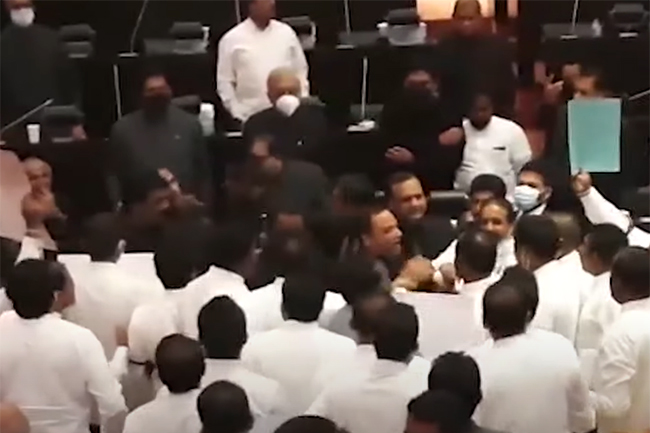
Tension erupts when Opposition MPs were called ’murderers’

Pandemonium reigned in Parliament today when the ruling party and opposition SJB MPs confronted each other trying to determine as to who should move the adjournment debate on the Presidential Commission report on political victimization which will come up tomorrow.

The issue was brought up by Chief Opposition Whip Lakshman Kiriella who requested Speaker Mahinda Yapa Abeywardene to allow the opposition to move the debate.

However, Leader of the House Dinesh Gunawardene argued that the opposition had agreed to allow the ruling party to move the debate. “The opposition agreed at the party leaders’ meeting that the government be allowed to move the debate. Therefore one cannot understand as to why the opposition MPs are wasting time bringing unnecessary arguments,” he said.

“Besides it was the SLPP which suffered political victimization under the previous government. We have a moral right to move the debate,” he added.

Tension erupted finally after tense arguments with MPs of both sides storming towards the well. Government MPs were seen holding placards and chanting that the opposition MPs are murderers. The placards said “Minimaruwo kalu andagana (murderers clad in black). Some MPs were holding images of Zahran Hashim who led the Easter Sunday carnage. Government MPs were wearing black arm bands, while the SJB MPs were wearing black.

There were near physical fisticuffs when MP Harin Fernando and Tissa Kuttiarachchi began pushing each other. A group of MPs from both sides settled the issue preventing physical blows

Posted in Uncategorized

Opposition questions right of Chinese Embassy to organise visits to Port City

The opposition today questioned the right of the Chinese Embassy in Colombo to organise visits to the Colombo Port City for Parliamentarians.

Opposition Samagi Jana Balawegaya (SJB) MP Harshana Rajakaruna said that an SMS had been sent today saying a visit to the Colombo Port City organised by the Chinese Embassy for Parliamentarians had been postponed.

He said the study visit to the Port City was scheduled to take place on 22 April after Parliament sittings.

However an SMS was sent by Parliament to the MPs saying the visit organised by the Chinese Embassy had been postponed.

Rajakaruna said that in the past the Urban Development Authority (UDA) had organised such visits to the Colombo Port City and not the Chinese Embassy.

He questioned the right for the Chinese Embassy to organise visits for MPs to property which belongs to Sri Lanka in Colombo.

The MP called on Speaker Mahinda Yapa Abeywardena to look into the matter.

Posted in Uncategorized

‘Former govt prevented formation of Chinese-Eelam’

The opposition claims the previous good governance government prevented the Port City region from becoming a Chinese state.

Speaking during a media briefing in Colombo today, Parliamentarian Rajitha Senaratne said the then Mahinda Rajapaksa-led administration handed the Port City region to China on a free-hold.

He said the good governance government however managed to amend the laws and removed the free hold agreement.

MP Rajitha Senaratne claimed that the present administration has now given the Port City land on lease to China along with powers to carry out all administrative activities.

He said through the proposed Colombo Port City Economic Commission Bill, the government has proposed to remove 21 laws that are operational in the country at present.

MP Rajitha Senaratne noted that if the bill is approved, such laws will not impact the Chinese entities carrying out activities in the region.

He said this will lead to the formation of Chinese-Eelam.

MP Rajitha Senaratne noted that the government has proposed to establish a Commission to control the entire region.

He said members to the Commission will be appointed solely by the President who will be able to name even foreign nationals to the body.

MP Senaratne added that even persons employed by Chinese firms can been appointed to the Commission by the President.

He said the members of the Commission are likely to fulfil the agenda of the Chinese companies operating in the region, since they will be paid by them.

Parliamentarian Rajitha Senaratne added that Sri Lankans who purchase goods from within the Port City region will be required to pay a special tax when leaving the area, although foreign nationals will not be liable to pay any levies.

MP Senaratne also noted that although all international currencies can be used within the region, the Sri Lankan Rupee cannot be used to pay for goods and services within the Port City according to the new regulations.

He added although the operation of casinos within the Port City region was banned by the good governance government, the present administration has permitted such activities.

MP Rajitha Senaratne also noted despite the previous government allocating a number of spaces to build parks and grounds for the use of locals, the present administration amended such clauses while working according to the interest of Chinese entities.

Posted in Uncategorized

SLPP Gen. Secretary Says Gammanpila Not Considered Party Leader In SLPP-led Alliance

SLPP General Secretary Sagara Kariyawasam said Pivithuru Hela Urumaya leader Minister Udaya Gammanpila did not enjoy the ‘party leader status’ in the ruling SLPP-led alliance.

Kariyawasam made this remark to Asian Mirror when asked about several party leaders in the ruling alliance boycotting a meeting convened by the Prime Minister.

The General Secretary admitted that several party leaders including Wimal Weerawansa, Vasudewa Nanayakkara and prof. Tissa Vitarana did not attend the meeting.

“But Gammanpila is not considered a party leader. So, it is wrong to say that he boycotted the party leaders meeting,” the General Secretary added.

However, responding to the General Secretary’s statement, Minister Gammanpila said as far as he knew he was a party leader in the SLPP-led alliance.

“Who says I am not a party leader?” Gammanpila asked.

Sri Lanka marks two years since deadly Easter attacks

Sri Lanka is marking one of its darkest days in history today (April 21), with the second commemoration of the deadly Easter Sunday terror attacks which claimed the lives of more than 250 and injured at least 500 others.

The country was left devastated on the 21st of April 2019 after a group of suicide attackers of the now-outlawed local Islamic extremist organization National Thowheed Jamaat (NTJ) carried out a series of blasts at St. Anthony’s Church in Kochchikade, St. Sebastian’s Church in Katuwapitiya, Zion Church in Batticaloa, Cinnamon Grand, Kingsbury and Shangri-La hotels in Colombo and a guest house in Dehiwala.

Sri Lanka declared a state of emergency immediately after the bombings and the probes launched into the incident led to the arrest of many who have had links to the suicide bombers.

Archbishop of Colombo, His Eminence Malcolm Cardinal Ranjith has appealed to all Sri Lankans to observe a two-minute silence at 8.45 am in remembrance of the victims of the massacre.

Catholic churches in the island have been asked to ring bells at 8:45 a.m. and observe two minutes of silence before once again ringing the bells. Afterwards, candles or oil lamps will be lit, followed by various religious observances.

Two main memorial services will take place at the St Anthony’s Church in Colombo and the St. Sebastian’s Church in Negombo. The Archbishop will be presiding the memorial service at the St Anthony’s Church where the first bomb was detonated at 8.45 a.m. on April 21, 2019.

Meanwhile, Police Spokesperson DIG Ajith Rohana said special measures are in place to beef up security at all churches in the country.

The Police Headquarters has issued a special message to the officers-in-charge (OICs) of police stations and senior officers of territorial divisions including Senior DIGs, DIGs, SSPs and SPs to monitor the situation.

Posted in Uncategorized

British parliamentarian calls for sanctions on Sri Lankan war criminals

Speaking in parliament yesterday(20-04-21), Elliot Colburn, MP for Carshalton and Wallington, and Chair of the All-Party Parliamentary Group for Tamils (APPGT) welcomed the work of the British Foreign Commonwealth and Development Office (FCDO) in bringing about the recent UN Human Rights Council resolution but questioned what further action was being taken.

He asked what steps the UK is taking “to implement the UN High Commissioner’s recommendations on applying sanctions, travel embargos, and filing cases against alleged war crimes under universal jurisdiction”.

Responding to the question, Wendy Morton, Parliamentary Under-Secretary of State for the FCDO, reemphasised the governments “serious concerns” for human rights in Sri Lanka and noted the UK-led resolution, “enhances the UN’s role in monitoring the situation and collecting evidence of human rights violations that can be used in future accountability processes”.

However, she further added that on sanctions, “it would not be appropriate to speculate on any further designation”.

Her statement comes as there are increasing calls to follow the US’s lead in placing sanctions on alleged Sri Lankan war criminals such as Shavendra Silva, who has been credibly accused of permitting mass atrocities such as the shelling of hospitals, summary executions, and widespread sexual violence. He is currently under a US travel ban due to these allegations.

Thus far the UK has yet to place a single sanction on any Sri Lankan military or government official implicated in human rights abuses.

We oppose govt. decision to suspend May Day rallies: JVP

Politburo member of the Janatha Vimukthi Peramuna Sunil Handunnetti today (20) stated that the party opposes the government’s decision to suspend all May Day rallies and processions.

He stated that if the basis of the activities being suspended was due to the ongoing Covid-19 situation, there were several activities that should have been suspended.

“We cannot say this is a decision taken due to health reasons because the government had already made plans for the rally to commence. We were informed of this today even though we discussed the health regulations to which we should adhere to during the rally yesterday. If they are to stop these rallies, they should have also stopped Gama Samaga Pilisandara and all festivals held on Avurudu” he stated.

He said that he suspects the government is disallowing this because they are scared of the retribution the that rallies will have on the government itself.

“We are speaking on the injustice done to people and giving them their rights on May Day. The government knows that they have taken away some people’s rights. Therefore they do not want us talking about them,” Handunnetti said.

Sri Lanka cabinet nod for laws against “false propaganda” online

Sri Lanka’s cabinet of ministers has approved a proposal to draft legislation to combat false and misleading statements on the internet, the cabinet office said today, days after the country’s Justice Minister reiterated the government’s commitment to criminalising social media posts deemed fake.

The cabinet has approved a resolution tabled by Justice Minister Ali Sabry and Media Minister Keheliya Rambukwella to advise Sri Lanka’s Legal Draftsman to draft a bill to “protect society from the harm caused by false propaganda on the internet”, a statement from the cabinet office said.

The announcement follows a statement by the Justice Minister on Sunday (18) that the government will go ahead with a previously announced plan to introduce laws styled after Singapore’s Protection from Online Falsehoods and Manipulation Act (POFMA), a controversial piece of legislation that has drawn widespread criticism as a tool to control the media and free speech.

The minister told reporters that there are posts circulating online that paint the country in an unflattering light, constantly referring to Sri Lanka as an unlivable place.

“We won’t allow this to continue,” he said, arguing for the need to introduce a legal regime to contain it.

“The profiles of 15 to 17% of Sri Lanka’s social media activists are fake. It is impossible to take legal action against them no matter what falsehoods they might utter,” he said.

The cabinet announcement today said the spread of false information on the internet poses a serious threat and is seen as being used to divide society, to spread hatred and to weaken democratic institutions.

“Various countries have already taken steps to legislate in order to address this problem. Steps should be taken to provide access to accurate information to citizens and civil society by introducing a new law to protect society from the harm caused by false propaganda on the internet,” it said.

In November last year, Media Minister Keheliya Rambukwella told a Ministerial Consultative Committee on Mass Media that a regulatory framework for Sri Lankan websites was on the cards.

The committee had reportedly studied Singapore’s controversial Infocomm Media Development Authority Act (IMDA), in addition to POFMA, which critics said will be emulated by Sri Lanka’s proposed regulatory framework in its mandate to curb reporting and content that spread falsehoods and incite racism.

Singapore’s IMDA passed in 2016 is one of the applicable acts to the statutory body responsible for broadcasting and content regulation (irrespective of the transmission medium). It received criticism from various quarters including the International Press Institute over allegations of controlling the media.

Under POFMA, passed in 2018, the Singaporean government can issue a “correction notice” to an individual or organisation for online content about a public institution that the authorities deem false or misleading. The government can even amend such content in the name of public interest. According to various international media reports, the law has been accused of targeting civil society activists, NGOs and opposition lawmakers. Allegedly false statements published by media websites in Singapore can, under POFMA, carry hefty fines up to 1 million Singapore dollars (USD 731,000) and jail sentences of up to 10 years.