Sri Lankan President and Prime Minister make phone calls to world Muslim leaders

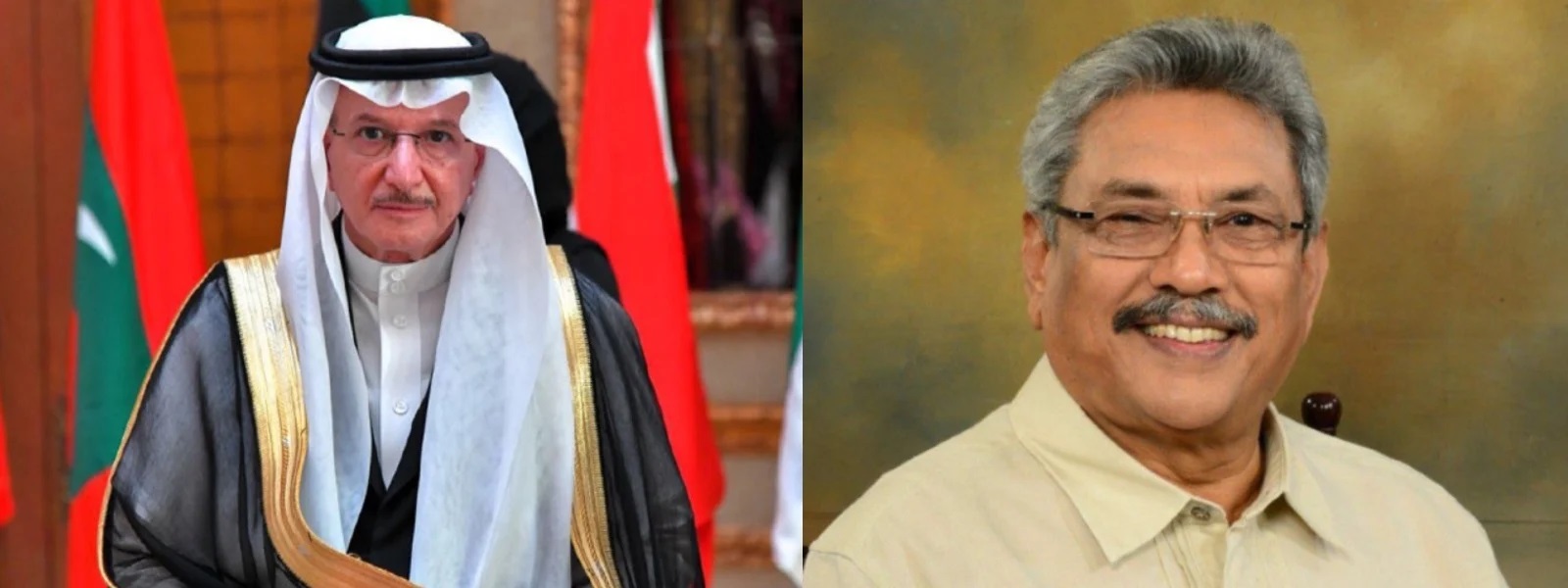
President Gotabaya Rajapaksa and Prime Minister Mahinda Rajapaksa have made phone calls to world Muslim leaders, a day before the UN Human Rights Council takes a vote on a resolution against Sri Lanka.

Secretary-general of the Organization of Islamic Cooperation (OIC), Dr. Yousef A. Al-othaimeen, had received a phone call yesterday (Sunday) from President Gotabaya Rajapaksa who discussed with him the existing relations between the OIC and Sri Lanka as well as the situation of the Muslim community in the country, the OIC said in a statement.

Al-Othaimeen praised the Sri Lankan President’s phone call and his willingness to open up and reach out to international organizations and welcomed the decision of the Government of Sri Lanka on the right of Muslims to bury their dead in accordance to Islamic rites.

The Secretary-general reaffirmed the OIC’S keenness to follow up the conditions of Muslim communities and defend their rights in non-oic member states, the OIC said.

Meanwhile, Prime Minister Mahinda Rajapaksa said he telephoned Deputy King Salman bin Hamad Al Khalifa of Bahrain yesterday.

Al-Othaimeen praised the Sri Lankan President’s phone call and his willingness to open up and reach out to international organizations and welcomed the decision of the Government of Sri Lanka on the right of Muslims to bury their dead in accordance to Islamic rites.

The Prime Minister tweeted saying they reviewed bilateral ties and other areas of cooperation that can be further solidified.

Rajapaksa said that the Deputy King had recalled and appreciated his efforts to sustain peace and stability in Sri Lanka from the time of his Presidency.

The OIC is the world’s largest Muslim body consisting of a number of Muslim countries which are part of the UN Human Rights Council.

Bahrain is also a member of the UN Human Rights Council.

Posted in Uncategorized

DMK tells Modi to ensure India votes for resolution on Sri Lanka

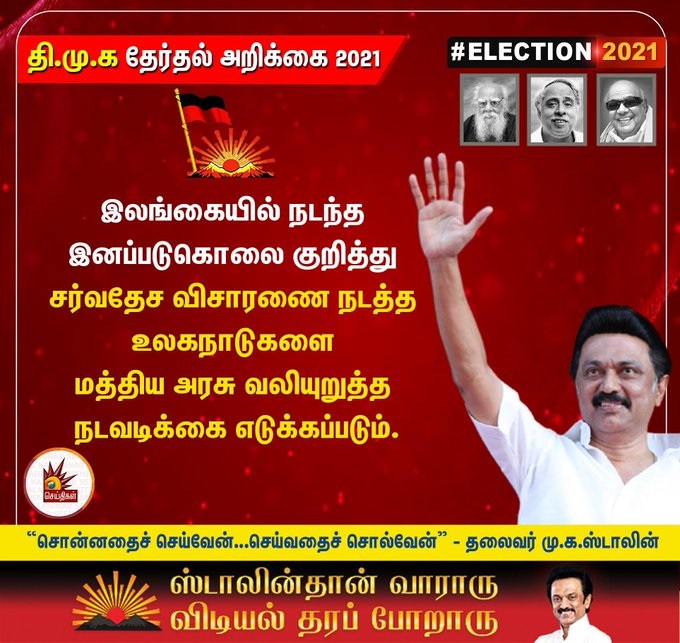
India’s Dravida Munnetra Kazhagam (DMK) has called on the Indian Government to vote in support of a resolution on Sri Lanka at the United Nations Human Rights Council in Geneva.

DMK President M.K Stalin called on Indian Prime Minister Narendra Modi to intervene and ensure support for the resolution.

A vote on the resolution against Sri Lanka will be taken at the United Nations Human Rights Council tomorrow (Monday).

He also questioned the silence of Modi on the matter even after Foreign Secretary Jayanath Colombage had said that India has assured support to Sri Lanka in Geneva.
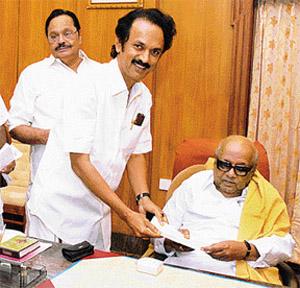
Stalin warned Modi that Tamils around the world will not forgive any attempt to betray the expectations of the Sri Lankan Tamils.

Just recently Modi spoke to President Gotabaya Rajapaksa and both agreed to maintain regular contact between relevant officials, including in the context of the continuing COVID-19 challenges.

The two leaders also reviewed topical developments and the ongoing cooperation between the two countries in bilateral and multilateral forums.

During the conversation Prime Minister Modi had reiterated the importance of Sri Lanka to India’s Neighbourhood First policy.

Chinese vaccine first given to Chinese nationals in Sri Lanka – Fernandopulle

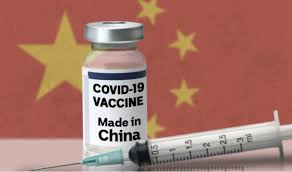
Chinese nationals residing in Sri Lanka will be prioritized when vaccinating with the China-made COVID-19 vaccine ‘Sinopharm’, stated State Minister of Primary Health Care, Epidemics and COVID-19 Disease Control Dr. Sudarshini Fernandopulle.

She said that as per a request by the Embassy of China in Sri Lanka, the Sinopharm vaccine will first be administered to Chinese nationals in the island.

When inquired regarding the lack of WHO approval for the Sinopharm vaccine, the State Minister said, “A lot of vaccines have been given the WHO approval for emergency use. They are being checked now.

Even in our country, permission has been given only to accept the donation [of Sinopharm vaccine] as of yet. Since the Sinopharm vaccine is used in China, the Chinese people living here will be able to get the vaccine as well.”

Sri Lanka’s National Medicines Regulatory Authority (NMRA) on Saturday approved the China-produced Sinopharm COVID-19 vaccine for emergency use in the island country.

This is the third COVID-19 vaccine to be approved in the country after the AstraZeneca and Russia’s Sputnik V vaccines.

When inquired on the public enthusiasm for COVID-19 vaccination, State Minister Fernandopulle rejected the statement that there is a decrease in the number of people volunteering to obtain the vaccine.

She stated that both age groups – 30 to 60 years and 60 years and above – were given the vaccine at pre-selected vaccination centers [Grama Niladhari Divisions]. However, there had been complaints of persons of age group 60 years and above facing issues when receiving the vaccination at the same time other age groups, she added.

Subsequently, steps were taken to vaccinate only the age group of 60 years and above at those same centers, she said. However, since some under the age group were covered by the vaccination program earlier, there is a slight decrease in the numbers obtaining the vaccine now, Fernandopulle clarified.

She added that the public from the age group 60 years and above from other Grama Niladhari Divisions will also be vaccinated from tomorrow (March 22) onwards.

Posted in Uncategorized

Central Bank suspends circulars to save dollars

The Central Bank did a 360 degree turn on its plan to save US dollars in the market, suspending decisions which forced banks and exporters to sell a portion of the US currency to the authorities.

The hurried measures came amidst anxiety that the dollar would go way beyond the 200-rupee level. In the early part of the week, it rose to more than Rs. 200 with pressure building and a likelihood that it would rise further but trawled back to Rs.198 on Friday after the Central Bank suspended the decisions, which were only announced a few weeks ago.

On Wednesday, the Central Bank suspended two circulars which directed banks to sell 10 percent of worker remittances to the Central Bank and the requirement that 50 percent of export earnings should be sold to the Central Bank. Additionally, in another move to save foreign exchange, the Central Bank suspended the purchase by banks in international sovereign bonds from March 23 to April 9.

Bankers and exporters welcomed this week the move saying pressure was building up in the market since banks too have obligations to pay foreign debt on loans and thus a crisis was building up in the market due to a shortage of dollars.

“There was pressure and a tight situation brewing in the market as we too have to pay loans and debt, it is not only the government that has to pay foreign debt,” said one banker, adding: “There was also pressure to pay import bills.”

According to estimates, Sri Lanka needs to pay back a total debt of $6.4 billion this year made up of $4.3 billion of government debt, $1.3 billion in Sri Lanka development bonds and the balance from privately-secured foreign loans.

Economists said that despite the Government’s confidence in not seeking the International Monetary Fund’s help, the situation merited seeking support from the global lending agency because delays in resorting to this measure would worsen the country’s debt crisis.

Analysts say IMF package will boost confidence in the market, encourage foreign investment and investment in Sri Lanka’s foreign bonds though on the flip side it means taking unpleasant decisions like cutting government spending and trimming the fat in the budget like piled-up debt from loss-making state-owned companies.

Posted in Uncategorized

Karunanidhi and the Sri Lankan Tamil Issue -FRONTLINE

A report in The Hindu, with the headline, ‘M. Karunanidhi: A lifelong warrior for Sri Lankan Tamil cause but misunderstood in the end’, gives an idea of not only Karunanidhi’s long association with Sri Lankan Tamil leadership but also his deep understanding of the Tamil problem in the island, besides the criticisms that were levelled against him. These criticisms, with regard to the question of the Sri Lankan Tamil struggle against Sinhala–Buddhist majoritarianism, are twofold and contrary to each other. The establishments of India and Sri Lanka accuse Karunanidhi of backing the LTTE and the Tamil Nationalists accuse Karunanidhi of betraying the LTTE.

I was a witness to the eventful period between 1984, when the Indian government acknowledged that it was offering military training to various Tamil groups, and 2009, when the LTTE was defeated by the Sri Lankan Army. Many failed to see the refined and nuanced statesman-like approach of Karunanidhi.

Karunanidhi and his party’s support for the Sri Lankan Tamils did not start with the anti-Tamil pogrom and riots of 1983 or Black July, as it has come to be known. Way back, in 1956, the DMK came out with a strong resolution in support of S.J.V. Chelvanagayam and his fight against the Sinhala Only Act enacted that year. Karunanidhi was of the opinion that by ejecting the TULF members from the Parliament through the 6th Amendment to the Sri Lankan Constitution in October 1983, President J.R. Jayewardene had created conditions for the Tamils to consider resorting to the option of armed rebellion. Hence, for Karunanidhi, armed rebellion and the demand for a separate state was a maximalist position akin to Periyar’s politics. Karunanidhi wanted the Sri Lankan Tamils to have a minimum common position, like that of Annadurai, while negotiating for their rights. He did not see the maximalist position as the destination, but as a hard bargaining tool, to ensure that there was no erosion in areas that fell under the minimum common position, and this included language rights, land rights and reasonable autonomy.

In a meeting in 1990, with the leader of the plantation Tamils, Thondaman, who was also an influential minister in the cabinet of J.R. Jayewardene and Ranasinghe Premadasa, Karunanidhi explained his position more clearly. His fallback position was summed up as ‘E-minus and D-plus, plus’. If geo-politics prevented the Eelam from coming to pass (E-minus), then the Tamils should at least secure more Devolution (D++) which went beyond the 13th Amendment to the Sri Lankan Constitution. His fine distinction between compromise and conciliation was lost not only on the LTTE and Sinhala Buddhist majoritarian leadership, but also on a wide section of the Indian policymakers. At some level, these three sections got into a stale binary prescription of ‘with us or against us’.

Karunanidhi had a better understanding of the Indian state than both the Tamil militants and the Sri Lankan state. He said it is extremely limiting to look at the concern exhibited by India either in geopolitical terms or the ‘Tamil Nadu factor’. He felt such reductionist readings blinded one from understanding the complexities that guide the functioning of the external affairs ministry in New Delhi. He also rejected the ‘spillover effect’ theory, that the refugee influx from Sri Lanka influences the relationship between the two countries, as also one that had been discarded. He cited two examples—the Dalai Lama and India’s relationship with China and the Chakma tribals and India’s relationship with Bangladesh—to demonstrate this. He said that the ‘spill over effect’ may prove to be an irritant but never destroys the bilateral relationship.

Karunanidhi often asked in private conversations why many political commenters failed to appreciate the logic underlying his arguments for getting the Indian Army out of Sri Lanka. “Peace-keeping is not a military task, and whenever the military has been deployed the civilian government is rarely able to get them back to the barracks. On the other hand we are forced to come up with new acts to defend the forces, when there is little progress on the ground. For instance, in the Northeast we do not see the roll back of the presence of the army. How do we look at the Armed Forces (Special Powers) Act (AFSPA) which empowers security forces to conduct operations anywhere and arrest anyone without prior notice? The AFSPA has been in force in the Northeast since 1958. If the IPKF was not brought back then, it may have stayed there forever. I am extremely grateful to Prime Minister V.P. Singh and the External Affairs Minister I.K. Gujral for agreeing to my suggestion to bring the Indian Army back without subjecting it to further bloodletting. In peace-building we need a language of fluidity rather than a language of assertion, which flows from the presence of armed forces.”

Karunanidhi was sceptical of the LTTE’s approach after May 1986, when it launched a bloody war against its fellow Tamil militant group TELO, and its insistence on being seen as the sole militant group in the struggle, achieving its goals through a combination of terror, intimidation and murder. The LTTE not only sought a ban on other groups but was also active in delegitimizing the political leadership of the TULF. Karunanidhi felt that no organization can legitimately claim to be the sole representative of a nation. He said the LTTE’s demand to be the sole representative has actually robbed the group of its perfectly legitimate claim of being one of the major representatives of the Tamils. Karunanidhi called the internecine war, ‘Sagodhara Yudham’ (A Battle Between Brothers) and underlined that it ‘would not lead to liberation but to a situation where we will lose sight of who is our enemy, and what is the purpose of our struggle’.

His repeated attempts to explain the need for a united front to the LTTE were rebuffed because the AIADMK and MGR were willing to back the LTTE as the sole representative of Sri Lankan Tamils. MGR also extended financial assistance to that group. Karunanidhi was deeply worried about the role of the Indian state and the AIADMK at that stage, where each agency of the Indian government had one Sri Lankan militant group under its influence.

The Indian government’s move to train militants in programmes from Dehradun in the north to the jungles adjoining Mettur in Tamil Nadu was taken without the knowledge of the Tamil Nadu government, and Tamil politicians. Karunanidhi was alerted to this fact in 1983 by two senior intelligence officials, after the Black July anti-Tamil pogrom. At that point, the Indian government wanted to send out the message that its Sri Lanka policy was in tune with the political will of Tamil Nadu. Indira Gandhi once again deployed G. Parthasarathy to forge a political consensus between the Government of India and the political parties of Tamil Nadu.

The training of Tamil rebels started because the United National Party (UNP) government of Jayewardene was the first to open up its economy and invite huge American presence in the Indian Ocean region.

It is important to remember that the popular narrative was that India’s relationship with Tamil militants was established after the anti-Tamil riots in July 1983. But Karunanidhi was already aware that from late 1979 onwards, Indian agencies were working with different groups.

He was the first to fully realize the implication of the 1982 shoot-out at Pondy Bazaar in the heart of Madras. On 19 May 1982, Prabhakaran, accompanied by C. Raghavan, an LTTE member, suddenly came face to face with Uma Maheswaran and his aide Jotheeswaran. Uma Maheswaran, former chairman of the LTTE, had broken ranks with Prabhakaran, and founded another militant group—the People’s Liberation Organization of Tamil Eelam (PLOTE). They exchanged fire. The police arrested Prabhakaran, Raghavan and Uma Maheswaran and they were given conditional bail on 6 August 1982. It was the beginning of the fratricidal war by the armed Sri Lankan Tamil groups on Tamil Nadu soil. The bloody toll continued till 19 June 1990, with the killing of thirteen leaders of the EPRLF, including its secretary general K. Padmanabhan, by a killer squad of the LTTE in Chennai.

Karunanidhi had a personal equation with most of the TULF leaders and the founder of the Ceylon Workers Congress, Savumiamoorthy Thondaman, and was keen to seek their inputs in formulating his responses. He felt the LTTE’s viewpoint was narrowly focused on the Jaffna Peninsula, and he needed to know the opinion of the people who lived in other Tamil-majority areas: the Eastern Province and the Central Highlands, with its plantations. This inclusive approach did not endear him either to the LTTE or its influential diaspora supporters.

Interestingly, Karunanidhi’s approach was carefully edited out from the narrative built by the intelligence agencies as well. From the seventeen volumes of the Jain Commission’s interim report, released on 28 August 1997, we get a glimpse of how Karunanidhi was viewed by the deep state. The often-cited portion of Justice M.C. Jain’s interim report appeared in volume 7, chapter 3, where all the blame is laid at Karunanidhi’s door. It read: “At different periods, the nature and levels of militancy varies and a period came when it assumed an anti-national character and penetrated into the social fabric of the Tamil population . . . the assassination of Rajiv Gandhi would not have been possible the way it materialised without the deep nexus of LTTE operatives with the Tamils in Tamil Nadu and the tacit support from the state authorities and law-enforcement agencies.”

When I was the bureau chief for Outlook magazine, Karunanidhi called Jain’s bluff. “Jain has many glaring, contradicting, motivated statements in his report. For instance, he includes the portions of IB reports which suit his purpose and leaves out those that hamper his theory.” Pointing out the contradictions in the report, Karunanidhi raised these questions: “If the Rajiv government had considered the LTTE dangerous, why did it fail to ban the organization after the IPKF was sent to Sri Lanka? Why is Jain silent about the two meetings between LTTE representatives and Rajiv Gandhi in 1991? . . . The key point here is that at this stage the DMK government was dismissed for our alleged LTTE nexus and the Central government was being propped up by none other than Rajiv Gandhi.”

Karunanidhi felt that the Frontline issue of 29 November 1999 explained the delusion perpetuated by the Jain Commission rather unambiguously. The Frontline article, ‘Tragi-comedy’, documented ‘India’s honourably motivated but schizoid and benighted encounter with Sri Lanka’s ethnic crisis’. It read: “The schizoid character of national policy, which took shape under the Indira Gandhi government and was inherited and developed by the Rajiv Gandhi administration, lay in this. On the one hand, the policy promoted a moderate and just negotiated political solution offering substantial autonomy for the Sri Lankan Tamils within the framework of a united Sri Lanka. On the other hand, the policy provided sanctuary to, armed, trained and funded the Sri Lankan militant groups—and especially the LTTE. This was done under the impression that the militant activities would be able to put pressure on the negotiating process and could be controlled by the Government of India to achieve the first objective—with active help from the AIADMK State government headed by M.G. Ramachandran, who was known to be close to the LTTE supremo, V. Prabhakaran.”

As mentioned earlier, the troubled equation between the DMK and the LTTE went back to 1986, when the DMK hosted the Tamil Eelam Supporters Organization conference and raised money for various Tamil organizations. It managed to bring in a host of leaders to express their solidarity with the Sri Lankan Tamil cause. The prominent participants were: Atal Behari Vajpayee of the BJP, N.T. Rama Rao of the TDP, H.N. Bahuguna of the Lok Dal, Farooq Abdullah of the National Conference, K.P. Unnikrishnan of the Congress-S and Balwant Singh Ramoowalia of the Akali Dal. The DMK wanted to hand over the money it raised during the conference to all the Tamil militant groups and the main political party, the TULF. The LTTE refused to accept the money given by the then Opposition party DMK. The LTTE leadership felt that accepting the money may affect its relationship with the ruling AIADMK. Later, when internal squabbling started in the DMK in the early 1990s, the various magazines owing allegiance to the LTTE not only supported the rebel Gopalsamy but also condemned Karunanidhi for ‘foisting’ his son on the party. What the LTTE and its single-minded supporters failed to see was a simple fact, the winnability of Karunanidhi’s son—he could win in the Assembly elections five times, while Gopalsamy would lose his seat from his home town Sivakasi for the Parliament in 1989 and Vilathikulam for the Legislative Assembly in 1996.

The LTTE did not look at the Tamil Nadu polity as a collective support base and chose to play politics with its political parties. The sanctity of the state was violated repeatedly by the militants and their reckless violence. The moral geography was trespassed in such a manner as to threaten the sociopolitical practices of Tamil Nadu. The ability to strike at will may be a military capability; certainly not a political act of a liberation movement. Karunanidhi, who could tolerate Gopalsamy, a sitting MP, making a clandestine trip to the LTTE’s hideout, without valid travel documents, was not willing to condone the conversion of Tamil Nadu into a killing field. He was further disillusioned with the October 1990 action of the LTTE forcing the Muslims to flee the Northern Province of Sri Lanka. He rightly saw this as an act of ethnic cleansing.

Karunanidhi played a role in facilitating the peace process initiated by Norway, between the Government of Sri Lanka (GOSL) and the LTTE from 2000 to 2006. The parties signed a Cease Fire Agreement (CFA) in February 2002 and continued with six rounds of direct peace talks during 2002-2003. More than anyone else, the Sri Lankan government was aware of India’s reservations with the presence of a Western power in the political process within the region. In 1995-96, when Liam Fox, undersecretary of the British foreign and commonwealth office, had assumed the role of a peace negotiator, the process failed to take off because of reservations from the Indian establishment. However, when Karunanidhi heard that there was a consensus in Sri Lanka between the two major political parties—the Sri Lanka Freedom Party and the UNP—about the Norwegian initiative, he nudged the Indian government to permit the talks. He said India can always withdraw its support if the Western powers try to overreach in the region. The NDA government led by Vajpayee agreed to make this diplomatic departure due to Karunanidhi’s presence in the NDA.

Karunanidhi said, “It was the second time George Fernandes and I jointly worked to help the Sri Lankan Tamils. The first was to get the Indian Army out of Sri Lanka in 1990. I knew that for a peace process to succeed, a conducive geopolitical environment was needed. I was also hopeful about the Scandinavian initiative because of the politically active Sri Lankan Tamil diaspora presence in countries like Norway, Sweden, and Denmark.”

To signal some progress in the peace process, LTTE chief Prabhakaran held a press conference in Wanni, Sri Lanka, in 2002. Jayalalithaa, the then chief minister, was outraged by the press meet. She said: “It is outrageous that a leader of a terrorist outfit, responsible for the deaths of millions of people and declared proclaimed offender by an Indian special court, should be allowed to walk free in a friendly nation and lionized by the media. It is shocking and disgraceful.” Jayalalithaa moved a resolution in the Assembly seeking Prabhakaran’s extradition.

A short personal detour is necessary to explain the nuances here. I was the managing editor of Sun News and took a team to Wanni to cover Prabhakaran’s press conference. When I returned to Chennai, Karunanidhi invited me to brief him on what I saw and learnt from my Wanni trip. He made his position clear—no war and a negotiated settlement, which guarantees both peace and justice. He said he would not support the AIADMK resolution as it would wreck the fragile peace process initiated by the Norwegians.

During the course of the discussion, Karunanidhi invoked one of the earliest legal tussles in the Madras High Court over the legitimacy of Arutpa (Songs of Grace), to highlight the distinction between the DMK and the LTTE. ‘Thiru Arutpa’, by Ramalinga Vallalar (1823–74), remains one of the finest explorations of spirituality and its relationship with humanity. The Tamil scholar from Jaffna, Arumuga Navalar (1822-79), launched a blistering campaign against the collection, and called it Marutpa (Songs of Ignorance). The colonial courts were totally at sea and couldn’t resolve the matter. It came to an end with the defence of Arutpa by the respected Saivaite scholar, Maraimalai Adigal, in the early twentieth century. Karunanidhi felt that Arutpa had space for vulnerabilities, frailties, and the body of work was free of judgement on acts of human imperfection. Additionally, he felt that Arutpa represented the core of the Self-Respect Movement. On the other hand, Marutpa was exacting in its standards, where punitive measures were not only considered fair but essential. Karunanidhi felt that the militancy in Sri Lanka was in the Marutpa mode, which robbed it of the ability to see the distinction between conciliation and compromise.

Karunanidhi favoured neither accepting the LTTE as the sole representative of Tamils nor denying its representational character in defining the politics of Sri Lanka. The governments—both Sri Lankan and Indian—contributed to the idea that the LTTE was only one of the two—either the sole representative or persona non grata. He listed out the instances where the two governments spoke only to the LTTE, undermining the political legitimacy of other Tamil parties in Sri Lanka.

At the 1986 SAARC meet at Bangalore, the then Sri Lankan president, J.R. Jayewardene, acknowledged Prabhakaran as the leader with whom he would like to talk and negotiate. All the other Tamil groups were ignored. Later, when the Indo-Sri Lankan Accord of 1987 was signed, the two governments gave importance only to the LTTE in the formation of the stillborn Interim Administrative Council. When the relationship between India and Sri Lanka got strained during the Premadasa regime, he used the LTTE as his main ally and declared that they are the trusted representatives of the Tamils. The early days of President Chandrika Kumaratunga’s first term in office were known for her talks with the LTTE only. Karunanidhi recollects the request from Rajiv Gandhi in 1989 to him as the chief minister of Tamil Nadu to talk to the LTTE and work out a settlement.

Sitting in his election camp house, in Thiruvarur, on 12 April 2011, Karunanidhi looked back on the killings in Sri Lanka, including that of Prabhakaran. “Sri Lankan Tamils have paid a huge price. It disturbs me both emotionally and intellectually when I read Jaffna scholar, A.J. Canangaratna’s observation: ‘The sad fate that the search for a homeland has rendered many of my people homeless is more poignant than any torture and killing’. My concern is to address this question rather than win the appreciation of some diaspora LTTE supporter who forms his opinion based on not the second- but tenthhand sources.”

That was the last extended discussion we had about Sri Lanka.

Posted in Uncategorized

Sri Lanka halts banks from buying sovereign bonds till April 09

Sri Lanka has extended a ban on domestic bank purchases of international sovereign bonds till April 09, 2021, in a bid to contain pressure on the exchange rate, the central bank said.

“The central bank with a view to easing pressure on the exchange rate and considering the substantial amount of possible/potential outflow of foreign exchange by banks and its import on banks’ risk management, licenses commercial banks and National Savings Banks are hereby informed to suspend the purchase of Sri Lanka International Sovereign Bonds with effect from March 23, until April 09, 2021,” Governor W D Lakshman said in a direction to lenders.

A purchase by domestic banks of sovereign bonds anticipates the repayment that has to be made by the Treasury and spreads the external payment pressure across time instead of one day.

Earlier in the week the central bank also suspended a dollar surrender requirement placed on banks after the rupee came under pressure amid excess liquidity injected mainly through failed bill auctions.

Sri Lanka’s rupee had come under pressure from liquidity injections made by failed Treasury bill auctions, despite the worst import controls since the 1970s which has created shortages of goods and given large profits to tax arbitraging import-substitution Mercantilists.

If banks pile up dollars to give the central bank using excess liquidity from failed Treasury bill auctions, there is pressure on the peg.

From last week liquidity windows have also added to the pressure.

Sirasa Network Under Fire Again: Nandasena Vows He Knows ‘How To Teach Media A Lesson’

President Nandasena Gotabaya Rajapaksa fired salvos at Capital Maharaja Group Chairman Kili Rajamahendran (Maharaja) and dissident media on Friday (20) warning that he knew how to “teach them a lesson if necessary”.

In his latest instalment of ගම සමග පිළිසඳර (Conversation with the village) in Walpane on Friday, the President revealed parts of his old self, his voice growing shriller as he issued dire warnings to media personnel and organizations he said were hell bent on destroying his government.

Issuing a clear broadside against Rajamahendran, President Rajapaksa claimed that some media proprietors were trying to control governments and the rulers.

“There are no kings in our country and no Maharajas. These mafias want to control governments and rulers. That’s not going to work with me. If necessary, I know how to teach them a lesson,” the Head of State threatened to a smattering of applause from the crowd.

Posted in Uncategorized

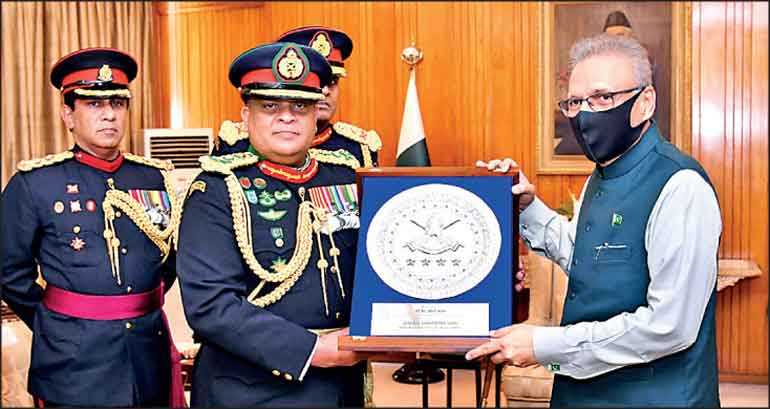
Sri Lankan army chief visits Pakistan

Sri Lankan Army Chief General Savendra Salwa visited Pakistan and met with Pakistan Army Chief General Qamar Javad Bajwa and President Arif Alvi, reported Dawn. The visit came a month after Pakistan Prime Minister Imran Khan undertook his first two-day official visit to Sri Lanka last month. Pakistan had also extended a $50 million defense credit line to Sri Lanka during that visit.

During his visit, President Alvi invited the people of Sri Lanka to take tours of the Buddhist heritage sites in Pakistan in order to promote the country’s tourism. Pakistan, he claimed, valued its relationship with Sri Lanka.

He also underlined the need for enhancing economic, cultural, and defense ties between the two countries. During the meeting, Alvi also raised the issue of Kashmir with Gen Silwa.

“The visiting dignitary acknowledged Pakistan’s continuous efforts for peace and stability in the region, especially in the Afghan peace process, and pledged to further enhance bilateral relations between both countries,” a release by the Pakistan army media wing (ISPR) reads.

During his meeting, the two leaders discussed matters of mutual interests, regional security issues, and ways to enhance military cooperation. Gen Salwa was also called on Prime Minister Imran Khan on Friday.

Sri Lanka’s approves China’s Sinopharm Covid-19 vaccine for emergency use

Sri Lanka’s National Medicines Regulatory Authority (NMRA) on Saturday approved China’s Sinopharm Covid-19 vaccine for emergency use in the island country.

According to State Minister of Production, Supply and Regulation of Pharmaceuticals Channa Jayasumana, this is the third Covid-19 vaccine to be approved in the country after the AstraZeneca and Russia’s Sputnik V jabs, reports Xinhua news agency.

Earlier this month, General Manager of the State Pharmaceutical Corporation (SPC) Dinusha Dassanayake said the SPC had also made an application to the NMRA to clear China’s Sinovac vaccine for emergency use.

Sri Lanka is in the midst of a mass inoculation program as it began inoculating all those above 30 years old in the urban Western Province from mid-February, after vaccinating frontline workers and health workers with the AstraZeneca doses.

Sri Lanka received AstraZeneca doses from India in January and February.

It also received 264,000 doses of the AstraZeneca vaccine under the World Health Organization-led COVAX facility which is being administered to those above the age of 60 years.

Source:IANS

Zahran Hashim, Kattankudy and the Islamic State in Sri Lanka By D. B. S.Jeyaraj

The final report of the Presidential Commission of Inquiry (PCoI) into the Easter Sunday attacks was handed over to President Gotabaya Rajapaksa by the Chairman of the Commission, Supreme Court Judge Janak de Silva at the Presidential Secretariat on February 01, 2021. Former President Maithripala Sirisena appointed the Commission of Inquiry on September 22, 2019, to investigate and report on the series of terrorist attacks on Easter Sunday and to recommend necessary action based on the findings. The first and second interim reports were handed over to the President on December 20, 2019 and on March 02, 2020, respectively.

The final report’s release has once again drawn attention to Mohammed Zahran Mohomed Hashim known as Zahran Hashim. The fiery Muslim preacher from Kattankudy in Batticaloa was a man about whom very little was known outside of Islamic circles before the Easter Sunday bombings. However, his name is now a household word as the alleged mastermind behind the Terror attacks on April 21, 2019. This column intends to focus on Zahran Hashim alias “Abu Ubaidah” and his deadly legacy this week.

Kattankudy

Mohammed Zahran Mohomed Hashim was born in the Muslim coastal town of Kattankudy in 1985. Kattankudy pronounced in Tamil as ‘Kaathaankudi’ is situated 211 miles away from Colombo in the Eastern littoral known as ‘Ezhuvaankarai’ (shore of the rising sun). It is a very small place with a land area of 2.56 sq. km. and 1.33 sq. km. of inland waterways. Kattankudy is reportedly the most densely populated town in Sri Lanka with 6,726 residents per square kilometre. The 2012 Census estimated the population in the Kattankudy urban council area as 47,603. Many in Kattankudy dispute these estimates saying thousands of permanent residents who were temporarily away in other parts of the Island or overseas were not enumerated.

In recent times, many Kattankudy residents have sought employment in the Middle-East. This has resulted in increased Islamisation of the Wahabi variety. Wahabis are an orthodox Islamic sect originating in Saudi Arabia

The thickly populated Kattankudy is arguably the most prosperous Muslim town in the East. It is said that Kattankudy is the busiest business centre in the Batticaloa District. The first Muslim Central College in Sri Lanka was established in Kattankudy in 1930. Kattankudy has produced many teachers, lawyers, accountants, engineers, academics and diplomats over the years. In addition, the natives of Kattankudy are well-known for their entrepreneurial skills and business acumen.

A very large number of leading Muslim commercial establishments in the East as well as in other areas of the island belong to people from Kattankudy. So much so that there is a popular saying in Tamil about there being no place in Sri Lanka without a “Kaaham” (crow) or a “Kaathaankudiyaan” (Man from Kattankudy). There is also a booming apparel industry in the town. Kattankudy is reputed for its mats, carpets, sarees and sarongs.

“Qahtankudy”

Interestingly enough there is a widely held belief among Kattankudy denizens that their ancestors hailed from the Qahtan region of South Arabia in what is present-day Yemen. It is said that Arabs who came from Qahtan known as Qahtanis married local Tamil women and got domiciled. The name Kattankudy is said to mean “Qahtan Settlement”. Kattan is derived from Qahtan while Kudi/y means settlement in Tamil. Some years ago there was even a proposal that Kattankudy’s name be officially changed to “Qahtankudy”. It was rejected. However, in recent times Kattankudy has acquired the hallmarks of an Arabian town. This is due to greater interaction between the people of Kattankudy and middle-eastern countries.

In recent times, many Kattankudy residents have sought employment in the Middle-East. This has resulted in increased Islamisation of the Wahabi variety. Wahabis are an orthodox Islamic sect originating in Saudi Arabia. Wahhabism is an ultra-conservative version of Islam that harks back to the past and rejects any religious innovation that came into being after the first three centuries of Islam. It seeks to purify Islam by practising monotheistic worship and rejecting other deviant forms.

Kattankudy today is a modern township bustling with women clad in Black Abayas and men sporting bristling beards. Date palms are grown within urban precincts and many signboards and street arches have Arabic lettering. Kattankudy has more than 60 registered and unregistered mosques. Except for a handful, most of them are in practice influenced by Wahabi ideology.

It must also be remembered that Kattankudy is the place where the LTTE in 1990 shot and killed people in four mosques while they were praying. 147 died in all. Kattankudy was affected badly by the 2004 tsunami too. 108 were killed and 93 reported missing. Some 2,000 dwellings were destroyed or damaged.

Born in 1985

It is in this Kattankudy milieu that Zahran Hashim was born in 1985 to Hayath Mohomed Hashim and Sameema Hashim. It is said that the surname Hashim was earlier spelt as Cassim but later changed to Hashim. The family resided in the Ward 3 area in the town. Zahran was the eldest of five children. Following Zahran were two brothers Zain and Rilwan. The youngest two were sisters Madaniya and Yaseera. All of Zahran’s siblings were married with children.

Zahran Hashim himself was married in 2010. His wife Fathima Haadiya is from Kekunagolla near Narammala in the Kurunegala District. She was a student at the Kekunagolla National School when the wedding took place. They had two children, a boy and a girl.

Jamiyyathul Al-Falah Madrasa

After obtaining primary and secondary education up to GCE O/L at a government school in Kattankudy, Zahran enrolled at the Jamiyyathul Al-Falah Madrasa (Theological College) in Ward 4 of Kattankudy in 2001. He was a very bright student but soon fell foul with his teachers due to his insolence and contrarian views. Young Zahran became very fluent in Arabic and was soon attracted to fundamental Islam and Tawheedism encapsulating the ‘indivisible oneness concept of monotheism in Islam.’

The thickly populated Kattankudy is arguably the most prosperous Muslim town in the East. It is said that Kattankudy is the busiest business centre in the Batticaloa District

Zahran Hashim became extremely rebellious at the Madrasa and argued vehemently with his teachers. He also refused to abide by norms and rules. As a result, he was expelled from Al–Falah Madrasa in 2007. Had he completed his full course of studies, Zahran would have become a ‘Moulavi’ or religious scholar/teacher. But he did not and therefore was officially denied such status. In later years, many of his followers addressed him as Zahran Moulavi and Hashim did not correct them. Some of his disciples opined that Zahran had completed his studies at a school in the South.

After being ejected from the Madrasa, Zahran Hashim attached himself to Sri Lanka Tawheed Jamaat (SLTJ). Tawheed, also spelt as Thowheeth, Thawheed and Tawhid, denotes oneness with God. The Oxford Dictionary of Islam states as follows: Tawhid is the defining doctrine of Islam. It declares absolute monotheism—the unity and uniqueness of God as creator and sustainer of the universe. Used by Islamic reformers and activists as an organising principle for human society and the basis of religious knowledge, history, metaphysics, aesthetics, and ethics, as well as social, economic, and world order. Jamaat on the other hand means assembly or congregation in Arabic.

National Tawheed Jamaat (NTJ)

Zahran Hashim initially worked with the Sri Lanka Tawheed Jamaat (SLTJ) in Kattankudy after his Madrasa studies ended abruptly. But Zahran with his ultra-radical views was soon at loggerheads with SLTJ. He then struck out on his own and formed his own organisation called National Tawheed Jamaat (NTJ). Associated with Zahran in this venture was his one-time mentor Mohamed Ibrahim Mohamed Naufer known as Naufer Moulavi. Neither SLTJ nor its off-shoot the Ceylon Tawheed Jamaat (CTJ) had anything to do with Zahran Hashim’s National Tawheed Jamaat.

Although short of funds, Zahran set up a makeshift prayer centre at a wooden shed in Kattankudy and got down to work. Hashim was a very powerful orator in Tamil and Arabic. He was forcefully effective in putting his viewpoint across. Soon Zahran Hashim became a popular figure in Kattankudy. Furthermore, he was invited by Muslim devotees in different parts of the island to conduct religious lectures. Zahran Hashim travelled to many districts in Sri Lanka to address Muslim congregations. It was during the course of such visits to the Northwestern Province that he met his wife Fathima Haadiya in Kekunagolla and married her. She was introduced to Zahran by Naufer Moulavi who was married to Haadiya’s aunt.

The fiery Muslim preacher from Kattankudy in Batticaloa was a man about whom very little was known outside of Islamic circles before the Easter Sunday bombings

Zahran Hashim with his ultra-radical views and flowery speeches became a magnet for young people of both sexes. He opened a Tamil website for NTJ and propagated his viewpoint. This attracted many in Tamil Nadu as well as those from Sri Lanka and Tamil Nadu who were working in gulf countries. He later operated a Facebook account on the same lines. Soon donations began to pour in. The NTJ Mosque was now housed in a modern building at New Kattankudy – Ward 3. Although Zahran’s oratory was relished by many at meetings, not many participated in the prayers conducted at the National Tawheed Jamaat Mosque also known as ‘Tharul Athar Athaviya.’ This may have been due to the proliferation of different mosques in Kattankudy.

Zahran Hashim also travelled around the country enrolling members for his National Tawheed Jamaat. The National Tawheed Jamaat (NTJ) began to grow in strength and influence. Even as NTJ began developing into a significant entity, Zahran Hashim’s political thinking became more and more extreme. He began sympathising openly with the Islamic State of Iraq and the Levant (ISIL) and the Islamic State of Iraq and Syria (ISIS).

The turning point came in June 2014 when ISIS rebranded itself as Islamic State (IS) and announced the creation of a ‘Caliphate’ (Islamic State) erasing all State borders and making Abu-Bakr Al-Baghdadi the self-declared supreme leader of the world’s estimated 1.5 billion Muslims. Thereafter, Zahran Hashim became an avid propagandist of IS in Tamil. He kept posting news items about IS battlefronts in Tamil and also wrote opinion pieces in support. Zahran Hashim was seen as the voice of IS in some Muslim circles.

Baduriya Mosque

Everything seemed hunky-dory for him but Zahran Hashim got into trouble by overreaching himself. To most Wahabi influenced Muslims in Kattankudy, the Baduriya Mosque at the Aliyar Junction in Ward 6 is anathema. This is because Baduriya Mosque adheres more to mystical Islam known as ‘Sufism’ and adopts practices such as paying homage to saints and indulging in grave worship. Wahabis regard this as blasphemous and heretical.

So in an ill-advised bid to teach a lesson to Baduriya Mosque people, Zahran Hashim organised a National Tawheed Jamaat meeting at the Aliyar Junction in close proximity to the mosque. When the meeting commenced on March 16, 2017, speaker after speaker made insulting references to Baduriya Mosque. The intention was to provoke Baduriya Mosque devotees. Zahran Hashim had brought clubs and swords clandestinely to the venue and kept them concealed on the stage. As expected, Baduriya Mosque devotees were provoked by the insults and retaliated by pelting stones at the stage. Zahran Hashim and his followers then set upon their rivals and attacked them with swords and clubs.

It must also be remembered that Kattankudy is the place where the LTTE in 1990 shot and killed people in four mosques while they were praying. 147 died in all. Kattankudy was affected badly by the 2004 tsunami too

In the clash that ensued several persons on both sides were injured. Three sustained serious injuries and were hospitalised. The people of Kattankudy were incensed at the violence done in the name of religion. A protest demonstration organised by the Baduriya Mosque management opposite the Kattankudy Islamic museum was well attended. There was tremendous pressure on the police to take action. As a result, nine from NTJ Mosque and two from Baduriya Mosque were arrested and remanded for several months. These included Zahran’s brother Zain. Zahran himself was wanted by the police. He chose to evade arrest by absconding. A story was spread in Kattankudy that Hashim had gone to the Maldives.

Tamil Nadu and Kerala

Zahran Hashim left Kattankudy and moved to the Northwestern Province from where his wife hailed. After spending some time in Sri Lanka, Zahran relocated to India where he began interacting with Muslim extremist groups in the South Indian States of Tamil Nadu and Kerala. His sojourns were mostly in the Malappuram District of Kerala and the Coimbatore, Trichy, Thirunelvely, Vellore, Nagapattinam. Kanniyakumari and Ramanathapuram Districts of Tamil Nadu. All these districts have sizeable Muslim populations.

It was during his lengthy stay in India that Zahran Hashim underwent a transformation. From a radical activist propagating fundamental Islamic ideology and eulogising the Islamic State, Zahran Hashim turned into an exponent of armed militancy and practitioner of violence. In a remarkable turnaround, Zahran Hashim resolved to return to Sri Lanka and promote violence for what he thought was the cause of Islam.

Jamaate Millat Ibrahim (JMI)

After returning to Sri Lanka Zahran began cultivating links with rich and educated supporters of the Islamic State (IS). The aim was to enlist more volunteers to go to the middle-east and fight for the IS. But the anti-Muslim violence in Ampara town in February 2018 and the Kandy District anti-Muslim violence of March 2018 made him change his mind. Zahran now wanted to attack a symbolic target like the Ruwanweliseya in Anuradhapura or the Esala Perahera in Kandy. New members were recruited, arms and explosives collected and arms training workshops held. This re-invigorated extremist fervour caused a split in the NTJ. Zahran and his militant disciples broke away and began functioning in tandem with the Jamaate Millat Ibrahim (JMI).

Kattankudy has acquired the hallmarks of an Arabian town. This is due to greater interaction between the people of Kattankudy and middle-eastern countries.

The Islamic State (IS) objective of eliminating or subjugating the “Kaffirs” (non -believers/infidels) and establishing a world-wide Islamic “Calpihate” was something which Zahran embraced wholeheartedly. I have seen some video clips of his speeches. They were very powerful spectacles of persuasive oratory of inhuman nature. He referred to the Christians as “Siluvai Vanangihal” (worshippers of the cross) and Hindus and Buddhists as “Silai Vanangihal” (worshippers of statues). While calling for the destruction of “Kaffirs”, Zahran emphasised one point strongly. He said that even if the Kaffirs were good people who were friendly and helpful towards Muslims, they had to be destroyed when necessary.

Tragically the violence done has been perpetrated by a group of Sri Lankan Muslims in the name of the IS for what is said to be a Pan-Islamic cause

Those disturbing words came brutally alive when Zahran and his followers launched the Easter bombings of April 21, 2019. Two Catholic Churches, Two upmarket Tourist Hotels and an Evangelical Church were targeted in Colombo, Negombo and Batticaloa in the morning. Suicide bombers with explosives strapped to their bodies exploded themselves while worship was going on in Churches and breakfast was being partaken of in Hotels. 268 people were killed and over 500 injured as a result of that “bloody” Easter Sunday. It is suspected that the Islamic State (IS) persuaded Zahran into attacking Hotels and Churches. It is also believed Naufer Moulavi played a part in influencing Zahran.

Islamic State (IS)

Two days after, the international ‘Jihadist’ or Islamic militant movement known officially as Islamic State (IS) claimed responsibility for the terror and horror of ‘bloody’ Easter in Sri Lanka. It attributed the attacks to “Islamic State fighters”. A few days later in April 2019, the then-leader of ISIS Abu-Bakr Al-Baghdadi praised the attackers for what he called retaliation against “the West” for defeating ISIS the previous month in Baghuz, Syria.

The IS, known earlier as Islamic State of Iraq and the Levant (ISIL) and Islamic State of Iraq and Syria (ISIS), aimed at establishing a worldwide ‘Caliphate’ or a single Islamic government. In 2014, the IS controlled extensive swathes of territory in Iraq and Syria. Subsequently, the areas held by IS shrank greatly, thanks to the military defeats inflicted by the US-led coalition of forces.

From a radical activist propagating fundamental Islamic ideology and eulogising the Islamic State, Zahran Hashim turned into an exponent of armed militancy and practitioner of violence

While the IS adopted positional warfare to preserve territorial control in the Middle-East, it resorted to brutal terrorist attacks at another level on a worldwide basis. After its territorial hold began to diminish in Iraq and Syria due to military reversals, the IS began to intensify and accelerate terrorist attacks elsewhere.

This was to demonstrate that the movement could not be crushed by the loss of territory and that it possessed a lethal, global reach. In order to carry out attacks in other parts of the world, the IS utilised militant Islamic organisations in those countries as agents by outsourcing deadly missions of violence to those entities. This is what is deemed to have happened in the case of Sri Lanka too.

According to the Federal Bureau of Investigation (FBI) of the USA, men who were part of a group of ISIS supporters which called itself “ISIS in Sri Lanka” had collaborated with IS in carrying out the Easter attacks in Sri Lanka. It is believed that Zahran Hashim was the linchpin in this lethal nexus between the Islamic State and the “ISIS in Sri Lanka”.

“Abu Ubaidah”

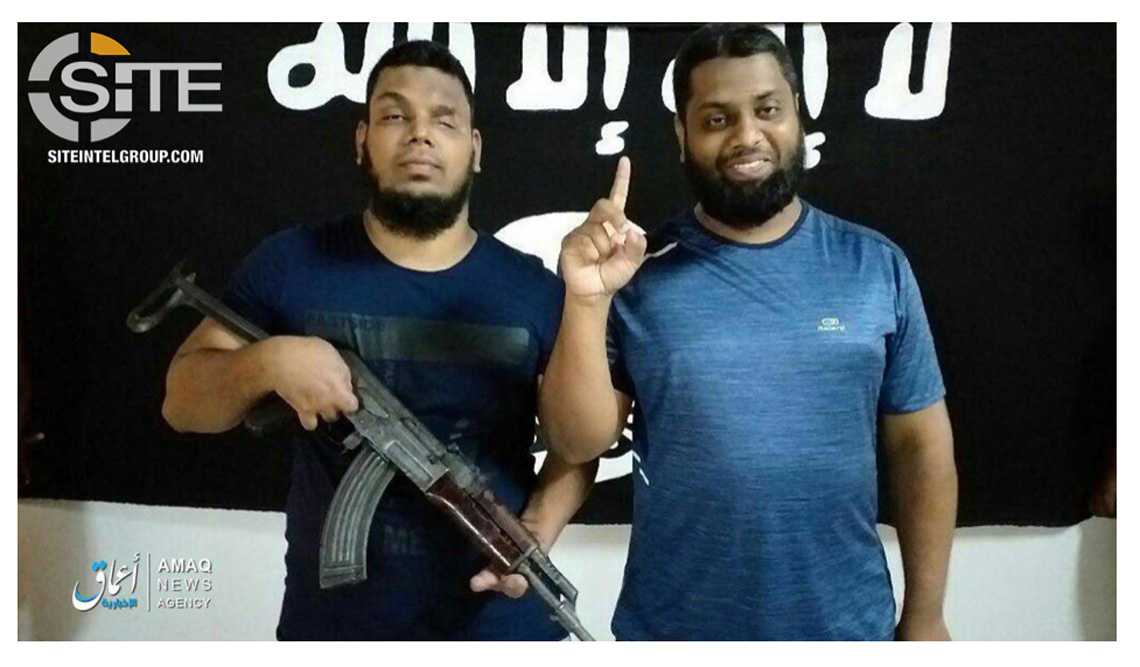
Zahran Hashim alias ‘Abu Ubaidah’ was one of the two suicide bombers who targeted Shangri-La Hotel at Galle Face. A media release by the Aamaq news agency on behalf of the Islamic State (IS) revealed that Zahran had adopted the nom de guerre “Abu Ubaidah” in the IS. Abu Ubaidah refers to Abu Ubaidah Amir ibn Abdillah ibn al-Jarra who was one of the ten prominent companions of Prophet Muhammad. He later served as a commander of the Rashidun Army under Caliph Umar. Abu Ubaidah, credited with several military victories, was hailed then as the “commander of all commanders.

Tragically the violence done has been perpetrated by a group of Sri Lankan Muslims in the name of the IS for what is said to be a Pan-Islamic cause. The misguided zeal and fanatical passion of Mohammed Zahran has caused great damage to the Muslim people of Sri Lanka. The Islamic State (IS) has only brought much death, destruction, displacement, misery and sorrow to many people of the Islamic faith living in different parts of the world. Sri Lanka is no exception.

D.B.S.Jeyaraj can be reached at dbsjeyaraj@yahoo.com