Covid cluster at a garment factory in Vavuniya: 21 infected at present

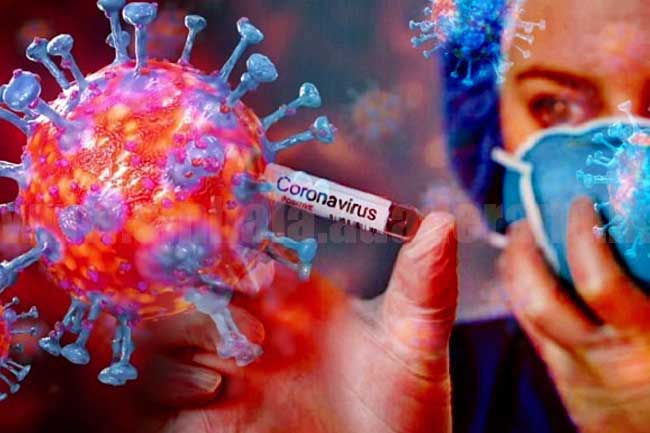
Vavuniya Public Health Inspectors say that 21 employees of a leading garment factory in the Vavuniya District have been infected with the Covid -9 virus.

The Vavuniya Public Health Inspectors said PCR tests conducted following the confirmation that a group of employees were infected have confirmed that 21 more workers have been infected with the virus.

The garment factory employs nearly 700 people and the workers have been referred for PCR tests, Public Health Inspectors said.

However, people in the area told Neth New that they could see that the garment factory where the infections were reported was continuing to operate. As a result, there is a fear among them that there is a possibility of a serious health risk in the area.

Therefore, the residents of the area have reportedly requested the health authorities to temporarily close the garment factory where the infected persons were found and prevent the spread of the Covid in the area.

Parliamentary approval needed to hold PC polls – Dinesh

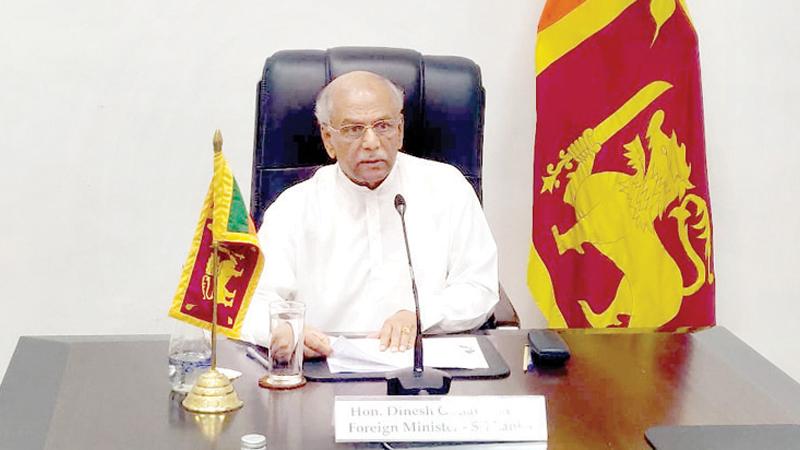
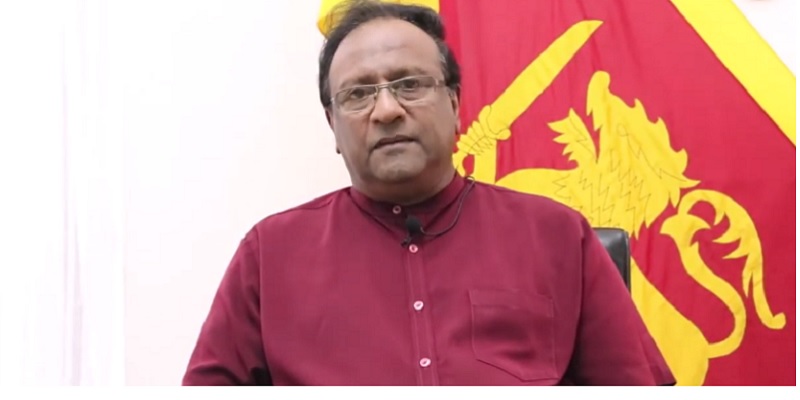
Parliamentary approval should be obtained before holding the Provincial Council elections, says Minister of External Affairs Dinesh Gunawardena.

Discussions are currently being held regarding the action to be taken in connection with the holding of the Provincial Council elections, the Minister added

Gunawardena mentioned this addressing the media following a ceremony held in Trincomalee.

“The previous government changed the law holding provincial council elections. However, the Supreme Court has ruled it illegal. Therefore, no one can hold an election without making a change in the law. The Supreme Court has asked the law to be fixed and passed.”

Posted in Uncategorized

Revised Core Group draft resolution tabled: Calls for implementation of 13A

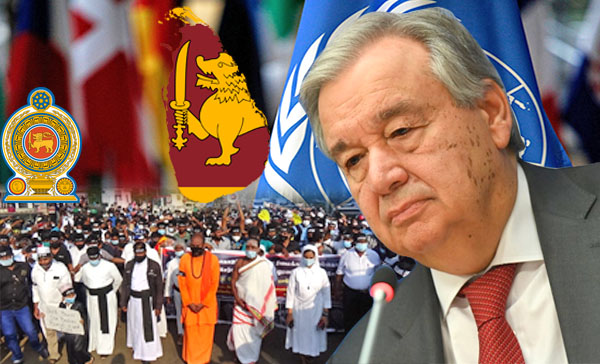
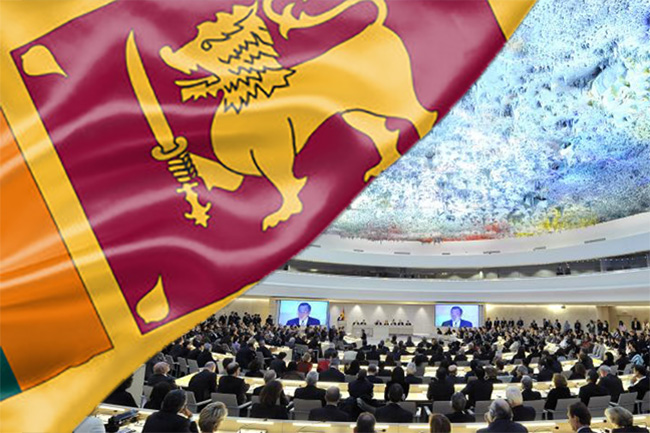
The draft of the revised Resolution by the United Nations (UN) Core Group of countries on Sri Lanka was tabled at the UN Human Rights Council (UNHRC) on Friday night (12) with more revisions, including a paragraph calling for the implementation of the 13th Amendment (13A) to the Constitution.
The Resolution, titled “Promoting reconciliation, accountability, and human rights in Sri Lanka”, was presented by the Core Group comprising Canada, Germany, Malawi, Montenegro, North Macedonia, and the UK.

The new paragraph on 13A also urged Sri Lanka to fulfil the commitment to devolve political power.

It said: “Calling upon the Government of Sri Lanka (GoSL) to fulfil its commitments on the devolution of political authority, which is integral to reconciliation, and the full enjoyment of human rights by all members of its population and encouraging the Government to respect local governance, including through the holding of elections for provincial councils (PCs), and to ensure that all PCs, including the Northern and Eastern PCs, are able to operate effectively, in accordance with the 13th Amendment to the Constitution.”

When the draft was revised for the first time, a new paragraph was inserted to highlight the joint statement issued on 26 May 2009 by then President Mahinda Rajapaksa and then UN Secretary General Ban Ki-moon to seek a political settlement and to bring about lasting peace and development in Sri Lanka. This paragraph remains unchanged.

It also said that states should comply with their relevant obligations under human rights law and international humanitarian law (IHL), including where applicable to prosecute those responsible for gross violations of human rights law or serious violations of IHL.

The Resolution has been revised to remove “positive” from the sentence which read “positive engagement between the GoSL and the Office of the UN High Commissioner for Human Rights (HCHR) between 2015 and 2019”. Now, it simply says “the engagement”, and the timeframe “between 2015 and 2019” has also been taken out.

The increased marginalisation of the Tamil and Muslim minorities, restrictions on media freedom, and restrictions on the public memorialisation of victims of war, including the destruction of a memorial, have been added in the new draft as areas of serious concern.

The paragraph on the mandatory cremation of Covid-19 victims has been amended to take off the sentence, “the decision made by the GoSL to mandate cremations for all those deceased from Covid-19”. The entire paragraph has not been taken out, however, as reportedly requested by the Government stating that the burial of victims has been allowed. The relevant paragraph now says: “…Expresses further concern that the response to the coronavirus (Covid-19) pandemic has had an impact on the freedom of religion or belief and exacerbated the prevailing marginalisation of and discrimination against the Muslim community, and that cremations for those deceased from Covid-19 have prevented Muslims and members of other religions from practicing their own burial-related religious rites, and has disproportionately affected religious minorities and exacerbated distress and tensions.”

The Resolution called on Sri Lanka to ensure the effective and independent functioning of the Human Rights Commission of Sri Lanka, Office on Missing Persons, and Office for Reparations to deliver their respective mandates.

It also called upon Sri Lanka to protect human rights defenders, to end surveillance, and to foster the freedom of religion or belief.

The final paragraph has been amended to include not only a written update but also an oral update from the Office of the UNHCHR at two separate UNHRC sessions instead of one.

Accordingly, the Resolution requested the UNHCHR to enhance monitoring and reporting on the situation of human rights in Sri Lanka, including on progress in reconciliation and accountability, and to present an oral update to the UNHRC at its 48th Session, as well as a written update at its 49th Session.

It said that a comprehensive report that includes further options for advancing accountability should be presented at the UNHRC’s 51st Session. Both reports are to be discussed in the context of an interactive dialogue.

Meanwhile, the UK Parliament, on 12 March, said that its parliamentarians would hold a general debate on a motion on the UK’s commitment to reconciliation, accountability, and human rights in Sri Lanka.

The House of Commons said that the general debate put forward by backbench MPs Siobhain McDonagh, Elliot Colburn, and Edward Davey will be held on 18 March.

However, Foreign Affairs Minister Dinesh Gunawardena said that Sri Lanka cannot in any way agree to the said Resolution, adding that the country’s response to the final draft and the final position on the matter would be declared next week at the UNHRC.

Gunawardena told The Sunday Morning earlier on Friday: “We cannot agree to the Resolution that they are bringing in. Many countries have already expressed their objection to the content during the meetings that have been held. We do have another round. We have not given a fixed date but we have the opportunity next week, after the Resolution is tabled. The Ambassador has the right to reply. We will make it next week.”

When queried about support at a vote on the Resolution, he said that Sri Lanka has no issue about the support of friendly countries.

“It is the western countries that run this. They do have a vote bloc. We are having fair support and it is growing. Only after the final draft is tabled will the reaction increase,” he added.


UNHRC’s latest draft resolution on Lanka incorporates India’s demand for devolution

The West-led Core Group on Sri Lanka in the UN Human Rights Council (UNHRC) on Thursday went a step further to get India’s support for the tough resolution it is planning to bring against Sri Lanka. It has incorporated India’s demand that Sri Lanka implement in toto, the 13th Amendment of the constitution, which devolves powers to the provinces.

According to DailyFT, the 11 March draft calls on the Government of Sri Lanka to fulfil its commitments on devolution of power, and “respect local governance” by holding Provincial Council Elections and ensuring all Provincial Councils function effectively in accordance with the 13th Amendment. The most recent revision to the paragraph on devolution also makes specific reference to the Northern Provincial Council. The Northern Province is predominantly Tamil.

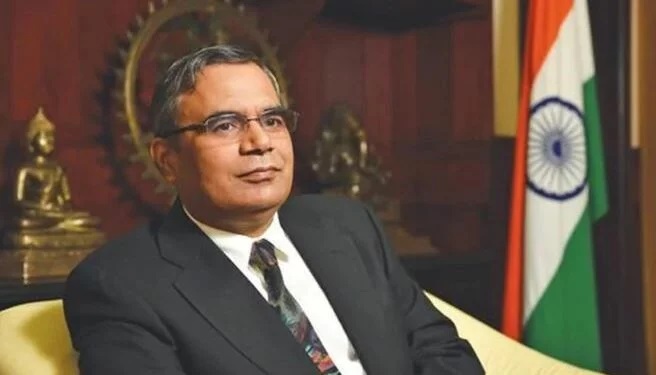
Significantly, the Indian High Commissioner Gopal Baglay is currently touring the Northern and Eastern Provinces, both with a significant Tamil population. He is meeting local leaders.

India believes that devolution of power under the 13A will pave the way for ethnic reconciliation and strengthen the unity and integrity of Sri Lanka. India’s Representative in the UNHRC Indra Mani Pandey told the council precisely that in February.

India was responding to an apparent move in Sri Lanka to jettison the 13A or do away with devolution of power to the provinces altogether, partly on account of the fact that the 13A is seen as a byproduct of the India-Sri Lanka Accord of 1987 which in turn is seen by Sinhala nationalists as an unbearable Indian imposition.

The revised draft of March 11 was expected to be tabled by end of business in Geneva Friday, ahead of a UNHRC deadline for submission of draft proposals. However, written revisions to the text are possible until March 16.

New Time Table

The revised draft calls on UN High Commissioner for Human Rights Michelle Bachelet to present an oral update on Sri Lanka’s progress on reconciliation and pursuing justice for grave human rights violations in September 2021, followed by a written report in March 2022, one year from now.

Bachelet is expected to deliver a comprehensive update to the Council when the resolution will come up for renewal at the UNHRC’s 51st Session in September 2022.

Data base on Lanka to be used for filing cases

In the 18-month period between the 46th Session of the Council and September 2022, the Office of the High Commissioner for Human Rights (OHCHR) will be mandated to establish a central database of information and evidence of human rights abuses in Sri Lanka that can be used to support international trials in jurisdictions outside the island.

If the resolution is adopted at the end of the current UNHRC session, the OHCHR evidence preservation mechanism on Sri Lanka will have an operating budget of at least $ 2 million and a team of between six to 10 personnel including legal officers, analysts, and victim support officers.

The evidence collection and preservation mechanism led by the OHCHR will be mandated to “develop strategies” for prosecutions against perpetrators of grave rights violations and related crimes in Sri Lanka. These include war-time abuses including enforced disappearances, summary executions and indiscriminate shelling of civilian and humanitarian targets, political murders and enforced disappearances and attacks against journalists.

Withdrawal From Co-Sponsorship

The previous Yahapalanaya administration won temporary reprieve from the prospect of international accountability measures when it co-sponsored a UNHRC resolution in 2015 and 2017. The previous Government pledged to establish local mechanisms with independent experts to seek accountability for serious human rights abuses and alleged war-time atrocities. But virtually none of the promises was kept. Promises followed by prevarication was the order of the day.

After the Gotabaya and Mahinda Rajapaksa came to power in 2019-2020, through Presidential and parliamentary elections, Colombo withdrew from the co-sponsorship saying that the co-sponsored resolution was unconstitutional, intrusive and divisive. The government also completely rejected the prospect of subjecting Lankan war heroes who liberated the country from a ruthless terrorist group to international criminal jurisdiction.

Lankan Foreign Minister Dinesh Gunawardena told the 46 th.Session twice that the Core Group’ endeavors were baseless, malafide and motivated by geo-political considerations. He repeatedly asked members to reject the resolution outright as such resolutions would be a threat to their own sovereignty and independence.

Source:newsin.asia

Posted in Uncategorized

President tells officials to focus on calling for PC elections soon

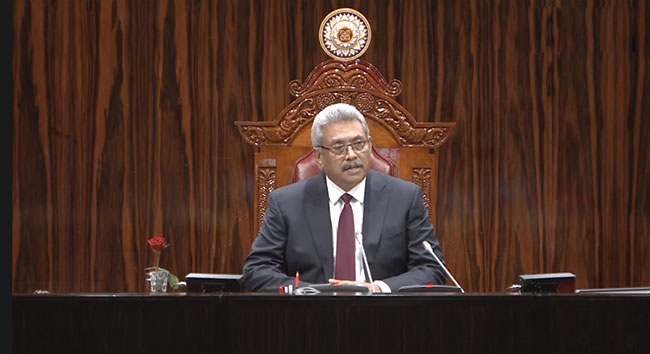
President Gotabaya Rajapaksa has instructed the relevant officials to take steps to do away with the Provincial Council (Amendment) Bill or its confusions and expedite the holding of the Provincial Council Elections, said the President’s Media Division.

According to a statement from the President’s Media Division, the President had pointed out that the Provincial Council (Amendment) Bill which included several segments including the Electorate System, Delimitation, a mix of the first-past-the-post/simple majority and proportional representation and composition of female representation which was moved by the former government was defeated and at present Provincial Councils are functioning in the absence of public representatives.

The President had emphasized on the need to raise awareness among the public of this situation and call for elections, it added.

The President had made these comment at a meeting with provincial council representatives of the Sri Lanka Podujana Peramuna on Friday (12).

Posted in Uncategorized

Core Group submits final draft resolution on Sri Lanka

The Core Group of countries have prepared the final draft of the resolution on Sri Lanka to be moved at the United Nations Human Rights Council (UNHRC), the Daily Mirror learns.

The resolution which has already been communicated to Sri Lanka, calls for the UN High Commissioner for Human Rights to enhance the monitoring and reporting of the human rights situation and progress on the reconciliation and accountability in Sri Lanka.

The resolution calls for the High Commissioner to submit a comprehensive report at the 51st session of the UNHRC.

Besides, an oral update has to be made at the 48th session.

Posted in Uncategorized

Salley must go to Saudi Arabia if he wants honour only Shari’a law: Minister

While claiming that former Western Province Governor Azath Salley’s recent statement would lead to religious extremism, Public Security Minister Sarath Weerasekara said Azath Salley should be arrested for making such statement.

Recently, he had allegedly said that he does not respect the law of the land but only respects and welcomes the Muslim law.

The minister said Salley’s remarks a statement has full of religious extremism.

“If he wants to act according to Shari’a law, he must go to Saudi Arabia. He cannot live in Sri Lanka. As long as he lives in Sri Lanka, he should act according to the law that prevails in Sri Lanka. We will arrest him and take legal action against him. I have personally told the CID to look into the matter,” the Minister said.

Posted in Uncategorized

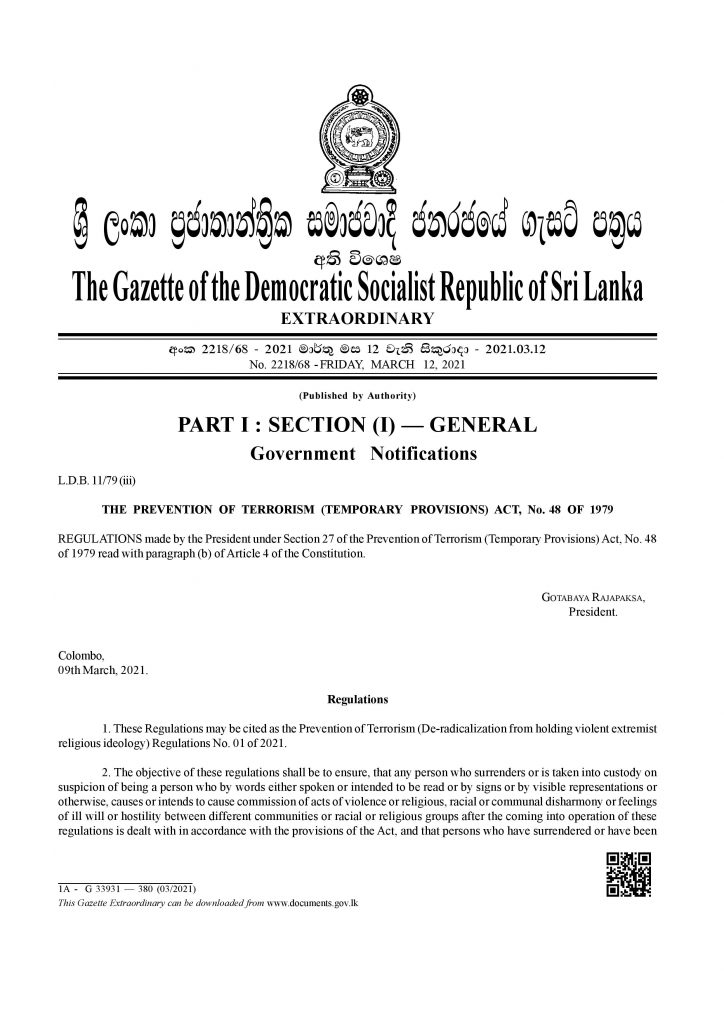
Gazette issued to de-radicalize detainees accused of extremism

President Gotabaya Rajapaksa has issued a gazette notice to de-radicalize detainees accused of extremism.

The gazette notice states that the objective of the regulations is to ensure that any person who surrenders or is taken into custody on suspicion of causing or intending to cause acts of violence or religious, racial or communal disharmony is dealt with in accordance with the provisions of the Act.

According to the gazette notice, any person who surrenders or is taken into custody on suspicion of being a person who by words either spoken or intended to be read or by signs or by visible representations or otherwise, causes or intends to cause commission of acts of violence or religious, racial or communal disharmony or feelings of ill will or hostility between different communities or racial or religious groups after the coming into operation of these regulations is dealt with in accordance with the provisions of the Act, and that persons who have surrendered or have been taken into custody in terms of any emergency regulation which was in force at any time prior to coming into operation of these regulations, continue in terms of these regulations, to enjoy the same care and protection which they were previously enjoying.

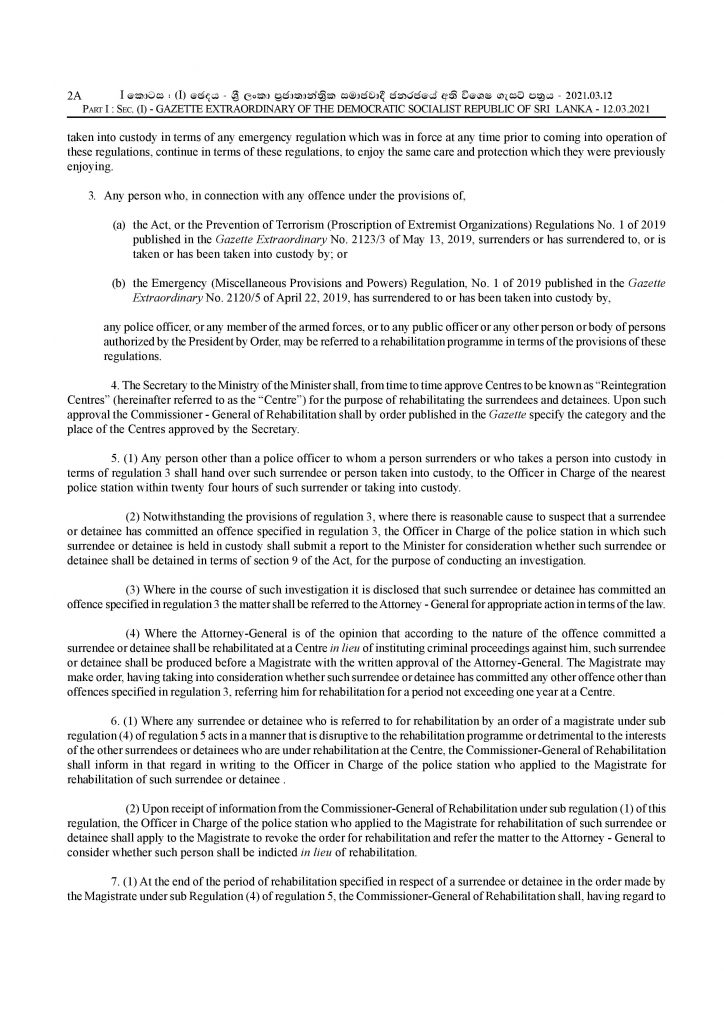
The gazette notice also states that any person who, in connection with any offence under the provisions of, (a) the Act, or the Prevention of Terrorism (Proscription of Extremist Organizations) Regulations No. 1 of 2019 published in the Gazette Extraordinary No. 2123/3 of May 13, 2019, surrenders or has surrendered to, or is taken or has been taken \ into custody by or the Emergency (Miscellaneous Provisions and Powers) Regulation, No. 1 of 2019 published in the Gazette Extraordinary No. 2120/5 of April 22, 2019, has surrendered to or has been taken into custody by, any police officer, or any member of the armed forces, or to any public officer or any other person or body of persons authorized by the President by Order, may be referred to a rehabilitation programme in terms of the provisions of these regulations.

The Secretary to the Ministry of the Minister has been instructed to from time to time approve centres to be known as “Reintegration Centres” for the purpose of rehabilitating the surrendees and detainees.

Any person other than a Police officer to whom a person surrenders or who takes a person into custody in terms of the regulations must hand over such surrendee or person taken into custody, to the Officer in Charge of the nearest Police station within twenty four hours of such surrender or taking into custody.

Notwithstanding the provisions of regulations, where there is reasonable cause to suspect that a surrendee or detainee has committed an offence specified in the regulations, the Officer in Charge of the police station in which such surrendee or detainee is held in custody must submit a report to the Minister for consideration whether such surrendee or detainee shall be detained in terms of section 9 of the Act, for the purpose of conducting an investigation.

Where in the course of such investigation it is disclosed that such surrendee or detainee has committed an offence specified in regulation 3, the matter must be referred to the Attorney General for appropriate action in terms of the law.

According to the gazette notice, where the Attorney-General is of the opinion that according to the nature of the offence committed a surrendee or detainee shall be rehabilitated at a Centre in lieu of instituting criminal proceedings against him, such surrendee or detainee must be produced before a Magistrate with the written approval of the Attorney-General.

The Magistrate may make order, having taking into consideration whether such surrendee or detainee has committed any other offence other than offences specified in regulation 3, referring him for rehabilitation for a period not exceeding one year at a centre.

If any surrendee or detainee who is referred to for rehabilitation by an order of a magistrate under sub regulation (4) of regulation 5 acts in a manner that is disruptive to the rehabilitation programme or detrimental to the interests of the other surrendees or detainees who are under rehabilitation at the Centre, the Commissioner General of Rehabilitation must inform in that regard in writing to the Officer in Charge of the Police station who applied to the Magistrate for rehabilitation of such surrendee or detainee.

Upon receipt of information from the Commissioner-General of Rehabilitation under sub regulation (1) of the regulation, the Officer in Charge of the Police station who applied to the Magistrate for rehabilitation of such surrendee or detainee can apply to the Magistrate to revoke the order for rehabilitation and refer the matter to the Attorney General to consider whether such person shall be indicted in lieu of rehabilitation.

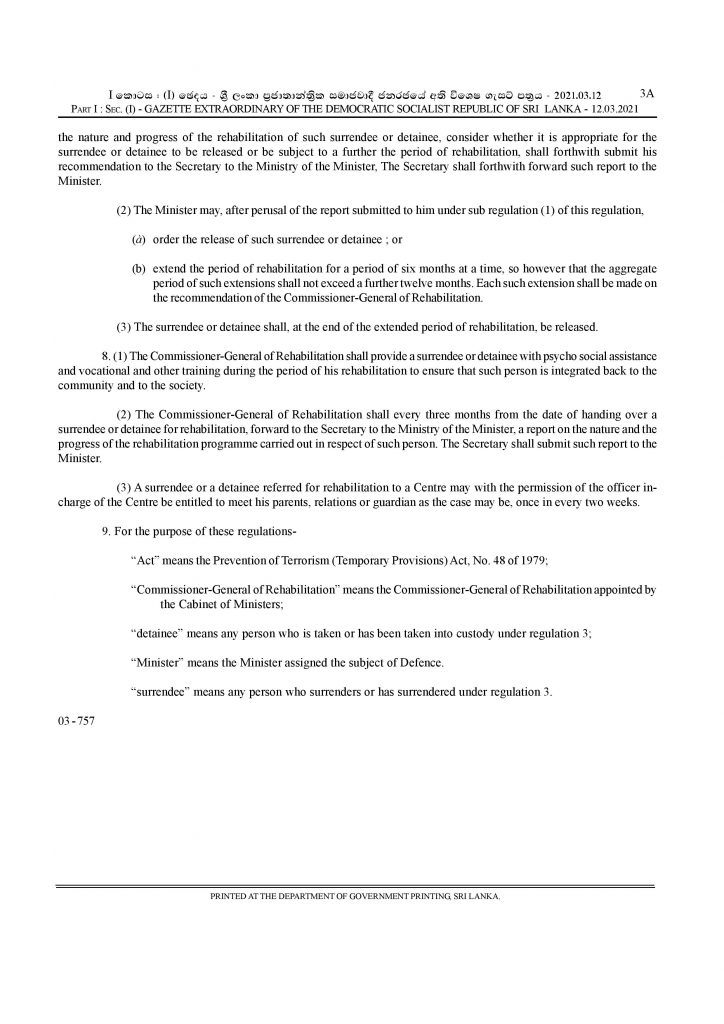
At the end of the period of rehabilitation specified in respect of a surrendee or detainee in the order made by the Magistrate under sub Regulation (4) of regulation 5, the Commissioner General of Rehabilitation shall, having regard to the nature and progress of the rehabilitation of such surrendee or detainee, consider whether it is appropriate for the surrendee or detainee to be released or be subject to a further the period of rehabilitation, shall forthwith submit his recommendation to the Secretary to the Ministry of the Minister, and the Secretary shall forthwith forward such report to the Minister.

The Minister may, after perusal of the report submitted to him under sub regulation (1) of the regulation, order the release of such surrendee or detainee or extend the period of rehabilitation for a period of six months at a time, so however that the aggregate
period of such extensions shall not exceed a further twelve months.

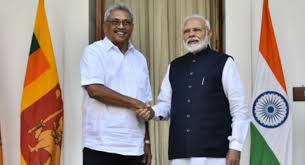
Modi speaks to President Rajapaksa days before Geneva vote

Indian Prime Minister Narendra Modi spoke to President Gotabaya Rajapaksa today, days before a vote in Geneva on a resolution against Sri Lanka.

All eyes are on the stand India will take on the resolution with some suggesting India will abstain from voting.

During the telephone conversation today Modi and Rajapaksa agreed to maintain regular contact between relevant officials, including in the context of the continuing COVID-19 challenges, the IANS news service reported.

The two leaders also reviewed topical developments and the ongoing cooperation between the two countries in bilateral and multilateral forums. Prime Minister Modi reiterated the importance of Sri Lanka to India’s Neighbourhood First policy.

The conversation between Modi and Rajapaksa took place days after Sri Lanka received 10 state-of-the-art railway passenger coaches from India as part of the supply of 160 coaches to Sri Lankan Railways by the Rail India Technical and Economic Service.

Meanwhile, the Indian High Commissioner to Sri Lanka Gopal Baglay also visited the Ram Setu in the island nation this week and offered his prayers on the occasion of Mahashivratri.

The official prayed for reinforcement of strong bonds between the people of India and Lanka, recalling their millennia-old links and the role of historical structures in creating these links.

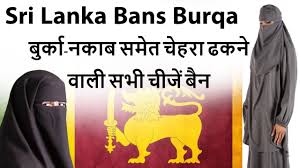
Public Security Minister signs order banning burqa in Sri Lanka

Minister of Public Security Rear Admiral (Rtd) Sarath Weerasekara says he has signed the Cabinet paper banning the burqa in Sri Lanka.

His remarks came during an event held at Munasinghe Aramaya in Kalutara today (March 13).

Explaining the reason for the move, the Public Security Minister said the burqa directly affects the national security of the country.

“We had a lot of Muslim friends when we were little. But Muslim females did not wear the burqa back then.”

Minister Weerasekara stressed that burqa is a symbol of religious extremism that came to Sri Lanka quite recently. “So, it will definitely be banned.”

Speaking on the regulation of Madrasas, he said there are more than 2,000 such schools in the country.

Minister Weerasekara said: “No one can arbitrarily open a school and teach the students whatever they want. All children aged from 5 – 16 years must study under a national education policy. We will take measures to ban more than 1,000 Madrasas which have not been registered under a national education framework.”

Posted in Uncategorized