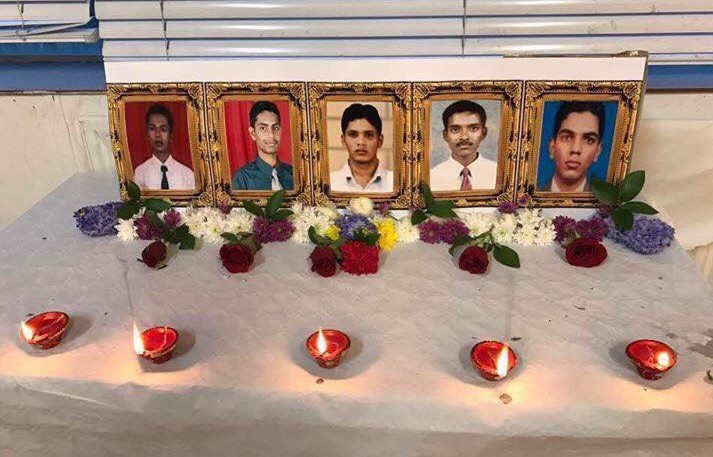
A father’s plea for justice: “Before Ragihar died, he cried out to me for help” – Dr. Manoharan

I am writing to thank you for your statement on 5 February continuing to draw attention to the human rights situation in Sri Lanka.

Victims in Sri Lanka desperately need your help to ensure accountability. I write to you here about the Trinco 5 case — an emblematic example of impunity. I would like this statement read out when you have your meeting on victims’ rights on 1 March 2021.

My beloved son Ragihar was murdered by Sri Lankan forces on 2 January 2006. Since that terrible day I have campaigned for the truth about what happened.

The last time I heard from my son, Ragihar, was a mobile phone message. It just said “DAD”. That was 2 January 2006. My son was a good boy and was celebrating finishing his exams with friends on the Trincomalee beach. That day I heard a bomb blast on the beach and 3 of my other sons returned home immediately. Ragihar did not. Within minutes of the explosion I got a call from him which said “Daddy, the forces are surrounding me”. He meant the security forces. That was all he said. Then there was silence – just the last unfinished text.

I immediately rushed to the scene but was blocked by Navy guards who wouldn’t let me through. I heard voices crying in Tamil “Help us! Help Us! But I couldn’t see properly as the lights where my son had been sitting near the Gandhi statue had purposefully been turned off. I then heard gunfire and lights go down near the statue.

Because I’m a medical doctor who had treated the Navy I was able to get access to the mortuary. I wanted to know if one of the bodies taken was my son. When I entered, the first body | saw was my beloved Ragihar. He had five gunshot wounds.

While I was there a police officer wanted me to sign a statement saying my son was a Tamil Tiger. If I agreed, they would release his body immediately. I refused. My son was a caring person. Ragihar was a good student, a table tennis and chess champion and a coach.

The government claimed my son was killed in a grenade attack. But 3 of the bodies I saw in the mortuary had head wounds showing they had been shot in the back of the head. I have photographs and the doctor’s report confirms this. The entry hole was small and the exit wound was big indicating the boys were shot at very close range. They were executed — 5 young men whose whole lives were ahead of them.

That evening I made a decision. I would challenge the authorities to tell the truth. I had seen Sri Lanka’s Special Task Forces near the scene and wanted them to be investigated.

From the moment I spoke out I received death threats. My other sons were also threatened. The journalist Mr Sugirdharajan who came with me to the mortuary to take photos was gunned down a few weeks later. His photos disproved the army’s claim that the students were killed in an explosion. A Buddhist priest who condemned Ragihar’s murder was also killed. It was simply too dangerous for me and my family to stay in Sri Lanka. With heavy hearts we left in December 2006. We lost our friends, medical practice and property. But our biggest loss is Ragihar.

As a father it is my duty to search for the truth. I have given video testimony to a Commission of Inquiry that was set up by former President Rajapaksa to investigate my case more commonly known as the ‘Trinco 5’ case.

Nothing came of these efforts. The government showed a lack of political will to acknowledge the role of the security forces. I could not stand idly by and decided to take my search for truth to the Human Rights Council in Geneva lobbying UN member states to ask Sri Lanka to tell the truth.

The Trinco 5 case has been included in the 2015 OISL report on Sri Lanka as an emblematic case of impunity or in simple language — a state cover up. 15 years on, the case remains stalled. It was proceeding as a non-summary case in a Magistrate’s Court in Trinco but on 3 July 2019, the 13 Special Task Forces suspects were apparently released.

How can the government fail to effectively investigate this case? This is a very serious murder case. The doctor’s report from the mortuary acknowledges the gunshot wounds. I cannot have any trust in the Sri Lanka criminal justice system if they can’t offer families like mine some answers.

The government claims the case stalled due to the inability to track down witnesses abroad but a serious murder case like this deserves proper investigation and a number of witnesses in Sri Lanka could still be interviewed. The Trinco 5 killings have been covered up because the security forces were involved.

Before Ragihar died, he cried out to me for help… when justice is served — when Sri Lanka finally tells the truth about what happened to my son — then we can say that Ragihar’s call for help has finally been heard. The Trinco 5 case is a litmus test of whether the Sri Lankan justice system is fit for purpose, In the absence of viable domestic avenues in Sri Lanka for accountability the United Nations Human Rights Council must adopt a robust resolution on Sri Lanka.

Please join me in asking the Sri Lankan government to ensure the Trinco 5 case is properly investigated.

( The statement made by Dr. Manoharan at a side event under the theme of “Sri Lanka: It is time for action to halt the rollbacks on human rights and ensure accountability” by UN Special Procedures)

Posted in Uncategorized

Chinese Permanent Representative in Geneva CHEN Xu extended China’s strong support to Sri Lanka in his official statement in the interactive dialogue on the OHCHR Report on Sri Lanka during the 46th Session of the UNHRC

Chinese Permanent Representative in Geneva Ambassador CHEN Xu on Thursday extended China’s strong support to Sri Lanka in his official statement in the interactive dialogue on the OHCHR Report on Sri Lanka during the 46th Session of the Human Rights Council.

The full text of the statement is as follows:

“As a friendly neighbour of Sri Lanka, China sincerely hopes that Sri Lanka maintains political stability, ethnic solidarity and national unity, and wishes Sri Lanka greater achievements in its national development. We commend the Government of Sri Lanka for its efforts to actively promote and protect human rights, advance sustainable economic and social development, improve people’s living standard, protect the rights of vulnerable groups, advance national reconciliation and combat terrorism.

It is the consistent stand of China to oppose politicisation and double standards on human rights, as well as using human rights as an excuse for interfering in other countries’ internal affairs. We are concerned about the clear lack of impartiality shown in the OHCHR’s report to this session on Sri Lanka and express our regret over the failure of the OHCHR to use the authoritative information provided by the Sri Lankan Government.

The so-called ‘preventive intervention’ and the proposed targeted sanctions contained in the OHCHR’s report are clear interference in the internal affairs of Sri Lanka and exceed the mandate of the OHCHR. We hope that the HRC and the OHCHR will strictly follow impartiality, objectivity, non-selectivity and non-politicisation principles, respect the sovereignty and political independence of all nations, respect the efforts of the nations for the protection and promotion of human rights, advocate constructive dialogue and cooperation, and abandon the practice of interfering in the internal affairs of other countries and exerting political pressure.”

Prior to the opening of the 46th Session of the UNHRC, President Gotabaya Rajapaksa wrote a letter to Chinese President Xi Jinping, requesting China’s understanding and assistance with the resolution. On 24 February, Foreign Minister Dinesh Gunawardena also made a telephone call to Chinese State Councilor and Foreign Minister Wang Yi, seeking continued solidarity and support.

Wang Yi reiterated that China is willing to unswervingly support Sri Lanka in order to jointly safeguard the legitimate rights and interests of developing countries, the basic norms governing international relations, and the purposes and principles of the UN Charter, including non-interference in other countries’ internal affairs.

Posted in Uncategorized

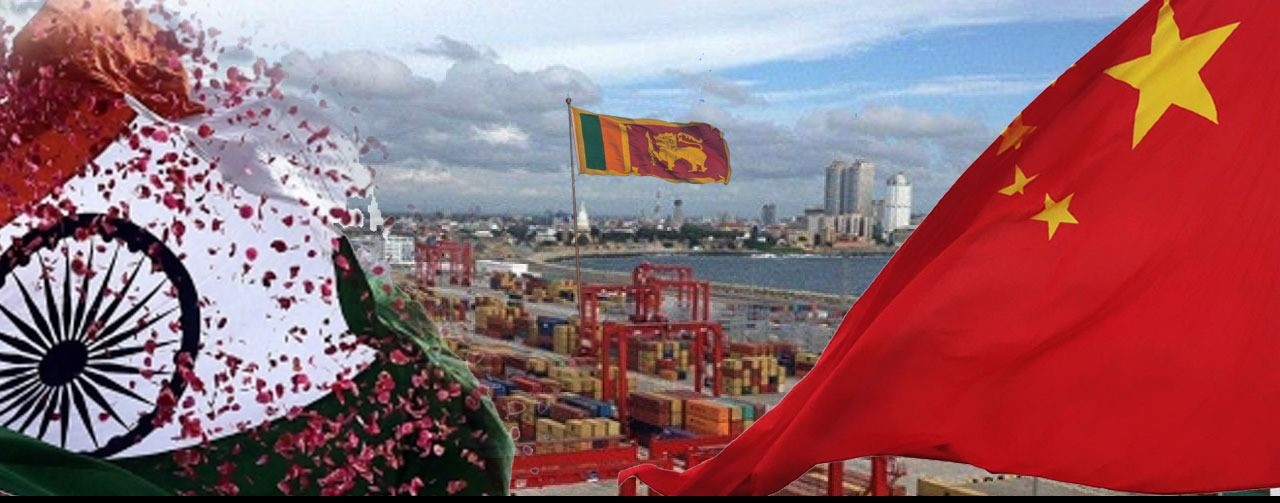
From ECT to WCT : Sri Lanka’s 360′ degree policy turn

The Cabinet of Ministers granted approval for the proposal to develop the West Container Terminal of the Colombo Port on a Build, Operate and Transfer basis for a period of 35 years as a public-private partnership with Adani Ports and Special Economic Zone Limited (APSEZ Consortium) and its local representative John Keells Holdings PLC and the Sri Lanka Ports Authority.

Cabinet Spokesperson Minister Keheliya Rambukwella told reporters on Tuesday (02), while India has named Adani Ports and Special Economic Zone Limited (APSEZ Consortium), which was earlier nominated to invest in ECT, Japan is yet to respond.

According to a document taken up for discussion at the cabinet meeting on the 01st of February, it was noted the WCT investment plan should be one similar to that of CICT or Colombo International Container Terminal.

According to that plan, China Merchants Port Holdings Company Limited has an 85% stake in CICT while the Sri Lanka Ports Authority has a 15% stake in it.

“Page 58 of the policy statement of the government, very clearly states the west terminal will have a public-private partnership with foreign partners, if required,” said Minister Rambukwella.

Though it is yet to be constructed, the long-term development plan of the Sri Lanka Ports Authority (SLPA) for the West Container Terminal includes the establishment of two floating LNG storage facilities.

India’s Adani Group already has a business named Adani Total Gas Limited which operates wide pipeline system supplying natural gas to most parts of India.

Adani Gas Ltd is involving another gas pipeline system with the Indian Oil Corporation Ltd, according to the company website.

The world war-era oil storage facility in Trincomalee is currently with the Indian Oil Corporation Ltd and it is also proposed for a joint venture across 100 acres of land for a bunkering facility for South Asia close to the storage facility.

The West Container Terminal will be of paramount importance for Sri Lanka’s future economy with respect to multiple business opportunities including transshipment of cargo.

Cabinet approves proposal to develop west terminal of Colombo Port with India

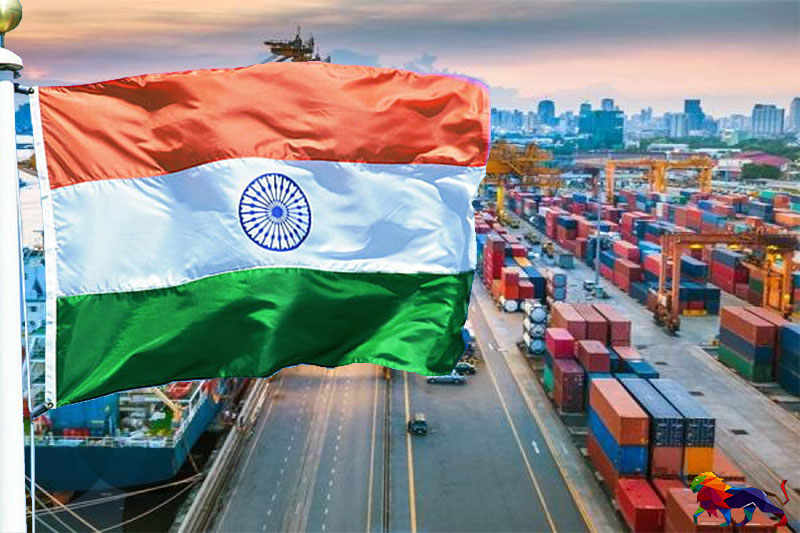
The West Container Terminal (WCT) at the Colombo South Port will be developed by India’s Adani ports and Special Economic Zone Limited (APSEZ Consortium).

The Cabinet has approved a proposal to develop the WCT as a Public- Private Limited Company in collaboration with the Sri Lanka Ports Authority and APSEZ Consortium.

The WCT will be developed under a Build, Operate, and Transfer (BOT) basis for a period of 35 years as a Public- Private Partnership with the Adani Group.

A proposal submitted by the Minister of Ports and Shipping to develop the WCT in partnership with the Adani Group and its local representative John Keells Holding PLC, and the Sri Lanka Ports Authority has been approved by the Cabinet.

A Cabinet appointed Negotiation Committee and a Project Committee will be appointed to evaluate the proposals submitted in this regard.

The Government had also called on the Japanese Government to collaborate in the development project.

The BOT plan approved by the Negotiating Committee was forwarded to the High Commission of India and the Embassy of Japan in Sri Lanka requesting for investors to be nominated to the project.

A proposal presented by Adani Ports and Special Economic Zone Limited has been approved by the Indian High Commission of Sri Lanka.

However, the Japanese Government is yet to name an investor.

The Cabinet appointed Negotiating Committee has presented its recommendation based on the discussions held between the two parties.

Every country in the UNHRC should support the oppressed Tamil people in Sri Lanka- TNA leader

Leader of the Tamil National Alliance (TNA) parliamentarian R. Sampanthan has said that every country participating in the UN Human Rights Council in Geneva should support the oppressed Tamil people in Sri Lanka.

Speaking to the media, the TNA Leader has said that a firm resolution must be adopted at the ongoing 46th Session of the UN Human Rights Council to punish those who committed war crimes during the war.

The leader of the Tamil National Alliance said that the resolution submitted by a number of Tamil political parties in this regard should be supported by other countries and added that a number of Tamil political parties have decided that the proposal submitted by Britain is not so significant.

MP Sampanthan noting that 11 years have passed since the end of the war but no one has intervened to bring justice to the victims of the war, said at least now the International Community should pay attention to the issue.

Posted in Uncategorized

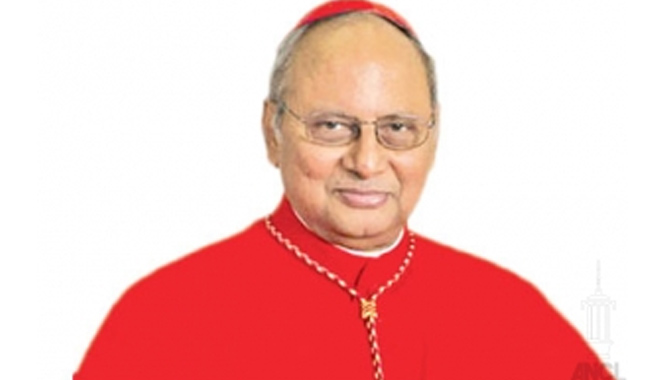
Easter Sunday Attack: PCoI failed to find who influenced the course of investigation – Cardinal

The report of the Presidential commission which probed the Easter Sunday attacks had failed to find out as to who had influenced the investigations in order to shield certain individuals, Archbishop of Colombo His Eminence Cardinal Malcolm Ranjith said today.

Cardinal Ranjith told a press conference that the church had received information that some ‘interested parties’ have influenced investigations in order save certain forces.

“We have information that there were certain groups had inflicted under influence on those who were investigated the attacks in order save certain individuals and the commission report had failed to disclose this” the Cardinal said.

“We have formed a team to study the Presidential commission report which includes Auxiliary Bishops of Colombo, priests and a few other experts. We will come up with an official stand on the commission report after the study. However we can clearly say the report had failed to address the core requirement of finding out who masterminded the attacks and who facilitated them,” he added.

Also he said the Catholic church did not expect the commission to make recommendation to proscribe any Buddhist organisation. Also he said he had received only one volume of the report. Cardinal Ranjith said both the previous and the present governments also cannot wash their hands off on this. Do we elect polictians to secure power? Not at all we elect them to mete out justice to people?” he said.

Auxiliary Bishop of Colombo Rev. Anthony Jayakody who also participated in the press conference elaborated on the ‘Black Sunday’ which has been declared on March 7, said all Catholics have been asked to come to church wearing black on that day. A special prayer will be recited for the Easter Sunday victims on that Sunday. This will be the beginning of a series of protests,” he said.

Posted in Uncategorized

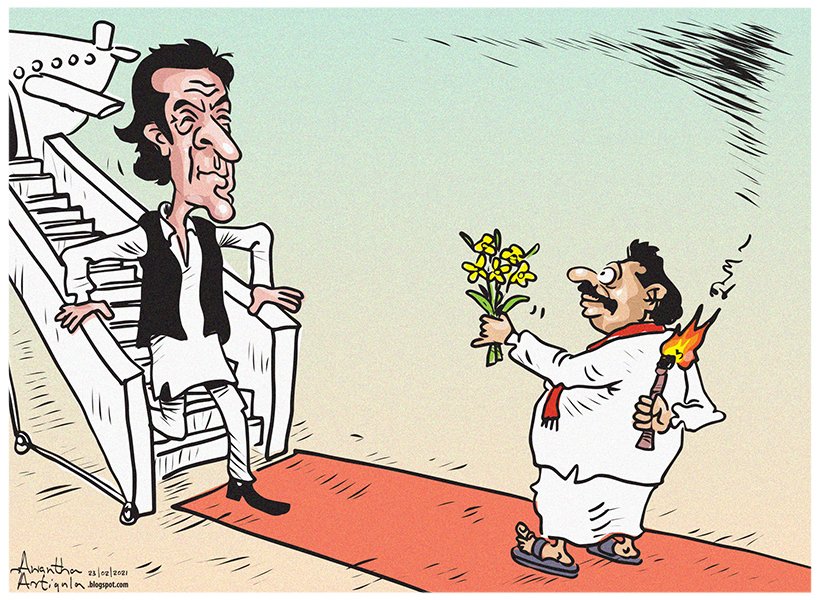
Imran Khan urged not to bat for Sri Lanka government in Geneva

Days after the Muslims made an appeal to the visiting Pakistan leader, uncertainty looms over Sri Lanka as it has put on hold the reversal of a controversial mandatory order to cremate the bodies of all those who died of Covid-19.

On Thursday, the government announced the reversal of the forced cremation policy that gave much pain to Muslims. However, the Director General of Health Dr Asela Gunawardena told journalists in Colombo that the guidelines for burials will not be ready until next week.

Local protests, international pressure and a visiting Pakistan Premier striking an apparent deal with the Rajapaksa regime forced the government to pull back.

A passionate letter from the Muslim Left Front (MLF), handed to the Pakistani High Commission in Colombo, on Wednsday (24) expressed the concerns of the Muslim community, while coming out strongly that Pakistan should not support the Sri Lanka government at the top UN rights body currently in session at a cost to the Tamils who have suffered immensely during the war and its aftermath.

The letter reflects the anxiety of many that Muslim burial rights might be granted upon the request of PM Imran Khan to negotiate a deal supporting Sri Lanka government efforts to reject an upcoming resolution at the UNHRC session in Geneva.

‘Not the act of a friend’

“This would not be the act of a friend to the people of Sri Lanka and come at the cost of the Tamil Community’s legitimate struggle to hold the state accountable for the heinous crimes committed against them”, the letter said.

It further stated, “Like Muslims, Tamils have been facing many challenges under successive regimes, especially the victims and family members of the enforced disappeared who have been demanding truth and justice”.

Recently Tamils and Muslims expressed their solidarity during the Pottuvil to Polikandy (P2P) rally seeking the global attention to their rights.

Raising concerns about continuous land grabbing, lack of accountability for war crimes, forced disappearance along with the cremation of those dead due to Covid-19 infection were among key points raised during the 5 day long P2P rally in the first week of February.

The MLF in their letter has highlighted the failure of the domestic justice for both Muslims and Tamils. This they say have prevented reconciliation in Sri Lanka and stopped the nation from moving forward towards a stable and secure future.

Whilst it is widely discussed that Sri Lanka sought the support of Pakistan to lobby the Organisation of Islamic Countries (OIC) to vote in its favour in the UNHRC session, the OIC Secretary-General in his address expressed their deep anguish against Sri Lanka.

“The OIC is concerned with the situation of Muslims in Sri Lanka as they are denied the rights to bury the bodies of virus victims,” said Yousef Al Othaimeen of Saudi Arabia. urged the Sri Lankan government to take swift action to guarantee and respect the right of burial of the Muslim community.

And this seems to have sent the Rajapaksa regime into panic mode and agreeing to bury those dead due to Covid infection.

Now that the ‘burning issue’ of forced cremation has been put on hold, the other issues faced by the Tamil and Muslim communities continue.

On March 22, the UNHRC is to vote on a resolution promoting reconciliation, accountability and human rights in Sri Lanka submitted by the United Kingdom, Canada, Germany, Malawi, Montenegro and North Macedonia.

Source:JDS

In the eye of the eagle -FT.LK

Blinken’s “atrocities” remark on Sri Lanka should make it clear to the Rajapaksa regime that though it rides on the dragon’s tail, it isn’t bunkered in the dragon’s lair; it is now in the eye of the eagle

Sri Lanka needs not only India’s vote but its active support – the Indian ‘umbrella’ to be unfurled—in Geneva next month. The carefully calibrated statement by the Indian representative on the OHCHR Report clearly declares before the international community, Delhi’s commitment both to Sri Lanka’s unity and territorial integrity as well as to the “aspirations” of the Tamil people, “meaningful devolution” and “the full implementation of the 13th Amendment”.

At precisely the moment that Colombo most needs and is soliciting Delhi’s support, GoSL’s Secr-etary/MFA trashed the 13th Amendment and meaningful devolution that Delhi’s representative had set out just days before as India’s bottom-line in his address to the UNHRC.

Executing 13A

The Rajapaksa regime’s views and intentions are made transparently clear in the interview given by Admiral Colombage, Secretary/Foreign Affairs, to Meera Srinivasan of The Hindu.

He absurdly asserts that the 13th Amendment/devolution is tantamount to/on a continuum with federalism, while federalism is tantamount to/on a continuum with secession.

“All the same, the Foreign Secretary does not see the existing 13th Amendment as a solution. …Despite Tamil parties seeking greater power devolution within an “undivided, indivisible Sri Lanka”, as senior Tamil Leader R. Sampanthan unfailingly states, Mr. Colombage views their demands as leaning towards separatism, “although they do not use the Tamil Eelam word.”

“When you say that you want a federal state, you want more devolution of powers, you want police powers, you want land powers, right? So that means you are asking for almost a separate state,” he said, referring to powers that the 13th Amendment envisaged, but the Centre is yet to part with.

“I personally feel that India also should not really harp on the same thing that prevailed in 1987, because the dynamics have changed…”

(India cannot abandon us: Sri Lanka – The Hindu)

This isn’t just the personal view of Admiral Colombage. It is the considered position of the Gotabaya Rajapaksa administration as evidenced by the dogmatic ‘denialism’ of its official (30-page) response in Geneva to the OHCHR Report: “The GoSL rejects the assertion in paragraph 7 of the report that “Sri Lanka’s armed conflict grew out of progressively deepening discrimination and marginalisation of the country’s minorities, particularly the Tamils”…Any attempt to attribute the war waged by the LTTE to alleged “discrimination and marginalisation” of Tamils, therefore, should only be perceived as an attempt to justify and legitimise the ruthless terrorism unleashed by the LTTE on the people of Sri Lanka including the Tamils themselves.” (p3)

By contrast, the Report of LLRC appointed by President Mahinda Rajapaksa and accepted by him (2011) affirmed:

“The Commission takes the view that the root cause of the ethnic conflict in Sri Lanka lies in the failure of successive Governments to address the genuine grievances of the Tamil people. The country may not have been confronted with a violent separatist agenda, if the political consensus at the time of independence had been sustained and if policies had been implemented to build up and strengthen the confidence of the minorities around the system which had gained a reasonable measure of acceptance. A political solution is imperative to address the causes of the conflict…” (LLRC Report, p 291, articles 8.150, 8.151)

The Gotabaya regime rejects this diagnosis. It will eviscerate the 13th Amendment and bury a political solution.

China’s doctrine

Even more portentous a development for Sri Lanka is the landmark speech of US Secretary of State Antony Blinken.

The US Secretary of State’s Chinese counterpart, Foreign Minister Wang Yi had earlier unfurled his country’s doctrine of human rights. Shannon Tiezzi, Editor-in-Chief of The Diplomat, analyses the paradigm shift presented by the Chinese Foreign Minister in his virtual address to the UNHRC on 22 February in a piece entitled ‘Can China Change the Definition of Human Rights?’

Tiezzi lucidly frames the occasion and the issue:

“…It was the first time a Chinese Government official had addressed the UN’s top human rights body – and the speech contained important clues about Beijing’s attempt to remake the very concept of human rights to better suit the Chinese Communist Party. Wang’s…remarks sought to shift the definition of “human rights” to one more suited to the CCP’s strength, by focusing first and foremost on economic development and security.” (Can China Change the Definition of Human Rights? – The Diplomat)

She explains that:

“…In this [Wang’s] formulation, economic prosperity tops the list, the nebulous concept of “happiness” replaces more concrete markers like racial and gender equality or freedom of religion, and security its elevated to a human rights priority. Wang’s full enumeration of human rights includes the concepts of “Peace, development, equity, justice, democracy and freedom.” The order here – with peace and (economic) development at the top, and democracy and freedom at the bottom – is particularly notable…Beijing’s formulation is attractive to a large number of countries – particularly other authoritarian-inclined governments…” (ibid)

She depicts this as an existential question for the UN Human Rights Council:

“…All this raises the question of how the Human Rights Council will function in coming years. Will it increasingly adopt China’s new definition of human rights, which quietly sidelines civil and political rights in favour of development-focused emphasis?” (ibid)

Blinken didn’t blink

US Secretary of State Antony Blinken picked up the gauntlet in his speech of 24 February and presented a soaring yet strongly committed, even combative vision. Its critically self-reflexive character exemplifies the distinction between the US Democrat and the Trumpian ultranationalist approaches, and more basically, between the American and Chinese ethos:

“…I’m here to reaffirm America’s commitment to respect and defend the human rights of all people, everywhere. As the Universal Declaration of Human Rights proclaims: all human rights are universal, indivisible, interdependent, and interrelated.”
“The United States is placing democracy and human rights at the centre of our foreign policy, because they are essential for peace and stability. This commitment is firm and grounded in our own experience as a democracy – imperfect and often falling short of our own ideals, but striving always for a more inclusive, respectful, and free country.”
“…I recognise that any pledge to fight for human rights around the world must begin with a pledge to fight for human rights at home. People of colour in the United States deal every day with the consequences of systemic racism and economic injustice. In his first week in office, President Biden took action to tackle the root causes of these inequities, including in housing, prison reform, improving the conditions of indigenous peoples, and fighting discrimination against Asian Americans.”
“We must do more to advance racial justice globally. We are eager to find a more effective and inclusive way to put ‘fighting racism’ at the top of the global human rights agenda.”
“The Universal Declaration of Human Rights states that all human beings are born free and equal in dignity and rights. And yet the rights of women and girls, persons with disabilities, LGBTQI people, religious minorities, and members of other minority groups are often violated or abused. We are committed to advancing gender equality and uplifting the rights of women and girls. And we will pursue a policy to end violence and discrimination of all kinds, including on the basis of sexual orientation, gender identity or expression, or sex characteristics.”
“The United States does not claim to be perfect but we strive every day to improve, to hold ourselves accountable, to become a more perfect union. We confront our own challenges openly, transparently, for the entire world to see. Sometimes it’s painful, sometimes it’s ugly, but we deal with our problems openly and fully.”
“There is no moral equivalence between the actions of the United States, which are subject to robust, impartial, and transparent accountability mechanisms – and those of authoritarian regimes, which violate and abuse human rights with impunity.”

“Together, we must push back against blatant attempts to subvert the values upon which the United Nations is founded – including that each of us as individuals are endowed with human rights and that states are obliged to protect those fundamental rights. Those who hide under the mantle of promoting economic development while seeking to undermine human rights will be held to account, including for their own human rights violations.”
“…The United States is fully committed to the universal protection and promotion of human rights…”
(Secretary Blinken: Remarks to the 46th Session of the Human Rights Council | US Mission to International Organizations in Geneva)

Though as an Obama supporter even while serving in Geneva (Barack Obama: History’s High Note – Groundviews), I relate to Tony Blinken’s universalist, progressive-democratic vision, as a foreign policy Realist I’d say Sri Lanka has two options:

1.Line-up with one perspective—one set of values—or the other (as the present administration has done by bandwagoning with China); or

2. Find the space between or a point of intersection, and balance dynamically between the ideological camps while articulating its own optimal fusion of the contending visions (as President Premadasa and Lakshman Kadirgamar strove to in their distinct ways).

Atrocities

President Gotabaya must digest Antony Blinken’s remark on Sri Lanka towards the conclusion of his UNHRC speech. The Hindu reported: ‘He also called on the Council to adopt resolutions in this session including one on Sri Lanka’s lack of accountability for war crimes. “We encourage the council to support resolutions in the session, addressing issues of concern around the world, including ongoing human rights violations in Syria, North Korea, the lack of accountability for past atrocities in Sri Lanka and the need for further investigation into the situation in South Sudan,” Mr. Blinken said. The UK and other countries have circulated a draft resolution asking for accountability for war crimes in Sri Lanka’s 26-year civil war.’ (US will seek to rejoin UNHRC: Blinken – The Hindu) Meanwhile the Voice of America (VoA) ended its report with “Blinken…said notorious human rights violators such as Syria, North Korea, Sri Lanka and South Sudan must be held to account.”

For us, the key phrase in Blinken’s speech is “…the lack of accountability for past atrocities in Sri Lanka…”, and the keyword is “atrocities”.

Tony Blinken’s stepfather was a survivor of three Nazi concentration camps, so when he uses the term ‘atrocities’ he means it in a precise sense. While every atrocity is a war crime, not every war crime is an atrocity. “Atrocities” denote a specific category of horror and evil. It has a certain resonance. It puts those Sri Lankans who are suspected of committing atrocities, ordering them, covering them up, blocking accountability for them, or pardoning those who committed them, on notice. If any such persons exist they should be worried as to what hard evidence the US Secretary of State has in his possession or had seen/has access to, that prompted his choice of terminology.

When Blinken used the term “past atrocities” I recalled Luis Moreno Ocampo, the legendary first Chief Prosecutor of the International Criminal Court telling some European TV station in 2012 (which I caught in Paris) that the ICC had opened a file on Sri Lanka.

On 18 February, just days before Wang Yi’s and Antony Blinken’s landmark addresses to the UNHRC, Obama’s former Ambassador-at-large on War Crimes, Stephen Rapp, co-authored a piece on Sri Lanka in the influential Just Security, which has run 10 articles in a series on Sri Lanka in the UN Human Rights Council this March. President Biden’s National Security Advisor Jake Sullivan and Director of National Intelligence Avril Haines are (or were until just recently) members of the webzine’s Editorial Board.

Ambassador Rapp’s new article alleges not only that those responsible for war crimes were running the country – he explicitly names President Gotabaya—but also that the President was responsible as Secretary/Defence for determinedly blocking any accountability investigations into those crimes. As proof he quotes from (and provides the link to) a 2010 interview that Rajapaksa gave the BBC’s Ethiraj Anbarasan, in which he exhibits uninhibitedly vehement loquaciousness on the subject.

‘…Perversely, those who have evaded justice for atrocities are now running the country, starting with President Gotabaya Rajapaksa. Credible evidence suggests that Rajapaksa is criminally responsible for war crimes and crimes against humanity from his time as defence secretary and a military commander during the civil war. (https://www.justsecurity.org/10537/sri-lanka-gotabaya-us-citizen-war-crimes-accountability/)

Yet Rajapaksa has made clear that he will block all efforts for accountability. In 2010, when he was defence secretary in the administration of his brother, Mahinda Rajapaksa, he told the BBC, “I am not allowing any investigations in this country. There is no reason. Nothing wrong happened in this country…Take it from me…This is my final word.”’ (US Can Restore Leadership on Human Rights by Promoting Accountability in Sri Lanka – Just Security)

Rapp’s appeal to the Biden administration is that a wrong signal risks proliferation. “…Impunity risks normalising their [‘the Rajapaksa regime’] behaviour, which would be…a dangerous precedent for people around the world living in countries where violent authoritarianism is on the rise.” (ibid)

Dragon and Eagle

Ambassador Rapp places the Sri Lanka issue at the UNHRC this March squarely within the framework of the post-Trump project of the United States to reassert global leadership. He argues that the Sri Lanka issue at the UNHRC is an opportunity for, and test of, the new US leadership. “Sri Lanka offers the first opportunity for Biden to fulfil his pledge to put human rights and multilateralism at the centre of US foreign policy…” (ibid)

Given the two contending philosophies of human rights and global governance unveiled at the 46th session of the UNHRC in Geneva last week by China and the USA, the March resolution on Sri Lanka becomes a test case of soft power competition, in which Washington and Beijing may utilise their global diplomatic resources and reach. The stakes seem too high to do otherwise.

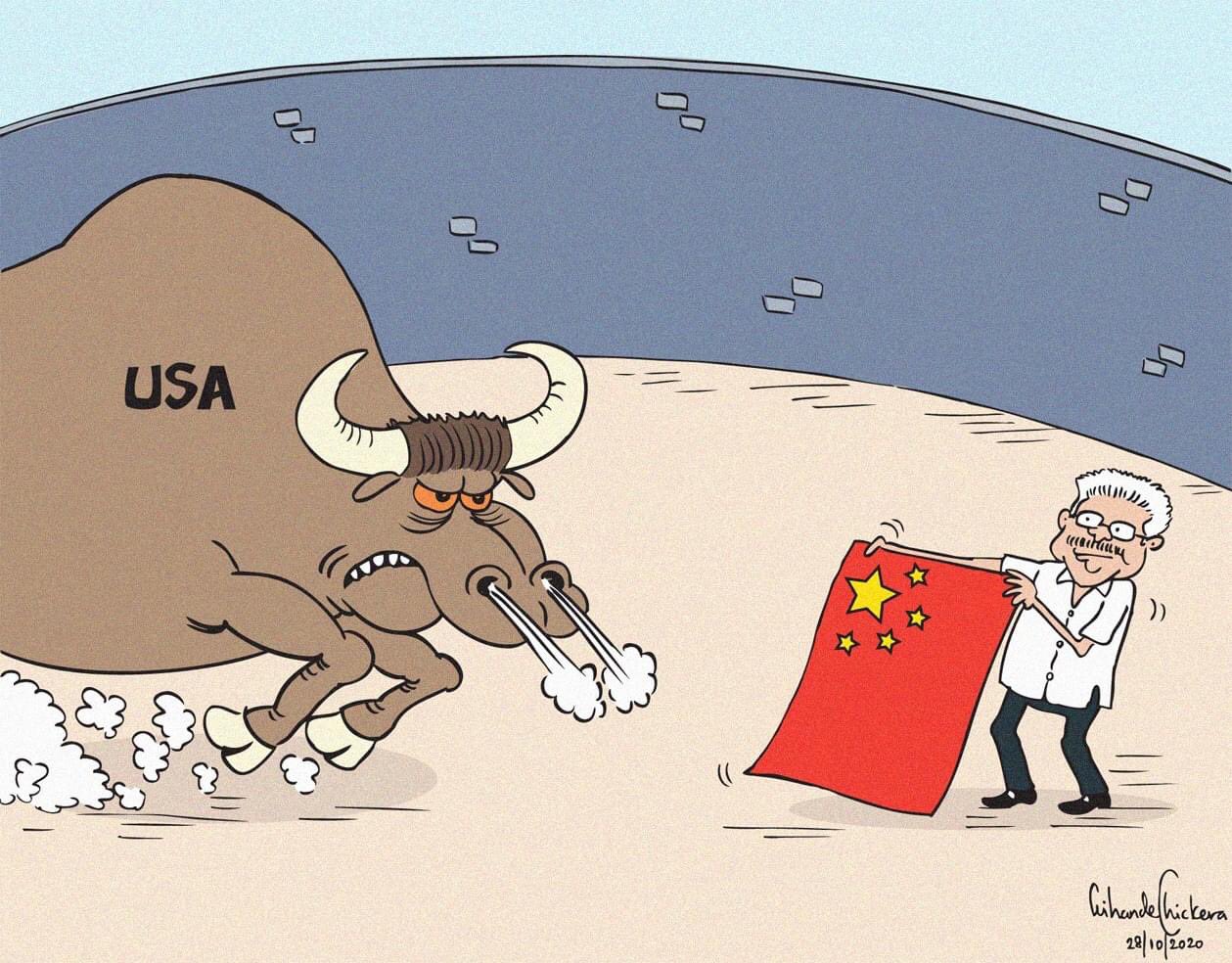
Having bet on Trump against Biden, the Rajapaksa regime is betting on China against America.

Lee Kuan Yew said that “America will remain the sole superpower” for at least two to three more decades (Forbes, 2013). Lee’s confidence that America’s world leadership would not be displaced by China was sourced in his admiration for the flexibility of US society, its ability to attract the world’s talent, the universality of the English language, and his famous metaphor of America’s ‘black box’ in which was hidden the secret of its ability to constantly remake itself as a country.

When Lee repeated this to Joe Biden and Jake Sullivan, Biden replied that he knew the secret of the American spirit hidden within the black box. Vice-President Biden retold this story and his reply to Mexico’s leadership in 2016: “…stamped into the DNA of every American is an overwhelming scepticism for orthodoxy and authority. The only way you make fundamentally new things is break old things. That’s the innovative genius that continues to repeat itself in my country.”

Blinken’s “atrocities” remark on Sri Lanka should make it clear to the Rajapaksa regime that though it rides on the dragon’s tail, it isn’t bunkered in the dragon’s lair. It is now in the eye of the eagle.


SJB appoints committee to study OHCHR report

Samagi Jana Balawegaya (SJB) today said its leader Sajith Premadasa had appointed an expert committee to study the UNHRC High Commissioner’s report on Sri Lanka.

SJB National Organiser Tissa Attanayake told a press conference that this expert committee will study the report and will give their opinion about it. He said SJB will come up with its official stand on the report once this study is completed. “However we urge the Government to deal with the issue diligently without getting into disputes with any of the member states,” he said.

SJB also urged the Government to hold the provincial council elections after making necessary amendments to the Provincial Council Elections Act.

Mr. Attanayake said the Government could not delay the Provincial Council Elections anymore as these institutions had to be administered by the people’s representatives as per the Constitution.

“There is no provision for the President to run the Provincial Councils through governors continuously as per the Constitution. Therefore it is essential to hold the Provincial Council Elections,” he said.

“We understand that amendments will have to be made to the Provincial Council Elections Act. It will be possible for the leaders of political parties which represent Parliament in a short time. Therefore we urge the government to bring in necessary amendments and hold the polls,” he added

Posted in Uncategorized

Sri Lanka, India, Maldives set up Secretariat for Trilateral National Security Advisors

In keeping with the discussions held at the previous National Security Advisor (NSA)-level trilateral meetings on Maritime Security Cooperation with India and the Maldives, a Secretariat for Trilateral National Security Advisors on Maritime Security Cooperation was established at the Sri Lanka Navy (SLN) Headquarters, Colombo today (March 01).

Secretary, Ministry of Defence and State Ministry of National Security and Disaster Management Gen. Kamal Gunaratne (Retd), Foreign Ministry Secretary Admiral Prof. Jayanath Colombage (Retd), Navy Commander Vice Admiral Nishantha Ulugetenne and the Defence Attachés of India and Maldives were also present at the brief opening ceremony.

The entire world is benefitted with this initiative as the Indian Ocean is the lifeline of the entire world, said the Foreign Secretary Admiral Prof. Colombage during the event while expressing his concerns into the importance of the Indian Ocean.

According to the Navy Commander Vice Admiral Nishantha Ulugetenne, the fully-fledged new Secretariat would be operated 24/7.

Sri Lanka hosted the fourth NSA-level trilateral meeting on Maritime Security Cooperation with India and the Maldives on Nov 27 and 28, 2020 in Colombo while Bangladesh, Seychelles and Mauritius represented the meeting virtually as Observer States.