Rajapaksas’ roar from Rajarata

President Gotabaya Rajapaksa and Prime Minister Mahinda Rajapaksa yesterday urged the public to rally around the Government ushering an aggressive development drive without being deceived by the false propaganda of the power-hungry opposition.

The call on the masses by the duo in chorus was at the first major post-COVID political rally of the ruling Sri Lanka Podujana Peramuna (SLPP) in Anuradhapura.

Both speeches were heavily weighted towards exposing the motives of the Opposition which however has been firing at the Government for sheer economic mismanagement causing multiple crises ranging from foreign reserves, rising inflation, scarcity of essential food and drugs, electricity and fuel to agriculture.

However, the President said the Rajarata rally is the beginning of a series of public rallies to make aware of the targets achieved by the Government in the face of challenges in line with the national policy framework “Vistas of Prosperity and Splendour”.

President Gotabaya Rajapaksa pledged to increase the income of farmers 100% with or without fertiliser, assuring to implement the national policy framework and would not hesitate to do anything for the benefit of the farming community.

“During the first election rally, I promised to provide fertiliser free-of-charge and to increase the guaranteed price of paddy. I provided farmers with the required fertiliser and funds and returned their lands. I promise to increase the income of farmers by 100% despite the fertiliser crisis,” he said.

President Rajapaksa affirmed he is committed to take any necessary steps for the well-being of the farming community.

The President also claimed that during the former Yahapalana Government, national security was weakened resulting in the 2019 Easter Sunday attacks, whilst the intelligence units were destroyed, war heroes were betrayed and the country’s sovereignty was compromised before the international community.

He said the country’s culture and traditions were also destroyed while monks were taken before the Court.

The President asserted that the SLPP-led Government changed that situation during the past two years, amidst many challenges post-COVID.

“We have ensured national security and will reclaim the country’s religious, cultural inheritance and stabilise the economy too,” he added.

He assured to implement the Government policies, without imposing further lockdowns, to ensure economic recovery and stability.

The President requested the public to refrain from being deceived and betraying the country once again.

He also pointed out that local and foreign forces were working together to prevent the journey of the Government, as they had done to topple Mahinda Rajapaksa’s Government in 2015.

“The policies of the Government are aimed at the well-being of the future generations. Therefore, we would continue to move forward despite obstacles,” he stressed.

President Rajapaksa pointed out that opposition who take to the streets to launch protests for political propaganda should first think about the inconvenience they cause the people and not the Government.

He also reminded the State sector officials that they should make a commitment to serve the country and the people.

Prime Minister Rajapaksa said the Government has embarked on an aggressive development drive to deliver its promises, assuring to improve the economy within the next three years.

“During the past two years, the Opposition attempted to sabotage every program that was initiated by the Government. They instigated the farmers, teachers, State sector workers and union members and took it to the streets to inconvenience the public,” he claimed, adding that the SLPP-led Government will not let them deceive the people of this country.

Rajapaksa said the health and safety ensured by the Government for free movement was being misused by the Opposition for their false propaganda.

“We are prepared to go into the streets. It is not new to us, as I am one of those who led the ‘Pada Yatra’ and as a politician who stood for the rights of the labourers. We will educate the people about the program of the Government,” Rajapaksa stressed.

The Prime Minister acknowledged the hardships faced by the farmers and assured them to improve their livelihood.

“Before 2005, farmers received a mere Rs. 12 or 13 for a kilo of paddy, but we managed to increase it by several folds. We have always been with the farmers and will continue to work for the wellbeing of the farmers,” he said.

Rajapaksa recalled that the Yahapalana Government stored paddy inside the Mattala Airport and disregarded the plight of the farmers.

The Prime Minister challenged the Opposition and insisted that it should face them directly without conspiring against the Government and the country through various means.

Affirming that the Government will not allow the Opposition to sabotage its work, Rajapaksa called on the masses not to be deceived by false propaganda and rally around the Government development initiatives during the next three years.

PM challenges Opposition for elections; SJB accepts challenge

Prime Minister Mahinda Rajapaksa yesterday challenged the main opposition for an immediate election to show the government’s strength, a challenge which was accepted by the Samagi Jana Balawegaya today.

Prime Minister Rajapaksa challenged the Opposition to a battle in an election and to see if they could defeat the government.

He said that they won’t make decisions thinking of the impending elections.

“If we had made decision thinking of impending elections, there would not have been Norochcholai coal-fired power station, Hambantota port and the Colombo Port City and even the war victory,” the Prime Minister said.

Meanwhile, SJB MP S. M. Marikar said “Premier Rajapaksa at the SLPP rally in Anurhapura challenged us to face an election. We are ready for it and we urge the government to hold the local government election immediately. Let’s see which way the people will go,”

He said the SJB will also hold a rally at Salgado Stadium in Anurhapura to challenge SLPP.


India Urged to Condition Financial Aid to Sri Lanka on the Implementation of the Indo-Sri Lanka Accord: TGTE

In a letter to Indian Prime Minister Shri. Narendra Modi, the Prime Minister of the Transnational Government of Tamil Eelam Mr. Visuvanathan Rudrakumaran urged him to condition any aid to Sri Lanka to ensure the territorial integrity of the Tamil homeland and on:

a) the implementation of Indo-Sri Lanka Accord;

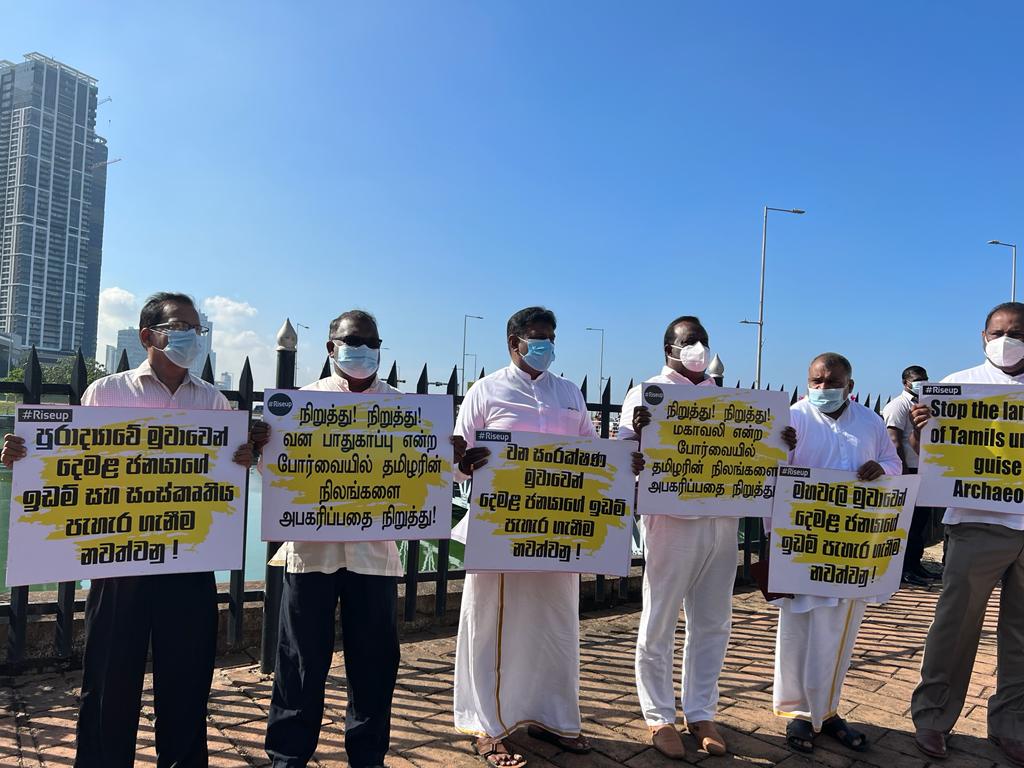
b) to stop Sinhala settlements (colonization) in the traditional Tamil areas in the NorthEastern part of the island and;

c) to stop demarcation of Tamil districts by incorporating Sinhala villages into Tamil districts.

The letter further stated that that the Sri Lankan government’s forced establishment of Sinhalese settlements, victory monuments, archeological reservations, wild-life sanctuaries, forest reserves, and special economic zones intend to reduce Tamils to a minority status in their own land.

It was also brought to the Prime Minister’s attention that the Sri Lankan government is also engaged in a program of demarcation of divisional boundaries to incorporate Sinhala villages into Tamil districts, thereby increasing the Sinhala population in the Tamil areas. It is also pointed out that this encroachment is facilitated by the overwhelming presence of the Sri Lankan military which is comprised almost exclusively of Sinhala persons. The letter also empathized with the Sinhala People, the Tamil People, and the Muslims who are suffering due to the economic downturn and thanked India’s generosity.

In reference to China’s growing footprints in Sri Lanka, the letter pointed out that Sri Lanka is giving a duplicitous perception that it is neutral between India and China, but the fact of the matter is that Sri Lanka’s relationship with China is that of a vassal state that can be used a springboard to harm India’s interests. The letter concluded by noting that the destruction of Tamil People as a viable distinct entity is not only a loss to humanity, but also detrimental to India’s national interests.

ABOUT THE TRANSNATIONAL GOVERNMENT OF TAMIL EELAM (TGTE):

The Transnational Government of Tamil Eelam (TGTE) is a democratically elected Government of over a million strong Tamils (from the island of Sri Lanka) living in several countries around the world.

TGTE was formed after the mass killing of Tamils by the Sri Lankan Government in 2009.

TGTE thrice held internationally supervised elections among Tamils around the world to elect 135 Members of Parliament. It has two chambers of Parliament: The House of Representatives and the Senate and also a Cabinet.

TGTE is leading a campaign to realize the political aspirations of Tamils through peaceful, democratic, and diplomatic means and its Constitution mandates that it should realize its political objectives only through peaceful means. It’s based on the principles of nationhood, homeland and self-determination.

TGTE seeks that the international community hold the perpetrators of war crimes, crimes against humanity, and genocide against the Tamil people to account. TGTE calls for a referendum to decide the political future of Tamils.

The Prime Minister of TGTE is Mr. Visuvanathan Rudrakumaran, a New York based lawyer. Tamils in the island of Sri Lanka faced repeated mass killings in 1958, 1977, and 1983 and the mass killings in 2009 prompted UN Secretary General Ban Ki-moon to appoint a Panel of Experts to report on the scale of the killings.

According to UN internal review report on Sri Lanka, over 70 thousand Tamils were killed in six months in early 2009 and Tamil women were sexually assaulted and raped by the Sri Lankan Security forces.

International Truth and Justice Project (ITJP) in February 2017 handed over details to UN of Sri Lankan Military run Rape Camps where Tamil women are being held as “sex slaves”. Also, According to UK Foreign and Commonwealth Office report on April 2013, there are over 90 thousand Tamil war widows in Sri Lanka.

Thousands of Tamils disappeared, including babies and children. UN Working Group on Enforced Disappearances stated in 2020 that the second highest number of enforced disappearance cases in the world is from Sri Lanka.

According to this UN report, the killings and other abuses that took place amount to war crimes and crimes against humanity. Independent experts believe that there are elements of these abuses that constitute an act of genocide.

Members of the Sri Lankan security forces are almost exclusively from the Sinhalese community and the victims are all from the Tamil community. Tamils overwhelmingly voted in a Parliamentary election in 1977 to establish an independent and sovereign country called Tamil Eelam. This Parliamentary election was conducted by the Sri Lankan Government.

Posted in Uncategorized

EU urges Sri Lanka to reduce the use of PTA and release on bail those detained without charges

The European Union welcoming the Sri Lankan government’s efforts to amend the draconian Prevention of Terrorism Act (PTA) to be fully compliant with the international norms has strongly urged Sri Lanka to reduce its use in the interim.

During the 24th meeting of the Joint Commission of the European Union (EU) and Sri Lanka held on 8 February 2022 in Brussels, Sri Lanka reiterated its objective to achieve measurable, tangible and verifiable results on the ground in meeting its commitments.

In this context, the EU welcomed the submission by the Government of Sri Lanka of amendments to the Prevention of Terrorism Act (PTA). However, the EU noted that important elements had not been included in the Amendment Bill gazetted, a joint press release said.

Sri Lanka took note of the views expressed by the EU to take further steps to make the PTA fully compliant with international norms.

In the interim, while taking note of the administrative steps taken in the form of directives issued by the Inspector General of Police, the EU urged Sri Lanka to continue reducing the use of the PTA, and to undertake further practical and administrative steps to release on bail those detained under the PTA without charges.

The Joint Commission meeting, which was held in a friendly and open atmosphere, reviewed bilateral relations and entailed an exchange of views and updates on a wide range of topics of bilateral interest – ranging from governance, reconciliation and human rights, to trade, development cooperation, climate change and environment, sectoral cooperation, security and counter-terrorism, and cooperation in multilateral fora.

The meeting provided an opportunity for updates on developments, relevant action and legislative initiatives in the EU and Sri Lanka. The discussion focused on democracy, governance, rule of law, human rights, including the rights of minorities, women, children and labor rights, and freedom of expression and association.

With respect to the COVID-19 pandemic, the EU congratulated Sri Lanka on the country’s effective vaccine strategy. Highlighting the need to address vulnerabilities and inequalities exacerbated by the pandemic, the EU emphasized its commitment to making the COVID-19 vaccine accessible to low- and middle-income countries in a fair and equitable manner. Sri Lanka appreciated the EU’s continued contribution to global vaccine equity.

Sri Lanka also apprised on progress in reconciliation and in the independent institutions, notably the Office of Missing Persons (OMP), the Office for Reparations (OR), the Office for National Unity and Reconciliation (ONUR), and the Human Rights Commission of Sri Lanka (HRCSL).

The EU strongly encouraged Sri Lanka to continue cooperation and engagement with the Human Rights Council and its mechanisms. In this context, the EU underlined the importance of independence and effective functioning of the Independent Institutions. The EU and Sri Lanka concurred on the importance of empowering civil society and giving it the necessary space to function in all its diversity. The EU reiterated its continued commitment to support Sri Lanka in justice reform and reconciliation.

The Joint Commission took stock of the conclusions of the Working Group on Trade and Economic Cooperation held virtually on 26 January 2022.

The EU and Sri Lanka noted the significance of bilateral trade relations. In this regard, the EU strongly urged Sri Lanka to lift forthwith import restrictions preventing many European products from entering its market.

Sri Lanka clarified that it has imposed temporary import restrictions on non-essential items, strictly as an interim measure, due to a foreign exchange shortfall resulting from the impact of the global pandemic. Sri Lanka noted that these measures are subject to continuous and progressive review.

Sri Lanka appreciated the valued contribution of the GSP+ regime to the country’s sustainable development. The EU acknowledged the constructive engagement by Sri Lankan stake-holders during the GSP+ monitoring mission in September 2021. The two sides reviewed Sri Lanka’s compliance with 27 International Conventions related to human rights, labor rights, protection of the environment and good governance covered by the GSP+ scheme. Sri Lanka reiterated its commitment to effective implementation of the 27 conventions, and noted its adherence to the principle of non-discrimination, and the removal of any further impediments in the exercise of labor rights and fundamental freedoms. The EU invited Sri Lanka to provide further updates on progress.

The Joint Commission also discussed the conclusions of the Working Group on Development Cooperation, which took place on 2 February 2022.

The Working Group reviewed all aspects of EU – Sri Lanka development cooperation, and discussed priorities of the EU Multi-Annual Indicative Programme (MIP) for 2021-2027. They also discussed the interventions adopted in 2021, including the COVID-19 response package. The EU noted that the MIP, which focuses on Green Recovery and Inclusive and Peaceful Society, supports Sri Lanka’s development priorities, and is aligned with the external dimensions of the European Green Deal, and the EU Strategy for Cooperation in the Indo-Pacific.

Appreciating the EU’s development cooperation, Sri Lanka reiterated the need for it to complement Sri Lanka’s national and developmental priorities. The EU and Sri Lanka expressed their commitment to work together on joint priorities under the MIP.

The EU and Sri Lanka agreed on the importance of continued cooperation in deterring and eliminating IUU fishing practices, and honoring commitments of the partnership.

Issues related to migration and readmission were also discussed.

The EU and Sri Lanka exchanged on ways to deepen cooperation in higher education and research and technical cooperation under the Erasmus+ programme, the Marie-Sklodowska-Curie programme, and the Horizon Europe framework programme.

The EU welcomed Sri Lanka’s update on its Nationally Determined Contributions under the United Nations Framework Convention on Climate Change (UNFCCC), and the country’s commitment to ambitious targets. The EU looked forward to working closely with Sri Lanka, bilaterally and in multilateral fora, on climate action and environment protection. Both sides exchanged views on priorities ahead of the 27th UN Climate Change Conference (COP27).

The EU and Sri Lanka reviewed ongoing cooperation in the area of security and counter-terrorism. Sri Lanka appreciated the EU’s continued listing of the Liberation Tigers of Tamil Eelam (LTTE) as a terrorist organization. Both sides stressed the importance of adherence to international norms and standards in the fight against terrorism. They reiterated willingness to further enhance cooperation in Maritime Domain Awareness.

The EU and Sri Lanka highlighted their commitment to continue joint efforts in the promotion of a rules based international order and effective multilateralism. They also discussed regional developments, and cooperation in the Indian Ocean. The EU presented Global Gateway, the new EU plan for major investments in infrastructure development around the world, which was launched on 1 December 2021. The initiative was welcomed by Sri Lanka.

The EU and Sri Lanka agreed to convene the next Joint Commission meeting in Colombo in 2023. They also discussed the timeframe of the next Working Group meetings under the Joint Commission.

The meeting was co-chaired by Ms Paola Pampaloni, Deputy Managing Director for Asia and the Pacific at the European External Action Service, and Admiral (Prof.) Jayanath Colombage, Secretary, Foreign Ministry of Sri Lanka.

The Joint Commission, which oversees the 1995 EU-Sri Lanka Cooperation Agreement on Partnership and Development, deals with a broad range of bilateral and multilateral issues of mutual interest. Its tasks are to ensure the proper functioning and implementation of the Agreement, set priorities, and make recommendations.

All three Working Groups established under the terms of the Joint Commission reported back from their respective meetings: the Working Group on Governance, Rule of Law and Human Rights in September 2021; the Working Group on Trade and Economic Cooperation Issues in January 2022; and the Working Group on Development Cooperation in February 2022.

Modi likely to visit Sri Lanka in March, Jaishankar expected soon

Indian Prime Minister Narendra Modi is expected to visit Sri Lanka in March, Foreign Ministry sources said. Sources said that Modi is likely to visit Sri Lanka to attend the BIMSTEC Summit.

Foreign Ministry sources also said that Indian External Affairs Minister S. Jaishankar is likely to visit Sri Lanka soon.

The visits are seen as part of attempts by India to further strengthen its relationship with Sri Lanka.

Finance Minister Basil Rajapaksa and Foreign Minister G. L. Peiris have just concluded separate visits to New Delhi.

Rajapaksa is expected to travel to India once again for follow-up discussions.

Following the meeting with Foreign Minister G. L. Peiris on Monday, Indian External Affairs Minister S. Jaishankar tweeted saying they had a productive meeting.

He said they discussed economic and investment initiatives that will strengthen Sri Lanka at this time and also focused on additional steps to enhance Sri Lanka’s energy security.

Both sides also exchanged views on the fishermen issue and agreed that bilateral mechanisms should meet early.

Posted in Uncategorized

Indian devotees to be allowed at Katchatheevu festival

Sri Lankan Fisheries Minister Douglas Devananda said that he has provided assurance to a senior DMK leader who spoke to him on behalf of Tamil Nadu Chief Minister M.K. Stalin over the phone to permit Indians for the Katchatheevu festival.

Minister Devananda also said that arrangements would be made for Indian devotees.

The Katchatheevu festival is set to take place on March 11 and 12. The Katchatheevu festival pertains to the festivities held at St Antony’s Church in Katchatheevu during the month of February or March every year.

According to a report on Times of India, Devananda said, the festival committee initially decided against permitting Indians for the festival due to the pandemic but the issue raised concerns among the devotees in Tamil Nadu.

Following this, the devotees made a representation to Chief Minister Stalin. Based on the representation, he wrote to Union External Affairs Minister S. Jaishankar. In the letter, Mr. Stalin said the denial of Sri Lankan authorities to permit fishermen community in Tamil Nadu from attending the function has created a deep disappointment.

Hence, he requested the Union External Affairs Minister to enable the participation of Tamil Nadu fishermen in the Annual festival.

The Katchatheevu island was ceded to Sri Lanka by India in 1974. However, Indian fishermen have rights to dry their nets and to take part in the festival every year.

The then-Indian PM Indira Gandhi ceded the Katchatheevu to resolve maritime boundaries in Palk Strait under India-Sri Lankan Maritime agreement.

Posted in Uncategorized

Japan provides Rs. 128 million to support humanitarian demining activities in Northern and Eastern Sri Lanka

The Government of Japan has provided a total sum of US$ 647,611 (approx. Rs. 128 million) to the Mines Advisory Group (MAG) for humanitarian demining activities in the Northern and Eastern Sri Lanka, the Embassy of Japan in Colombo said.

Ambassador of Japan Mizukoshi Hideaki, , and Ms. Cristy McLennan, Country Director of MAG signed the grant contract on the 1st February 2022. Due to the current prevailing Covid-19 situation, the contract was signed remotely.

MAG commenced operations in Sri Lanka in 2002 with approximately 20% of its clearance activities accomplished through Japanese assistance. Since 2009 when precise data was made available, MAG has released the total of 98km2 of suspected contaminated land in the country.

It is expected that this FY’s project would contribute to facilitating the efforts of the Government of Sri Lanka to make mine contaminated areas safe lands for internally displaced people and enhancing directly or indirectly 7,374 people’s livelihoods in Mannar, Mullaitivu, Vavuniya and Trincomalee Districts.

This year, MAG marks 20th anniversary of launching the demining activities in Sri Lanka. As the country moves towards “mine impact-free” in the coming years, MAG is engaging with not only demining activities but also the livelihood of demining staff by addressing the socio-economic needs, skills gaps and opportunities for them. Japan would like to sincerely appreciate the devotion and perseverance of the staff at MAG towards this valuable exercise.

Since the beginning of Sri Lanka Mine Action program, Japan has been a major donor in the area of mine clearance in Sri Lanka, assisting all the four demining NGOs currently operating in Sri Lanka. More than US$ 40.8 million in assistance was rendered towards this cause through its Grant Assistance for Grassroots Human Security Project (GGP).

Furthermore, this year also marks the 70th anniversary of the establishment of diplomatic relations between our two countries and we are in the midst of cerebrating this great milestone. Japan is convinced that these demining projects are one of iconic symbols of “Sri Lanka and Japan” friendship.

The Government of Sri Lanka aims to achieve “a mine impact free Sri Lanka” within a few years and to become the next mine impact free country in the world. Through this project, the Government of Japan endeavors to ensure that Sri Lanka is safe for all.

Posted in Uncategorized

Women victims of the Prevention of Terrorism Act

Nearly three years have passed since the deadly 2019 Easter Sunday bombings. While failing to prosecute the actual perpetrators, the state has single-handedly used the Prevention of Terrorism (Temporary Provisions) Act No. 48 of 1979 (PTA) as a cudgel to persecute the entire Muslim minority. As was experienced by Tamils during the civil war; women are uniquely victimised by the state’s overreach – either as collateral damage of arrests under the PTA, or targeted themselves because of family ties with detained men.

The vast majority of recent PTA detainees are Muslim men from Batticaloa and Mawanella, arrested for dubious links to the suicide bombers or to the banned National Thowheeth Jama’ath (NTJ) group. In Kattankudy, one three-wheeler driver was arrested for delivering food once for NTJ leader and suicide bomber Zahran Hashim’s class, another man for having booked bus seats for the bombers, and still another for fixing a television antenna in one of the suicide bombers neighbourhoods. A man who bought a motorcycle belonging to Zahran’s brother has been arrested, as has a person whose van was suspected of being used for unspecified “extremist activities” – when the insurance company tried to seize that detainee’s van due to the non-payment of instalments, the brother-in-law who helped the family salvage the van was also arrested. Some have been arrested for unwittingly attending Zahran’s training in Nuwara Eliya and Hambantota, when they believed that they were simply going for a trip. Many were daily wage labourers in shoe making shops, small restaurants, and roadside boutiques. They have been swept up in mass arrests and have been locked up for over 34 months, longer than the 18 months allowed under the PTA. One wonders whether the amendments proposed to the PTA to reduce detention from 18 months to 12 makes any sense to these detainees. And whenever they are finally released, they will have lost their livelihoods and suffered reputational damage and psychological trauma because of their prolonged arbitrary detention under the PTA.

Now the PTA advisory board is releasing some of those wrongfully detained; but interestingly, the terms and conditions of cancelling their detention orders are very harsh. For the rest of their lives, these men and their families will be under the grip of the state intelligence apparatus, similar to Tamil “rehabilitated” men and women. The conditions of the suspension of the detention order include informing the Officer-In-Charge (OIC) of the Counter Terrorism and Investigation Division (TID) of a change of residence, any plans for local travel with requirements to report back on return, monthly reporting to its Colombo office, reporting to the OIC within 72 hours of notification, and obtaining prior written approval from the Director of Counter Terrorism for any travel abroad.

Mohamed was arrested for allegedly having connections with local and foreign Muslim extremists and sharing extremist videos while he was just a school student. Mohamed’s mother Ismiya was happy to see her son who has been detained for almost 11 months returning home unexpectedly. Now, on his return, he should abide by the above conditions. Ismiya is a single mother who has three girls and lives in a rented house. She hoped to send Mohamed to the Middle East once he finished his General Certificate of Education Advanced Level (GCE A/L) examination so that she could build a house and give her daughters in marriage. Mohamed now cannot even travel to other districts without the TID knowing, let alone go abroad.

What often goes unnoticed is that women bear the brunt of these mass arbitrary detentions. The cost they pay is heavy in a patriarchal society when their breadwinners are detained by the state. Often, arrest receipts are not promptly issued, leaving spouses unaware for days (and in some cases, weeks) of where their loved ones are detained. Most families are too poor to travel to detention centres outside their districts and are able to visit their loved ones only when the International Committee of the Red Cross provides a travel allowance. Many lawyers are reluctant to offer counsel, afraid of facing surveillance and harassment themselves. Filling this void, some unscrupulous lawyers swoop in and extort vulnerable families, promising to secure bail without explaining that bail is only available to pre-trial PTA detainees with the Attorney General’s consent. Desperate to secure the release of their primary breadwinners and unaware of the legal landscape, many poor families fell into this trap, and some also sold jewellery – the only asset they had. One young lady sold her house to pay the legal fee and settle a loan since her husband’s business collapsed after his arrest.

When a primary breadwinner is detained, those left behind have to pick up the pieces. Some women in conservative households have ventured out to work for the first time. A woman named Jaziya started weaving fishing nets after her husband was detained. She makes just Rs. 300-350 per day – not enough to send her teenage son to a different school after his school was closed. Other women have reported selling household items, valuables, and land to survive.

As they struggle to keep their households running, wives of detainees are visited by security agencies and summoned to the police stations. Security personnel obtain information from the families and then write statements in Sinhala that they cannot understand. Women report feeling unsafe with these frequent visits by male security forces, and fearful of the community censure these visits bring. Just last month, a TID officer went into the home of one PTA detainee and confiscated the sewing machine belonging to his wife, claiming that her husband had used this sewing machine to stitch clothes for suicide bombers and thereby stripping her of her sole source of income to look after her three children. That woman filed a complaint with the Human Rights Commission of Sri Lanka, but many are afraid to travel alone to seek assistance from different entities.

Detention of a loved one brings community censure, further isolating already marginalised women. For example, one woman named Fathima explained how the detention of her brother had affected not only her family’s income – forcing her and her mother to weave mats for subsistence – it also affected her marriage prospects and ended her engagement. Although she is married now, she keeps her husband separate from anything connected with her brother, fearing that even accompanying her during prison visits could result in her husband being detained.

Those who assist families of detained persons are likewise placed under surveillance and interrogated, further isolating affected families from social support. For example, one woman who distributed food rations from a civil society organisation came under surveillance. Well-wishers and local charities are harassed when they offer support, and are called in for questioning by intelligence officers as to their connections with the detainees or on made up accusations that they are part of the banned NTJ. On top of this, the society permanently ostracises the relatives of detainees for being “menaces”. Thus, although the state might detain only the head of the household, women who are left behind are themselves treated as security threats and denied the care and services they need to sustain basic family life.

Resisting global calls to repeal the PTA, the Government has tried to strengthen it with proposed “deradicalisation” regulations while recently proposing mere window dressing reforms. Concerned that the deradicalisation proposal mirrored China’s Uyghur policies, the European Parliament recommended suspending the General Scheme of Preferences-Plus (GSP+) trade status with Sri Lanka last June. The Supreme Court has stayed the operation of the deradicalisation regulations pending the conclusion of fundamental rights petitions, and additional challenges may be raised against the half-hearted PTA reforms recently proposed. Last year, we heard many desperate families being pressured to sign statements agreeing to send their loved ones to rehabilitation. These families fear that unless they agree to rehabilitation, their loved ones could be placed in remand custody for several years. Rehabilitation thus seems to be the only way to limit arbitrary detention to two years and a secure release.

The problems are only compounded where women are the ones detained. In Batticaloa, 16 “B” reports have been filed against 66 persons, of whom six are women. The state has successfully kept these individuals in remand custody without any mention of the charges, saying simply that investigations into the Easter attacks are ongoing. Most of the women in custody are detained for being related to the Easter bombing suspects or for listening to a sermon of the now-banned NTJ. Hailing from poor, religiously-conservative backgrounds, these women barely stepped outside their homes, much less kept abreast of what their male relatives did. One 57-year-old woman is detained because her daughter is married to a suspect who allegedly gave technical support to the Easter Sunday bombers. Suffering from breast cancer for the last 10 years, she has not received adequate medical care. A 22-year-old was arrested in December 2021 because she was married to a bombing suspect – her one-year-old baby is now growing up without a mother. The same is true for two other mothers, aged 38 and 25, who were arrested under the PTA purely because of their marital ties to the alleged Easter Sunday attack suspects. In both cases, the children are staying with frail and elderly grandmothers, who struggle on a subsistence wage to raise the children.

Like their Muslim sisters, Tamil women continue to be arrested under the PTA, based on nothing more than their contact with male suspects. One middle aged housewife was detained by the TID after unwittingly paying Rs. 300,000 to an agent with hopes of going to New Zealand, not knowing that the “agent” was wanted in connection with terrorism-related money laundering. Three years after her arrest, she still remains in remand custody. Due to financial difficulties, her teenage daughter was forced to wed. Another Tamil woman was arrested on suspicion of being in contact with a wanted suspect. She was forced to sign a document without knowing its contents and has been separated for three years from her 10-year-old daughter, who has had to grow up in a children’s home.  Another woman was arrested after trying to visit her younger brother in police custody; she remains in remand custody almost for three years now, leaving her feeble mother-in-law to look after her disabled husband and two children.

Over 25 women are currently detained under the PTA. These women all come from poor families and are being held almost entirely due to their relationships or contact with male suspects. Because of their poverty, they lack access to effective legal representation. They all have children or dependents who rely on them for subsistence and support. After years in jail without access to each other, family bonds are shattered, and new traumas are formed. One detainee has reported being tortured to sign a confession while in remand custody. While many of these women languish in detention for almost three years, no charges are brought nor clear reasons given for their arrest.

Ultimately, the same story repeats. Having failed to stop the Easter attacks or deliver justice to its victims, the state has committed to persecuting an entire community to show the Sinhala majority that it is taking action. Trampled in this tough guy approach of mass arrests and prolonged arbitrary detention are women from poor communities who are either collateral damage or face arrest themselves based purely on whom they know. The stark reality of these increasingly isolated women receives scant attention as the state consciously destroys their lives and families with no due process nor reparation in sight.

Posted in Uncategorized

PTA – Not Amend, But Repeal

The lead story of this newspaper said, “The Appeal Court yesterday (Monday), ordered the release on bail of lawyer Hejaaz Hizbullah, who had been detained for nearly two years under the Prevention of Terrorism Act (PTA).”

He has been in custody since April 2020 under the PTA over ‘Bloody Easter Sunday’ that took place on 21 April 2019, an attack executed by Islamist terrorists.

However, President Gotabaya Rajapaksa speaking in Parliament last month said there was no threat to national security. The very reason for the birth of the PTA, 43 years ago was due to a threat to national security facing the country at that time. But if there is no threat now to national security, then there is also no need for this draconian piece of legislation to still be in the country’s statute books.

Some of the PTA’s pernicious features are, “where a statement made by a suspect, orally or in writing, in the course of an investigation, or not, it may be proved against such person.

“Every person who commits an offence under this Act shall be triable without a preliminary inquiry, on an indictment before a High Court Judge sitting alone without a jury or before the High Court-at-Bar by three Judges without a jury, as may be decided by the Chief Justice.

“Where any person is in remand under this Act, the Defence Ministry Secretary may direct that such person be kept in the custody of any authority, in such place and subject to such conditions as may be determined by him.”

The PTA was passed by the J.R. Jayewardene Government in 1979 for the singular purpose of crushing LTTE terrorism, which, in its wake was leaving behind a trail of destruction replete with cold blooded murders of law enforcement officers and political opponents, armed robberies of State and cooperative Banks and the destruction of public property and making good their escape, before, subsequently killing innocent civilians as well.

Two such examples that took place on the eve of passing the PTA, were the killing of four CID officers in the Vavuniya jungles on 7 April 1978 investigating LTTE terrorism and the destruction of the Avro civilian aircraft run by State-owned Air Ceylon, predecessor of the current national carrier SriLankan, five months later on 7 September 1978.

To investigate the root cause that led to the genesis of the PTA, that dates back to 1975, the year when the SLFP Mayor for Jaffna, Alfred Duraiappah was gunned down by LTTE terrorists, who later made a successful getaway. The Government in power at that time was the SLFP-led UF Government.

Meanwhile, the 1977 Parliamentary Poll was epoch making for more reasons than one. For the first time a minority party became the major opposition party in Parliament. That was the Jaffna Tamil based TULF which swept the Polls in the North and East of the country under the separatist or secessionist ticket. The TULF and the LTTE terrorists who were at large then had at least one thing in common. Both were campaigning for separatism, one democratically and the other through violence. Post-1977, such acts of violence exacerbated.

And with Police investigations on LTTE terrorism virtually drawing a blank, an exasperated Jayewardene, who had a record five-sixths majority in Parliament, got the draconian PTA passed in 1979.

But the PTA did very little to stamp out LTTE terrorism. It was ultimately defeated in a conventional war on 18 May 2009. Nonetheless, even after the subjugation of LTTE terrorism nearly 13 years ago, this pernicious piece of legislation still continues to be in the country’s statute books.

Draconian, because it can be abused, not least by vested political interests, for the two-fold purpose of making the minorities in particular to toe the line and the other, to be used as a communal red herring to gain the majority Sinhala vote by crying ‘wolf, wolf’.

But if there is no threat to national security as stated by no lesser person than the President himself last month, it’s now ‘more than about time’ that the PTA is repealed.

Pope to support push for justice – Catholic Church prepared to seek international probe

Pope Francis has offered support to the Catholic Church in Sri Lanka in its fight for justice over the Easter Sunday attacks, Reverend Father Cyril Gamini Fernando said.

In an interview with Daily Mirror online and Lankadeepa online last evening, Reverend Father Cyril Gamini Fernando said that Cardinal Malcolm Ranjith had written to the Pope mentioning his concerns on the investigations into the Easter Sunday attacks.

Reverend Fernando said that the Pope has responded offering support to do what is required.

The Catholic Church has expressed dissatisfaction over the investigations into the Easter Sunday attacks.

Reverend Fernando said that the church wants the recommendations of the Presidential Commission appointed to conduct inquiries into the attacks, to be fully implemented.

He also said that the Criminal Investigations Department must question former Attorney General Dappula de Livera over claims he had allegedly made that there was a “conspiracy” behind the Easter Sunday attacks.

Reverend Fernando said that if the Sri Lankan Government fails to ensure justice then the church is prepared to seek an international investigation.

He said that steps have already been taken to brief the international community as well as the large Sri Lankan Catholics based overseas.

Reverend Fernando said that seeking international support should not be seen as an attempt to betray the country but support the people.

The priest also denied claims that the Catholic Church was working at meeting a political agenda of the opposition.

He insisted that the Catholic Church is not interested in politics and only wants justice for the victims of the Easter attacks.

Reverend Fernando said that the Catholic Church has decided it will continue to fight for justice no matter who is in power.