

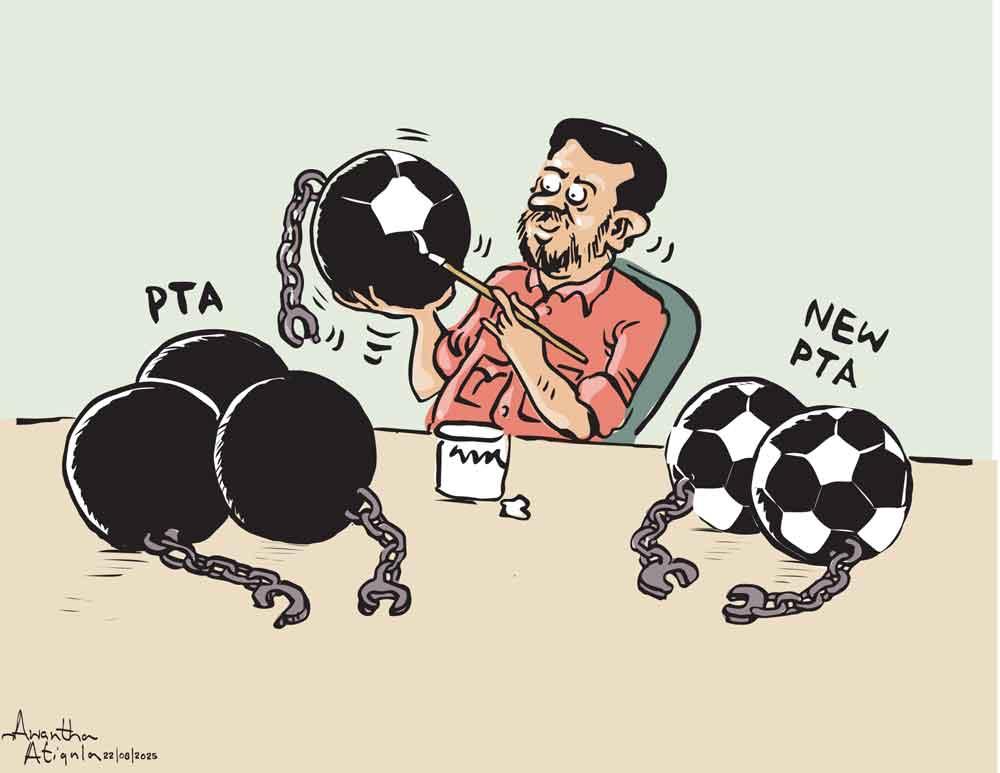
What is unfolding in Sri Lanka today is not a dramatic invasion or an overt loss of sovereignty, but something far subtler and therefore more dangerous: a renewed form of imperial influence advancing quietly through the language of reform, stability, and modernisation. This phenomenon is not new to the Global South, but its present intensity and the ease with which it appears to be gaining ground right before our eyes should give serious pause. The troubling reality is that this occurrence has coincided with a regime that seems inexperienced in the craft of statecraft and ill-equipped to distinguish between genuine assistance and predatory intervention. That vulnerability is now being exploited with alarming effectiveness.
Taken in isolation, each piece of ‘reform’ pushed onto the national agenda may appear defensible, even benign. But when viewed as a whole, the pattern is unmistakable. Education reforms funded and guided by multilateral agencies seek to reshape curricula and values in ways that provoke deep social unease. Economic restructuring demanded by the IMF prioritises fiscal orthodoxy and short-term stability while offering little credible pathway to growth, industrial renewal, or social protection.
Now, layered onto this is the quiet drafting of a new anti-terror law that threatens to curtail basic freedoms and place Sri Lanka’s democratic credentials – and even its trading future – at risk. Together, these developments suggest not a confident sovereign state charting its own course, but a regime stumbling in the dark, overly eager to appease external actors whose interests are not necessarily aligned with those of the Sri Lankan people.
The most disturbing feature of what is taking place is the apparent unawareness of the powers that be, and to make matters worse, even the collective Opposition. As far as the Government is concerned, it seems oblivious to the political and moral pits it is digging for itself in the name of reform. External entities, cloaked as benevolent benefactors, are treated as neutral advisers rather than as actors with their own strategic and ideological agendas. The inability or unwillingness of the regime to distinguish between genuine partnership and disguised coercion points to the deeper problem of an acute lack of experience in statecraft. That deficiency is now being exploited in ways that earlier governments, for all their faults, often resisted or at least navigated with greater caution.
This deference has reached almost theatrical proportions. The Government appears willing to bend over backwards to accommodate the demands and expectations of these modern imperialists, even when doing so contradicts its own stated principles and electoral promises. Nowhere is this more evident than in the ongoing attempt to introduce a new anti-terror law to replace the much-maligned Prevention of Terrorism Act (PTA). While the public discourse is saturated with distractions and emotionally charged side issues, the real danger is being quietly prepared in the background, inching its way through the legislative process with minimal scrutiny.
This tactic is hardly new. Governments across time and ideology have mastered the art of diversion. When controversial legislation threatens to provoke resistance, attention is deliberately drawn elsewhere. Populist controversies are amplified, cultural flashpoints are inflamed, and media cycles are consumed by issues that, while not unimportant, serve conveniently to distract from what truly matters. The public, as expected, takes the bait. So does the opposition. Meanwhile, the serious business of expanding state power over citizens proceeds largely unchallenged.
What makes the present silence over the proposed Protection of the State from Terrorism Act (PSTA) particularly galling is the identity of those now in power. No political force protested the PTA more vociferously than the JVP, now rebranded as the NPP. For decades, it mobilised against the act, paralysed cities, disrupted daily life, and rightly condemned the PTA as a draconian instrument used to stifle dissent under the pretext of national security. If one were to tally the hours spent protesting against the PTA, the cumulative loss in productivity would likely amount not to days or months, but to years. Yet today, at the very moment when a new and potentially more dangerous law is being readied, that same moral fervour is conspicuously absent.
If there was ever a time for principled resistance to legislation that threatens fundamental freedoms, it is now. And yet, the Opposition – fragmented, distracted, and perhaps out-manoeuvred – has largely fallen silent. By falling for and chasing diversionary controversies, it risks rendering itself irrelevant at a time when relevance is most urgently needed. If the Opposition hopes to retain any credibility, it must urgently wake up to the looming danger and alert the public to the freedoms they are about to lose, quietly and perhaps permanently.
The NPP’s own record makes this state of affairs even more consequential. It did not merely promise to reform the PTA; it pledged to abolish it entirely. The act was described, unequivocally, as incompatible with democracy and justice. Yet instead of abolition, what has emerged is a replacement law that, according to the latest draft, appears more expansive, more ambiguous, and more prone to abuse than the PTA itself. As this legislation edges closer to becoming law, it stands poised to become yet another broken promise in a growing catalogue that has already begun to erode public trust in the Government.
At its core, this legislative exercise misses the very point that the JVP/NPP consistently made with such clarity from the Opposition benches. The problem with the PTA was never merely its technical deficiencies, but the philosophy underpinning it; the elevation of State power over individual liberty, justified by an elastic notion of national security. Abolition was demanded because reform could not cure a law so fundamentally flawed.
Yet power has a way of changing perceptions. Once in office, confronted with waning popularity and the temptations of control, the same party now appears to seek what previous regimes hesitated to pursue: an even sharper instrument of repression. Where others clung to the ‘known devil,’ this Government seems intent on forging a new one.
The metaphor writes itself. For decades, dissent in Sri Lanka was cut down with a saw. The promise was to discard the tool altogether. Instead, it is now being replaced with a chainsaw – more powerful, more efficient, and far more destructive – while the media and Opposition alike remain mesmerised by carefully staged distractions. The tragedy is not only the betrayal of principle, but the normalisation of it.
None of this is to deny that modern states require legal frameworks to address genuine security threats in an evolving global landscape. Terrorism is real, and the State has a duty to protect its citizens. But security cannot be built on the systematic erosion of liberty. Sri Lanka has already paid a heavy price for decades of abuse under the PTA: lives disrupted, dissent criminalised, and trust in institutions corroded. What the people do not need is a PTA version 2.0, repackaged and legitimised under a new name.
Ultimately, this is a test not only of governance, but of sovereignty. A regime that allows itself to become a pawn in the hands of external powers – however benevolently those powers present themselves – risks forfeiting both its legitimacy and its future. The sooner this Government learns to see through the disguise of modern imperialism, the better it will be for its own survival and for the democratic health of the nation. History, after all, has never been kind to those who surrendered their principles in exchange for the illusion of stability.