

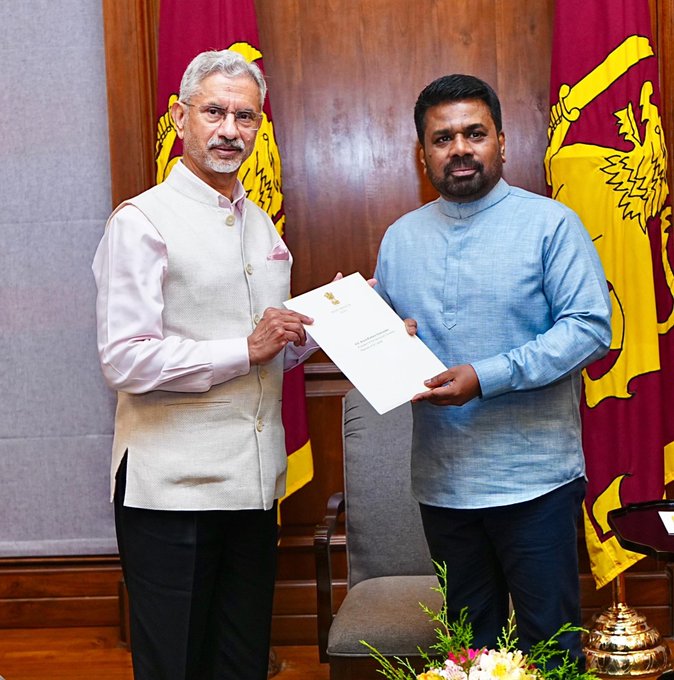
The sudden phone call from India’s External Affairs Minister Dr S. Jaishankar last week saying he was coming to Sri Lanka as his Prime Minister Narendra Modi’s special envoy must have taken the Sri Lankan government by surprise. Foreign Minister Vijitha Herath was in Parliament, where the government was voting on additional funds for the recovery process from Cyclone Ditwah, when he was sent a note that his Indian counterpart was wanting to get through to him urgently. Minister Herath rushed back to his ministry to take the call to be told of the visit.
Confirmation of the Jaishankar visit to Sri Lanka came from the Indian side. The Indian External Affairs Ministry in New Delhi announced on Monday that its minister will visit Sri Lanka the next day. “The visit underscores India’s Neighbourhood First Policy,” it said. The Ministry of Foreign Affairs in Colombo was silent on the visit. The Sunday Times heard of the visit earlier and announced it last week (Dec. 21). President Anura Kumara Dissanayake’s movements, if any, had to be restricted for the visiting dignitary. He was coming not as Minister of External Affairs but as Modi’s special envoy, which gave him a higher status, protocol-wise. If there were other appointments already pencilled in, the diary had to be cleared.
It was no coincidence that the Indian VIP was arriving in the midst of a previously scheduled visit by a Chinese delegation. Thus, Dr Jaishankar, whose government wanted it known they were the ‘first (foreign) responder’ to the Ditwah disaster, and rightly so, made it to Colombo in an Indian private jet 24 hours before the Chinese delegation arrived.
It was Deputy Tourism Minister Ruwan Ranasinghe who was rushed to Katunayake to greet Dr Jaishankar on arrival. Video clips showed the deputy minister walking behind the visiting VIP and the Indian High Commissioner after the welcome. Here too, an announcement came from Dr Jaishankar’s own X post. “Landed in Colombo this evening… Look forward to my meeting with Sri Lankan leadership tomorrow,” he tweeted. Still, there was no announcement from the Sri Lankan government.
On Wednesday (Dec. 23), Dr Jaishankar met President Dissanayake and handed him a letter from Prime Minister Modi. Again, it was Dr Jaishankar who tweeted, “Pleased to call on H.E. President @anuradissanayake in Colombo today. Conveyed Prime Minister @narendramodi’s warm wishes and message of solidarity in the aftermath of Cyclone Ditwah.” It went on to list the work his government had done under its ‘Operation Sagar Bandhu’ and announced a commitment of USD 450 million to Sri Lanka—of which USD 350m is on a credit line and USD 100m a grant. The fact that India was the ‘first responder’ was emphasised in the tweet, apart from mentioning “the building on our civilisation ties”.
He referred to the Indian Humanitarian Assistance and Disaster Relief (HADR) as a ‘glowing tribute’ to India’s military, humanitarian, medical material, logistical and technical prowess, promoting the country’s policy goal as a first responder and net security provider from a regional force to a global maritime vision.
The Indian minister in his post referred to Sri Lanka as its closest maritime neighbour.
Soon after meeting President Dissanayake, the Sri Lankan media was told there would be a “press statement’ by the visiting minister—again, the invitation came from the Indian High Commission in Colombo. But it was an invitation to attend by listening to the live coverage on YouTube from the comfort of their newsrooms—not in person. There was no invitation from either the Presidential Secretariat (where the statement was read out), the Foreign Ministry or the Media Ministry of the host government. The entire visit seemed to be orchestrated by the visitors. Not only was this unprecedented, but when the Indian minister came to the podium to read out his speech, there were clapping and cheers from inside the Sri Lankan Presidential Secretariat, which continued after he finished reading out the text.
The Indian High Commission was careful to say it was a ‘press statement’ that the minister read out. The Sri Lankan Foreign Ministry at last decided to say something on the visit and sent a “Statement to the Media” quoting the Foreign Minister Herath’s welcome address at the event. It was a ‘statement to the media’ read to it through YouTube in the presence of a largely Indian delegation.
Later in the day, the visiting special envoy met with Prime Minister Harini Amarasuriya, who was feted big-time in India only weeks ago, and Sri Lankan northern political leaders. The official photograph released shows the local leaders seated in a row listening attentively to the minister seated on the opposite side.
With its neighbourhood in crisis and the situation in Bangladesh worsening vis-à-vis India, and China seemingly making gains in the region, especially in the Indian Ocean, a constructive role in Sri Lanka, for the second time in recent years, enhances India’s global image as a stabilising force in the neighbourhood and an effective strategic and defence partner for external powers.
Dr S Jaishankar also took the time to meet Tamil political leaders from the North and the upcountry plantation sector that witnessed significant damage, including loss of lives, during Cyclone Ditwah.
The Tamil nationalist parties’ delegation, led by Ilankai Thamil Arasu Katchchi (ITAK) president C.V.K. Sivagnanam, reiterated India’s diplomatic push to ensure the government holds the much-delayed Provincial Council election at the earliest.
In addition to ITAK, representatives from the Eelam People’s Revolutionary Front (EPRLF), the People’s Liberation Organisation of Tamil Eelam (PLOTE), the Tamil Eelam Liberation Organisation (TELO) and the All Ceylon Tamil Congress (ACTC) took part in the meeting.
Collectively, they pointed out that India has a ‘moral duty’ to ensure PC polls were held on time, stressing that the ‘PC system’ was the brainchild of India, and later it was introduced into the country’s constitution through the 13th Amendment.
We have pointed out the need to have the PC polls on time since most of the PCs’ terms expired over a decade ago. As a party that has secured successive mandates from Tamil people for power devolution based on a federal structure within an undivided country, we stressed India’s role in this,” ITAK President Sivagnanam said.
Chinese CCP delegation in Colombo
Hot on the heels of the visit by the Indian External Affairs Minister, a high-profile delegation from the People’s Republic of China led by Wang Junzheng, Member of the 20th Central Committee, Communist Party of China, and Secretary of the CPC Committee of the Xizang Autonomous Region, arrived in the country.
The Chinese delegates met with President Dissanayake at the Presidential Secretariat hours after Dr Jaishanker’s meeting. NPP sources were keen to stress that the Chinese visit was mainly to strengthen party-to-party ties, namely between the Chinese Communist Party (CCP) and the Janatha Vimukthi Peramuna (JVP), the main constituent party of the NPP.
The Chinese delegates told the President that China will collaborate with Sri Lanka to enhance the understanding and friendship that was established between the leaders of both nations during President Dissanayake’s official visit to China and will continue to support the ongoing projects in Sri Lanka and initiate new projects.
They also pledged additional support for Cyclone Ditwah recovery efforts, but there was no announcement of financial support by way of grants or loans.
The Chinese Embassy also hosted an event at the Colombo Shangri-La Hotel where the members of the Chinese delegation shared insights on China’s 15th Five-Year Plan (2026-2030). Among those in attendance at the event were former president Maithripala Sirisena and Opposition Leader Sajith Premadasa.
The Chinese delegates also met with the JVP General Secretary Tilvin Silva at the JVP headquarters at Pelawatta on Wednesday. The two sides discussed the long-standing friendship and cooperation between the Communist Party of China and the JVP.
The JVP General Secretary, who undertook an official visit to China in June, briefed the Chinese delegation on the history of the JVP, the current political situation in Sri Lanka, and cooperation activities in line with the Memorandum of Understanding signed during President Dissanayake’s official visit to China.
Both sides also exchanged views on the need for, and measures to, strengthen cooperation between the Communist Party of China and the JVP in the coming year.
Source :Sunday Times LK