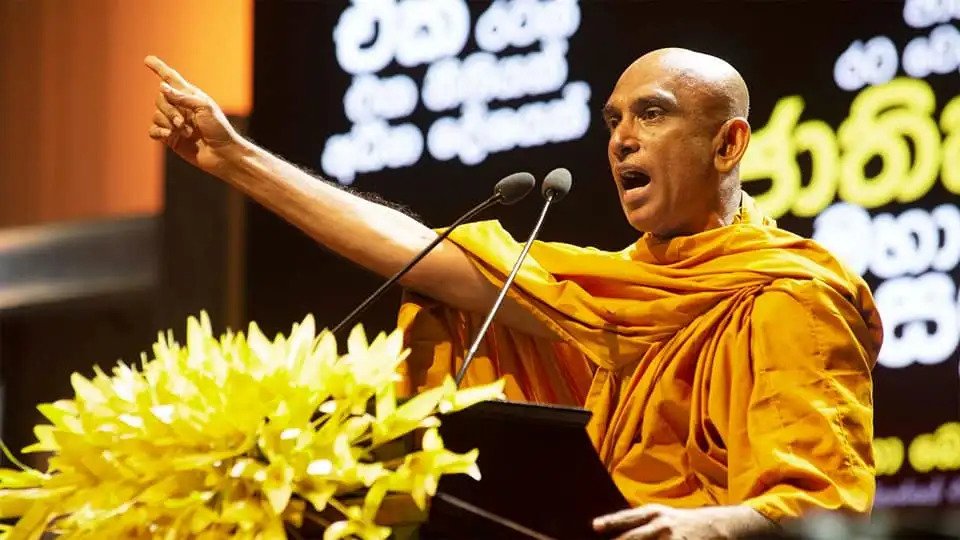
Following the accusation levelled against the former Member of Parliament, Ven. Athuraliye Rathana Thera, over the alleged abduction and intimidation of General Secretary of the Ape Janabala Pakshaya, questions have been raised why the long arm of law has so far failed to make an arrest.
Submitting an affidavit, General Secretary of the Ape Janabala Pakshaya (AJP) Ven. Vedanigama Wimalatissa has alleged how the bonus seat his party secured at the 2020 General Election was ‘robbed’. According to the priest, this seat was obtained forcibly by threatening him with death. (In the affidavit it says that the priest was threatened by the then Senior DIG Western Province Deshabandu Tennakoon in the presence of Ven. Rathana and a former Minister. Ven. Wimalatissa claims that this was done by forcing him to place his signature on several blank papers on August 16, 2020.)
Speaking to the Daily Mirror, Ven. Wimalatissa explained how he went hiding before the general election as Deshabandu Tennakoon was out to arrest him with an arrest warrant. This is because he rejected the proposal brought by Ven. Rathana to contest the general election under the banner of Sri Lanka Podujana Peramuna (SLPP).
According to Ven. Wimalatissa, people gathered around AJP in numbers and seeing how this party was getting popular, the accused Ven. Rathana had wanted him not to contest under AJP, but under the SLPP banner. “He said that if we contest under SLPP, we will certainly get a few number of parliamentary seats in addition to other perks from their leaders to which I did not agree. This disagreement led Ven. Rathana to fall out with me,” the complainant Ven. Wimalatissa said.
After the fall out, Ven. Rathana was accused of trying to abduct AJP General Secretary before the general election as the latter was conducting a successful election campaign throughout the country.
“Although I constantly received threats, I ignored them and carried out the election campaign during the last two weeks. Because of the threats, I had to leave the temple -the Asgiriya Maha Viharaya- where I was residing and go into hiding. On July 31, 2020, I got a call from a fellow monk who was with me at Asgiriya Maha Viharaya that a police team in search of me had surrounded the temple. The team had been led by former HQI of the Kandy Police. Since they couldn’t find information from the monks at the temple where I had taken shelter, they had chased away all the monks and the devotees who gathered on hearing the police presence at the temple. After chasing away the monks, the police had broken the doors and taken to their custody all the valuables in the temple including the pure gold Buddha statues,” Ven. Wimalatissa added.
According to him, Chief Sanganayake of the Central Province Ven. Godamunne Pangnanada Thera had rushed to the temple soon after he came to know of the police presence at the temple. The Chief Sanganayake had then called Wimalatissa Thera on his mobile phone and informed that the HQI Kandy wanted to talk to him.
“I asked the HQI why they have surrounded the temple and chased away the monks and the devotees. The HQI said that on the instructions of Senior DIG Western Province Deshabandu Tennakoon, he came to arrest me with an arrest warrant and wanted me to disclose where I was,” the complainant monk said.
At the general election, the AJP has secured a bonus seat. Hence Ven. Wimalatissa was still in hiding in fear of Ven. Rathana as the former received more threats this time as the latter wanted AJP to nominate his name to the only bonus seat the party secured.
As the pressure was mounting on, Chairman Saman Perera and members of Ape Janabala Pakshaya, had unanimously taken a decision to nominate Ven. Wimalatissa to the national list and his name has been sent to the Election Commissioner to fill the bonus seat their party secured.
Priest threatened
“This irked Ven. Rathana more and he started threatening me continuously. I went to the Election Commissioner’s office on August 7, 2020 with a fellow monk- Ven. Arambepola Rathanasara to put my signature to the necessary documents in order to fill the national list seat. When we left the Election Commission, we noticed a vehicle carrying Ven. Rathana and Ven. Galagoda Aththe Gnanasara following us in another vehicle. We managed to escape from them but on a later date, Ven. Rathanasara had been abducted and assaulted by Ven. Rathana in a bid to find out my whereabouts. Later he had been released. After a few days, Ven. Rathanasara had lodged a complaint at Mirihana Police regarding his abduction, but he had to withdraw the complaint as Deshabandu Tennakoon had forced him to withdraw it,” Ven. Wimalatissa said.
Ven. Rathanasara
When contacted Ven. Rathanasara to find out the veracity of the allegations leveled by Wimalatissa Thera, the former confirmed that he was allegedlly abducted and was assaulted to find out where the latter was in hiding.
“Although I was in contact with Ven. Wimalatissa, I was not aware where he was. They did not believe what I said. After a few days I was released. I then lodged a complaint at the Mirihana Police, but had to withdraw it due to the threats I received. If the investigation officers summon me to give a statement I will submit all the details to them – how I was abducted and the threats I received from Deshabandu Tennakoon to get the complaint withdrawn,” said Ven. Rathanasara.
“I have given a statement to CCD”- Deshabandu Tennakoon
When contacted Deshabandu Tennakoon to find out whether there is any truth to the allegation that has been leveled against him by Ven. Vedanigama Wimalatissa, Tennakoon said that his statement regarding this has been recorded by the Colombo Crimes Division (CCD).
“I have given a statement to the CCD in this regard and since the matter is now under investigation, I do not want to make any comment on this,” he said.
Meanwhile, attempts made by this newspaper to get a response from former President Gotabaya Rajapaksa failed as he did not respond to the two text messages sent to him on October 16 and 17.
On August 16, 2020, a friend of the complainant monk had called him from Japan and wanted him to meet the then President Gotabaya Rajapaksa at his Mirihana residence as the President wanted to solve the bonus seat issue that had cropped up.
“As requested I went to Mirihana with a friend of mine the same afternoon – on August 16, 2020. Few minutes later Ven. Rathana too came there. I was asked to come to Mirihana for a discussion with President Gotabaya Rajapaksa. I was greeted upon my arrival by the President who was in a pair of shorts. He wanted me to go to the adjoining room until he finished a discussion with Ven. Rathana Thera. He never gave me an audience to discuss the bonus seat issue. Later Rajapaksa’s Secretary wanted me to go to the office of a former minister as the President had asked this former Minister to solve the matter. It was at this time, the friend who accompanied me in the vehicle called and said that the vehicle in which we came to Mirihana had been taken by the police to the Mirihana Police Station on the instruction of Deshabandu Tennakoon,” the complainant monk said.
He further said how one of the security officers at Rajapaksa’s residence directed him to a parked white car, directing him to go to the office of the former minister. “I was taken to the said office by Ven. Rathana Thera, accompanied by a security officer believed to be from the President’s security division,” the complainant monk said.
Solving the bonus seat issue
According to him, when he was taken to the said office, the said minister was seated by the side of a conference table and seated next to him was Deshabandu Tennakoon and OIC Kollupitiya Sumith Gunaratne. At this point the former minister had told the complainant monk that Gotabaya Rajapaksa wanted him to solve the bonus seat issue and had given instruction to nominate a person whom he thinks is the most suitable to be an MP. Having said so, the former minister had asked Ven. Rathana Thera whether he would like to accept the MP’s slot to which he had agreed.
“I did not agree to what the former minister suggested and said that I have to think about it before coming to a conclusion. (Deshabandu Tennakoon got annoyed about what I told and said, ‘You all know who I am. I am Deshabandu Tennakoon, the Senior DIG in charge of the Western Province. Pointing a finger to the person seated next to him, Tennakoon said ‘he is the OIC Kollupitiya Police Station who has been placed there by the President to carry out his (President’s) ‘work’. He then took a paper from his pocket and said that it is an arrest warrant taken to arrest me and handed over the paper which was bigger than an A4 paper. When I read it, it did not carry my name, but about an arrest on some other person for violating the Archeological Act,” Ven. Wimalatissa alleged.
The complainant monk had then asked the OIC Kollupitiya where they had taken his friend who had accompanied him to Gotabaya Rajapaksa’s residence and the vehicle in which he travelled, to which OIC Sumith Gunaratne had said it should be either to the Mirihana Police or to the Cinnamon Garden Police.
Giving him about 10 A4 papers, Tennakoon had then asked the monk to put his signature on them, so he will be released to go back with his friend, who accompanied him to President Rajapaksa’s Mirihana residence.
“I demanded them to release my friend and the vehicle first, and once they confirm that they have been released I will put my signature on the blank papers. After a few minutes I received a call from my friend to say they were released and are leaving Colombo. It was only after that call that I put my signature on the papers given by Tennakoon,” he said.
Although he signed these papers, the complainant monk has said that the Chairman of AJP has removed him from the party’s secretary post on August 8, 2020, and had appointed a new party secretary.
“I told them that it’s only the party secretary who can remove or appoint a member to the bonus seat and that since I was not the secretary anymore, though I put my signature on these blank papers, they (Signatures) will be of no use to them.” Ven. Wimalatissa said.
Further he described how he was then taken to the white colour defender jeep of the OIC Kollupitiya. He was made to sit on the rear seat.
“Tennakoon further wanted the Kollupitiya OIC to get Saman Perera to the police station to obtain a statement regarding a vehicle issue and arrest him. I immediately called Saman Perera and wanted him to be careful of the Police. It was then that I received a call from a friend of mine who asked where I was. I told that I don’t know the location, but in OIC Kollupitiya’s jeep. The driver of this jeep overheard this and immediately informed OIC of Kollupitiya Police. I was then dragged out of the jeep and put into a car, my hands were tied and they covered my face and head with the robe I was wearing and abducted me. Later I was blindfolded and taken from one place to another for several weeks,” the complainant monk said.
“We were asked to stop conducting this investigation by the then IGP Deshabandu Tennakoon. As a result we could not conclude the investigation, but we’re glad that under the present IGP, the CCD has once again started this inquiry, which we believe will go in the right direction and eventually help bring the accused to book,” police sources said.
“As per the MoU, AJP agreed to give us even the one seat it won”- Ven. Rathana Thera
Former MP, Ven Athuraliya Rathana Thera when contacted said how his party signed a Memorandum of Understanding (MoU) with the AJP.
“As per the MoU, AJP agreed to give us a seat even if they secured one bonus seat. AJP obtained around 60, 000 votes and secured one seat. Instead of giving this seat to us, as promised, Ven. Wimalatissa got his name registered with the Election Commission for the bonus seat without our knowledge and went into hiding. Gotabaya Rajapaksa wanted to solve this issue and when Ven. Wimalatissa and I met him at his Mirihana residence, we were asked to meet yet another politician in his office in Colombo. By this time Saman Perera, Chairman of AJP, had removed Ven. Wimalatissa from the party Secretary’s post,” Ven. Rathana said.
When asked why Ven. Wimalatissa was threatened, intimidated and his signature placed on a few blank sheets, Ven. Rathana said that the former was neither threatened nor intimidated.
“Why did we want to intimidate him? As you said we never got his signature on blank papers. Although allegations have been levelled against Deshabandu Tennakoon for pointing a pistol against him, it was a made up story. Two years after this incident Ven. Wimalatissa lodged a complaint against us for abduction. Few of my staff members were arrested. Once again in March this year, he had lodged a complaint citing that his earlier complaint wasn’t inquired. He even gave a letter to the Election Commission stating that he had no objection in appointing me to the national list. As claimed by Ven. Wimalatissa, there wasn’t such an issue regarding the nationalist seat,” Ven. Rathana said.
Source:Daily Mirror.lk