Harin nominates Harsha as 6-month President

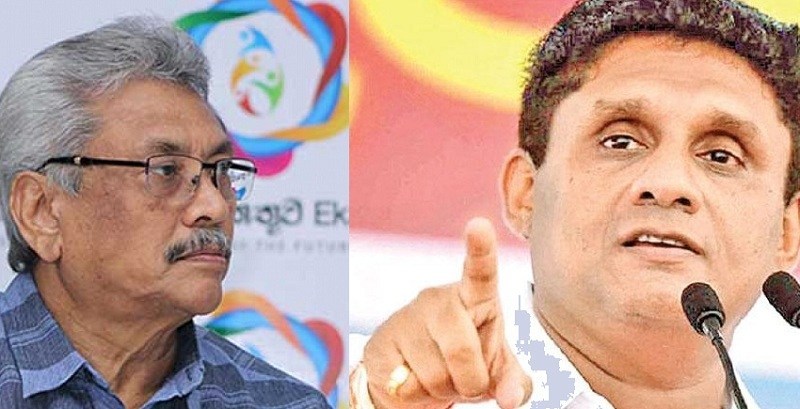
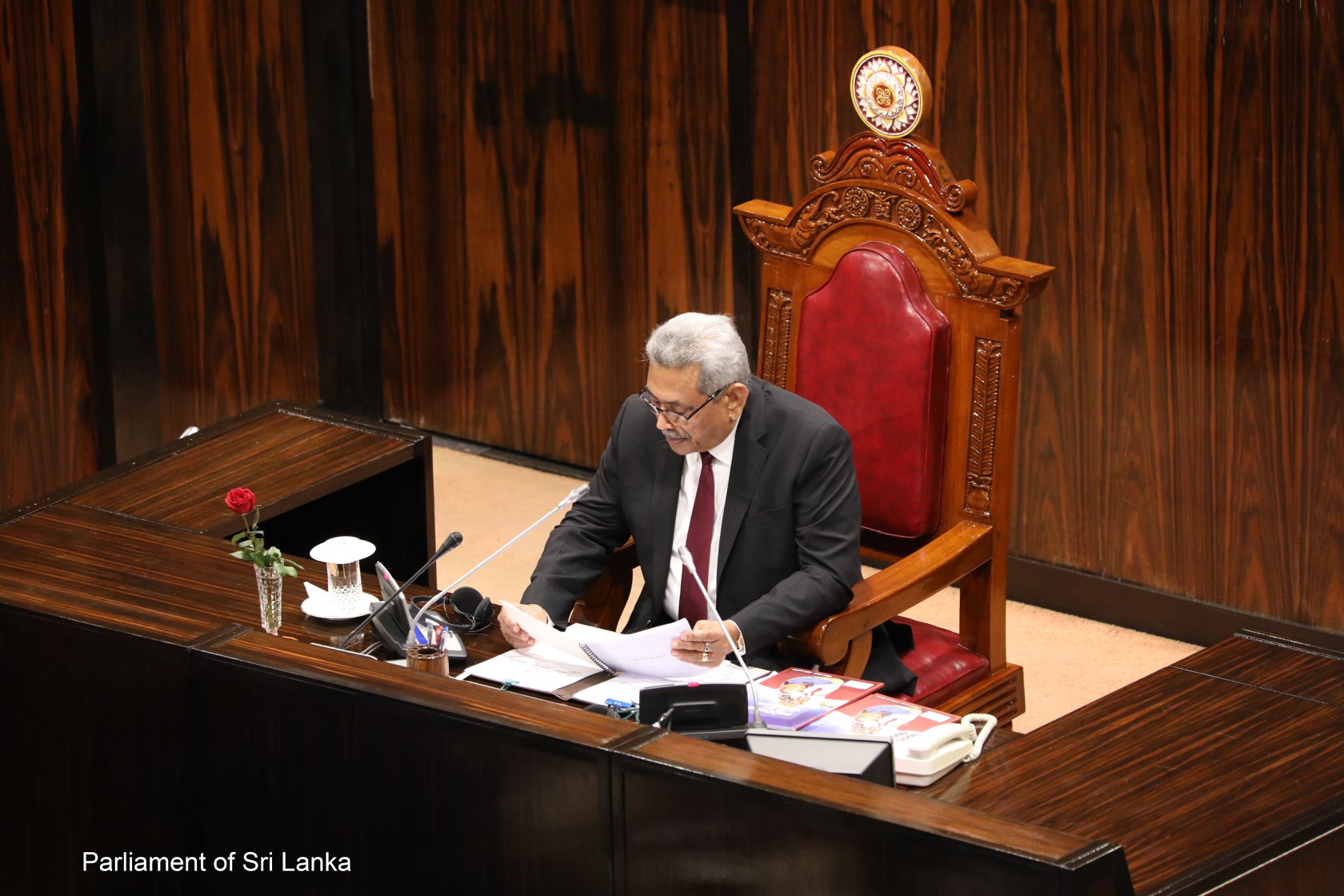
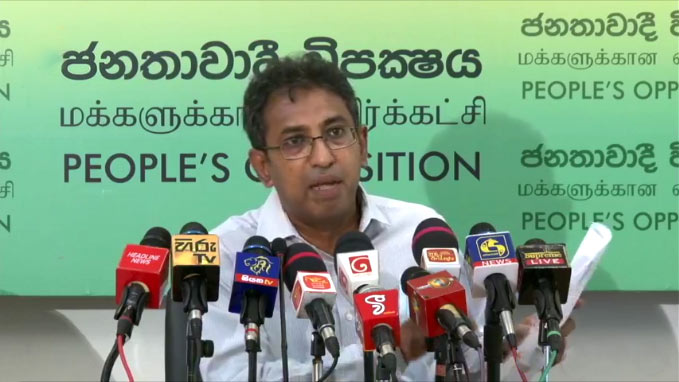
Samagi Jana Balawegeya (SJB) Opposition Parliamentarian Harin Fernando yesterday (6) urged the Parliament to come together to provide a solution to the people protesting on the streets, and suggested that fellow SJB MP and economist Dr. Harsha de Silva be made a caretaker President for six months at least, until an election can be held.

“People are protesting on the streets because they are frustrated. We as the Parliament are responsible for providing them with an answer. We need to put our political differences aside and come together to provide a solution. If President Gotabaya Rajapaksa resigns, then what next? The Constitution allows the Parliament to appoint a President. Let us come together. I propose that Dr. de Silva be made a caretaker President until an election can be held,” Fernando told the Parliament yesterday.

He said that the current President’s downfall has been the latter’s pride and his refusal to listen to criticism.

“I have told from back then that this is a curse. No President has fallen so fast, in two years,” he claimed.

He urged the Parliament to put aside its differences and come together for the people.

“Even the all-party meeting today (6) ended with no conclusion. The Parliament will get hit next,” he warned yesterday.

On Sunday (3), the 11 constituent parties of the Governing Alliance, led by Sri Lanka Podujana Peramuna (SLPP) Government MPs Udaya Gammanpila, Wimal Weerawansa, and Vasudeva Nanayakkara, proposed that an all-party, Interim Government be formed as a solution to the current political crisis gripping the country. Following the resignations of the Cabinet of Ministers on Sunday, four Cabinet portfolios (Finance, Foreign, Education, and Highways) were appointed in order to maintain stability in the country until a full Cabinet is appointed. However, President’s Counsel M.U.M. Ali Sabry resigned as the Finance Minister. The Government lost its two-thirds majority in the Parliament recently as 40 MPs announced that they will function independently. Although President Rajapaksa has reportedly called upon the Opposition to show a 113 majority to hand over power, the SJB, the National People’s Power (NPP), and the Tamil National Alliance (TNA) have stressed that they will not accept any solution that does not include the resignation of the President.
UN human rights office urges Sri Lanka to defuse tensions peacefully

The UN human rights office (OHCHR) on Tuesday (5) urged authorities in Sri Lanka to defuse tensions peacefully, after a state of emergency was declared in response to protests over the country’s deepening economic crisis.

OHCHR said that the situation has worsened and that there have been shortages of food and fuel, along with power cuts, prompting new protests by desperate Sri Lankans.

Following the state of emergency and other restrictions, Liz Throssell, Spokesperson for OHCHR said her office was “concerned that such measures are aimed at preventing or discouraging people from legitimately expressing their grievances through peaceful protests, and that they frustrate the exchange of views on matters of public interest”.

Deteriorating situation

Public frustration has been rising in recent months with largely peaceful demonstrations taking place across the country.

However, amid sudden shortages in fuel, cooking gas and essential food items; worsening inflation, currency devaluation and rolling power cuts over the past two weeks, the situation has worsened.

“This led to further protests by Sri Lankans left desperate by the rising cost of living and difficulties to obtain basic items,” Ms. Throssell added, speaking to journalists in Geneva.

‘Unwarranted’ violence

After a demonstration outside the president’s residence on 31 March, the Government declared a state of emergency on 1 April, announced a 36-hour curfew from 6pm on 2 April and shut down social media networks for 15 hours the following day. 

There have also been reports of excessive and unwarranted police violence against protesters.  

OHCHR reminded the Sri Lankan authorities that measures related to states of emergency “must comply with international human rights law”, should be limited to the extent strictly required by the situation and be proportionate to it, and “should not be used to stifle dissent or hinder peaceful protest”.

“The UN human rights office will continue to closely watch developments,” said the agency’s spokesperson.

Drift towards militarization

As UN rights chief Michelle Bachelet noted in her recent report to the Human Rights Council in February, the drift towards militarization and the weakening of institutional checks and balances in Sri Lanka have affected the State’s ability to effectively tackle the economic crisis and ensure the realization of the economic, social and cultural rights of all citizens.

The High Commissioner had also previously voiced her concern over how the Government responds to criticism and dissent in ways that undermine civic space.

“We reiterate these concerns today,” said the UN official.

“We urge the Government, political parties and civil society to engage in immediate, inclusive and meaningful dialogue to find a solution for the pressing economic and political challenges that Sri Lanka faces and to avoid further polarization of the situation”. 

Call for restraint

Meanwhile, in New York, Farhan Haq, Deputy Spokesperson for the Secretary-General, told journalists at a regular media briefing that the UN’s team in Sri Lanka is “closely following the situation.”

He said the UN Resident Coordinator in the country, Hanaa Singer-Hamdy, had reminded the Government that the rights to peaceful assembly, association and expression are universal fundamental rights which help foster dialogue between citizens and the State. 

On Friday, the top UN official in the country also called for restraint from all sides, and for the de-escalation of tensions, away from violent confrontation. 

“Our UN team encourages all citizens to engage in dialogue for peaceful solutions,” said Mr. Haq.

Speaker says Parliament can’t ask Prez to step down

Speaker Mahinda Yapa Abeywardane is reported to have ruled out the possibility of Parliament to ask President Gotabaya Rajapaksa to step down .

At the hurriedly summoned party leaders’ meeting in Parliament, the main opposition Samagi Jana Balawegaya (SJB) has sought parliamentary intervention to prevail upon the President to quit in a move to douse tension in the country.

However, the Speaker has rejected it saying Parliament has no democratic right to ask the president to resign. He said the current crisis should be resolved only through democratic means.

He said the President had called for the parties to get together and evolve a solution to form an interim government. The Speaker said it was up for the people who elected the President to decide on it.

Also, the opposition declined to join hands with the government for an interim government.

Meanwhile, the government’s parliamentary majority was shaken after 42 MPs including ten from Sri Lanka Podujana Peramuna (SLPP) vowing to sit independent in the House.

On behalf of the SLPP group, MP Anura Priyadarshana Yapa announced the decision to function independent of the ruling side. Afterwards, former President Maithripala Sirisena announced the decision of Sri Lanka Freedom Party (SLFP).

MP Wimal Weerawansa who spoke on behalf of the 11 party alliance spelled its decision once again and asked the Speaker to intervene.

Posted in Uncategorized

Sajith urges Executive Presidency abolition

Opposition and Samagi Jana Balawegeya (SJB) Leader Sajith Premadasa yesterday (5) called for the abolition of the Executive Presidency, urging the process of abolition to be commenced within this week.

“This deal-making brand of politics has been rejected by the country. The country is asking for a new start. The people are telling this Government to go home. That is the truth. There is nothing outside of that that we can do here. These 150 members of the Government approved the 20th Amendment to the Constitution. Now, the time has come to change the Executive Presidency. Let us make this an opportunity to do so. Start the process to abolish the Executive Presidency this week itself,” said Premadasa while speaking in Parliament.

Addressing Prime Minister Mahinda Rajapaksa, Premadasa reminded Rajapaksa that even his own people were against Rajapaksa retaining even a little bit of power as the Premier through the 20th Amendment to the Constitution.

“Remember during the debate on the 20th Amendment to the Constitution Bill where we said that we do not need a Constitution to make the Prime Minister a scarecrow and the President all-powerful or vice versa. We spoke about checks and balances. It is clear that we need to change the Executive Presidency, but we also do not need an all-powerful Prime Minister. There need to be checks and balances.”

Premadasa called on the House to begin the mechanism to abolish the Executive Presidency within this week.

“Let us have a backbone, and within this week, bring the mechanism to abolish the Executive Presidency. Let us stop playing opportunistic politics and agree to one policy.”

The 19th Amendment to the Constitution, passed in 2015, diluted the powers of the Executive Presidency, while the 20th Amendment to the Constitution, passed in 2019, enhanced them and simultaneously weakened the powers of the Prime Minister.

Furthermore, Premadasa spoke about the wave of islandwide public protests that have intensified over the past week, mostly centred around the “Go Home Gota” slogan.

“The Parliament must reflect the voice and heartbeat of the people on the roads. There need not be another voice here since we represent the public. Today, the public has stepped onto the roads with no fear despite the curfew, the state of emergency, and the brief social media ban. The entire country is telling in one voice that we cannot continue on this path; that this group of people cannot do this. If we cannot represent their struggle here, is it any surprise then that they are saying that all 225 of us are not needed?” he questioned.

He stressed that nobody from the SJB will be an “opportunist at this moment to become temporary ministers and play musical chairs”.

“If we are coming to power, we will come with the blessings of the people, and not in any other way,” he added.

On Sunday (3), the 11 constituent parties of the governing alliance, led by Government Parliamentarians Udaya Gammanpila, Wimal Weerawansa, and Vasudeva Nanayakkara, proposed that an all-party Interim Government be formed as a solution to the current political crisis gripping the country. Following the resignations of the Cabinet of Ministers on Sunday, four Cabinet portfolios (Finance, Foreign, Education, and Highways) were appointed to maintain stability in the country until a full Cabinet is appointed. However, newly appointed Finance Minister, President’s Counsel (PC) M.U.M. Ali Sabry resigned overnight. The Government lost its two-thirds majority in the Parliament yesterday as 40 members of Parliament (MPs) announced that they will function independently. Although President Gotabaya Rajapaksa has called on the Opposition to show a 113 majority to hand over power, the SJB, the National People’s Power (NPP), and the Tamil National Alliance (TNA) have stressed that they will not accept any solution that does not include the resignation of the President.
Posted in Uncategorized

Four-hour talks between President and SLFP MPs who quit govt

The parliamentary group of Sri Lanka Freedom Party (SLFP) that quit the government called on President Gotabaya Rajapaksa this evening (April 05).

According to reports, the meeting lasted for nearly four hours.

Speaking to the media afterwards, SLFP general secretary MP Dayasiri Jayasekara said the party’s parliamentary group will continue to sit independently in the House despite the discussions.

Posted in Uncategorized

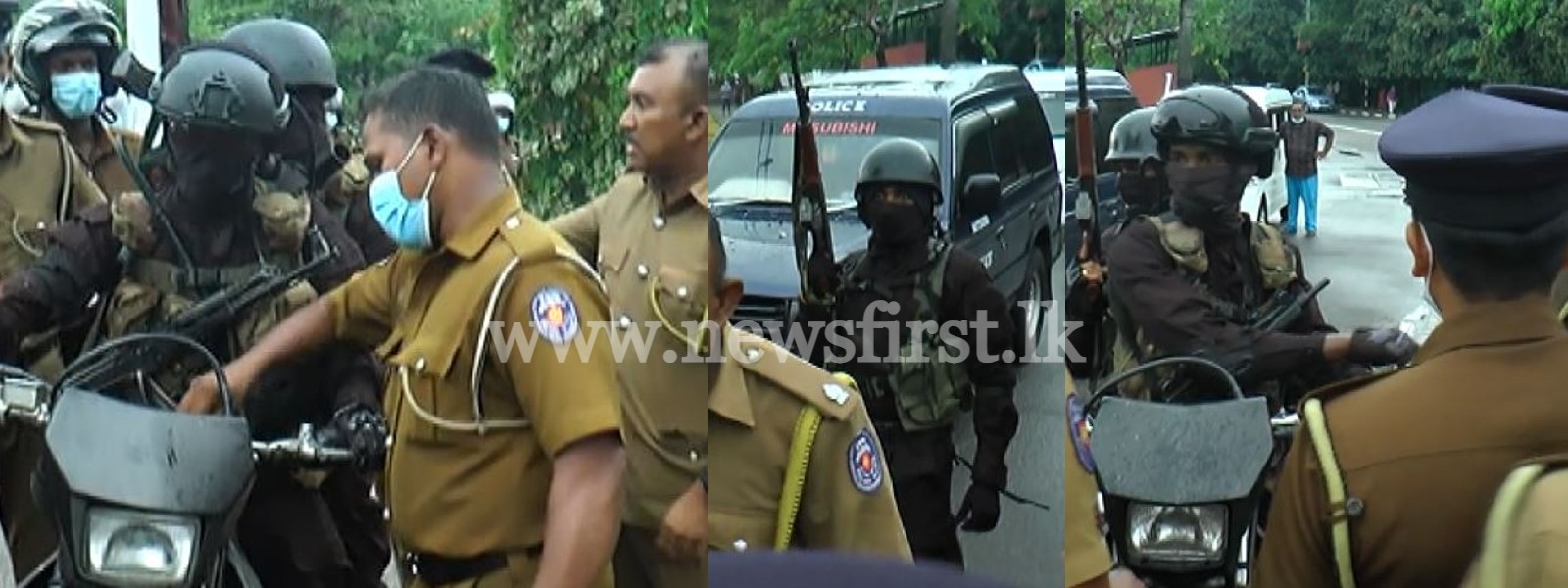
Masked men in unregistered bikes are from Army : Inquiry against Police officers

Sri Lanka’s Police Chief has ordered for an immediate independent investigation over a confrontation that had taken place between several police officers and a team of Army Riders during a protest opposite Parliament on Tuesday (5).

The Chief of Defence Staff and Commander of the Army General Shavendra Silva has requested the Inspector General of Police to immediately conduct an inquiry into the ‘unethical and ill-mannered behaviour’ of two Police officers and initiate disciplinary action against them when a four -member team of Army Riders on the directions of the Director Operations of the Army HQ arrived at the road entrance to the Parliament complex.

Defence Secretary General Kamal Gunaratne (Retd) has also already informed the IGP and the Secretary to Ministry of Public Security in regard to the incident and requested them to inquire into the unacceptable conduct of those Police Officers.

Posted in Uncategorized

Massive protest near PM’s Wijerama residence

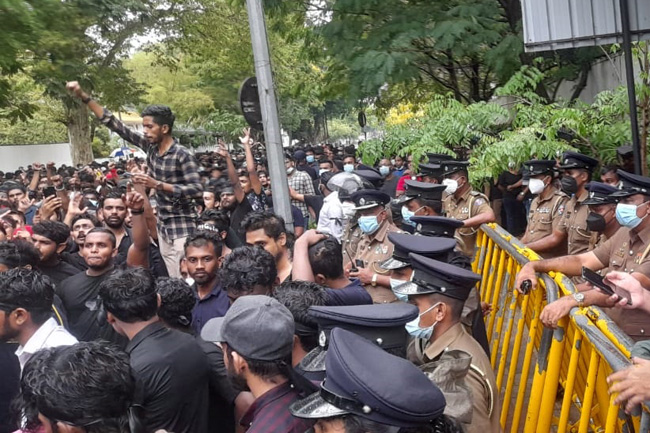
University students have thronged in large numbers near the Prime Minister’s residence on Wijerama Road in Colombo 07, staging a demonstration against the incumbent government.

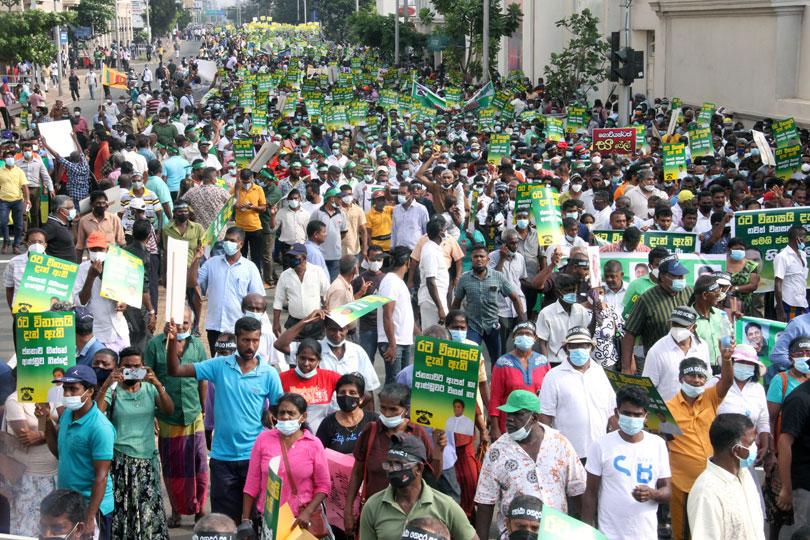
Mass protests are continuing in many parts of the island today as well, as people took to the streets to seek solutions for the ongoing crises in the country and to urge the government to step down.

In the aftermath of the agitation in Mirihana on March 31 near the presidential residence on Pengiriwatte Road, demonstrations were staged all across the island. The protesters also defied a countrywide curfew which was in force from 6.00 p.m. on Saturday (April 02) to 6.00 a.m. on Monday (April 04).

Posted in Uncategorized

Sri Lanka crisis: Gotabaya Rajapaksa loses parliamentary majority

41 lawmakers leave coalition, leaving Rajapaksa’s government with fewer than the 113 members needed to maintain a majority in the 225-member house

Sri Lanka’s President Gotabaya Rajapaksa on Tuesday lost his parliamentary majority, as a group of lawmakers from the ruling party and its allies sat independently in the House, deserting the government that faces enormous public criticism for “mishandling” the economic crisis.

Over 42 MPs, including from key partner Sri Lanka Freedom Party (SLFP), quit the ruling Sri Lanka Podujana Peramuna (SLPP or People’s Front)-led alliance, and the government lost its majority in the 225-member legislature. Thier defection signalled the collapse of the government ‘s popularity that, in 2020, fetched it a formidable two-thirds majority. However, there is no vote of confidence scheduled yet to test the strength of the government or Opposition .

In his address to Parliament on Tuesday, Leader of Opposition Sajith Premadasa blamed the government for the current crisis, and said it was time for the country to abolish Executive Presidency that allows the President sweeping powers to take unilateral decisions. Opposition legislator and Jaffna MP M.A. Sumanthiran too intervened, challenging the government to put its recently imposed Emergency regulations to vote in the House, as is mandated in the Constitution.

The Parliament will convene on Wednesday to debate the country’s economic crisis that has resulted in severe shortage of essentials for citizens and skyrocketing prices. It has also led to a spontaneous eruption of street protests, with citizens demanding that the President step down.

The President’s attempt to appoint a “new” Cabinet after mass resignations appears to have backfired, with the newly appointed Finance Minister Ali Sabry resigning barely 24 hours after his appointment. Top bureaucrat and Secretary to the Treasury and Finance Ministry resigned on Tuesday, resulting in two crucial positions falling vacant at a time of a dire economic crisis.

Meanwhile, the International Monetary Fund (IMF), where Sri Lanka has sought support, on Tuesday said that it is monitoring political and economic developments in Sri Lanka “very closely” amid growing public unrest, Reuters reported. “IMF staff is looking forward to program discussions with the authorities, including during the visit of the newly appointed Finance Minister to Washington later this month,” IMF Sri Lanka mission chief was quoted as saying. Except, with Mr. Sabry’s resignation, Sri Lanka did not have a Finance Minister as of Tuesday.

On Tuesday, citizens and professionals including health workers, lawyers, continued agitating at different locations, including outside Prime Minister Mahinda Rajapaksa’s private resident, asking the Rajapaksas to resign immediately. As protests swell in different parts of the country, despite the police attempting to disperse crowds with water cannons and tear gas in some areas, the Ministry of Defence urged citizens not to resort to violence. “I further emphasize that the security forces will act to maintain peace and also will not hesitate to enforce law against those involving in violence,” said General GDH Kamal Gunaratne (Retd), Secretary, Ministry of Defence in a statement.

The UN on Tuesday expressed concern over “excessive and unwarranted police violence” against protesters. Recalling the report of the UN Human Rights Chief, a spokesman said in a statement: “the drift towards militarisation and the weakening of institutional checks and balances in Sri Lanka have affected the State’s ability to effectively tackle the economic crisis.”

Source:The Hindu

Sri Lanka opposition rejects president’s unity government offer

Sri Lanka’s opposition has rejected an invitation from the president to form a unity government, urging his resignation over the country’s worsening shortages of food, fuel and medicines.

The opposition’s demand on Monday came as anti-government protests continued throughout the country over its worst economic crisis in memory and deepening mistrust in President Gotabaya Rajapaksa’s leadership.

Earlier on Monday, the president’s office said he “invites all political parties represented in the parliament to come together to accept ministerial portfolios in order to find solutions to this national crisis”.

The largest opposition political alliance – the United People’s Power or Samagi Jana Balawegaya (SJB) – rejected the proposal.

“The people of this country want Gotabaya and the entire Rajapaksa family to go and we can’t go against the people’s will and we can’t work alongside the corrupt,” top SJB official Ranjith Madduma Bandara told The Associated Press news agency.

SJB has 54 MPs in the 225-member parliament.

The left-wing People’s Liberation Front (JVP) also responded by urging Rajapaksa and his once-popular and powerful family to immediately step down.

“He really must be a lunatic to think that opposition MPs will prop up a government that is crumbling,” JVP MP Anura Dissanayaka told reporters in Colombo.

The main minority opposition party, the Tamil National Alliance (TNA), joined the voices dismissing the idea.

“His offer to reconstitute the cabinet with opposition MPs is nonsensical and infuriates the people who have been demanding his resignation,” TNA MP Mathiaparanan Abraham Sumanthiran told the AFP news agency.

All 26 Cabinet ministers handed in their resignations on Sunday, after thousands of people defied a countrywide state of emergency and curfew and joined street protests to denounce the government.

Two other Rajapaksa brothers, Finance Minister Basil Rajapaksa and Irrigation Minister Chamal Rajapaksa, were among those who resigned, along with the prime minister’s son, Sports Minister Namal Rajapaksa.

The departures cleared the way for the country’s ruling political family to seek to shore up its weakening position and attempt to stem growing public protests.

But the president has already reappointed four of the outgoing ministers – three of them to their old jobs – while replacing brother Basil Rajapaksa as finance minister with the previous justice chief. Previous ministers of foreign affairs, education and highways kept their positions.

Protests continue

On Monday, April 4, police used a water cannon to disperse protesters who marched towards the Rajapaksa family home in southern Sri Lanka demanding that the ruling family quit.

The debt-laden country, led by Rajapaksa and several members of his family since 2019, is struggling to pay for imports of fuel and other goods due to a scarcity of foreign exchange, leading to hours-long power cuts and a shortage of essentials.

The extent of the crisis became clear when the country could not pay for imports of basic supplies because of its huge debts and dwindling foreign reserves.

As protests grew and calls increased for him to step down, President Rajapaksa assumed emergency powers by decree at midnight on Friday. The government also declared a countrywide curfew, which was lifted Monday morning.

Authorities also reportedly blocked access for nearly 15 hours to Facebook, Twitter, YouTube, WhatsApp and other social media platforms that were used to organise the protests.