EU gives SL a wake-up call on trade policy

Delivering a wake-up call to the Government, the European Union (EU) Mission in Sri Lanka last week stressed on the need to align trade policies before the situation worsens.

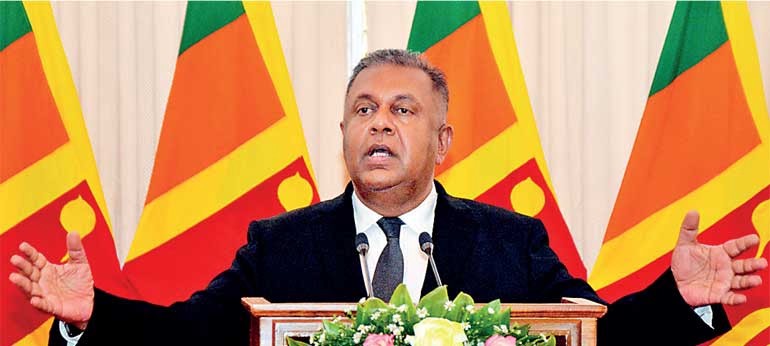
Although import restrictions imposed by the Government are understood in the context of the Balance of Payment (BOP) crisis, EU Ambassador Denis Chaibi said: “Conventions of the World Trade Organisation (WTO) should be respected.”

“Last year, EU exports to Sri Lanka were the lowest recorded in a decade,” he told a webinar titled ‘GSP+: Past, Present, Future’. It was jointly organised by the Federation of Chambers of Commerce and Industry of Sri Lanka (FCCISL) and the Colombo Chamber of Commerce.

Pointing out that the balance of trade with the EU had always been in favour of Sri Lanka, the Ambassador raised concerns on the serious imbalance exacerbated by import restrictions not formally notified to the WTO.

“We have no problem with the beneficiary balance for Sri Lanka, because the EU believes in free and fair trade. However, at some stage, there should be a reflection before this matter gets worse,” Chaibi stressed.

He explained that some considerations could be given if the restrictions were temporary and duly notified.

It was also revealed that a mission was scheduled in the coming months to assess the progress of Sri Lanka to retain the GSP+ concession.

Although it is yet to be decided whether the review will be held virtually or in person, Chaibi said the EU was keen to allow Sri Lanka to continue to reap the benefits of GSP+ for which it wanted to ensure the concerns raised on the human rights front were addressed.

“Commitment to international conventions, where social standards are respected make economies more competitive,” he said, adding that Sri Lanka was in a good position compared to other countries in the region.

The mission will conduct the first formal review of Sri Lanka’s compliance to the conventions laid out by the EU and progress in areas of concerns since a resolution was adopted by the European Parliament in June, urging the European Commission to temporarily withdraw Sri Lanka’s GSP+ status.

Underlining the benefits enjoyed by Sri Lanka through the preferential access to the largest and most competitive high-end EU market, Chaibi said: “It is not easy to replace a market.”

Last year Sri Lanka’s merchandise exports amounted to $ 10 billion, and the Government has set a target of $ 12 billion in 2021, of which $ 5.7 billion was achieved by June.

The EU remains Sri Lanka’s largest export market, accounting for 30% of the total. Nearly 60% of Sri Lankan exports benefit from some form of preferential access due to EU GSP+ and US GSP schemes.

The resolution on Sri Lanka was adopted noting the Government’s persistent failure to adopt and enact human rights reforms and repeal the draconian Prevention of Terrorism Act (PTA). Up to 628 votes were cast in favour of, 15 against, and there were 40 abstentions.

In January 2020, the EU delegation in Sri Lanka reassured that it would continue the GSP+ concessions to Sri Lanka till 2023 while noting that there would be ‘no changes’ in the rigorous monitoring of the country’s progress in implementing the conventions.

Sri Lanka regained the EU GSP+ privileges for Sri Lankan exports in May 2017. The trade preferences under GSP+ consist of the full removal of duties on 66% of tariff lines, covering a wide array of products, including textiles and fisheries.

The GSP+ scheme is conditional on Sri Lanka advancing human and labour rights and working towards sustainable development. Since the resumption of GSP+ concessions in 2017, Sri Lanka’s total exports to the EU has increased by 28%.
Posted in Uncategorized

Sri Lanka’s COVID-19 cases tally increases to 369,343

Another 1,232 COVID-19 cases have been detected today in the country, raising the number of confirmed infections to 369,343.

Accordingly, 3,660 coronavirus cases have been detected in Sri Lanka today.

The Epidemiology Unit of the Ministry of Health said 46,211 persons are currently receiving treatment for coronavirus at several facilities across the country.

Earlier today, 2,188 persons who recovered from COVID-19 were discharged from hospitals, raising the number of recoveries in the country to 316,528.

3,524 suspected COVID-19 cases are also under medical observation at present.

Sri Lanka’s coronavirus death toll is currently at 6,604.

Rights groups concerned over police abuses, urges Scotland to suspend training programmes

The Scottish government should provide details of a review of Police Scotland training for Sri Lankan police, Human Rights Watch, Freedom from Torture, the Sri Lanka Campaign for Peace and Justice, and Pax Christi Scotland said in a letter to the Scottish Justice Secretary Keith Brown.

Scottish ministers were further urged to exercise their authority to suspend the training program, which risks appearing to endorse the actions of Sri Lanka’s abusive police force.

Human Rights Watch notes that the Sri Lankan police in recent months have allegedly been responsible for torture and extrajudicial killings. They have been implicated in a pattern of such abuses over many years, despite receiving Police Scotland training “on an almost continuous basis” since 2013.

“Police Scotland should halt its Sri Lanka training program until the Sri Lankan government and police demonstrate a willingness to reform,” said Yasmine Ahmed, UK director at Human Rights Watch. “Scottish ministers have the authority to end this program, which does not live up to their government’s support for human rights.”

It was also mentioned that the Scottish government has announced that an important objective of the training program is to address gender-based violence. However, the Sri Lankan police spokesman recently said on a television talk show that it is not police policy to detain or prosecute men who are alleged to threaten or assault their wives. “We try to reconcile the matter,” he said. “If we remand the person, the husband and wife will be separated, then what will happen to the children?”

The human rights groups said that under the administration of President Gotabaya Rajapaksa, who took office in November 2019, the Sri Lankan police have also targeted ethnic and religious minorities for abuse, suppressed dissent, and narrowed the space for civil society organizations.

New COVID-19 guidelines: gyms, spas closed; public events banned

Sri Lanka has imposed new restrictions and guidelines as measures to prevent the spread of the COVID-19 virus within the country.

The measures include closing gyms, spas, children’s parks, swimming pools, and indoor sports halls with immediate effect.

In addition to this, musical events, beach parties, and carnivals have also been banned.

These new restrictions and guidelines will come into effect immediately and last until August 31.

According to the revised guidelines, the shopping malls will remain closed while only one person per household is permitted to go outside unless engaged in essential services.

The public transport is only allowed to transport seated passengers of the bus/train within the provincial limits.

Private sector offices can be operated with a minimum number of staff required while heads can summon employees outside the province.

Besides, the schools, preschools, universities, tuition classes will remain closed while weddings are also not allowed.

Spas are not permitted while children’s parks, carnivals, musical shows and beach parties are also not allowed under the revised guidelines.

However, restaurants can be operated with 50 percent of seating capacity while hotels, rest houses and guest houses are allowed to operate with 25 percent of capacity.

Reports claiming Mangala has succumbed to COVID-19 are false

Social Media reports claiming that former MP Mangala Samaraweera has passed away after battling COVID19 are false, his colleagues confirmed to Daily Mirror a short while ago.

When contacted, SJB party member, Rehaan Jayawickreme said Mangala was responding well to treatment and was not on a ventilator.

Rehaan dismissed all social media reports claiming Mangala was seriously ill and had succumbed to the virus, as false and urged people not to spread fake information

Posted in Uncategorized

Vatican looking into Easter attacks: Rev. Father Cyril Gamini Fernando

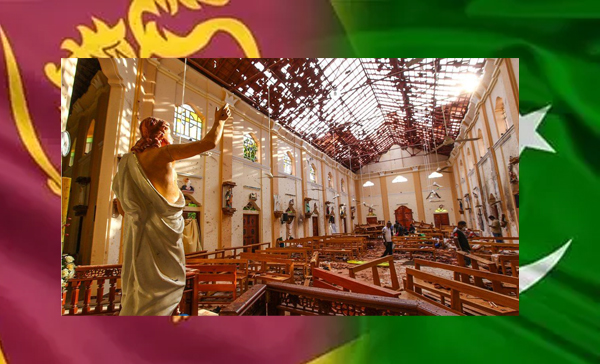
Reverend Father Cyril Gamini Fernando has stated that justice is yet to be served with regard to the Easter Sunday terror attacks of 2019, and that the Vatican is looking into the matter.

“We still do not see the truth about this being revealed. So we are being forced to seek international assistance. We believe that His Holiness and the Vatican’s Commission on Justice and Peace are looking into this,” he said.

He also mentioned that the information revealed by former Attorney General Dappula de Livera on the same must be divulged to the public immediately.

“We hope that the government will continue to implement these investigations, lawsuits, and further investigations, as well as the recommendations of the Presidential Commission on the Easter Attack. It is also important to uncover the conspiracy revealed by former Attorney General Dappula de Livera,” the Reverend Father stated.

Posted in Uncategorized

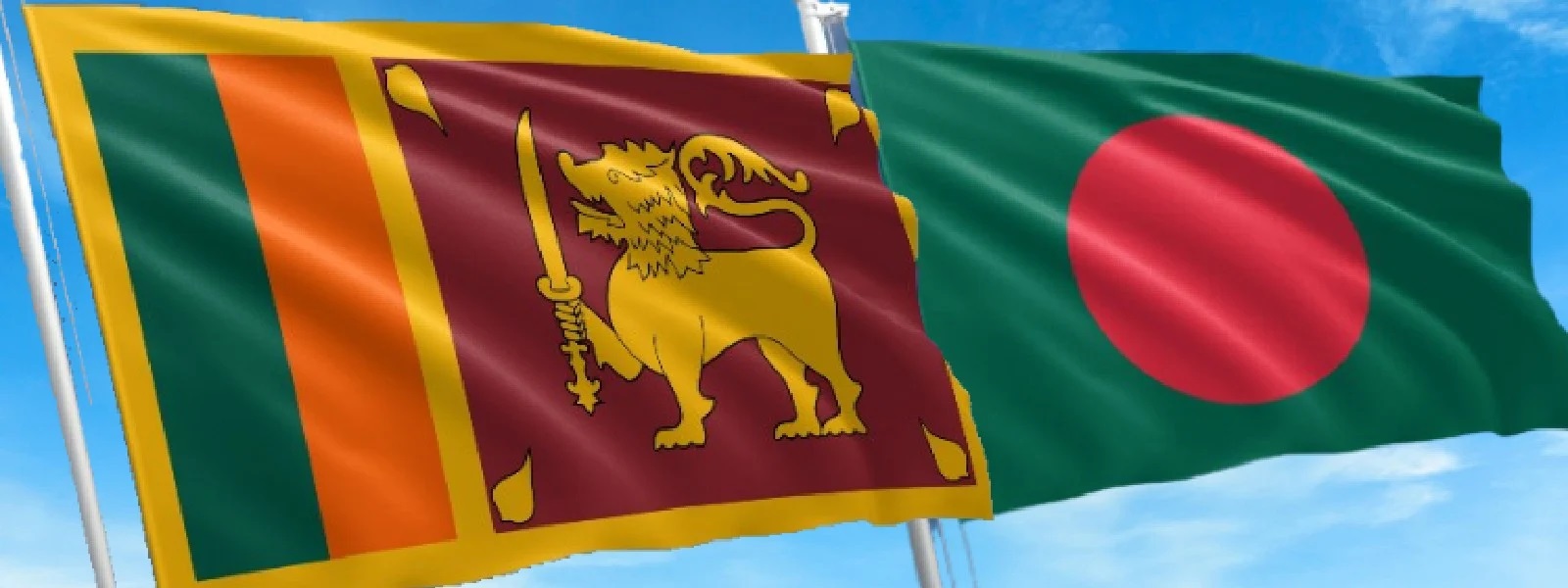
Sri Lanka to get the initial $50 m tranche of $250m currency swap with Bangladesh Bank this week

The central bank of Bangladesh (BB) will lend $50 million to under-pressure Sri Lanka this week as part of Bangladesh’s efforts to support the Island nation suffering from a foreign exchange crisis, The Daily Star reported.

The credit under the first-ever loan to any country from Bangladesh will be given under the currency swap agreement inked by the BB and the Central Bank of Sri Lanka (CBSL) on August 3.

As per the deal, the BB will provide a total of $250 million to help prop up the island nation’s fast-depleting foreign reserves and ease pressure on its exchange rate.

The financing will be given in three phases. The first tranche of the loan will be given this week, according to a top official of the central bank.

The remaining two tranches will involve $100 million each.

Seeking anonymity, the BB official said the central bank would give the first tranche for three months.

If the CBSL fails to repay the loan within the deadline, it will get three more months to repay. If it fails to pay back again, it will be given three more months.

The CBSL will return the amount in three months at the interest rate of the London Interbank Offered Rate (Libor) plus 2 per cent. If it can’t honor the deadline, the interest rate will not change.

But if the tenure goes up to six months, the interest rate will be Libor plus 2.5 per cent.

The Libor is the global reference rate for unsecured short-term borrowing in the interbank market and acts as a benchmark for short-term interest rates.

This week, the three-month Libor is 0.14 per cent and the six-month Libor is 0.18 per cent.

If the CBSL fails to return the money, the Sri Lankan government will pay back the loan as per the state guarantee attached in the agreement, the BB official said, adding the outstanding balance limit will never exceed $200 million. He said Bangladesh was not extending the loan for any commercial purpose.

“It is being given to help a friendly SAARC member country which is in trouble. Bangladesh is, however, following the international best practices and maintaining due diligence.”

The decision for the currency swap agreement was set in motion during Sri Lankan Prime Minister Mahinda Rajapaksa’s visit to Bangladesh in March.

As per the deal, the CBSL will hand over an equivalent amount of its currency, which depreciated 6.8 percent against the US dollar this year.

Yesterday, the US dollar traded at 199.52 Sri Lankan rupees.

The BB will open an account with a bank in the South Asian country to keep the sum, which will be around 49.5 billion Lankan rupees, a BB official said earlier. The amount would be used for import payments.

Bangladesh’s import bill with Sri Lanka is $50-55 million a year.

The swap agreement is a good deal for the BB, which has a record $45.9 billion in its coffers as of August 3.

Under the agreement, Sri Lanka will pay more than double Bangladesh gets from all of its investments.

The injection of the American greenback from Bangladesh would be a great relief for Sri Lanka, which has $3.7 billion of foreign debt maturing this year.

It had $2.4 billion in foreign currency reserves at the end of July, down from $4 billion in April.

In 2020, Sri Lanka’s economy contracted 3.6 per cent because of the financial fallout from the coronavirus pandemic.

The country’s $4.5-billion tourism industry, one of its major foreign currency earners, was hit particularly hard, while its exports were down by about 17 per cent last year.

Because of the foreign exchange crisis, the Sri Lankan government imposed an indefinite import ban in March last year to save hard currency, according to the financial newspaper Nikkei Asia.

Sri Lanka rupee non-credible peg breaks to 211-215 to US dollar

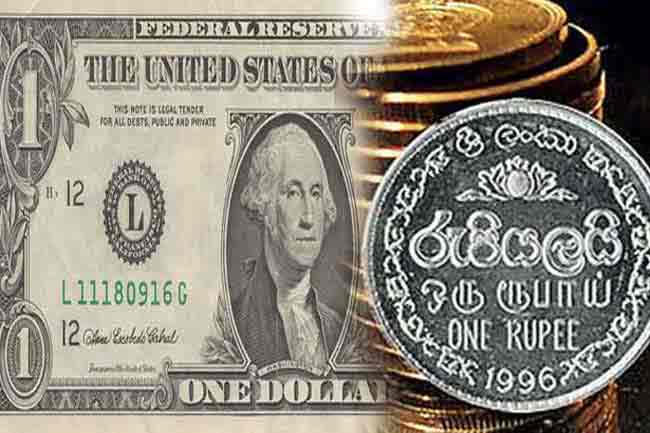
Sri Lanka rupee’s non-credible peg to the US dollar which was kept to around 203 in the breach with the moral suasion has broken to 211-215 levels with most banks giving up on the earlier, rate, market participants said.

Most domestic banks have started to sell dollars around 211 to the US dollar to importers while foreign banks are selling around 215, market participants said.

On Tuesday Commercial Bank was quoting a rate of 206.50/211.00 for Telegraphic Transfers, Hatton National Bank 206/211, Seylan Bank 204/211.

State-run Bank of Ceylon was still quoting 198.50/203 on their website with a proviso that deals above 7,500 would have to get a quote from the dealing room.

Sri Lanka’s rupee peg is non-credible (or soft) due to liquidity injections and the lack of floating overnight rate to keep the exchange rate fixed (credible peg).

Sri Lanka has been printing large volumes of money to pay state worker salaries and keep interest rates low and turn government debt into reserve money (bank notes or liquidity) at weekly bill and bond auctions which then hit the forex markets.

Two weeks ago a failed bond auction injected 53 billion rupees into money markets only part of was taken out before it disappeared as outflows mostly through government debt.

Unlike in mid 2020, when private credit collapsed, with stronger economic activity and growing private credit, printed money hits the forex market faster as cascading credit takes place.

Weak confidence had also led to capital flight from stock markets where foreign investors benefited from rising stock prices due to liquidity injections and higher profits reported by so-called ‘crony’ import substitution firms before costs and weak demand caught up with them.

Analysts had called for curbs on the domestic operations of the central bank as policy became increasingly activist since 2011 with discretionary policy involving ‘flexible’ exchange rate and ‘flexible’ inflation targeting.

Sri Lanka needs monetary discipline to avoid further downgrades: Bellwether

Bank Treasurers had warned authorities at a meeting on Wednesday that the non-credible peg at 203, which was kept through a moral suasion and informal agreement was not tenable.

Due to bar on outright interbank trading there is no price transparency for the dollar rupee rate in the spot or forward market, leading to banks charging and paying various rates to exporters and importers based on bargaining power.

Another meeting with authorities is due shortly, market participants said.

Sri Lanka’s has fallen victim to Keynesian stimulus, discretionary monetary policy and undermining of Treasuries auctions since the end of the war, critics have said.

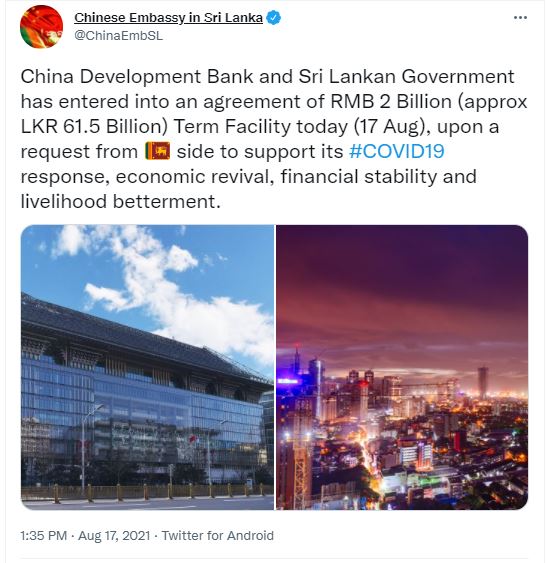
Sri Lanka signs Rs. 61.5 Bn Term Facility with China Development Bank

The China Development Bank and Sri Lankan Government entered into an agreement of RMB 2 Billion (approx LKR 61.5 Billion) Term Facility on Tuesday (17).

The Chinese Embassy in Sri Lanka Tweeted that this agreement was signed upon a request from Sri Lanka to support its #COVID-19 response, economic revival, financial stability and livelihood betterment.

Posted in Uncategorized

Daily COVID deaths hit record high with 171 new fatalities

The total number people who fell victim to COVID-19 infection in Sri Lanka soared yet again as a record high of 171 new fatalities were confirmed by the Director-General of Health Services on Monday (August 16).

This marks the ninth consecutive day that the daily count of COVID-19 deaths surpassed 100.

The new development has pushed the official death toll from the virus outbreak in Sri Lanka to 6,434.

According to the data released by the Department of Government Information, the latest victims include 102 males and 69 females.

As many as 134 deaths were reported among the elderly people who are aged above 60 years. In addition, 35 individuals aged between 30-59 years and two males below 30 years have also succumbed to the virus infection.