

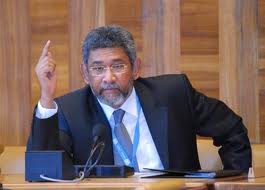
Prof Rohan Gunaratna has long been a confidant of Gotabaya Rajapaksa. It is a relationship that goes back at least to the second-term of MR, though the latter did not give him the access to, let alone influence in the policy making process, especially the foreign-policy making process, that the (then) Secretary/Defense had suggested.
In 2018, Gotabaya Rajapaksa held a very successful second annual convention of the Viyathmaga at the Shangri-la hotel. Prof Gunaratna was the key speaker on foreign policy.
Given that relations with India are in a fluid situation, Tamil politics including in Tamil Nadu are at an inflection point, and the Government of Sri Lanka (GoSL) is facing a challenge in Geneva, it is of quite considerable importance to read the collective mind of the Gotabaya regime, through the recent statement of Prof Rohan Gunaratna, in a Sunday Observer interview of February 14th 2021.
Let me reproduce the relevant section in extenso and then take a closer look at it.
“…The background to the Accord was India providing sanctuary, financing, arming, training, and directing the LTTE. With India compelling Sri Lanka to sign the Accord, the government faced an insurrection in the south. The unhappiness was reflected when a naval rating hit Rajiv Gandhi nearly assassinating him.
The LTTE assassinated Gandhi after returning to violence having reneged on the Agreement. The reality in Sri Lanka is that any Government devolving powers to the North and East will be toppled. The historical experience is that devolution of power to the provinces will be exploited by the separatists to secede.
Tamil politicians both TNA and others are not trusted. They are either associated with the LTTE international network or with India. In February 2016, the Chief Minister of Sri Lanka’s Northern Province, C.V. Wigneswaran sought India’s direct intervention in the complete implementation of the Amendment.
Having suffered from Indian covert assistance to the LTTE and five other terrorist groups, Sri Lankans detested Indian intervention. Although India is unlikely to rearm the LTTE, Sri Lankans are suspicious of Indian designs especially, in the north and the east.
Increasingly, an opinion is building in Sri Lanka to abrogate the 13th Amendment along the lines of India revoking the special status, or limited autonomy, granted under Article 370 of the Indian Constitution to Jammu and Kashmir—a region administered by India as a state which consists of the larger part of Kashmir and which has been the subject of dispute among India, Pakistan, and China since 1947.
On August 5, 2019, the Government of India, cut off communication lines in the Kashmir Valley, a region gripped by a prolonged separatist terrorism and insurgency. Kashmiri politicians were taken into custody, including the former chief minister.
The Government is aware of the LTTE planning to harness the political freedoms in the north and the east and subvert the Tamil community. If there is a revival of the LTTE, the Sri Lankan Government will not hesitate to move in this direction.
The current strategy by the separatists is to masquerade as human rights activists and provoke Government overreaction. As such, the Government did not respond decisively to the P2P protest. However, having witnessed the detrimental impact of the protest, the Government will no longer permit a similar episode as it compromises the hard-won stability and security.
The Government is also aware of the LTTE working both on the political and terrorist fronts. In addition to plotting intermittent attacks, the LTTE network overseas is building a support infrastructure in the north and the east.
After the military defeat of the LTTE in May 2009, Sri Lankans are unwilling to devolve land, police and financial powers to the provinces. The structure implemented in the North and the East should be acceptable to all parts of the country.”
(Permitting religious cults is dangerous – Prof. Gunaratna | Sunday Observer)
Unpacked, what does this mean?
“…The background to the Accord was India providing sanctuary, financing, arming, training, and directing the LTTE…”
That is only partly true. “The background to the sanctuary, financing, arming, training and directing the LTTE” was the anti-Tamil pogrom of July’83, of which Prof Gunaratna makes no mention here. As for “directing the LTTE”, any Tamil belonging to the senior generation of the armed movement knows that the LTTE was the organization that received the least Indian training and was least penetrated by, let alone directed by India, if only because Prabhakaran was very careful not to permit it. This is why the IPKF knew little about the LTTE because the RAW had no control over it and not as much actual knowledge of its workings as it thought. Prabhakaran wiped out the TELO in 1986, accusing it of being India’s proxy. In short, India and the LTTE were not on a continuum as Prof Gunaratna implies.
“The reality in Sri Lanka is that any Government devolving powers to the North and East will be toppled.”
This is untrue. Governments not only devolved power but had an elected Provincial Council in the North and East and was not toppled. Certainly, Mahinda Rajapaksa was not defeated electorally for that reason. It is true that an excess of devolution would topple a government, which is what happened with Yahapalanaya and the new post-unitary Constitution project.
But that is not what Rohan Gunaratna says. He says “any government devolving powers…” This means any degree of devolution is taboo. This clearly means that the Gotabaya Rajapaksa Presidency will not devolve power to the Northern and Eastern Provincial Councils. Prof Gunaratna clearly does not care how this may play in Chennai and Delhi. He obviously discounts the question as to whether a government should risk the blowback.
He then says “The historical experience is that devolution of power to the provinces will be exploited by the separatists to secede.” What? Where? When? Whom? He does not say. The bulk of the evidence, from Canada through Switzerland to India and South Africa, is to the contrary. In most cases, secession is deterred or deferred precisely by the devolution of power. What matters though is that this line, by itself or taken together with one that preceded it, tells us and the world that any kind of devolution to the provinces is ruled out by the Gotabaya camp.
Prof. Gunaratna tars the TNA and Tamil politicians. “Tamil politicians both TNA and others are not trusted. They are either associated with the LTTE international network or with India.” This means that in the collective mind of the GR camp, being “associated with the LTTE international network” is on the same footing as being associated “with India”. This is indicative that India is seen as an enemy, just as is the LTTE.
This also means that in the minds of the GR camp’s thinkers, Sampanthan, Sumanthiran, Rasamanikkam etc. are not legitimate players because they are hooked up with either the LTTE or India.
What this really means is that there will be no political process, no political negotiation, no political dialogue, still less political settlement, with the TNA or Tamil politicians, so long as the GR regime is in power—because there are no legitimate interlocutors on the Tamil side.
One notes that Prof Gunaratna does not mention as exceptions, Douglas Devananda, Karuna Amman or Pillaiyan, despite the fact that they are allies of the government. Is it because none of them are willing to renounce the principle of devolution, the 13th amendment and the Indo-Lanka Accord?
Prof. Gunaratna gives a clear signal as to what comes next. “Increasingly, an opinion is building in Sri Lanka to abrogate the 13th Amendment along the lines of India revoking the special status, or limited autonomy, granted under Article 370 of the Indian Constitution to Jammu and Kashmir…”
So, the new Constitution that the Gotabaya regime is drafting will unilaterally slash the 13th amendment and reduce the quantum of devolution, if any power is devolved. This may not await a new Constitution. The regime may move an amendment in Parliament which will probably secure a two-thirds majority, and if the courts hold that a referendum is necessary, carry the referendum too.
Prof. Gunaratna makes amply clear that another P2P will not be permitted and that if it is repeated or anything like it undertaken, the regime will crack down hard:
“Kashmiri politicians were taken into custody, including the former chief minister. The Government is aware of the LTTE planning to harness the political freedoms in the north and the east and subvert the Tamil community. If there is a revival of the LTTE, the Sri Lankan Government will not hesitate to move in this direction. The current strategy by the separatists is to masquerade as human rights activists and provoke Government overreaction. As such, the Government did not respond decisively to the P2P protest. However, having witnessed the detrimental impact of the protest, the Government will no longer permit a similar episode as it compromises the hard-won stability and security.”
In short, there will no longer be space for peaceful civic protest. If undertaken it will be met with repression.
Either the regime does not care that this may trigger violent protest if not revive terrorism, or it is hopeful that it will!
Prof Rohan Gunaratna’s bottom-line can be credibly taken as the Gotabaya presidency’s bottom-line: “After the military defeat of the LTTE in May 2009, Sri Lankans are unwilling to devolve land, police and financial powers to the provinces.”
Police powers are controversial and can be introduced in phases, linked to the behavior of the Provincial Council, but what meaning can devolution possibly have without some substantive measure of the devolution of land and financial powers to the provinces?
Since the 13th amendment already devolves such powers to the provinces, does Gunaratna’s disclosure not indicate that these powers will be revoked? If they are, what will remain as the residue?
Is this not unilateralism, given that a bilateral accord, whatever its historical context, exists, as guarantee of such devolution?
What will be the response of the Tamils, India and the world community at large?