

Nature has its own unpredictable ways, and Cyclone Ditwah devastated the nation like none other since the Boxing Day Indian Ocean tsunami of 2004. Of course, as with any national disaster, natural or man-made, tsunami or insurgency/war, the political Opposition has always tried to get the goat of the Government, for allegedly failing in its duties. This one is no exception.
In Parliament since, and outside even when the disaster was happening, multiple Opposition parties and leaders criticised the leadership of President Anura Kumara Dissanayake for not doing enough and timely, to mitigate the people’s sufferings. In particular, they were upset and angry that the President did not promulgate a National Emergency to handle the calamity.
As was known, lower-level Government authorities required the kind of powers that only an Emergency Proclamation can give them, even to evacuate people forcefully from their half-destroyed homes to the safety of the relief shelters. Even the Police Force would have been more comfortable with extra powers, to deal with criminal elements that could turn roguish, exploiting the impossible situation around them.
In particular, the Opposition leaders insisted that unless the Government proclaimed a National Emergency, aid-giving nations would be hesitant. Their argument carried less weight, but they did claim that foreign nations would ask why give aid to a nation, whose Government had not taken the catastrophe as seriously as it should have. President Dissanayake and his ruling JVP-NPP had their reasons, not all of them justifiable. While in the Opposition, they had opposed the unending nature of the Emergency Proclamation of predecessor Presidents. Their governments and Security Forces misused and abused the Emergency provisions, and the nation’s memory had not erased them. In its pre-democratised mainstreaming era, the JVP, during its two insurgencies, were victims of the Emergency powers and the ‘obnoxious’ Prevention of Terrorism Act (PTA). They had then promised that when in power, they would not use/misuse the former, and modify, if not repeal the latter.
After purportedly delaying the promulgation of the Emergency, President Dissanayake, in his national address on the disaster, declared that the Emergency would be in effect only as long as it was required to set right the Ditwah situation. He can be expected to formally withdraw the Emergency in the coming days or weeks.
Imaginative initiative
It was a coincidence that one of neighbouring India’s two aircraft carriers, INS Vikrant, was berthed at Colombo, when Ditwah struck. The Sri Lanka Navy (SLN) has since clarified that Vikrant was making a port call at Colombo, in connection with the SLN’s ‘International Fleet Review’ – and there was nothing more to it.
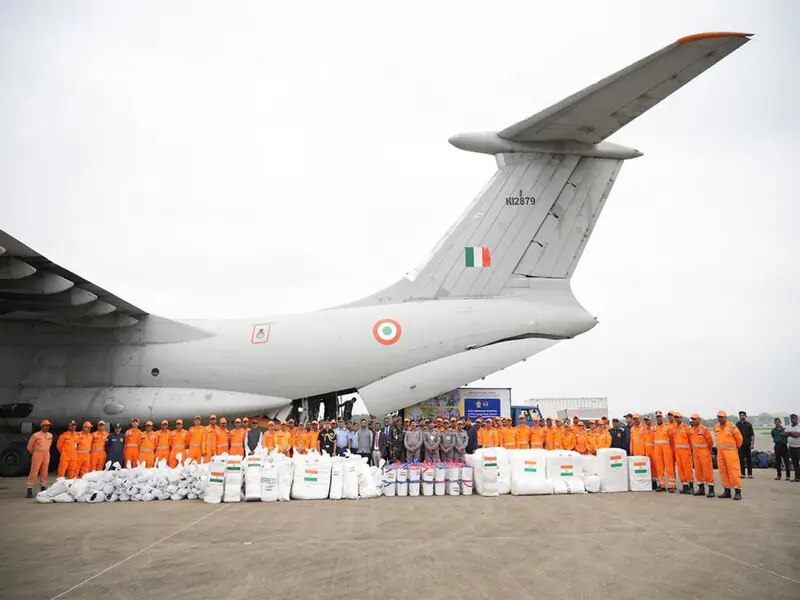
As imaginative as the Sri Lankan Government was, it sought immediate Indian relief assistance – and Vikrant, obviously on official direction, donated it all from its stores, then and there. Needless to say, helicopters on board the carrier were also pressed into service, as requested by the host Government, to help out in the rescue and relief operations.
Further Indian assistance followed, rushed through air and sea. To cover the North and the East, another Indian naval vessel, INS Sukanya, brought in relief material by their tons to the eastern Trincomalee Port. By that time, other nations, starting with the neighbourhood, woke up to Sri Lanka’s needs, and have rushed aid and assistance. That includes China and Pakistan, apart from some Gulf Arab nations. Certain sections of the media, especially social media, took extra care to report them, as if to cloud the Indian role.
Non-reciprocal
The Sri Lankan Government, the Opposition and the media have mostly thanked India and Prime Minister Narendra Modi for the initiative. After all, this has been India’s habit and practice whenever neighbours, all of them small in size, economies and resources, are caught in the midst of a storm – of whatever kind. When historic adversary Pakistan was struck by a massive Himalayan earthquake, as Nepal was on another occasion, India volunteered assistance. New Delhi did not expect the ‘Kashmir issue’ to be settled in India’s favour because of this humanitarian initiative. But the Islamabad-Rawalpindi’s collective ego would not allow it, accept it.
Remember Covid and the Aragalaya-centric economic crises. India was the first responder. In the case of the Covid catastrophe, India’s non-reciprocal assistance extended far beyond the neighbourhood. India also created relief history without realising it, when it shipped life-saving oxygen to Sri Lanka, when there was a huge shortage. All this and more, when India had to care for its 1.4-billion population, which too was not immune to the coronavirus.
All this was at a time when resource-rich nations looked the other way, and wantonly. They ignored the need and demand for vaccines in the Third World, which they stored away for themselves or priced them so high that the Global South could not access them. Their inability and incapacity stood out even more as they were already suffering from the after-effects of the unprecedented global lockdown.
Inherited legacy
Contemporary India is the inheritor of socio-cultural values that are ingrained in the nation’s DNA. The Sanskrit national motto, Vasudeva Kudumbakam with a parallel Tamil phrase, Yadum Oore, Yavarum Kelir, mean one and the same: ‘The world is one family.’ Leave aside the language employed, no other nation, nor any international fora like the UN, has such a motive/motif, neither by inheritance or legacy, nor even as a marketing coinage, developed by a PR consultant. Yes, long before now, at the height of the 2004 tsunami, India did not even wait for a formal or an informal request from the Sri Lankan Government, to rush in aid and assistance. On the contrary, Prime Minister Manmohan Singh called President Chandrika Kumaratunga, this way, when her Government was yet to recover from the impossibility of the situation, and that of the nation, even more. As it happened, early Indian assistance, by sea and air, reached within hours. It turned out that, expecting an affirmative Sri Lankan response to New Delhi’s offer of instant assistance, Establishment India had begun loading the aid material on its naval ships and Air Force transporters, even before Singh called CBK. Again, the tsunami had not left India alone. It had devastated southern coastal Tamil Nadu, and the nation’s island-territories like the Andaman and Nicobar Islands.
Complex nature
The Indian troops that had helped Sri Lanka in the immediate rescue and rehabilitation of the tsunami victims left once their mandated assignment had been fulfilled – and their local counterparts had taken full charge. India had done this all the time, especially in the case of Sri Lanka, given the complex nature of social and political life.
For India, which had begun practising the latter-day UN coinage, ‘Responsibility to Protect’ (R2P), rather seriously, it was not about legal or military action, as was expected or mandated. Instead, it’s about the humanitarian responsibility that larger nations are duty-bound by history and geography to undertake in the case of their smaller, sovereign neighbours.
As may be recalled, the UNGA passed the R2P resolution in 2009. But since Independence, India has been offering relief, not only to post-Partition refugees from the newly-formed Pakistan, but also those from Tibet, Burma, now Myanmar, and the Upcountry Tamils from Sri Lanka.
As coincidence would have it, India ended up housing hundreds of thousands of Bangladeshi refugees at one time, and close to three hundred thousand Sri Lankan Tamils, at another. That is to say, for India, R2P is more about humanitarian assistance, and none at all on the ‘occupation’ front, as mischievously alleged.
What is even more unique about India’s R2P is that it started implementing it on the humanitarian front without signing international conventions on refugees, and declining to pass a binding civil law. There is pressure on India even now, especially from UN agencies, but despite changes of Governments, New Delhi has carried on as ever. The simple idea is to reach out, not get caught in international red-tapism.
Rohana’s ‘Third Class’
According to reports of the time, the post-democratised JVP acknowledged India’s non-hegemonic approach to human suffering and relief, when the Indian troops on tsunami relief went back home empty-handed once their job was done – even if half-done, as in the case of the IPKF, earlier. Now that the JVP has come a long way, maybe it is time for the Party to actively consider removing the Third Class, ‘Indian Hegemony’, from the Five-Class formulation of slain founder, Rohana Wijeweera.
In the contemporary situation, it is a dichotomy, an incongruent absurdity. In particular, the JVP should not be worried about possible criticism from fringe, breakaway groups like the Frontline Socialist Party (FSP), which are sure not to miss out any opportunity to degrade the present-day rulers, that too in ideological terms, with particular reference to founder Wijeweera – the generation’s ‘Sri Lankan Che’, in another century and time.
Ironically, there are other peripheral groups too that have reacted quizzically and quixotically to the Government seeking and accepting Indian assistance at times such as this one – not to forget the Aragalaya-centric economic crisis and assistance. In particular, some members of the Tamil Diaspora are drawing parallels between the presence of INS Vikrant at Colombo during Cyclone Ditwah and the Indian military’s ‘Operation Poomalai’, or ‘Operation Garland’, during a phase in Sri Lanka’s ethnic war, in 1987. It’s not only mischievous, but atrocious, too.
The Diaspora aims to provoke the Sinhala nationalist hard-liners who are now docile owing to the calamitous situation all around them, by calling the coincidental presence of Vikrant as ‘Operation Poomalai-II’. Is anyone with a voice in Jaffna listening? If so, what have they got to say now about their Diaspora cousins, who are still pulling political strings from the comfort of distance and their own wealth and happiness?
(The writer is a Chennai-based Policy Analyst & Political Commentator. Email: sathiyam54@nsathiyamoorthy.com)