

It was a situation President Anura Kumara Dissanayke would rather not have been in, but last week he and those in his government were in for a rude awakening, facing a backlash from senior members of the Buddhist clergy as well as many others over the handling of the case involving controversial monk Ven. Galagoda Aththe Gnanasara Thera.
The uproar was not due to the imprisonment of Gnanasara Thera, who was evading arrests after the Supreme Court overturned a presidential pardon granted to him by President Maithripala Sirisena for contempt of court, but over the decision by the Prisons Department to bring him to court in prison garb instead of his robes.
The televised footage of the Thera being escorted to courts in the lay attire of a white sarong and white national tunic shirt evoked almost an immediate reaction, mainly from members of the Buddhist clergy who expressed their anger over Gnanasara Thera being stripped of his robes – an action, they claimed, cannot be done bypassing the traditions and disciplinary rules established within the Buddha Sasana.
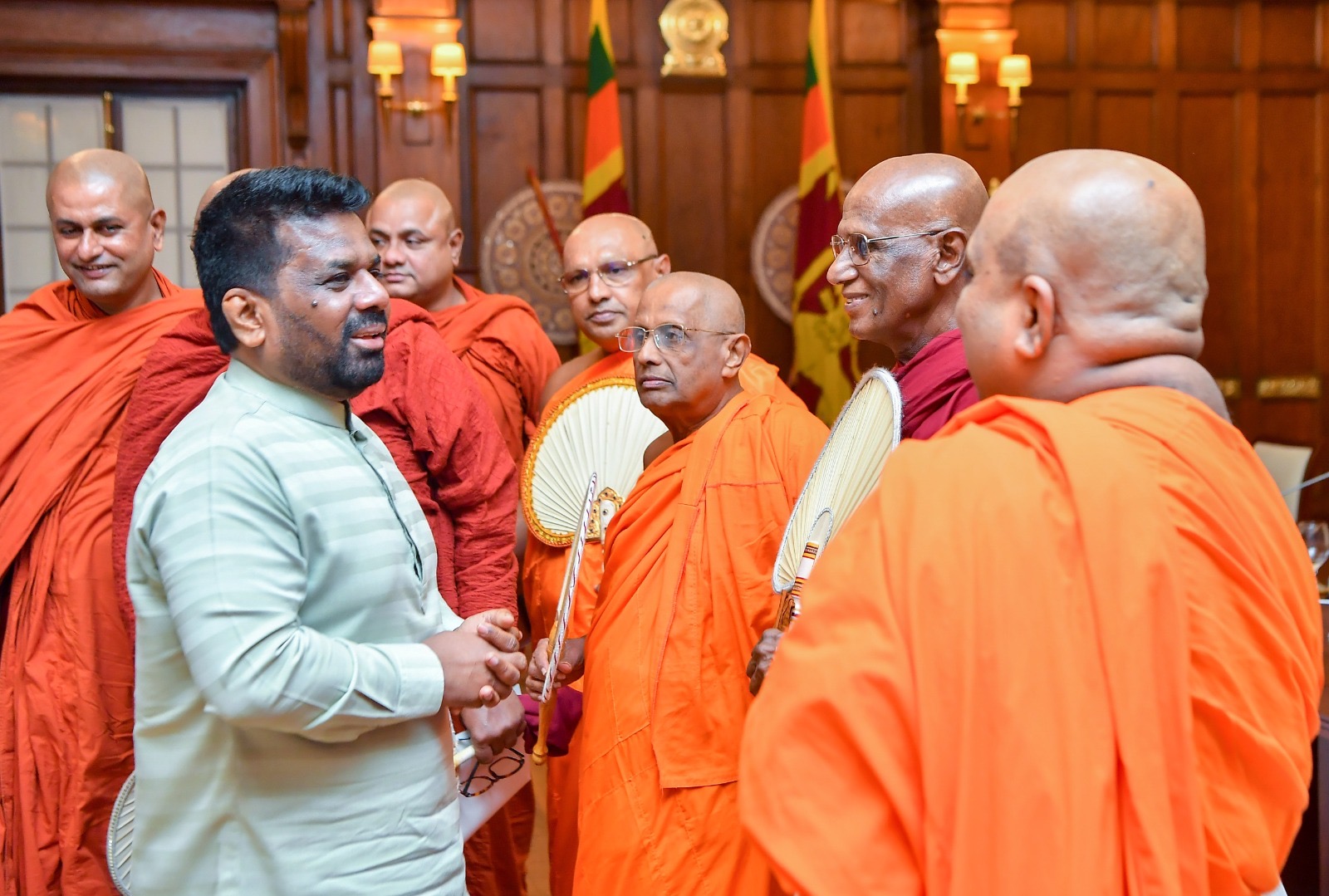
While the President and the government’s initial reaction may have been to ignore the general outcry over the issues, a letter from the Mahanayake Theras of three Buddhist Nikayas (Sects) to the Commissioner General of Prisons objecting to the Gnanasara Thera being deprived of his robes elicited a prompt response, with the President inviting senior members of the Maha Sangha belonging to the three main chapters to the Presidential Secretariat to discuss the issue on Thursday.
“The discussion was held to consider the letter addressed by the Mahanayake Theras to the Commissioner-General of Prisons regarding the action taken by the Department of Prisons to remove Gnanasara Thera’s robes and present him before the court in the lay attire, as well as the situation that has arisen in society in connection with this incident and the measures that should be taken in the future to prevent similar situations,” the Presidential Secretariat said in a statement after the meeting.
While the remarks made by the President at the meeting were made public, little of the comments by the members of the Buddhist clergy present have been made public so far. A request was made by the Theras for the President to consider a pardon for Gnanasara Thera. “The court overturned the pardon granted by President Sirisena, ruling that it was not done in accordance with the law. Now, you have the opportunity to do so according to the law and grant him a pardon,” one Thera told the President at the meeting.
The President explained that a pardon could only be considered after the appeal process is concluded, adding that in Gnanasara Thera’s case this was ongoing. “My wishes should not become the law,” the President said.
The Supreme Court, in overturning the pardon granted to Gnanasara Thera, said that these conclusions do not, in any manner, signify that the President is precluded from granting a pardon to Gnanasara Thera. Any such pardon may be granted only in accordance with the law and upon due consideration of all relevant material placed before the President,” the Court said, thus keeping the door open for a fresh pardon for the monk.
At the meeting, the President defended the actions of the Prisons Department officials to deprive Gnanasara Thera of the robes, saying they had acted in accordance with the existing laws and regulations, while acknowledging that it was deeply shocking and distressing for Buddhists and the Maha Sangha to see a monk whom they respectfully paid homage to one day being seen in a different manner another day.
The President was of the opinion that new rules should be formulated regarding the manner in which Buddhist monks serving jail terms are taken outside the prison premises. Towards this end a committee was appointed. Its members are Buddha Sasana Ministry Secretary Prince Senadheera, Justice and National Integration Ministry Additional Secretary Piyumanthi Peiris, Public Administration Ministry Additional Secretary Wasantha Ariyarathna, Buddhist Affairs Commissioner-General R.M.G. Senarathna, and Prisons Department Commissioner A.C. Gajanayake.
The committee has been given two weeks to prepare a report recommending amendments to the existing laws to strengthen efficiency, good governance, security, cultural values and the rule of law within the prison.
Appointments of committees always come to the rescue of governments in difficult situations, and they have eased the pressure on the incumbent government to some extent, though not all members of the clergy are pleased with the outcome. On Friday, Venerable Kotapitiya Rahula Anunayake Thera wrote to the President, requesting a meeting with members of the Buddhist clergy representing the Kotte chapter, as they were not represented at Thursday’s meeting. The letter stated that the authority to decide whether Gnanasara Thera should retain or be deprived of his robes rests with the Kotte Sangha Sabha, of which the monk is a member.
Along with this, a writ application has been filed in the Court of Appeal challenging the prison authorities’ decision to remove Gnanasara Thera’s robes. A protest march led by Buddhist monks also began last morning from Kandy after a special religious ceremony at the Magul Maduwa (audience hall) of the Dalada Maligawa (Temple of the Tooth), demanding a pardon for Gnanasara Thera. The march will continue from Kandy to Colombo and conclude on October 15. Ven. Ulapane Sumangala Thera, who is leading the march, said they will conclude the walk at the location where Gnanasara Thera is being held and will continue to protest till he is granted a full pardon.
For President Dissanayake and those in the JVP-led National People’s Power (NPP), who have built their political careers on a healthy dose of Marxism and who should be familiar with the oft-repeated words of Karl Marx on religion being the ‘opium of the masses’, it must be sinking in that the political cost of being insensitive to the religious beliefs of the people can be heavy. And hence, the damage control measures that have been put in place, but how far they will go to appease the agitated Buddhists in particular, will be seen in the weeks ahead.