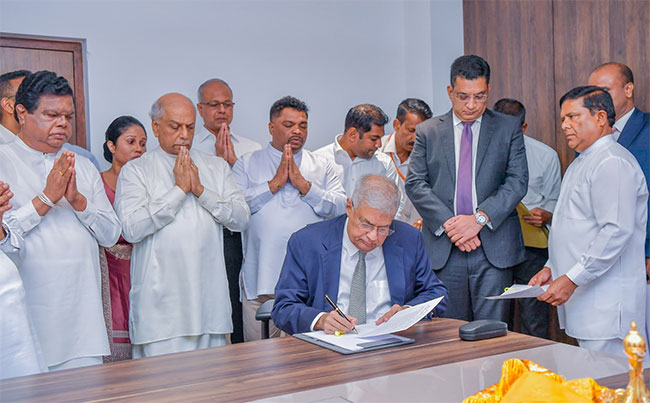
Ranil Wickremesinghe to Contest as Independent Candidate, Not From UNP

Chief of Staff to the President and National Security Advisor Sagala Ratnayaka said that the upcoming elections will be held on time, despite what anyone has to say.

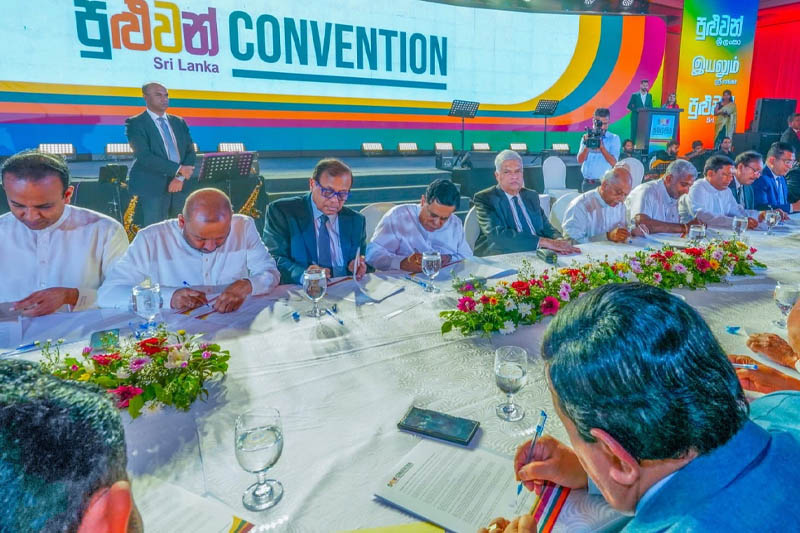
Speaking in Kollonawa on Wednesday (12), Sagala Ratnayaka said that Ranil Wickremesinghe will contest the upcoming President election as an independent candidate, and not representing the United National Party.

He said that UNP will support the President, adding that talks are underway seeking support from other parties as well.

Sri Lanka’s 6-year Presidential term: problem in drafting 19th amendment explained

A member of the team that drafted Sri Lanka’s 19th amendment to the constitution has explained the constraint they worked with, which has led to the possibility of a 6-year Presidential term enabled by a two thirds’ majority vote.

The deficiency in the constitution was highlighted in a report by EconomyNext on Tuesday.

President’s Counsel Jayampathy Wickramaratne, a member of the drafting team, explained that they were instructed not to make changes that required a referendum.

The team was advised that a bill to amend the constitution should be passed “only by a two-thirds majority, in keeping with the pledge of Presidential candidate Maithripala Sirisena in his election manifesto that no amendment necessitating a Referendum would be placed before Parliament.

“As such, the draft did not propose reducing the maximum period from six to five years.”

However he argues why the Presidential term should not go beyond five years in the the present case, on several grounds, including the circumstances of ex-President Gotabaya Rajapaksa’s election by the people, democratic principles and constitutional morality.

The full reponse is reproduced below:

Dear Sir,

I refer to the new item titled ‘Constitutional Error Could Give Ranil and Parliament Another Year’ written by your Political Correspondent in your esteemed journal. It is implied therein that the drafters of the Nineteenth Amendment to the Constitution ‘neglected’ to ensure that the maximum period to which the term of the President and Parliament could be extended without recourse to a Referendum was also reduced to five years while reducing the respective terms to five years.

As a member of the team that drafted the Nineteenth Amendment to the Constitution, I wish to make a clarification for the benefit of your readers. Article 83 lists the constitutional provisions which cannot be changed without a Referendum. The news item reproduces Article 83. You might note the words ‘and this Article’ in Article 83(b). Thus, to reduce the maximum period to five years, Article 83 itself must be amended, requiring a Referendum. The drafting team was well aware of this necessity.

However the government had clearly advised the drafting team that the Nineteenth Amendment Bill should be passed only by a two-thirds majority, in keeping with the pledge of Presidential candidate Maithripala Sirisena in his election manifesto that no amendment necessitating a Referendum would be placed before Parliament. As such, the draft did not propose reducing the maximum period from six to five years.

I wish to take this opportunity to express my views on whether the five-year terms of the current Parliament and the current President could be extended to six years, as the maximum period mentioned in Article 83 is six years.

When the People of Sri Lanka voted Gotabhaya Rajapakse as President and later elected the present Parliament, the term of the President and Parliament was five years.

Voters knew that Parliament could be dissolved earlier in the circumstances laid down in the Constitution and that the President could seek a fresh mandate after four years in office.

However, the upper limit of each term was clearly five years. As the People voted for a President and a Parliament for only five years, such a Parliament cannot extend the terms by even a day as that would violate the franchise already exercised by the People.

Any amendment of the Constitution that impinges on the franchise must be approved by the People at a Referendum, as the franchise (Article 3, read with Article 4) is an entrenched provision listed in Article 83. Any increase in the duration of the term of the President or Parliament can apply only to a new President or a new Parliament for whom the People vote knowing what the applicable term is.

On this issue, I take the further view that a two-thirds majority in Parliament and a 50-%-Plus-One majority of the People cannot make ANY amendment to the Constitution.

In international law, certain basic norms (jus cogens) are accepted as peremptory norms from which no derogation is permitted. Examples include prohibitions against slavery and torture, genocide, the use of armed force and piracy on the high seas and racial non-discrimination.

Similarly, are there basic norms from which a democracy such as Sri Lanka cannot derogate? Can a tyrannous majority adopt any constitution? Would the Supreme Court have the power to examine a Bill for the amendment of the Constitution or a new Constitution, certified by the Cabinet of Ministers as one that requires the People’s approval at a referendum, if certain basic democratic norms are alleged to be violated? Such questions may seem academic at first blush, but given experiences from elsewhere, should they be brushed aside?

When freedom from torture is recognised as a peremptory norm that binds the international community, can the People of Sri Lanka restrict its application within the country, invoking their sovereignty? Put differently, are there no limits to the internal dimension of sovereignty?

The Lawyers Collective recently raised the pertinent question of whether the amending process is also governed by the principle of ‘constitutional morality’, a concept which has recently gained wide acceptance in India.

Simply put, constitutional morality demands that the spirit of the Constitution be respected and should not be undermined even at the behest of the majority. It is thus a counterpoise to popular or social morality that can sometimes be undemocratic and violative of rights.

In Navtej Singh Johar v. Union of India, the Indian Supreme Court observed as follows: “The concept of constitutional morality is not limited to the mere observance of the core principles of constitutionalism as the magnitude and sweep of constitutional morality is not confined to the provisions and literal text which a Constitution contains, rather it embraces within itself virtues of a wide magnitude such as that of ushering a pluralistic and inclusive society, while at the same time adhering to the other principles of constitutionalism.”

The Court explained that it is further the result of embodying constitutional morality that the values of constitutionalism trickle down and percolate through the apparatus of the State for the betterment of each and every individual citizen of the State.

“The society as a whole or even a minuscule part of the society may aspire and prefer different things for themselves. They are perfectly competent to have such a freedom to be different, like different things, so on and so forth, provided that their different tastes and liking remain within their legal framework and neither violates any statute nor results in the abridgement of fundamental rights of any other citizen. The Preambular goals of our Constitution which contain the noble objectives of Justice, Liberty, Equality and Fraternity can only be achieved through the commitment and loyalty of the organs of the State to the principle of constitutional morality.” (AIR 2018 SC 4321).

My view is that peremptory norms that limit the internal dimension of sovereignty are found in the Preamble to our Constitution, which refers to ‘immutable republican principles of representative democracy’ that assure to ‘all peoples freedom, equality, justice, fundamental human rights and the independence of the judiciary as the intangible heritage that guarantees the dignity and well-being of succeeding generations of the People of Sri Lanka’.

Increasing the terms of the current President and Parliament who were elected for five years goes against those ‘immutable republican principles of representative democracy.’

(Dr) Jayampathy Wickramaratne, President’s Counsel

Posted in Uncategorized

Renovation in Sri Lanka’s Northern rail track to reduce Colombo-Jaffna train time to 5.5 hours

The ongoing renovations in Sri Lanka’s Northern railway track from Maho to Anuradhapura will help to reduce Colombo-Jaffna journey time to around 5.5 hours from the current 7.5 hours, Transport Minister Bandula Gunawardana said.

The work to upgrade the track started in January this year and is part of a $91.27 million project carried out by IRCON, an Indian state firm, and is expected to be completed in six months.

“The train to Jaffna takes 7.5 hours to travel. Now it has been under renovation after more than 100 years. This is being done for the first time since the British rule with complete removal of tracks under an Indian credit line,” Gunawardana told a media briefing on Monday (10).

“Within next few months, there will be a railway track established in the North passengers can travel at 100 km per hour. Within 5.5 hours, people can be able to travel from Colombo to Jaffna.”

India has provided $318 million to upgrade 128 kilometres in track from Maho to Omanthai.

Railways has been a priority sector in India’s assistance to Sri Lanka.

So far India has executed over $1 billion of projects.

IRCON re-built the 253 kilometres of track to the North and another 115 kilometres in the South.

Sri Lanka calls on BRICS to ensure rules based order

Sri Lanka called on BRICS to ensure a rules-based order, not only when it suits the rich and powerful, but as an equitable and justifiable model for a sustainable world order.

Foreign Minister Ali Sabry undertook an official visit to Russia at the invitation of his counterpart, Sergey Lavrov, Minister of Foreign Affairs of the Russian Federation from 10-11 June 2024 to attend the BRICS Foreign Ministers’ meeting with the developing countries held in Nizhny Novgorod, Russia. The meeting was attended by high level representatives of 22 countries including 17 Foreign Ministers.

Minister Sabry, delivering his statement at the meeting, stated that Global South should collectively address global challenges of climate change, debt burden and food security. He further stressed that the architecture of global governance, established in the aftermath of World War II has achieved significant milestones. “However, that it was increasingly evident that this structure must evolve to reflect the contemporary realities of our world”, he added. The Foreign Minister highlighted that voices and interests of emerging economies and developing nations must be integrated more fully into the decision-making processes of international institutions.

Emphasizing the need for the rules based order, the Foreign Minister stated that “it is imperative that we strive hard to ensure a rules-based order, not only when it suits the rich and powerful, but as an equitable and justifiable model for a sustainable world order. This means upholding international law and ensuring the principles of fairness, justice, and respect for sovereignty guide our actions. Only then can we create a world where all nations, regardless of their size or power, have a fair opportunity to thrive”.

While underscoring the important and effective role of the regional organizations in shaping the world order, Minister Sabry who also spoke in his capacity as chairman of the Indian Ocean RIM Association (IORA) said “IORA can serve as a platform for fostering regional cooperation and advancing the shared goals of sustainable development and security”.

The Minister, while referring to the plight of the citizens of Gaza said that “it is the duty of the Global South to get together and ensure the justice for helpless and defenseless population of Gaza particularly women and children and rescuing them from total annihilation”.

Foreign Minister Sabry also met with Foreign Ministers of the Russian Federation, Belarus, Iran and Kazakhstan on the sidelines of the meeting.

During the meeting with the Russian Foreign Minister Sergey Lavrov, the two Ministers reviewed the multifaceted engagements between the two countries and agreed to further enhance relations in trade, education, tourism and regional cooperation including interactions in IORA. Being a Dialogue Partner of IORA, Russian Foreign Minister reaffirmed Russia’s fullest support for Sri Lanka’s chairmanship of IORA.

Minister Sabry also met the Iranian Acting Foreign Minister Dr. Ali Bagheri Kani and agreed to fully implement the consensus reached between President Wickremesinghe and the late Iranian President Ebrahim Raisi during his recent State Visit to Sri Lanka.

In addition, Minister Sabry also met Deputy Prime Minister and Minister of Foreign Affairs of the Republic of Kazakhstan Murat Nurtleu. Both Ministers discussed avenues for further strengthening bilateral cooperation in trade, tourism, energy, transportation, multilateral and regional fora. Kazakhstan welcomed Sri Lanka’s decision to establish the first Sri Lankan Mission in Central Asia in Astana following the decision made by the two Presidents to establish diplomatic missions in the two countries. Foreign Minister Nurtleu also expressed hope that Kazakhstan would also reciprocate in establishing an Embassy in Sri Lanka in the near future.

During the meeting with the Belarusian Minister of Foreign Affairs Sergei Aleinik, the two Ministers agreed on the importance of early convening of the political consultations and Joint Commission on Trade and Economic Cooperation between the two countries towards further consolidating the existing friendly ties. The Foreign Ministers also recognized the friendly relations and the robust people to people exchanges between Sri Lanka and Belarus.

Chargé d’Affaires of the Embassy of Sri Lanka in Moscow Ambassador P M Amza, Director General Economic Affairs (Multilateral) of the Ministry of Foreign Affairs K K Yoganaadan and, Counsellor of the Embassy of Sri Lanka in Moscow Ruvini Munidasa associated with the Minister during these meetings.

Posted in Uncategorized

Election Commission to Certify 2024 Voter List in July

The National Election Commission has announced its plans to certify the 2024 voter list by the end of July.
Chairman R.M.A.L. Ratnayake stated that the commission is currently examining the appeals filed over the initial draft of the voter list.

This process is being overseen by District Assistant and Deputy Election Commissioners. Once certified, the 2024 voter list will be used for all elections held after July.

Posted in Uncategorized

Easter attacks: Inquiry committee appointed to probe actions taken on prior intelligence

President Ranil Wickremesinghe has appointed a Committee of Inquiry to investigate the actions taken by the State Intelligence Service (SIS), Chief of National Intelligence (CNI), and other relevant authorities concerning prior intelligence received about the bomb attacks on April 21, 2019.

This decision follows the findings of the Final Report of the Commission of Inquiry, dated January 31, 2021, which highlighted that Indian Intelligence agencies and other sources had provided advance warnings about the impending attacks.

The Committee of Inquiry will be chaired by Ms. A.N.J. De Alwis, Retired Judge of the High Court. Other esteemed members of the committee include SLAS special grade Officer Ms. K.N.K. Somaratne and Senior Lawyer Mr. W.M.A.N. Nishane, AAL. The committee’s mandate includes examining whether adequate actions and measures were taken by the SIS, CNI, and other relevant authorities based on the prior intelligence and evaluating the sufficiency of these measures.

Additionally, the committee will investigate the circumstances surrounding the Directorate of Military Intelligence’s (DMI) initial belief that the Vavunathivu killing of two police officers on November 30, 2018, was connected to the LTTE. This belief was held for four months before suspects with alleged links to the National Thowheed Jamath (NTJ) were identified.

A compact disk containing the Final Report of the Commission of Inquiry on the Bomb Attacks of April 21, 2019, has been provided to the committee. The President has authorized the committee to inquire relevant officials and examine pertinent documents to thoroughly investigate these matters.

Ms. Sarathanjali Manoharan, Senior Assistant Secretary to the President, will serve as the Secretary to the Committee of Inquiry. The committee is expected to submit its report, including findings and recommendations, to the President by September 15, 2024.

Posted in Uncategorized

AKD on Sri Lanka’s ethnic issue: NPP concerned with future, not past

The leftist National People’s Power (NPP) is concerned not with the past but the future, NPP leader Anura Kumara Dissanayake said following a discussion with representatives of the Ilankai Thamil Arasu Kachchi (ITAK) in Jaffna.

Dissanayake told reporters on Tuesday June 11 that the NPP in their manifesto for the 2019 presidential election had recognised the need for Sri Lanka’s provincial council system to continue.

“We must also have a dialogue on moving forward. There is a need for constitutional changes. We must also implement the provisions in the constitution that establish peace,” he said.

“In the present, we’re not about the past but how to create the future. To do that, Tamil people should be given a strong guarantee of rights in politics. They must be given a right make decisions for themselves. If everyone lives in the past, we will not be able to create a future,” said Dissanayake.

The NPP leader did not elaborate on the meaning of “right to make decisions for themselves”.

The party has been largely noncommital on its stance on the 13th amendment to the constitution, which the Marxist-Leninist Janatha Vimukthi Peramuna (JVP), which controls the NPP, violently opposed during the late 1980s.

The full implementation of the 13th amendment continues to be a point of debate.

President Ranil Wickremesinghe has indicated his willingness to fully implement the amendment without police powers, particularly in light of India stressing on its importance. Sharing police powers remains an issue, with many nationalist parties in the south arguing against it.

The 13th amendment to Sri Lanka’s constitution emerged from the controversial Indo-Lanka Accord of 1987 as a purported solution to the worsening ethnic conflict, four years after war broke out. Provincial councils came in the wake of this amendment, though land and police powers have yet to be devolved to the provinces as originally envisioned. Both Sinhalese and Tamil nationalists have historically opposed the amendment, the former claiming it devolved too much, the latter complaining it didn’t devolve enough.

A full implementation of the amendment would see land and police powers devolved to the provinces, a development that is not likely to garner support from Sri Lanka’s more hardline parties. In February, sections of the Buddhist clergy took to the streets against the proposed full implementation of the constitutional amendment.

Posted in Uncategorized

Modi likely to visit Sri Lanka in August

Indian Prime Minister Narendra Modi is likely to visit Sri Lanka in August this year, officials from the President’s office told journalists here.

President Ranil Wickremesinghe who attended the swearing-in ceremony of Prime Minister Modi had invited the latter to visit Sri Lanka when the duo met on Sunday at Rasthrapati Bhavan.

Wickremesinghe had discussed the visit of Prime Minister Modi with Indian External Affairs Minister S. Jaishankar in Delhi on Monday. Both the President and the Indian External Affairs Minister discussed the visit of the Indian Leader during which it was revealed that the visit is likely to take place in August this year. Jaishankar had assured President Wickremesinghe that he would visit Sri Lanka soon and look into the Indian Prime Minister’s visit.

Sajith says SJB government will implement Sri Lanka’s 13th amendment

A government led by Sri Lanka’s main opposition Samagi Jana Balawegaya (SJB) will implement the 13th amendment to the constitution, opposition leader Sajith Premadasa said, also claiming that people in the north have become addicted to false promises made by politicians.

Speaking at an event in Jaffna on Sunday June 09, Premadasa said an SJB government would ensure all civil and economic rights of the people.

“People in Jaffna district and the northern province have become addicted to the candy politics (losinjara deshapalanaya) of various leaders. They hand out these candies at election time.

“We will end the period that people fell for candy. Not just your civil rights, we will also provide economic, social, religious, cultural, educational health and right to life, as well as the right to a good income avenue to our beloved people,” said Premadsa.

An SJB government will implement the 13th amendment to Sri Lanka’s constitution, the opposition leader said, though he did not elaborate on to what extent the provisions in the amendment will be carried out.

“The people say enough talk, make it happen. I say to you that as action, we will definitely implement the 13th amendment, the amendment that’s contained in our country’s constitution.”

President Ranil Wickremesinghe has said that he is agreeable to full implementation of the 13th amendment except police powers.

At an all-party conference in July last year, Wickremesinghe said new police legislation would need to be introduced before police powers are dissolved to the provinces. Wickemesinghe also said Sri Lanka must either retain its provincial councils (PCs) with powers adequately devolved as provided for by the 13th amendment to the constitution or abolish the PC system entirely.

The full implementation of the 13th amendment continues to be a point of debate.

President Wickremesinghe has indicated his willingness to fully implement the amendment, particularly in light of India stressing on its importance. However, sharing police powers remains an issue, with many national parties in the south arguing against it.

The 13th amendment to Sri Lanka’s constitution emerged from the controversial Indo-Lanka Accord of 1987 as a purported solution to the worsening ethnic conflict, four years after war broke out. Provincial councils came in the wake of this amendment, though land and police powers have yet to be devolved to the provinces as originally envisioned. Both Sinhalese and

Tamil nationalists have historically opposed the amendment, the former claiming it devolved too much, the latter complaining it didn’t devolve enough.

A full implementation of the amendment would see land and police powers devolved to the provinces, a development that is not likely to garner support from Sri Lanka’s more hardline parties. In February, sections of the Buddhist clergy took to the streets against the proposed full implementation of the constitutional amendment.

Any future Sri Lankan government will have to comply with IMF deal: Cabinet Spokesman

No future Sri Lankan government will have room to maneuver with the International Monetary Fund deal at least until 2028 as it will be the key for the island nation to come out of the ongoing unprecedented economic crisis and seek commercial borrowing from international capital markets, Cabinet Spokesman Bandula Gunawardena said.

His comments come as some of the opposition political leaders have publicly expressed their willingness to amend the IMF deal, citing it has burdened the public amid Economic Transformation Bill tabled in the island nation’s parliament is expected to ensure sustainability of international agreements.

“In drafting the budget for the upcoming year 2025, irrespective of the government ruling, it is imperative to address the loan agreements established with the International Monetary Fund (IMF) until 2028,” Gunawardena told reporters at a media briefing in Colombo.

“By 2025, it is anticipated that the external foreign resource gap will not adequately cover international transactions. Past trends suggest that $5,018 million is needed for this purpose. Any government formulating the forthcoming budget must secure this funding.”

President Ranil Wickremesinghe’s government has already planned to facilitate such resource gap and if the island nation goes with the IMF deal, the global lender is expected to disburse $663 million in 2025 in addition to a $700 million budget support while the World Bank has pledged $400 million and the Asian Development Bank (ADB) has promised $300 million, he said.

“It is anticipated that there will be a loan relief of $3,655 million through the restructuring of foreign debt,” Gunawardena said.

“The parties aspiring to assume state power must inform the country if they would be abiding by the agreements outlined by President Ranil Wickremesinghe,” he said, adding that there is no alternative for the future budget of the country.”

He said Sri Lanka will be able to tap the international capital markets in 2027 which will be for the first time in eight years, provided its foreign exchange reserves reach $14 billion before that as outlined by the IMF agreement.

He also said Sri Lanka, if goes with the IMF deal, will have a greater cushion in repaying its sovereign defaulted debts, extended to more than 20 years from 2028.

The Minister also said Sri Lanka missed the opportunity of not falling into the debt trap and economic crisis by implementing the Fiscal Management Responsibility Act passed by the parliament in 2003 when Wickremesinghe was the prime minister.

“Had we implemented it, we would have been saved from the economic crisis,” he said.

Sri Lanka is facing political uncertainty as it will be going for the presidential poll between September 17 and October 16 later this year.

Political analysts say incumbent president Wickremesinghe, despite pushing for reforms to ensure the economic recovery from the economic crisis, is not the most populour leader among the general public.

Opposition political leaders like center-right Samagi Jana Balawegaya (SJB) leader Sajith Premadasa and Marxist Janatha Vimukthi Peramuna (JVP) leader Anura Kumara Dissanayaka are populour among the voters, but have been largely silent on specific economic policy strategies on the recovery and economic growth.

A close ally of President Wickremesinghe has put forward a suggestion to postpone both presidential and parliamentary polls by two years. However, the idea met with strong opposition.

Wickremesinghe government also has delayed local government elections without a specific date after initially postponing it twice citing there was no fund due to the economic crisis.

Posted in Uncategorized