Modi likely to visit Sri Lanka in August

Indian Prime Minister Narendra Modi is likely to visit Sri Lanka in August this year, officials from the President’s office told journalists here.

President Ranil Wickremesinghe who attended the swearing-in ceremony of Prime Minister Modi had invited the latter to visit Sri Lanka when the duo met on Sunday at Rasthrapati Bhavan.

Wickremesinghe had discussed the visit of Prime Minister Modi with Indian External Affairs Minister S. Jaishankar in Delhi on Monday. Both the President and the Indian External Affairs Minister discussed the visit of the Indian Leader during which it was revealed that the visit is likely to take place in August this year. Jaishankar had assured President Wickremesinghe that he would visit Sri Lanka soon and look into the Indian Prime Minister’s visit.

Posted in Uncategorized

Sajith says SJB government will implement Sri Lanka’s 13th amendment

A government led by Sri Lanka’s main opposition Samagi Jana Balawegaya (SJB) will implement the 13th amendment to the constitution, opposition leader Sajith Premadasa said, also claiming that people in the north have become addicted to false promises made by politicians.

Speaking at an event in Jaffna on Sunday June 09, Premadasa said an SJB government would ensure all civil and economic rights of the people.

“People in Jaffna district and the northern province have become addicted to the candy politics (losinjara deshapalanaya) of various leaders. They hand out these candies at election time.

“We will end the period that people fell for candy. Not just your civil rights, we will also provide economic, social, religious, cultural, educational health and right to life, as well as the right to a good income avenue to our beloved people,” said Premadsa.

An SJB government will implement the 13th amendment to Sri Lanka’s constitution, the opposition leader said, though he did not elaborate on to what extent the provisions in the amendment will be carried out.

“The people say enough talk, make it happen. I say to you that as action, we will definitely implement the 13th amendment, the amendment that’s contained in our country’s constitution.”

President Ranil Wickremesinghe has said that he is agreeable to full implementation of the 13th amendment except police powers.

At an all-party conference in July last year, Wickremesinghe said new police legislation would need to be introduced before police powers are dissolved to the provinces. Wickemesinghe also said Sri Lanka must either retain its provincial councils (PCs) with powers adequately devolved as provided for by the 13th amendment to the constitution or abolish the PC system entirely.

The full implementation of the 13th amendment continues to be a point of debate.

President Wickremesinghe has indicated his willingness to fully implement the amendment, particularly in light of India stressing on its importance. However, sharing police powers remains an issue, with many national parties in the south arguing against it.

The 13th amendment to Sri Lanka’s constitution emerged from the controversial Indo-Lanka Accord of 1987 as a purported solution to the worsening ethnic conflict, four years after war broke out. Provincial councils came in the wake of this amendment, though land and police powers have yet to be devolved to the provinces as originally envisioned. Both Sinhalese and

Tamil nationalists have historically opposed the amendment, the former claiming it devolved too much, the latter complaining it didn’t devolve enough.

A full implementation of the amendment would see land and police powers devolved to the provinces, a development that is not likely to garner support from Sri Lanka’s more hardline parties. In February, sections of the Buddhist clergy took to the streets against the proposed full implementation of the constitutional amendment.

Any future Sri Lankan government will have to comply with IMF deal: Cabinet Spokesman

No future Sri Lankan government will have room to maneuver with the International Monetary Fund deal at least until 2028 as it will be the key for the island nation to come out of the ongoing unprecedented economic crisis and seek commercial borrowing from international capital markets, Cabinet Spokesman Bandula Gunawardena said.

His comments come as some of the opposition political leaders have publicly expressed their willingness to amend the IMF deal, citing it has burdened the public amid Economic Transformation Bill tabled in the island nation’s parliament is expected to ensure sustainability of international agreements.

“In drafting the budget for the upcoming year 2025, irrespective of the government ruling, it is imperative to address the loan agreements established with the International Monetary Fund (IMF) until 2028,” Gunawardena told reporters at a media briefing in Colombo.

“By 2025, it is anticipated that the external foreign resource gap will not adequately cover international transactions. Past trends suggest that $5,018 million is needed for this purpose. Any government formulating the forthcoming budget must secure this funding.”

President Ranil Wickremesinghe’s government has already planned to facilitate such resource gap and if the island nation goes with the IMF deal, the global lender is expected to disburse $663 million in 2025 in addition to a $700 million budget support while the World Bank has pledged $400 million and the Asian Development Bank (ADB) has promised $300 million, he said.

“It is anticipated that there will be a loan relief of $3,655 million through the restructuring of foreign debt,” Gunawardena said.

“The parties aspiring to assume state power must inform the country if they would be abiding by the agreements outlined by President Ranil Wickremesinghe,” he said, adding that there is no alternative for the future budget of the country.”

He said Sri Lanka will be able to tap the international capital markets in 2027 which will be for the first time in eight years, provided its foreign exchange reserves reach $14 billion before that as outlined by the IMF agreement.

He also said Sri Lanka, if goes with the IMF deal, will have a greater cushion in repaying its sovereign defaulted debts, extended to more than 20 years from 2028.

The Minister also said Sri Lanka missed the opportunity of not falling into the debt trap and economic crisis by implementing the Fiscal Management Responsibility Act passed by the parliament in 2003 when Wickremesinghe was the prime minister.

“Had we implemented it, we would have been saved from the economic crisis,” he said.

Sri Lanka is facing political uncertainty as it will be going for the presidential poll between September 17 and October 16 later this year.

Political analysts say incumbent president Wickremesinghe, despite pushing for reforms to ensure the economic recovery from the economic crisis, is not the most populour leader among the general public.

Opposition political leaders like center-right Samagi Jana Balawegaya (SJB) leader Sajith Premadasa and Marxist Janatha Vimukthi Peramuna (JVP) leader Anura Kumara Dissanayaka are populour among the voters, but have been largely silent on specific economic policy strategies on the recovery and economic growth.

A close ally of President Wickremesinghe has put forward a suggestion to postpone both presidential and parliamentary polls by two years. However, the idea met with strong opposition.

Wickremesinghe government also has delayed local government elections without a specific date after initially postponing it twice citing there was no fund due to the economic crisis.

Retired top Police investigators extend support to NPP

Two top retired Police investigators, Ravi Seneviratne and Shani Abeysekara, have extended support to the National People’s Power (NPP) led by Anura Kumara Dissanayake.

Retired Senior DIG Ravi Seneviratne and former Director of the Criminal Investigations Department (CID) Shani Abeysekara took the stage at an NPP event attended by retired Police officers.

Speaking at the event, Ravi Seneviratne addressed Anura Kumara Dissanayake as the next President of Sri Lanka.

Seneviratne said that some retired Police officers who attended the event were harassed and threatened.

The former top Police officer raised the question if the law is being respected in Sri Lanka today.

He also expressed confidence in the NPP saying it had a plan for the country.

Ravi Seneviratne and Shani Abeysekara handled a number of high-profile cases.

However, they were harassed by former President Gotabaya Rajapaksa and his administration.

Posted in Uncategorized

Sri Lanka ventures into deep space exploration with China

Sri Lanka is to venture into deep space exploration through the collaboration between a Sri Lankan company and China’s Deep Space Exploration Laboratory (DSEL).

Supreme Deep Space (Pvt) Ltd. and China’s Deep Space Exploration Laboratory (DSEL) have outlined several areas of collaboration to advance space exploration and technology. This partnership promises to leverage Sri Lanka’s unique expertise and China’s advanced capabilities in various research initiatives.

The partnership not only places Sri Lanka on the global space exploration map but also allows the nation to contribute significantly to groundbreaking scientific endeavors.

The timing of this partnership is particularly noteworthy given the current global landscape of space exploration. The United States’ Artemis program is set to compete with China’s lunar ambitions, aiming to land astronauts on the Moon by 2026 and establish a sustainable presence there. Both nations are seeking international collaborators, and Sri Lanka’s cooperation with China may suggest a strategic alignment, although the primary focus remains on the scientific and technological advancements this partnership will bring.

In the wake of China’s highly successful Chang’e 6 lunar mission, the visit of Professor Wu Weiren, Chief Designer of China’s Lunar Exploration Program, to Sri Lanka sparked considerable intrigue and excitement.

China’s Chang’e 6 mission, launched on May 3, 2024, marks a monumental achievement in space exploration. The mission successfully landed on the far side of the Moon in the South Pole-Aitken Basin, a region that holds significant scientific interest due to its ancient impact history. Chang’e 6 aims to return approximately 2 kilograms of lunar samples to Earth, providing unprecedented insights into the Moon’s composition and geological history.

Professor Wu Weiren’s visit underscores the strategic importance of this collaboration. The establishment of Supreme Deep Space is a testament to the visionary approach of leveraging Sri Lankan expertise in space science and technology. This initiative is poised to inspire a new generation of scientists and engineers in Sri Lanka, fostering a culture of innovation and exploration.

Supreme Deep Space will create a comprehensive database to catalog local expertise relevant to space missions. This database will include scientists, engineers, and researchers with specialized knowledge in areas such as astrophysics, materials science, and space mission logistics. This initiative aims to streamline collaboration and ensure that the best minds in Sri Lanka are contributing to global space missions.

A key area of cooperation is joint research on 3D printing technologies for construction. This research will focus on developing methods for building structures on the Moon using lunar regolith, which could significantly reduce the cost and complexity of establishing lunar bases. By combining DSEL’s advanced 3D printing technologies with Sri Lankan innovations, the partnership seeks to pioneer new techniques for off-Earth construction.

Another exciting collaboration involves joint research on breaking down H2O to generate oxygen. With the potential discovery of water ice at the Moon’s poles, this research could provide critical life support resources for future lunar missions. The project will explore efficient methods to electrolyze water, harnessing solar power to produce oxygen and hydrogen, essential for sustaining human presence on the Moon.

The partnership also aims to investigate the feasibility of a space elevator using graphene, a material known for its incredible strength and conductivity. This ambitious concept involves creating a tethered structure from the Earth’s surface to a geostationary orbit, enabling cost-effective transport of materials and personnel into space. Joint research will focus on developing graphene production techniques and testing its application in space elevator technology.

Supreme Deep Space and DSEL will conduct joint research on the lower gravity impact scenario, taking advantage of Sri Lanka’s Hikkaduwa region. This area, with its unique geological features, provides an ideal environment for studying the effects of reduced gravity on various materials and biological systems. The findings could offer valuable insights into how different substances and organisms might behave in lunar or Martian conditions.

The collaboration extends to Tracking, Telemetry, and Command (TT&C) services, ground segment support, and IT resource sharing. Supreme Deep Space will provide critical infrastructure for mission monitoring and control, leveraging Sri Lanka’s strategic geographic position. This support will ensure seamless communication and data exchange between Earth-based stations and spacecraft, enhancing the overall efficiency and safety of space missions.

Finally, Supreme Deep Space will play a pivotal role in mission monitoring and control. By establishing state-of-the-art facilities equipped with advanced technologies, the company will support DSEL’s missions in real-time. This includes tracking spacecraft, analyzing mission data, and coordinating with international space agencies to ensure the success of collaborative space endeavors.

These areas of cooperation between Supreme Deep Space and DSEL mark a significant step forward for Sri Lanka in the global space community. By harnessing local expertise and contributing to cutting-edge research, Sri Lanka is poised to become a key player in deep space exploration, driving innovation and scientific discovery for the benefit of humanity.

With missions like Chang’e 7 and 8 on the horizon, aimed at exploring the Moon’s south pole and establishing a lunar research station, Sri Lanka stands to benefit immensely from its association with DSEL. These missions align with the broader objectives of Supreme Deep Space, paving the way for Sri Lanka to become an integral part of international space missions.

Posted in Uncategorized

India to establish industrial zone in Trinco; Jaishankar to visit Sri Lanka soon

President Ranil Wickremesinghe, who is currently in New Delhi, held a meeting today (10) with India’s External Affairs Minister Dr. S. Jaishankar.

During the meeting, Mr. Jaishankar addressed the swift resumption of development projects initiated in Sri Lanka with Indian investments, which had been halted midway.

He expressed his intent to visit Sri Lanka in the near future to oversee the progress of these activities.

Minister Jaishankar assured that he would visit Sri Lanka soon to coordinate the Prime Minister’s visit and expedite the commencement of development projects funded by Indian investments.

The discussions also covered India’s “Neighborhood First” policy. Minister Jaishankar highlighted plans for an industrial zone in Trincomalee, to be established by the Indian government, which will attract numerous Indian investors and potentially investors from other countries.

President Wickremesinghe noted that the new Economic Transformation Act will devolve powers in agriculture, health, education, and economic management to the Provincial Councils.

President Wickremesinghe also mentioned that the Truth and Reconciliation Bill will be submitted to Parliament by next July. The meeting also covered the agricultural modernization program being implemented in the country and addressed the ongoing issues between the fishermen of both nations, aiming for a swift resolution.

President Wickremesinghe announced that estate line rooms will be designated as estate villages through a gazette notification, allowing for their development under the Ministry of Home Affairs.

He also extended warm congratulations to Minister S. Jaishankar on his reappointment. The President also recalled his invitation to the Indian Prime Minister to visit Sri Lanka in the near future.

In attendance were President’s Secretary Saman Ekanayake, Foreign Ministry Secretary Ms Aruni Wijewardene, Sri Lankan High Commissioner to India Ms Kshenuka Senewiratne, and President’s Private Secretary Ms Sandra Perera.

AKD pledges to dissolve Sri Lanka parliament immediately upon election as president

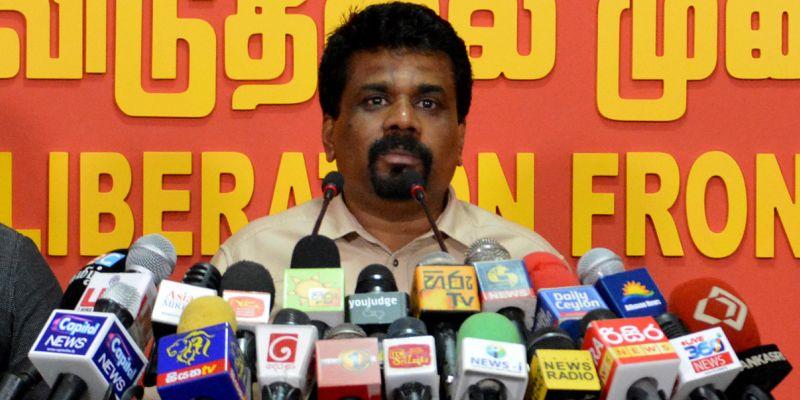
National People’s Power (NPP) leader Anura Kumara Dissanayake will dissolve parliament the same night his victory is announced at Sri Lanka’s upcoming presidential election, Dissanayake said.

At a party event in Hambantota on Sunday June 09, Dissanayake said the NPP will win the parliamentary elections that will be held immediately after the presidential election.

The next parliament will have 120 to 130 MPs from the NPP, he added.

“We may be laughing and clapping, but what we’re doing is Sri Lanka’s biggest political transformation that will see power exchanged between the common people. The NPP is today opening up the road for talented, skilled youth in the villages to move forward in politics.

“Power must transfer to new leaders,” he said.

Dissanayake said though that the current parliament will not continue even for a day after he is elected at the presidential poll.

“In the current parliament, there are only three of us from the NPP. After we win the presidential election, we will dissolve parliament that very night. Remember that. It won’t be held for even a day.

“And after that? There are three of us now. It will surpass 120, 130. What does that mean? Those who have been kept out of parliament all this time, a massive number of children of farmers and fisher folk who came through free education will be in parliament.

“A new change,” he said.

The parliamentary election will be followed by the long delayed local government elections, he added.

Support for l Dissanayake dropped six percentage points to 39 percent in April, levelling with opposition leader Sajith Premadasa, while support for President Ranil Wickremesinghe increased three points to 13 percent in a presidential election voting intent poll.

The Sri Lanka Opinion Tracker Survey (SLOTS) conducted by the Institute for Health Policy showed that, according to its Multilevel Regression and Poststratification (MRP) provisional estimates of presidential election voting intent, National People’s Power (NPP) leader Dissanayake and main opposition Samagi Jana Balawegaya (SJB) lader Premadasa were now neck and neck while United National Party (UNP) leader Wickremesinghe had made some gains. A generic candidate for the ruling Sri Lanka Podujana Peramuna (SLPP) had the support of 9 percent of the people surveyed, up 1 percentage point from March

Posted in Uncategorized

Shavendra Silva’s term as Chief of Defence Staff extended

President Ranil Wickremesinghe has extended the term of General Shavendra Silva as the Chief of Defence Staff.

General Shavendra Silva has been given an extension until 31st December 2024, a gazette notice stated.

The gazette notice issued by President’s Secretary Saman Ekanayake said that the President, in terms of Section 3 of the Chief of Defence Staff Act, No. 35 of 2009,
has re-appointed General Lokugan Hewage Shavendra Chandana Silva, as the Chief of Defence Staff for the period of June 01, 2024 to December 31, 2024.

SLPP’s opposition to privatisation and restructuring discarded: Mahinda, too, votes for Electricity (Amendment) Bill

In spite of differences between President Ranil Wickremesinghe and the Sri Lanka Podujana Peramuna (SLPP) over the latter’s call for early General Election, a consensus seems to be emerging on the overall political strategy with the ruling party voting for the Sri Lanka Electricity Amendment Bill, political sources say.

The SLPP has so far declined to officially endorse Ranil Wickremesinghe candidature at the forthcoming Presidential Election though several members publicly supported the UNP leader.

SLPP leader Mahinda Rajapaksa, in spite of publicly declaring his opposition to the government privatization and restructuring plan, voted for the Bill along with his elder brother Chamal Rajapaksa, MP, his son, Shashendra Rajapaksa and General Secretary Sagara Kariyawasam, who recently warned of the SLPP withdrawing support to the government.

However, SLPP National List MP Namal Rajapaksa skipped the vote. Namal Rajapaksa was among about 10 SLPPers absent at the time of the voting.

During the debate JJB MP Vijitha Herath declared that the Bill was enacted to pave the way for the Adanis.

The Supreme Court determined the Bill as a whole is inconsistent with Article 12(1) of the Constitution and shall only be passed by the special majority of Parliament required under Article 84 (2). This inconsistency shall however cease if Clause 1(2) and Clause 1(3) were amended, the SC declared.

Political sources said that the SLPP’s stand was surprising against the backdrop of former President Mahinda Rajapaksa’s declaration on May 12 that the privatization and restructuring programme of the government should he stopped, pending the conclusion of the Presidential Poll later this year.

The following MPs voted for the Bill: Prime Minister Dinesh Gunawardena, Leader of the House Susil Premjayantha, Bandula Gunawardena, Wijeyadasa Rajapakse, Gamini Lokuge, Rear Admiral (retd.) Sarath Weerasekera, Major (retd.) Pradeep Undugoda, Premanath C. Dolawatte, Madura Withanage, Nalin Fernando, Lasantha Alagiyawanna, A.H.M. Fowzie (SJB), Indika Anuruddha, Sisira Jayakody, Prasanna Ranaweera, Nimal Lanza, Kokila Harshani Gunawardena, Milan Jayatilleke, Upul Mahendra Rajapaksa, Sahan Pradeep Vithana, Vudura Wickremanayake, Piyal Nishantha de Silva, Anupa Pasqual, Rohitha Abeygunawardena, Sanjeewa Edirimanne, Lalith Warnakumara Manju, Dilum Amunugama, Lohan Ratwatte, Anuradha Jayarathna, Mahindananda Aluthgamage, Pramitha Bandara Tennakoon, Rohana Dissanayake, Janaka Bandara Tennakoon, Nalaka Bandara Kottegoda, Jeevan Thondaman, S.B. Dissanayake, C. B. Ratnayake, M. Rameshwaram, Ramesh Pathirana, Manusha Nanayakkara, Mohan de Silva, Geetha Kumarasinghe, Sampath Atukorale, Isuru Dodangoda, Kanchana Wijesekera, D.V. Chanaka, Ajith Rajapaksha, Chamal Rajapaksha, Douglas Devananda, Carder Masthan, Seevanesathurai Chandrakanthan, Wimalaweera Dissanayake, S.M.M. Musharaff, D. Weerasinghe, Kapila Nuwan Atukorale, Mahinda Rajapaksa, D. B. Herath, Shantha Bandara, Johnston Fernando, U.K. Sumith Udukumbura, Samanpriya Herath, Anura Priyadarshana Yapa, Ashoka Priyantha, Priyankara Jayaratne, Ali Sabri Raheem, Shehan Semasinghe, S.M. Chandrasena, S. C. Muthukumarana, M. G. Weerasena, Siripala Gamlath, Jagath Samarawickrema, Nimal Siripala de Silva, Thenuka Vidanagamage, A Aravinda Kumar, Janaka Tissakuttiarachchi, Major (retd) Sudarshana Denipitiya, Vijitha Berugoda, Shashendra Rajapaksha, Dr. Gayashan Nawanandana, Kumarasiri Ratnayake, Pavitradevi Wanniarachchi, Janaka Wakkumbura, Premalal Jayasekera, John Seneviratne, Akila Saliya Ellawela, Muditha Prishanthi, Ranjith Siyambalapitiya, Kanaka Herath, Tharaka Balasuriya, Sudath Manjula, Rajika Wickremesinghe, Ali Sabry, Tiran Alles, Dr. Seetha Armbepola, Suren Raghavan, Wajira Abeywardena, Jayantha Ketagoda, Sagara Kariyawasam, Yadamini Gunawardena, Manjula Disanayake, Ranjith Bandara, Jayantha Weerasinghe and Mohamed Faleel Marjan.

Of the 103 MPs who voted for the Bill, two represented the SJB (Manusha Nanayakkara and A.H.M. Fowzie).

Sources said that Udayakantha Gunatilleke, though being present in Parliament at the time of the voting, hadn’t voted. The JJB’s three MPs -Anurta Kuamar Dissanayake, Vijitha Herath and Dr. Harini Amarasuriya – voted against the Bill, whereas the 10-member Tamil National Alliance (TNA) abstained.

Twenty MPs who had been elected on the SLPP ticket at the last General Election voted against the Bill, along with 36 SJB MPs. The SJB won 54 seats at the last General Election.

Former President Maithripala Sirisena (SLPP/Polonnaruwa) skipped the vote, whereas other SLFP MPs voted for the Bill. They included Wijeyadasa Rajapakse and Nimal Siripala de Silva, leading two factions in the SLFP.

Sources said that the SLPP’s backing for the Bill meant that the May 12 statement regarding their opposition to privatization and restructuring was not relevant.

They said that the SLPP was most likely to support the Economic Transformation Bill (ETB) that had been challenged by the SJB in the Supreme Court.

The Supreme Court summarized the Constitutionality of Sri Lanka Electricity Bill as follows:

The Bill as a whole is inconsistent with Article 12(1) of the Constitution and shall only be passed by a special majority of Parliament required under Article 84 (2). This inconsistency shall however cease if Clause 1(2) and Clause 1(3) are amended as set out in the summary of the Determination of the Supreme Court.

Clauses 3(6) (a) and 10(1) (c) are inconsistent with Article 12(1) of the Constitution and shall only be passed by the special majority required under Article 84(2). However, the inconsistency shall cease if those Clauses are amended as set out in the summary of the Determination of the Supreme Court.

The first proviso to Clause 11(1) of the Bill is inconsistent with Article 12(1) of the Constitution and shall only be passed by the special majority of Parliament required under Article 84 (2). However, the said inconsistency shall cease if the Clause is amended as set out in the summary of the Determination of the Supreme Court.

Clause 17 is inconsistent with Article 12(1) of the Constitution and shall only be passed by the special majority of Parliament required under Article 84(2). The said inconsistency shall however cease and Clause 17 may be passed by a simple majority if the Clause is amended as set out in the summary of the Determination of the Supreme Court.

Clause 18(3) (e) (ii) of the Bill is inconsistent with the provisions of Article 12(1) and shall only be passed by the special majority of Parliament required under Article 84(2). The said inconsistency shall however cease if Clause 18(3) is amended as set out in the Summary of the Determination of the Supreme Court.

Clause 18(3) (f) of the Bill is inconsistent with Article 12(1) and Article 14(1) (g) of the Constitution and shall only be passed by the special majority of Parliament required under Article 84(2). However, the said inconsistency shall cease if the Clause 18(3) (f) is amended as set out in the summary of the Determination of the Supreme Court.

Clause 18(5) (b) (ii) is inconsistent with Article 12(1) of the Constitution and shall only be passed by the special majority of Parliament required under Article 84(2). The said inconsistency shall however cease if Clause 18(5) (b) (ii) is amended as set out in the summary of the Determination of the Supreme Court.

Clause 21 and Clause 23 are inconsistent with Article 12(1) of the Constitution and shall only be passed by the special majority of Parliament required under Article 84(2). The said inconsistency shall however cease if those Clauses are amended as set out in the summary of the Determination of the Supreme Court.

Clause 38 (2) of the Bill is inconsistent with Article 12(1) of the Constitution and shall only be passed by the special majority required under Article 84(2). The said inconsistency shall cease if Clause 38(2) is amended as per the summary of the Determination of the Supreme Court.

Clause 48 is violative of Article 4(a) read together with Article 3 and 76 and hence needs to be passed by the special majority of Parliament and approved by the People at a Referendum.

The definition of ‘national grid’ in Clause 53 of the Bill is inconsistent with Article 12(1) of the Constitution and shall be passed by the special majority of Parliament required under Article 84(2). However, the said inconsistency shall cease if the said definition is amended as set out in the summary of the Determination of the Supreme Court.

Sri Lanka to allocate foreign job quota for retired soldiers after deaths in Russia-Ukraine war

Sri Lanka government has decided to allocate a quota of foreign employments for retired military personnel after reports of over 15 deaths of former servicemen who had gone to Ukraine and Russia to take part in the ongoing war for money.

At least 16 Sri Lankans are reported to have been killed and over 600 likely to have joined as combatants mainly to Russian side, taking risk for higher salary, official sources say.

However, an escapee has said over 200 Sri Lanka ex-soldiers have died in the Russia-Ukraine frontline amid drone attacks.

The Foreign Employment Ministry has expressed willingness to provide a quota from foreign employment opportunities received by the government to retired military personnel and their family members, the Ministry of Defence said in a statement after a discussion on Tuesday (04).

It said Foreign Employment Ministry had already said that “a certain amount of construction sector job opportunities will be provided in Israel”.

“Arrangements are being made to provide loan facilities to expatriates at concessional interest rates through state banks and 67 personnel from the Army have been identified to be sent for these jobs,” the Defence Ministry said.

“Further, instructions have been given to Navy and Air Force authorities to call for nominations from prospective personnel.”

“Furthermore, it was informed that retired three armed forces members under the age of 44 years will be selected and they will have to undergo a brief training through the Ministry of Labour and Foreign Employment and also face an examination conducted by them.”

The new job opportunities to retired military comes as a Sri Lankan delegation is expected to leave to Moscow to have discussions over concerns over hundreds of the island nation’s ex-soldiers now joined Russia-Ukraine war.

Returnees from Russia have said hundreds of Sri Lankan ex-soldiers and other are serving in Ukraine-Russia frontlines with most being duped that they were sent for support work as camp helpers.

Sri Lankan ex-soldiers have been recruited by several teams of people on the promise of high salaries for working as camp helpers. Sri Lanka has already arrested two military officers who were involved in one recruitment team.

The Defence Ministry has already made it mandatory to get its clearance fpr ex-servicemen applying for Russian visit visas.

Tens of thousands of retired Sri Lankan soldiers have been facing difficulties in managing with monthly pensions after an unprecedented economic crisis in 2022.