The Vesak holidays last week, which also presented a long weekend holiday, saw the usual politicking that has become quite common due to the upcoming elections take a more pious outlook, with political leaders of all key political parties racing against each other to engage in religious observances in their constituencies while moving around with the general public.
While many members of his staff were taking a break during the long holidays, President Ranil Wickremesinghe, whose travels were confined to Colombo due to the adverse weather that prevented him from taking any helicopter rides even for the opening of the State Vesak Festival in Matale, attended quite a few Vesak events in Colombo.
The President was seen opening the pandal set up by one of his loyalists, former Colombo Municipal Councilor Kithsiri Rajapaksa, as well as opening the dansala organised by Rajapaksa. Wickremesinghe also attended the Vesak Zone organised by the Gangarama Temple in Colombo after engaging in religious observances.
Prior to the holidays, the Wickremesinghe Government faced continuous questions by the media regarding the finalising of the country’s debt restructuring programme, given that the month of May was also coming to an end. However, the Government expressed hope of signing the Memorandum of Understanding (MoU) with the Official Creditor Committee (OCC) of the Paris Club and the Export-Import Bank (Exim Bank) of China before the completion of the International Monetary Fund’s (IMF) Executive Board review of Sri Lanka’s Extended Fund Facility (EFF) programme due next month.
The IMF meanwhile maintains that Sri Lanka’s overall performance in the IMF programme has been strong as the macroeconomic policies have started to bear fruit. However, IMF Director of Communications Julie Kozack said that the completion of the second review by the IMF Executive Board required the implementation of prior actions agreed by the Sri Lankan authorities and completion of a financial assurance review.
She noted that the completion of the financial assurance review included confirmation from multilateral partners, financing contributions, and the adequate progress of the debt restructuring.
Meanwhile, some of the prior actions that need to be implemented for the second review include the implementation of the Public Debt Management Act and the Public Financial Management Act, which aims to reinforce fiscal discipline by introducing binding fiscal rules and is essential for meeting ambitious fiscal targets, notably a primary surplus target of 2.3% of the Gross Domestic Product (GDP) by 2025.
Understanding the urgency of getting the financial legislations in place, the Government last Wednesday (22) presented the Economic Transformation Bill and the Public Financial Management Bill in Parliament.
Unrealistic targets
Meanwhile, State Minister of Finance Shehan Semasinghe last week took a swipe at the parliamentary Opposition over what he implied as faulty targets.
While addressing Parliament during an adjournment debate, Semasinghe criticised the economic policies proposed by the main Opposition Samagi Jana Balawegaya (SJB).
“According to estimates for 2024, the Government expects to collect Rs. 3,870 billion in tax revenue and a total Government revenue of Rs. 4,127 billion. As of now, Rs. 1,040 billion in tax revenue and Rs. 1,522 billion in total revenue have already been collected for 2024,” he revealed.
The State Minister added: “According to the SJB proposal, if the corporate tax is reduced to 24%, only Rs. 640 billion can be collected this year, with a 21% reduction. With a 21% reduction, we can estimate a loss of Rs. 140 billion. If we talk of the Pay-As-You-Earn (PAYE) tax, there will be a loss of Rs. 40 billion. They also talk of Valued-Added Tax (VAT) reduction, but overall, the SJB is talking about cutting off revenue of over 10% of the GDP.”
RW’s stance to Cabinet
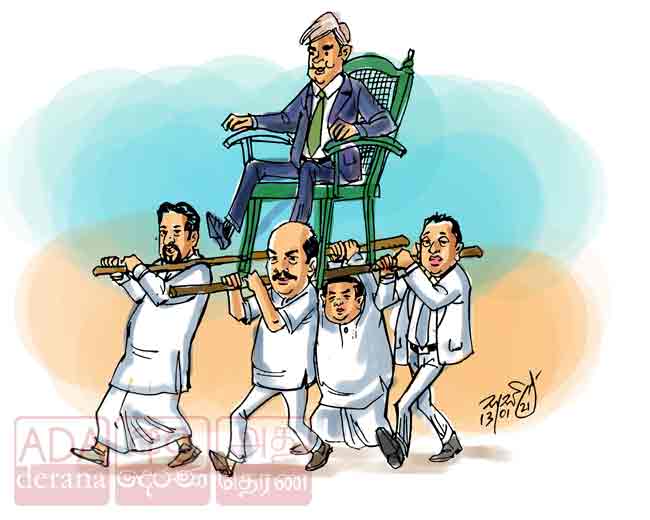
While pushing the country’s economic agenda in line with the IMF programme, President Wickremesinghe is also faced with responding to the disinformation campaign pushed by his coalition partners in the Government, the ruling Sri Lanka Podujana Peramuna (SLPP), which continues to push the agenda of holding Parliamentary Elections prior to the Presidential Election.
After making several public statements on which election would be held first, President Wickremesinghe last Wednesday informed the Cabinet of Ministers that the Presidential Election would be held first during the scheduled period this year and that the relevant funds had already been allocated for the said election.
Basil’s conundrum
The many news reports planted by the SLPP of an early dissolution of Parliament in order to hold Parliamentary Elections prior to a Presidential Poll have left many wondering which election will be held first. It is interesting to see SLPP theoretician Basil Rajapaksa’s propaganda campaigns back in action.
The ruling SLPP is currently faced with multiple issues in order to hold the party rank and file without further erosion and Basil is now a man facing the conundrum of the party’s next political move. Basil is no novice to electoral politics and is well aware that the SLPP’s future hangs on key decisions that will have to be taken at the upcoming Presidential Poll.
It is evident that the SLPP is split over the party’s stance at the Presidential Election – whether to support President Wickremesinghe or field its own candidate at the poll. Basil understands that the SLPP’s political path will be adversely affected in the event the party supports President Wickremesinghe at the election. Such a move could then also further solidify the split in the party, with a good portion joining with Wickremesinghe for the Parliamentary Elections.
However, if the SLPP fields a candidate at the Presidential Poll, who stands a high chance of losing, such a result would also have a definite impact on the SLPP’s performance at the Parliamentary Elections.
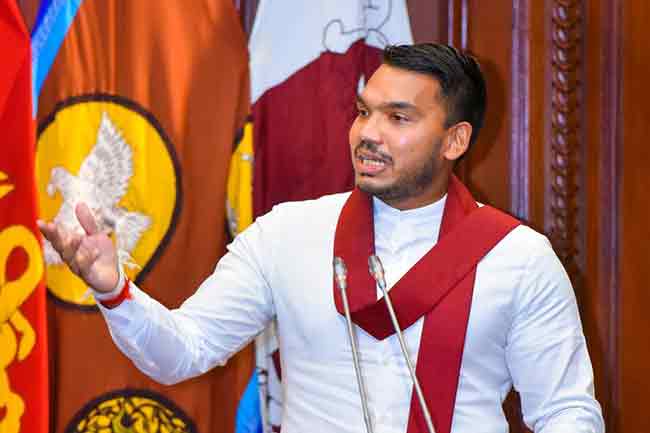
After weighing all these issues, Basil’s only solution is to push for a Parliamentary Election prior to the Presidential Poll. He believes that although the party will not be able to record a victory at the Parliamentary Elections, the SLPP can prevent a further erosion of its members and voter base in a bid to rebuild in time for the 2030 Presidential Election, when SLPP National Organiser Namal Rajapaksa is expected to contest at the poll.
President Wickremesinghe’s firm stance of holding the Presidential Election as scheduled with Parliamentary Elections afterwards has greatly disappointed Basil. In fact, Basil has been pushing for the holding of Parliamentary Elections first with the President during the eight rounds of talks held so far between Basil and Wickremesinghe.
It is in such a backdrop that Basil decided to launch a propaganda campaign by planting news stories that Parliament would be dissolved next month.
SJB’s stance
The holding of Parliamentary Elections prior to a Presidential Election also stands to benefit the main Opposition SJB.
The SJB has seen a growth in its support base as the main Opposition political party rather than due to an individual – the party’s leadership.
Given that a Presidential Election will be focused on an individual, the SJB may not stand to enjoy the full benefit of the support enjoyed by the party at a Presidential Election led by Opposition and SJB Leader Sajith Premadasa.
Basil’s polls campaign
All these issues have compelled SLPPers supportive of Basil to launch a propaganda campaign to push for an early Parliamentary Election. Their aim is to create a public discourse on the need for a Parliamentary Election prior to a Presidential Election, while on the other hand also create a volatile environment in the stock market with the news in order to push President Wickremesinghe to consider the dissolution of Parliament to hold Parliamentary Elections. Interestingly, SLPP propagandists have already claimed the deadline for the President to dissolve Parliament as well.
However, Basil’s choice of messenger to carry out the propaganda campaign, his loyalist, Sri Lanka’s former Ambassador to Russia Udayanga Weeratunga, seems to have been a wrong one. The Rajapaksa relative has from time to time made various public statements on Basil’s behalf and has earned the public criticism of SLPP Leader Mahinda Rajapaksa (MR) as well. MR has earlier stated that Weeratunga did not represent the party or the Rajapaksa family.
Weeratunga, this time around, has said that a decision had been made to dissolve Parliament on or after 14 June, adding that the Parliamentary Elections would be held first and that it would then be decided whether the elected prime minister from that government would be fielded as the presidential candidate or if a different person would be chosen.
“The Parliamentary Election will definitely be held in the first week of August. This was decided after discussions between the President’s faction and representatives from the SLPP,” he further said.
Participating in a television talk show, Weeratunga also noted that President Wickremesinghe would not contest the next Presidential Election.
He added that businessman-turned-politician Dhammika Perera would be the SLPP’s prime ministerial candidate at the Parliamentary Elections.
No dissolution
Janatha Vimukthi Peramuna (JVP)-led National People’s Power (NPP) Leader Anura Kumara Dissanayake (AKD) meanwhile claims that President Wickremesinghe will not dissolve Parliament to hold Parliamentary Elections prior to the Presidential Election.
He notes that although the President is constitutionally able to dissolve Parliament, he will not do so since he is aware that such an action will result in him losing his bargaining power with other political parties.
AKD explains that if Wickremesinghe does not dissolve Parliament, until the next president is sworn into office, he can remain in power and have the support of a Cabinet of Ministers. “If he dissolves Parliament, he loses his power. There is no way he would dissolve Parliament when he could retain power for several months more,” he said.
On the other hand, if President Wickremesinghe moves to dissolve Parliament at the current juncture, he will also stand to lose the support of the members of the ruling SLPP who are currently supporting him.
SLPP ministers in the Government who have expressed their support of Wickremesinghe are likely to return to the party fold to contest the Parliamentary Elections. The United National Party (UNP), which has only one sitting Member of Parliament (MP) at present, will also stand to lose a considerable portion of its voter base.
President Wickremesinghe will therefore fight back the Basil-backed propaganda campaign in order to hold the Presidential Election first.
Backtracking
Realising that Basil’s propaganda campaign had backfired without public support and President Wickremesinghe reiterating the holding of the Presidential Election first, SLPP General Secretary Sagara Kariyawasam told the media last week that the party had not requested Wickremesinghe to hold Parliamentary Elections first but had only conveyed its opinion to the President.
“The decision to dissolve Parliament is in the hands of the President. SLPP Founder Basil Rajapaksa informed the President that it is better to hold the General Elections first. The President will take the decision. We are ready to face any election, be it the Presidential, Parliamentary, Local Government, or Provincial Council Elections,” he said.
UNP campaign
The UNP meanwhile is in the process of preparing for the launch of a UNP-led alliance in June. The alliance will form Wickremesinghe’s platform for the Presidential Election.
It is learnt that several political parties, civil society organisations, and members of certain parties are expected to join this alliance, while talks are also underway to obtain support from several MPs from the SLPP and the main Opposition SJB.
Meanwhile, the SLPP dissidents’ group led by MPs Anura Priyadarshana Yapa and Nimal Lanza is all geared to hold the official launch of the broad alliance together with members of the Sri Lanka Freedom Party (SLFP) and several other parties on 8 June in Ambalantota in Hambantota. This new alliance is expected to be converted to the broad alliance that would support Wickremesinghe’s candidature.
Objecting to Basil
However, there seems to be growing friction between the Yapa-Lanza alliance and the official SLPP, with objections being raised by the former against Basil’s involvement in Wickremesinghe’s election campaign.
Wickremesinghe’s campaign committee, which includes members of the Yapa-Lanza alliance, several ministers, and MPs of the SLPP as well as the SLFP, now holds weekly meetings. The committee usually meets every Monday to discuss campaign-related work and the next steps.
President Wickremesinghe, meanwhile, had invited the SLPP’s Basil to also attend this campaign committee meeting.
It is learnt that a majority of committee members have opposed the President’s decision to permit Basil and his representatives to attend the meetings.
It is also learnt that Yapa and Lanza, along with the SLFP’s Duminda Dissanayake, had boycotted a recent meeting of the committee where Basil had also been invited to attend. These members had also avoided the dinner that had been held after the meeting.
Following the latest development, the Yapa-Lanza group and the SLFPers in the committee have discussed Basil’s role at a meeting convened in Parliament and have decided not to attend any future meetings that include Basil, especially in relation to planning political campaigns. They have also informed Wickremesinghe that Basil should not attend these meetings when the SLPP has not even decided to support the President’s candidature.
The Yapa-Lanza alliance maintains that it will receive the support of around 40 sitting MPs.
Meeting SLPPers
Meanwhile, President Wickremesinghe recently met with several groups of SLPPers. The meetings were with former Provincial Council members of the SLPP and the party’s parliamentary group.
The meeting with the former Provincial Councillors was organised by Minister Pavithra Wanniarachchi’s husband, Kanchana Jayarathna. During the discussion, the SLPPers had pointed out that people in their constituencies still considered them as councillors although Provincial Councils had been defunct for over five years.
However, the former councillors have noted that they will publicly extend support to Wickremesinghe only when the SLPP has made an official decision to support the President at the upcoming Presidential Election. The President, it is learnt, had agreed and had asked the group to take the Government’s ‘Aswesuma’ and agriculture modernisation programme to their constituencies.
Some of the SLPPers at the meeting had complained that they were yet to receive the compensation for their houses that had been destroyed on 9 May 2022. Wickremesinghe had tasked his Chief of Staff Sagala Ratnayaka to discuss the matter with the relevant State officials.
Namal’s stance on RW
The SLPP once again claimed that it was not supporting President Wickremesinghe at the polls, with Namal Rajapaksa, who is of the view that the party should field its own candidate at the upcoming Presidential Election, saying that Wickremesinghe was the UNP’s candidate and that it was up to the SLPP to decide on the party’s own candidate.
Namal further noted that the party would also have to decide on whether it would support the UNP.
Portfolio talk
Meanwhile, Premadasa is working to ensure that none of the MPs in his fold will cross over to the Wickremesinghe Government.
The growing dissension within the SJB over certain decisions taken by Premadasa, such as giving prominence to dissident SLPPers who have joined the party fold and accepting a large number of commanders from the tri-forces to the party fold, has resulted in many SJB seniors deciding to discuss the allocation of ministerial portfolios under a future SJB government.
Several discussions have been held among a group of SJB seniors about the growing dissension over Premadasa’s actions and the need to address these issues.
It is in such a backdrop that Premadasa announced that MP Harsha de Silva would be appointed as the minister of finance in an SJB-led government. He made the announcement during a speech at an event held in Galle.
“After @sajithpremadasa announced in Galle that @HarshadeSilvaMP will be his future finance minister, all of a sudden the #ranilist seems to be very, very hurt. Don’t worry, a few more months for elections so save your emotions for later,” SJB member Rehan Jayawickreme said on X.
Premadasa’s move to give prominence to SLPP dissident MP Dr. Nalaka Godahewa on economic issues was opposed by senior SJBers, claiming that the SJB Leader should give de Silva his due place as the party’s economic advisor.
SF ready to move
Meanwhile, SJB Chairman and MP, Field Marshal Sarath Fonseka (SF) continues to indicate his intentions of moving out of the SJB by saying that he is prepared to take up any challenge to take the country forward. “I took on the challenge of liberating this country and ended a nearly three-decade-long conflict. I am willing to take on any challenge that ensures Sri Lanka heads in the right political direction and we rid ourselves of the current corrupt political system,” he said.
Fonseka’s statements that he is prepared to make a decision on behalf of the country have now turned out to indicate that he is gearing to contest the upcoming Presidential Election.
News reports quoting sources close to Fonseka claim that he is expected to make the announcement of his candidature at the upcoming Presidential Poll next month. It is learnt that he is currently exploring the possibility of contesting as an independent presidential candidate.
The Court of Appeal has meanwhile set 5 June to take up the petition filed by the SJB leadership seeking the annulment of the enjoining order issued by the Colombo District Court that prevents the SJB from removing Fonseka from the party chairmanship and post of Kelaniya Organiser.
Another plan
It is interesting that Fonseka is looking at contesting the upcoming Presidential Election as an independent candidate, especially given his close association with President Wickremesinghe. Fonseka has been seen together with Wickremesinghe on several occasions, including in the President’s office in Parliament as well as in Wickremesinghe’s office at the Finance Ministry.
Given the tie between Fonseka and President Wickremesinghe, one could also wonder whether it is yet another ploy by the latter to break the SJB vote bank, especially the SJBers who are not too keen to support either Wickremesinghe or Premadasa at the Presidential Election.
No SJBers for SF
However, SJB seniors immediately claimed that no SJBer would join Fonseka even if he defected from the party.
While maintaining that the party had not been informed by any verified source of Fonseka’s decision, SJB General Secretary Ranjith Madduma Bandara said that SJBers would not defect from the party when its Leader Premadasa had already declared that he would contest the Presidential Election.
Debate conundrum
Meanwhile, the much-touted debate between Premadasa and AKD is yet to pan out despite the latter agreeing to one of the dates presented by the SJB for the debate. AKD on Monday (20) agreed for the debate to be held on 6 June.
The venue, time, and subject topics of the debate are to be finalised following a discussion between the SJB and JVP/NPP.
The SJB last Sunday (19) issued a fresh set of dates for debate between a committee of experts and another debate between the leaders of its party and the JVP-led NPP.
In a letter to NPP Executive Committee Member Dr. Nalinda Jayatissa, SJB Head of Operations MP Nalin Bandara proposed the dates 27, 28, 29, 30, and 31 May for the debate between the Economic Councils of the two parties, while proposing the dates 3, 4, 5, 6, and 7 June for the Leaders’ debate.
However, the JVP/NPP has not commented on the debate between the Economic Councils of the two parties, which has been sought by the SJB.
The SJB meanwhile is yet to announce its decision to participate in the debate with AKD on a date given by them, with some SJBers claiming that the party first needed to see a printed economic policy of the JVP/NPP. The JVP/NPP has maintained that the statements made by the party’s Economic Council members reflect its economic policies, although they are not in print.
Dilith to replace Sajith
Amidst the confusion over the Premadasa-AKD debate, with the SJB Leader yet to officially announce his agreement for the debate on 6 June, Mawbima Janatha Party (MJP) Leader, businessman-turned-politician Dilith Jayaweera has expressed preparedness to replace Premadasa in the debate with AKD.
Jayaweera claims that Premadasa will not participate in the debate and that he is prepared to participate instead and answer any question posed to him.
Wijeyadasa barred
The crisis within the SLFP meanwhile took a new turn with the Colombo District Court on Monday (20) issuing an interim order preventing Justice Minister Dr. Wijeyadasa Rajapakshe from functioning as the SLFP Leader and Keerthi Udawatte from functioning as the Acting General Secretary of the party.
The petition seeking the enjoining order was filed by the pro-Nimal Siripala de Silva faction’s Acting General Secretary of the party, Duminda Dissanayake.
Following the interim order issued by the Colombo District Court, members of the pro-de Silva faction of the SLFP returned to the Party Head Office at Darley Road, Colombo.
However, Rajapakshe has meanwhile filed a petition before the Civil Appellate Court of the Western Province seeking the lifting of the enjoining order obtained by Dissanayake from the Colombo District Court barring him from holding the post of SLFP Leader and Udawatte as the party’s Acting General Secretary.
The court heard the case on three days last week and it has been fixed again for Friday (31).