UK Tourists Assaulted by Railway Employees: Investigation Launched

An official investigation has been initiated in response to an incident at the Nawalapitiya railway station, where two foreign tourists were reportedly assaulted by two railway employees.

Two British nationals, who were traveling on the Podi Manike train from Colombo to Badulla, found themselves embroiled in an ugly incident.

Their journey commenced at the Kandy railway station.

Upon investigation, Railway Superintendent N.M.J. Idipola revealed that the duo had been removed from the train, citing that despite holding third-class tickets, they had occupied seats in the first-class compartment.

Sumeda Somaratne, President of the Sri Lanka Railways Station Master’s Association, confirmed that a railway guard had instructed the foreign passengers to disembark.

Despite these instructions, the two foreigners had refused to vacate the train compartment, and Sumeda Somaratne noted as a result they were removed from the train.

The Nawalapitiya Police indicated that no possibility of arresting foreigners exists in this context.

Meanwhile, H. M. K. Bandara, the General Manager of Sri Lanka Railways, has directed the railway security department to conduct an investigation and submit a comprehensive report regarding this incident.

Sri Lanka opposition to table first-ever no-faith motion against sitting speaker

Opposition parties in Sri Lanka will table a motion of no confidence against an incumbent speaker on Tuesday March 05 for the first time in the legislature’s history, opposition lawmaker G L Peiris said.

“At no point in the history of this country has a no-confidence motion (NCM) being tabled against a speaker. It’s a special event,” said Peiris.

Speaking to reporters on Monday, Peiris said NCMs have been tabled against four prime ministers and 14 ministers, and against 27 governments as a whole.

“This is the 26th speaker. No NCM has been tabled against a speaker. The opposition has taken this decision responsibly, looking ahead and in the absence of an alternative,” he said.

“All parties in the opposition have already expressed their full support for this NCM. This too is a rare occurrence. Various opinions exist within the opposition, but when it comes to this matter, every group in the opposition has been able to reach a consensus,” he added.

The NCM was filed by the main opposition Samagi Jana Balawegaya (SJB) against Speaker Mahinda Yapa Abeywardena for approving the controversial Online Safety Bill allegedly in violation of Supreme Court recommendations.

The SJB said previously that the motion was filed against the speaker’s “gross misconduct and disregard for the supreme law of the land”.

“He has betrayed the trust of the people and the parliament. It’s time to unite for transparency and accountability,” the party said in a statement.

Peiris is not a member of the SJB but sits in the opposition. His formation of “independent” MPs formerly of the ruling Sri Lanka Podujana Peramuna were party to the signing of the NCM against Speaker Abeywardena on Monday February 26.

Tamil National Alliance (TNA) MP M A Sumanthiran, a vocal critic of the bill, was also part of the signatories to the motion.

Parliament’s recent passing of the Online Safety Bill (OBS) has been controversial.

The Centre for Policy Alternatives (CPA) said in January that the process followed in enacting bill raised serious questions on law-making and its impact on constitutional democracy. The organisation urged the government to replace the act with a law that “genuinely addresses” concerns on online safety.

Claiming that the process of drafting the OSA was shrouded in secrecy, CPA said the rushed manner of its passage raises questions as to the intentions of the government in enacting a law that has significant implications for fundamental rights and the rule of law in Sri Lanka.

“CPA has previously commented on the substance and process followed with the Bill and challenged its constitutionality. In light of recent events surrounding the enactment of the OSA, CPA condemns the enactment of such a draconian law that can further limit freedom of speech and the right to dissent,” the organisation said.

Posted in Uncategorized

Auctioning of SriLankan Airlines postponed

The decision to auction SriLankan Airlines, the national carrier of Sri Lanka, has been put on hold and the Treasury is to pump money into the airline for 6 months, Minister of Ports, Shipping and Aviation Nimal Siripala de Silva said.

He said that the restructuring of SriLankan Airlines was postponed on a recommendation made to the Government that it first settle the outstanding debts of the airline.

Accordingly, the Cabinet has decided to release funds from the Treasury for 6 months to manage the airline before it is restructured.

Minister Nimal Siripala de Silva said that once the airline is restructured the funds used by the Treasury will be collected.

The move to restructure SriLankan Airlines comes as the airline continued to face several cancellations and delays over the past few weeks.

On February 27th several SriLankan Airlines flights scheduled to leave from the Bandaranaike International Airport in Katunayake were disrupted.

According to reports, at least 10 flights were either delayed or cancelled.

The flights included those operating to India, Malaysia, Indonesia, Bangladesh, the Maldives, Saudi Arabia, South Korea, the UAE and Kuwai.

It was also reported that SriLankan Airlines flights to Chennai, Bangalore, and Abu Dhabi were cancelled.

Sri Lanka, India working to link power grids via $1.2bn undersea transmission line

Sri Lanka and India are working on an estimated USD 1.2 billion undersea transmission line that will link the island nation’s power grind with that of India to provide energy security to this country, a top Sri Lankan official said on Tuesday.

The proposal is to link Sri Lanka’s north central town of Anuradhapura and Chennai, the capital of Tamil Nadu state in India through a direct power line. After a 130km overland transmission line in India, an undersea line (via a submarine cable) will emerge at Thiruketheeswaram in Mannar in northeast Sri Lanka.

Sulakshana Jayawardena, Secretary to the Ministry of Power and Energy said, “This will raise our hopes on energy security.” He said this days after the fifth meeting of the India-Sri Lanka joint working group (JWG) for cooperation in the power sector was held on February 28 here. The High Commissioner of India to Sri Lanka Santosh Jha also attended the meeting.

“The proposal for the power grid interconnection was discussed at this meeting,” Jayawardena said.

The 4th meeting of the JWG was held in June 2019 in India. This was the 5th meeting of the JWG.

A statement from the Indian High Commission said that during the meeting, discussions were held on the power grid interconnection between India and Sri Lanka and the Sampur Solar Power project, to be built by India in Sri Lanka’s eastern Trincomalee district.

On March 1, India and Sri Lanka signed an agreement for the development of a hybrid renewable energy system for the Delft, Analativu and Nainativu islands of the northern Jaffna peninsula.

The project, to be carried out under grant assistance from the Government of India, will comprise a 530 kW of wind power, 1,700 kW of solar power, 2,400 kWh of battery power and a 2,500 kW diesel power system for the three islands, which are not connected to Sri Lanka’s national grid.

The proposal to link Sri Lanka with the Indian power grid was proposed more than a decade ago, but it has made little progress till now. In 2023, Sri Lanka said it had hoped to get the transmission line in place within two to three years so that renewable power produced on the island/s can be sold to India.

After the February 28 meeting, Pankaj Agarwal, Secretary, India’s Ministry of Power, highlighted the benefits that could be accrued by Sri Lanka in the power sector integration with India.

“It would cause significant cost reductions with Sri Lanka gaining capacity to export to India once the offshore wind capacity in Sri Lanka is harnessed. (It will) also encourage private sector investment in Sri Lanka’s power sector,” he said, according to a statement from the Indian mission in Colombo.

However, there is no formal agreement in place as yet. Jayawardena told a local news channel that earlier there was an MoU signed between the two countries to conduct necessary technical assessment.

“That is the only agreement. However, it was proposed (at the meeting) that the project should be implemented within a legal framework,” he said.

Jayawardena on Tuesday said the project, which is expected to cost USD 1.2 billion, would require the establishment of a new institution where Sri Lanka would have a 50 per cent representation.

However, the proposal needs further discussions as Sri Lanka would need to source funding for it, he added.

The statement from the Indian High Commission also noted that substantial progress had been made on the Sampur Solar Power project, especially after the visit of the President of Sri Lanka to India in July 2023, during which an energy permit for 50 MW power plant was granted to the implementing agency, Trincomalee Power Corporation Limited (TPCL).

The TPCL is a joint venture between the Indian entity NTPC Ltd and the Ceylon Electricity Board (CEB).

The Indian side also agreed to extend technical assistance to CEB in areas to be identified by the Sri Lankan side, it said.

After the March 1 agreement, local media reports have highlighted how the energy sector was identified as a priority area in the India-Sri Lanka Economic Partnership Vision document, which was adopted during the visit of President Ranil Wickremesinghe to India in July 2023.

Several landmark initiatives such as the power grid connectivity, and multi-product two-way oil pipeline are currently under discussion between India and Sri Lanka in the energy sphere. India’s overall development partnership portfolio stands at USD 5 billion with almost USD 600 million being in grants alone.

Source: PTI

Posted in Uncategorized

UNHRC concerned about constitutional jugglery to suppress Opposition: GL

Dissident SLPP MP Prof. G. L. Peiris, yesterday (04) said that the ongoing attempts by the Wickremesinghe-Rajapaksa government to suppress the Opposition had attracted the attention of the Geneva-based United Nations Human Rights Council (UNHRC).

Referring to the recent declaration made by Volker Türk, UN High Commissioner for Human Rights at the 55th session of the HRC, the former External Affairs Minister said that regardless of what the state controlled media reported, the UN had issued a very clear warning over the brazen manipulation of parliamentary process to intimidate the Opposition.

Addressing the media at his residence at Kirula Road, Prof. Peiris dealt with the Opposition decision to move a No-Confidence Motion (NCM) against Speaker Mahinda Yapa Abeywardena over the authorisation of the Online Safety Act, sans mandatory Supreme Court recommendations, the Speaker’s controversial role in the appointment of Deshabandu Tennakoon as the IGP and preposterous salary increase granted to CBSL employees.

Declaring that the Opposition would hand over its NCM today (05), Prof. Peiris said that Volker Türk expressed concern over the introduction of laws with potentially far-reaching impact on fundamental rights and freedoms, the rule of law and democratic governance. Prof. Peiris quoted the UN official as having said these included the Online Safety Act, the Anti-Terrorism Bill, the Electronic Media Broadcasting Authority Bill and the NGO Supervision and Registration Bill.

The UN official also questioned the new IGP’s appointment in spite of the Supreme Court’s finding that he was responsible for torture of an individual in 2010.

Prof. Peiris said that contrary to earlier reports regarding the vote at the Constitutional Council in respect of the IGP’s appointment, the Opposition could now confirm that Speaker Abeywardena never exercised his right to vote at the CC but in a letter addressed to President Ranil Wickremesinghe declared his support to Deshabandu’s appointment.

Pointing out that the Speaker as Chairman of the Constitutional Council couldn’t, under any circumstances, either support or oppose a particular proposal in a letter to a third party, Prof. Peiris alleged that the Galle District MP had turned the Parliament upside down.

The former minister said that there had never been a NCM move against a Speaker since Sri Lanka gained independence. “We had no option but to take action against him to prevent the government repeating the same strategy in respect of the Anti-Terrorism Bill,” Prof. Peiris said, adding that the Opposition was united on this particular issue. The retired top law academic explained that manipulation of the Constitutional Council was a very serious matter, as bad as the disregarding of SC recommendations in respect of the Online Safety Bill.

He alleged that the government was busy undermining the parliamentary system. Though there had been issues with regard to passage of laws previously, the Parliament never witnessed such an outright manipulation, Prof. Peiris said, pointing out that the Speaker chose to conveniently remain silent even after the Human Rights Council, in a letter dated Feb 8, pointed out glaring omissions.

Posted in Uncategorized

Mannar wind power: CEA to decide post-public consultation

In the wake of various allegations being made by certain parties, including environmentalists, regarding the negative impact of the proposed Mannar wind power project, the Central Environmental Authority (CEA) and other authorities await the conclusion of the public consultation programme to make a final decision.

Recently, the Board of Investment approved India’s Adani Green Energy Limited’s United States dollars ($) 442 million initiative to build two wind power facilities in Mannar and Pooneryn, with the Mannar project slated to have a capacity of 250 megawatts. Meanwhile, a number of environmentalists have already warned the Sri Lankan Government on the impact it exerts on the country’s environment, according to the Environmental Impact Assessment (EIA) conducted on the project. They have raised serious concerns about its unfavourable conditions for migratory birds and also urged the CEA to take immediate action regarding the issues.

However, when contacted by The Daily Morning yesterday (4), the CEA Chairman Venura Fernando said that no final decision has been taken thus far regarding the approval of the project as it is still at the public consultation stage, where the CEA cannot make any decision. Fernando noted that the EIA report has already been published, and that it is open for every individual and civil society organisation to come up with their proposals and views with regard to the project, and that therefore, there is much more time to take a decision regarding the power project.

“We have published the EIA report, and that is how the public, including those parties who raise various concerns, became aware of the respective matters. According to the standard procedure, the decision is to be taken after the public consultation stage. We have to go through what the people have said about the project. Then, we review all the matters raised by the stakeholders, after which we take a decision,” he added.

Speaking further, he stated that the CEA has never taken its attention away from the matter and its impact on the environment, but that it should adhere to the prescribed procedures when dealing with such projects of national importance.

Posted in Uncategorized

Sri Lanka’s Online Safety Act can criminalize nearly all forms of expression – Core Group tells UNHRC

The Core Group on Sri Lanka at the UN Human Rights Council have expressed concern over the recent legislative developments regarding human rights in the country.

UK’s Deputy Permanent Representative to the United Nations Rita French delivering a statement on behalf of the Sri Lanka Core Group comprising Canada, Malawi, Montenegro, North Macedonia, the United Kingdom and the United States stressed that the Online Safety Act has the potential to severely restrict online communication and could potentially criminalise nearly all forms of expression, creating an environment that has a chilling effect on freedom of expression.

They urge the government to enact amendments to align the Act with Sri Lanka’s human rights obligations and commitments.

Further more, the Core Group called for the Prevention of Terrorism Act (PTA) to be replaced with legislation that is consistent with Sri Lanka’s international obligations, and encourage the release of unjustly held long-term PTA detainees and for Sri Lanka to maintain a moratorium on its use.

“As the government brings forward other legislation with potentially serious implications for fundamental freedoms and civic space, we encourage comprehensive consultations with stakeholders, including civil society, and due legislative process,” she noted.

FULL STATEMENT: This statement is on behalf of the Sri Lanka Core Group comprising Canada, Malawi, Montenegro, North Macedonia, the United Kingdom and the United States.

High Commissioner,

There have been several important legislative developments regarding human rights, reconciliation and civic space. Unfortunately, some of these developments give cause for concern.

The Online Safety Act has the potential to severely restrict online communication and could potentially criminalise nearly all forms of expression, creating an environment that has a chilling effect on freedom of expression. We urge the government to enact amendments to align the Act with Sri Lanka’s human rights obligations and commitments.

We continue to call for the Prevention of Terrorism Act (PTA) to be replaced with legislation that is consistent with Sri Lanka’s international obligations. We acknowledge the recent release of nine Tamil leaders detained last November. We encourage the release of unjustly held long-term PTA detainees and for Sri Lanka to maintain a moratorium on its use.

While we note the government’s efforts to establish a Commission on Truth, Unity and Reconciliation, we stress the importance of an inclusive participatory process to build trust in advance of any legislation. Any future commission must be independent, inclusive, meaningful, and transparent, meet the expectations of affected communities, build upon previous transitional justice processes, and provide pathways for accountability.

As the government brings forward other legislation with potentially serious implications for fundamental freedoms and civic space, we encourage comprehensive consultations with stakeholders, including civil society, and due legislative process.

We welcome the government’s stated commitments on land releases but note with concern reports of increased tensions around land seizures in the north and, particularly, the east of the country.

High Commissioner,

We urge the government to engage with you and your office to address these and other challenges, and we remain ready to support Sri Lanka in addressing HRC resolution 51/1.

Posted in Uncategorized

India notes increase in investments in Sri Lanka

India has taken note of an increase in investments in Sri Lanka as well as other countries in the region.

India’s External Affairs Minister S Jaishankar, in a veiled dig at Maldives President Mohamad Muizzu for his comment earlier this year, said that big bullies do not offer $4.5 billion aid or vaccine or food when neighbouring countries are in distress.

Jaishankar was responding to a question on whether India is being perceived as a “bully” in the region. Moreover, the question was in reference to Muizzu calling India a bully amid the India-Maldives row.

Jaishankar, who was speaking at an event promoting his book ‘Why Bharat Matters’, stressed on India’s role in providing assistance to its neighbouring countries whenever any crisis arose. As per ANI, Jaishankar said at the event, “The big change today in this part of the world is what has happened between India and its neighbours. When you say India is perceived as a big bully, you know, big bullies don’t provide $4.5 billion when the neighbours are in trouble. Big bullies don’t supply vaccines to other countries when Covid-19 is on or make exceptions to their own rules to respond to food demands or fuel demands or fertiliser demands because some war in some other part of the world has complicated their lives.”

The minister’s comment comes after Muizzu had said earlier in the year, “We might be small but that doesn’t give you the licence to bully us.” Maldivian ministers were suspended for their derogatory remarks on Prime Minister Narendra Modi who had posted pictures from his visit to Lakshadweep and had promoted the union territory as a tourist destination.

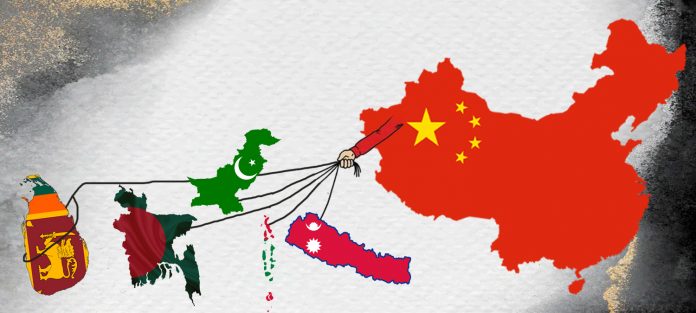
Jaishankar said that much has changed between India and its neighbours, especially with Nepal and Bangladesh. He said there are roads and railways and waterways that didn’t exist a year ago. Indian businesses use Bangladeshi ports on a national treatment basis, he said. Jaishankar also highlighted the increase in investments in Nepal, Sri Lanka, Bhutan, Bangladesh and the Maldives.

“The volume of the trade and the investments which are there, it’s actually a very good story to tell. Not just with Nepal and Bangladesh, with Sri Lanka as well, I would also say even with the Maldives,” the minister said, further adding that Bhutan has consistently been a strong partner of India.

“So, our problem in the neighbourhood, very honestly, is with respect to one country. In diplomacy, you always hold out hopes that, yes, okay, keep at it and who knows one day what the future holds,” he said.

Meanwhile, Muizzu had asked India to remove military personnel from the island nation before March 10. The remaining Indian troops manning the two aviation platforms will be withdrawn by May 10. Muizzu is widely seen as a pro-China leader.

SJB to file objections to injunction preventing suspension of Sarath Fonseka

The Samagi Jana Balavegaya (SJB) has stated before the courts that it will file objections requesting to invalidate the injunction issued preventing the suspension of Field Marshal Sarath Fonseka’s party membership and positions held in the party, and from taking disciplinary action against him.

Appearing for the Opposition Leader Sajith Premadasa, President’s Counsel Romesh de Silva communicated this to the Colombo District Court when a petition filed by SJB Chairman Field Marshal Sarath Fonseka in this regard was taken up this morning (04).

Accordingly, the Colombo District Judge Sandun Withana ordered the relevant objections to be taken up for consideration this afternoon.

The Colombo District Court, which considered a complaint filed by Fonsek recently, issued the relevant injunction on Leader of the SJB Sajith Premadasa, its General Secretary Ranjith Madduma Bandara, National Organiser Tissa Attanayake and Treasurer of the party Dr. Harsha de Silva.

Sri Lanka Podujana Peramuna to decide on election after Basil’s return

The national organiser of the ruling Sri Lanka Podujana Peramuna (SLPP) will take a decision on whether to contest the 2024 presidential election on its own or support a candidate fielded by an alliance party is part of, a spokesman said.

SLPP legislator Piyal Nishantha told reporters that Rajapaksa is set to arrive in the country on Tuesday March 05.

“The SLPP has no wish to count its eggs before they’re hatched. Our national organiser is a very creative leader that steered the party to victory in a very short period of time,” said Nishantha.

Following Rajapaksa’s return, said Nishantha, the SLPP’s executive committee, headed by Rajapaksa, will decide whether to form an alliance and “provide an opportunity to a candidate” or field its own candidate at the presidential poll that’s due to be held between September 17 and October 17 this year.

“From that moment on, we’ll say compete with us and see if you can,” said Nishantha.

President Ranil Wickremesinghe has said that a presidential election will be held this year before a parliamentary election in 2025. However, some opposition groups have expressed uncertainty over the matter.

In a recent interview with India’s WION network, Wickremesinghe was noncommittal about contesting the presidential election that should constitutionally be held by at least October 17 this year. He did, however, say “both presidential and parliament” elections are due when asked about elections happening in 2024.

Asked how optimistic he is of his own chances, Wickremesinghe said: “For me to be back, I must contest.”

When pressed for his plan, he said: “I have come here to put the economy into order. My first order is to focus on that we get out of bankruptcy.”

There was no confirmation from the president that he would definitely be running.

Meanwhile, there are reports that Wickremesinghe wishes to abolish the executive presidency.

Posted in Uncategorized