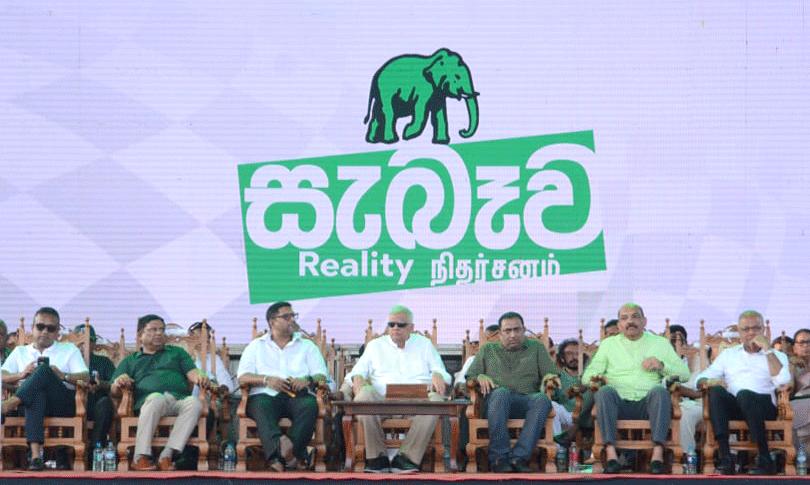
The 2024 May Day saw-according to some newspapers-41 May Day rallies, meetings or seminars being held throughout the country. Other newspapers lowered the number to 22. Pride of place was given to Colombo where the UNP, JVP/NPP, SLPP and SJB held their rallies. All four parties had big crowds but the attendance was highest at the JVP rally. Furthermore the JVP rallies in Matara and Anuradhapura also had large crowds. Compared to the “Thun Sinhala” rallies the JVP rally in Jaffna was a poor show.
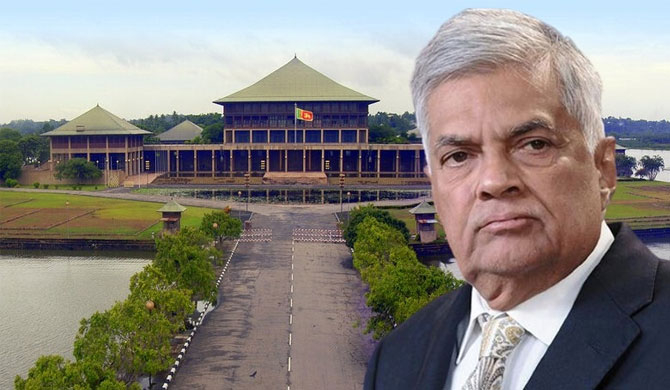
The Ceylon Workers Congress (CWC) which is the largest trade union representing plantation workers of Indian descent held its rally in Kotagala. The CWC is a constituent of the Government headed by President Ranil Wickremesinghe. CWC General Secretary Jeevan Thondaman is a Cabinet Minister in the Government. Ranil Wickremesinghe was the chief guest at the huge CWC rally.
President Wickremesinghe brought “glad tidings of great joy” to the workers gathered in Kotagala. He announced to a wildly cheering audience that the daily wage of plantation workers had been raised from Rs. 1,000 to Rs. 1,700. The 700 rupee increase amounted to a 70% pay rise. The president displayed a copy of the Gazette proclamation to the people. The plight of the plantation workers has prompted many to describe them as the “wretched of the up-country earth”. The daily wage increase would no doubt provide a degree of economic relief to them.
Ranil Wickremesinghe also addressed the UNP rally at Maradana in Colombo. There were no grand announcements as in the case of the Kotagala rally. President Wickremesinghe spoke about the difficult situation in which he took over as President and of the economic progress achieved so far. Ranil repeated his appeal to the main Opposition parties to cooperate with the Government in uplifting the country economically. He urged the SJB and JVP to work with him in implementing the agreement with the International Monetary Fund (IMF) once again, Ranil made no pointed reference to the forthcoming presidential election or about his plans to contest polls.
Both the SJB and UNP May Day Rallies were disappointments in another sense. Prior to May Day there was much speculation in the media that a number of MPs from the Sri Lanka Podujana Peramuna (SLPP) would climb the SJB stage on May Day thereby indicating they had defected from the SLPP. Likewise there was speculation that some SJB Parliamentarians would mount the UNP stage on May 1st. Neither of these anticipated crossovers took place.
No SJB Crossovers
I do not know why the much-touted appearance of SLPP Parliamentarians on the SJB stage did not happen. Despite the speculation, I had not written anything about it as I felt it was highly improbable. However, I did refer to the possibility of some SJB parliamentarians mounting the UNP stage on May Day in the second part of this article published last week. As such I probed the nonappearance of the Telephone Party MPs and learn the reasons for the non -event.
Apparently arrangements had been made for fourteen MPs from the Samagi Jana Balawegaya (SJB) to cross over to the Government side by appearing on the UNP stage on May Day. Ten of these were persons who had been Cabinet ministers, state ministers and deputy ministers in the “Good Governance” Government headed by President Sirisena and Prime Minister Wickremesinghe from 2015 to 2019. The SJB hierarchy had suspicions about this. Some SJB Bigwigs were engaged in “sweet and sour” talks with the potential dissidents to prevent them from pole vaulting.
In an unexpected turn of events the crossover did not take place. This was not because of pressure by the SJB high command. It was due to the intervention of President Ranil Wickremesinghe himself. When Ranil got to know about the crossover plan hatched by his UNP colleagues, he had vetoed it. The UNP leader had communicated with his party deputies involved in the exercise and told them to call it off. He had also got in touch with some of the SJB parliamentarians concerned and asked them to delay their defection plans.
Wickremesinghe had explained the reasons as to why he did not want a SJB crossover at this point of time to both party leaders as well as potential SJB defectors. Ranil said that he was planning to contest the Presidential election as an independent non -party candidate backed by an assorted alliance of parties, groups and individuals. He would declare his candidacy in June or early July. When that happened Ranil wanted everyone including SJB MPs to support him by joining the alliance backing him. As such he did not want crossovers at this juncture.
Vadivel Suresh
This was why the SJB Parliamentarians did not appear on the UNP platform as expected. Nevertheless some top SJB figures were conspicuous by their absence on the SJB party stage on May Day. As far as the UNP Mayday was concerned only one MP elected on the SJB ticket in 2020 was present on the UNP stage. This was Badulla district MP Vadivel Suresh.
The outspoken Vadivel Suresh has been estranged from Sajith Premadasa for several months. Suresh had organized a meeting of Tamil plantation workers in the Badulla district. Sajith was scheduled to address it. Thousands of worker had forfeited their half-day pay in order to attend the event. Sajith had backed out at the last minute saying he was ill. To Suresh’s chagrin, the Badulla district MP discovered that Premadasa had lied to him about being sick. The leader of the Opposition had gone to a meeting with Sinhala people in the Moneragala district.
Angry over this deception and the shabby treatment meted out to the Badulla district Tamil plantation workers, Suresh demanded that Premadasa apologize to the workers. Sajith agreed but did not do as he promised. Suresh therefore began functioning independently. He has been voting with the Government in Parliament. More importantly Suresh is the General Secretary of the influential Lanka Jathika Estate Workers Union (LJEWU). This has now been brought back under the aegis of the UNP. Hence Suresh’s appearance on the UNP stage was no surprise but not much notice was taken of it.
Gayashan Nawananda
There was however another surprise. Though MPs elected on the SJB ticket did not cross, a single MP elected on the SLPP ticket did cross over on May Day. Moneragala district MP Gayashan Nawananda mounted the UNP stage on May Day. Moreover he brought 800 supporters along with him for the UNP rally. Nawananda, a nominee of Vasudeva Nanayakkara on the SLPP List in 2020 has declared himself an independent after the “Aragalaya”.
Nawananda’s presence with 800 supporters was indeed a pleasant surprise to the UNP. Since President Wickremesinghe did not want defections or crossovers at this juncture, Nawananda was not lionised as he ought to have been at the UNP rally. Speaking to reporters the Moneragala MP said it was President Ranil Wickremesinghe who can steer the country forward during these trying times. The MP said his support for President Ranil Wickremesinghe should be considered as his support for the country.
Ranil’s Strategy
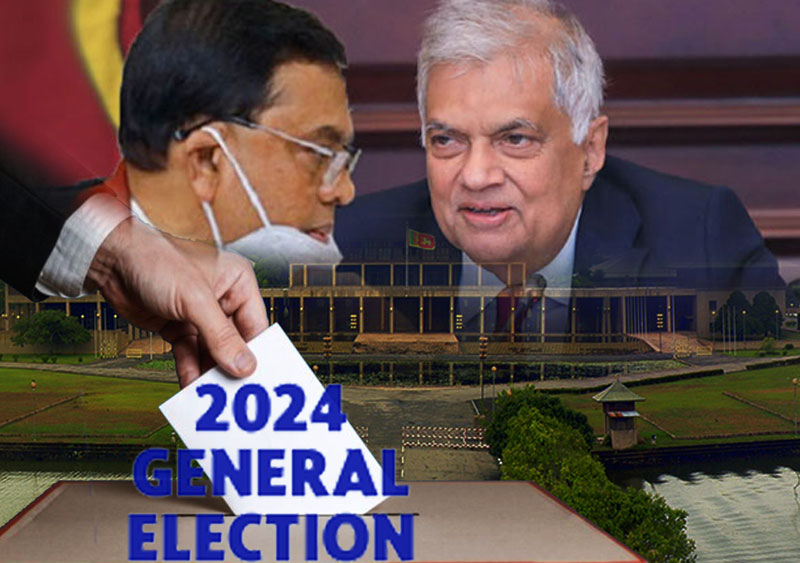
Ranil’s decisive action in stopping or postponing the SJB MP crossover at this point in time is due to his evolving strategy in facing the 2024 presidential poll. As stated in the second part of this article last week, Ranil Wickremesinghe intends to project himself on a personal level as a presidential candidate because he regards himself as the best choice. He does not want to be a party nominee. Ranil told Party members that this election would not be a party vs party election. It would be more of a clash between personalities.
Therefore, Wickremesinghe would not have a party label. Instead, he would be an independent non-party common candidate (Nirpakshika Podu Apekshaya) backed by a group of parties, organizations and key individuals. He would come forward as a “national candidate” backed by people from all ethnicities, religions, regions and all walks of life. In short, Wickremesinghe would be an independent candidate backed by a coalition or alliance. He will have the backing of the alliance but will not be an alliance candidate.
What is noteworthy is that Ranil will be an independent, non-party candidate and not a nominee of the coalition or alliance. This coalition or alliance would not be a collection of political parties alone. It would be an assortment of parties, segments of parties and party individuals. People may join forces cutting across party lines or political alignments. Party members and groups would “De-align” from earlier stances and “Re-align” in support of Wickremesinghe.
There was a time when Ranil was toying with the idea of getting some MPs of the SJB to join his Government. He interpreted that move as a re-unification of the UNP rather than the fragmenting of the SJB. Most MPs of the SJB were from the UNP or aligned with the UNP who had split with the grand old party and hitched their wagons to the Sajith Premadasa star only because they wanted to win elections. Very few of them were hostile or opposed to Wickremesinghe.
Basil Rajapaksa
Ranil’s attempts to get back some SJB parliamentarians were proving successful when Basil Rajapaksa threw a spanner in the works. The SLPP insisted that if an SJB MP was brought into the Government and made a minister, it must be evenly matched by an SLPP MP also being appointed a minister. Earlier Ranil had resisted all attempts by Basil to get some SLPP stalwarts inducted into the Cabinet. Among these was Kalutara MP Rohitha “Ratharang” Abeygunawardena.
When SJB Kalutara MP Dr.Rajitha Senaratne was about to join the Government, “Ratharang” demanded that he too should be made a minister. Appointing Ratharan as a minister was disfavoured by Ranil. So Rajitha’s crossover was put on hold.
Ranil was dependent on SLPP votes in Parliament but he wanted to have the ministers he preferred in Cabinet. Basil Rajapaksa wanted to keep Ranil dependent on the SLPP. He did not want Wickremesinghe to strengthen himself by getting MPs from the SJB or elsewhere. In this tricky situation Ranil chose not to bring in new ministers. Thus even the UNP’s solitary MP Wajira Abeywardana was not made a minister.
Waves not Ripples
With the Presidential election drawing near Ranil’s evolving strategy to win the presidency too began changing. Instead of getting MPs from other parties to break away and support him as individuals or in groups, Ranil wanted them to do so en masse. Instead of garnering support in trickles, he wants a flood. Instead of creating ripples, Ranil wants a wave. What Ranil wants to implement is a wave strategy to win. He wants a “Ranil Ralla or pro-Ranil wave of support from multiple parties and MPs. He wants to ride the crest of this wave to win the 2024 Presidency.
It must be noted that Ranil has not openly declared his candidacy so far. When questioned, he sidesteps or diverts. As Bill Clinton famously said “It’s the economy stupid”, Ranil too emphasises that reviving the economy is of paramount importance. So when asked about the presidency, he talks about the need to repair the economy and emerge as a non-bankrupt nation first. That is his vision and mission. Contesting the presidency is to continue with that mission. Thus it is open knowledge that Ranil Wickremesinghe will throw his hat into the presidential stakes ring when he is satisfied that a milepost in economic progress has been reached.
Alliance/Coalition
It appears therefore that Ranil will proclaim his presidential candidacy in June or early July. This will be followed by the formation of an alliance or coalition of parties, groups and individuals supporting his candidacy. The spadework would have been done already. Therefore the alliance would be active almost immediately. Thereafter parties and persons can join it or associate themselves with it.
This is where Wickremesinghe’s envisaged wave strategy comes in. The UNP, Dinesh Gunawardene’s MEP, Thondaman’s CWC, Devananda’s EPDP, Athaulla’s NC, Pillaiyan’s TMVP who are all part of the Government will join the alliance and declare support.
On another level the group of SLPP cabinet ministers, state ministers and deputy ministers led by Prasanna Ranatunga would declare support. The “independent” group of SLPP dissidents led by Anura Priyadarshana Yapa and SLPP Backbencher group led by Nimal Lanza will also follow suit.
Ranil’s main target however is the UNP break-away SJB and the Tamil and its Muslim party allies. According to UNP circles talks have been almost finalised in this regard. A large number of MPs from the SJB will start joining the pro-Ranil alliance in groups and as individuals. Thereafter the Tamil and Muslim parties aligned with the SJB like the Rishad Bathiudeen led ACMC, Rauff Hakeem led SLMC and Mano Ganesan led TPA are also expected to join the alliance.
Ranil “Ralla”
This process by itself would be akin to a wave of support for Wickremesinghe who hopes to ride the crest of this winning wave. He does not want trickles or ripples . He wants a wave or a “Ranil Ralla”.
There are however some key questions. Will all the parties and groups back this pro-Ranil alliance “ as expected? Will there be splits in some parties due to this? What will the Tamil nationalist parties representing the North -Eastern Tamils do? Above all, how will the Rajapaksa led SLPP respond to this? Finally what are the chances of the Wickremesinghe Wave-Ranil Ralla strategy succeeding? These questions will be delved into in greater detail in the fourth and final part of this article.
D.B.S.Jeyaraj can be reached at dbsjeyaraj@yahoo.com