Sri Lanka to host first-ever Chinese marathon in May

Sri Lanka will host the first-ever Chinese marathon this May, where over 2000-3000 Chinese athletes will arrive under the ‘Ni Hao Zhong Guo’ programme, Sri Lanka Institute of Tourism and Hotel Management Chairman Shirantha Peiris announced.

Peiris recently visited the municipality of Chongqing in China to finalise an agreement under the Ni Hao Zhong Guo programme to bring in additional Chinese tourists to Sri Lanka over the next two-year period.

Accordingly, it has been proposed to organise a marathon for the Chinese athletes from May 1 to 3, this year. This is to be followed by a seafood festival organised on the Unwatuna beach strip. Sri Lanka Tourism Promotion Bureau Chairman Chalaka Gajabahu revealed plans to make this an annual event.

According to the Ni Hao Zhong Guo programme, Sri Lanka is expected to lure one million tourists over the next two years. Sri Lanka is expected to generate a revenue of Rs.225 billion. However, Peiris noted that two years would be rather ambitious and instead, proposed a four-year period.

‘Strongly opposed to Indo-Lanka accord,’ confirms JVP

“As a political party we strongly opposed the Indo-Lanka Accord decades ago, and dedicated our initiatives to safeguarding Sri Lanka’s sovereignty, at the cost of many lives,” said Vijitha Herath of the Janatha Vimukthi Peramuna (JVP) led National People’s Power (NPP). “This stance has not changed and will not change,” he told reporters in Colombo.

Herath, who recently accompanied party leader Anura Kumara Dissanayake as he toured India last week, said that the party prioritises the national security and territorial integrity of the country at all costs.

“The political situation today is different, the world has changed, and so has global politics,” he said at a media briefing. “Even though we have changed as well, we will not allow ourselves as a nation to be pigeonholed to fit the needs or appease power struggles among other nations.”

He said that his party will engage in politics while ensuring the country’s sovereignty and territorial integrity remain intact. “Although we will not hesitate in engaging with other nations on economic pursuits, we will not fall victim to global power dynamics and stay on course to develop and advance our nation,” Herath continued.

The MP emphasised that under NPP governance, his party will deal transparently with other governments and ensure that the nation’s advancements particularly in terms of economic development are priotised. “Throughout the country’s history, we have consistently made decisions to safeguard our territorial integrity, and we stand by that commitment today and in the future. We give our assurance to the people of this country that these principles will not waver.”

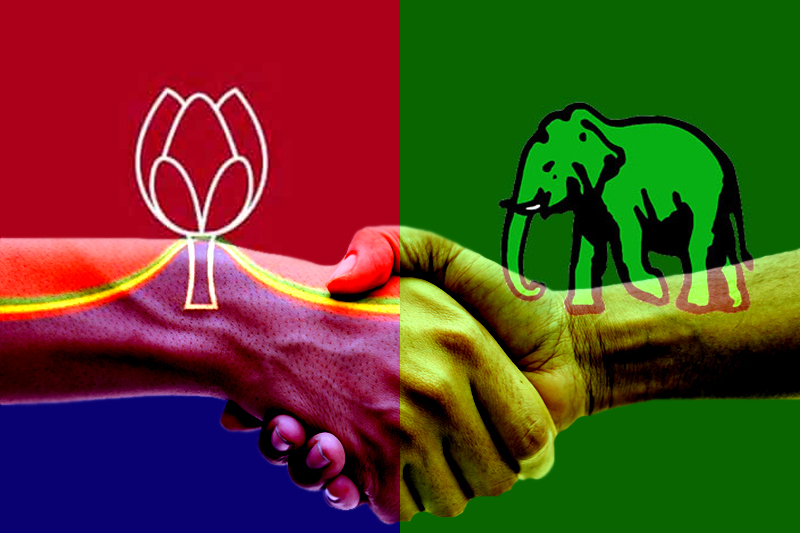
The Indo-Lanka Accord was signed in 1987, without any input from Tamil parties, and established the 13th Amendment to Sri Lanka’s constitution which created the system of Provincial Councils, promising greater devolution of land and police powers to a merged North-East. The JVP staged two insurrections against the state in the early 1970s and the late 1980s. The latter of these was chiefly in response to the Indo-Lanka accord and the 13th Amendment which sought to devolve powers to Tamils in the North-East. Tens of thousands were killed. Then leader Rohana Wijeweera framed Tamil demands for self-determination as in-hoc with US imperialist interests in his 1986 book “Solutions for Tamil Eelam Struggle”.

Referring to the discussions over the visit by the leader of the NPP Anura Kumara Dissanayake to India, Herath remarked that this visit was not undertaken hurriedly as cited by other political commentators, stating “this meeting was organized well in advance and we were in India on an invitation by the Indian government over a month ago”.

He further said “India is our closest neighbour”. “Sri Lanka and India have longstanding bilateral and diplomatic relations. It was our intention to strengthen those ties formally through this visit.”

The JVP, which has historically held a frosty view of relregardations with its northern neighbour, has yet to clarify on any policy decisions with regards to Delhi.

In 2015, then-JVP Propaganda Secretary Herath told The Island, “the JVP is against federalism”. Whilst accepting that “the grievances of the Tamil people should be redressed,” Herath reiterated that “federalism is not that solution”. He also spoke out against the merging of the Northern and Eastern provinces, as outlined by the Indo-Lanka accord. “It is the JVP that went before the courts and got an order to demerge the two provinces that had been arbitrarily merged after the Indo-Lanka Accord,” he added, referring to when the JVP filed three separate petitions with the Supreme Court of Sri Lanka calling for the North Eastern Province to be demerged. The Province was formally demerged into the Northern and Eastern provinces on 1 January 2007.

Throughout the armed conflict, the JVP would weaponize the pretence of Marxism to justify their hardline opposition to Tamil demands. In the 2004 parliamentary elections, the JVP became a coalition partner of the United Peoples Freedom Alliance (UPFA) and stood opposed to continued peace negotiations with the LTTE; they further rejected the possibility of joint post-tsunami aid distribution, and in 2005 endorsed Mahinda Rajapaksa on a platform specifically opposed to the peace process. In early 2006 the JVP openly promoted a military solution that would culminate in the Mullivaikkal genocide.

During peace talks between the LTTE and the Sri Lankan government, the JVP would consistently protest against the ceasefire – slamming international mediation and the concept of granting devolution or autonomy to the Tamil homeland.

Lankan economists and Indian traders stress benefits of Indo-Lanka land bridge By P.K.Balachandran

In his speech at the seventh Indian Ocean Conference (IOC) in Perth, Australia on February 10, Sri Lankan President Ranil Wickremesinghe reiterated the plan to build a land bridge between Sri Lanka and India to boost trade and economic integration between the two countries.

He had proposed a bridge across the Palk Strait when he was Prime Minister between 2002 and 2004 and named it the “Hanuman Bridge”. Since then, Wickremesinghe has been advocating economic links between Sri Lanka and the South Indian States particularly, because these are not only nearer Sri Lanka but are growth centres in India.

He would highlight the fact that, collectively, the four South Indian States of Tamil Nadu, Kerala, Karnataka and Andhra Pradesh have a GDP of US$ 500 billion. Sri Lanka could link up with these growing regional economies.

However, despite the favourable conclusion of a feasibility study on a land bridge in the early 2000s, the idea fell by the way side due to political opposition in Sri Lanka and Tamil Nadu.

When Wickremesinghe was on visit to India in Jul 2023, he again proposed a land connection between India and the ports of Colombo and Trincomalee. The Indian Prime Minister Narendra Modi endorsed the idea and the two countries decided to conduct a feasibility study at an early date, the Vision Statement issued in New Delhi said.

“Since then, there have been several indications that both countries are keen to go ahead with the project. Such a bridge will facilitate trade and people-to-people contact,” Wickremesinghe said at the Perth conference which was organized by the India Foundation in collaboration with India’s Ministry of External Affairs and the Australian Government, with support from the S. Rajaratnam School of International Studies, Singapore, and the Perth-US Asia Centre.

Land connectivity will help India’s Southern States as well ports on India’s Eastern seaboard like Vishakhapatnam, Kolkata and Chennai. Ships from these ports now have to go around Sri Lanka to reach Colombo, the only major commercial port in Sri Lanka. But if a land link is established with a bridge across the Palk Strait, traders can use road/and rail transport which are cheaper and less time-consuming.

In 2002-2004 Sri Lanka envisaged a four-lane highway with a parallel single rail track that was estimated to cost US$ 1 billion. The Sri Lanka Institution of Engineers and the Indian Institution of Engineers (Tamil Nadu Centre) prepared a Concept Paper which supported the plan. But as stated earlier, it did not get political support from both the Tamil Nadu and the Sri Lankan side.

In June 2015, the Indian Road Transport Minister Nitin Gadkari proposed building the 23 km bridge with ADB assistance of US$ 2.8 billion as part of the Asian highways project. But Wickremesinghe, who was Prime Minister then, was non-committal. Vasudeva Nanayakkara, a leftist politician, said that if the bridge was built the 60 million Tamils from Tamil Nadu would swamp Lanka.

However, Wickremesinghe now feels that the political climate in Sri Lanka is conducive for closer ties with India, given the significant role India has played in rescuing Sri Lanka from an economic abyss. Till now, no voices have been raised against the proposed ‘land link’.

Support of Experts

Wickremesinghe’s plan has the support from Lankan development experts Gayasha Samarakoon, Muttukrishna Sarvananthan and Prof. Rohan Samarajiva. Samarakoon and Sarvananthan said in a paper published by Routledge, that a land bridge would bring down the transport cost in India-Sri Lanka trade by 50%.

It will also save on time. According to them, the 23 km bridge could be traversed in less than an hour. And from the arrival point at Talaimannar, it would take another 7–8 hours to reach Colombo by road (roughly 367 km). The total travel time between India and Colombo would be 9 hours with a few more hours to accommodate Customs requirements.

They further said the waiting time for Customs clearance and other formalities could also be significantly reduced if the land route was used because the land route would involve only exports/imports to/from India, whereas the Colombo Harbour would be handling trade to and from all over the world.

Lower transport costs would bring down prices of goods in Sri Lanka. An uptick in trade would also create thousands of direct and indirect jobs. The road link with Colombo and Trincomalee would also contribute to the economic development of backward provinces like the Northern Province, the North Central Province and the Eastern Province.

“The business communities in the Northern and North Central Provinces have long complained about their inability to directly engage in international trade. Presently, businesspersons in the Northern and North Central Provinces can engage in export/ import trade only through exporters/importers in Colombo. The proposed bridge would boost direct international trade between the Northern, North-Central, and Eastern regions of Sri Lanka and India, particularly Southern India,” Samarakoon and Sarvananthan said.

Presently, only a small fraction of Indian tourists visits the Northern, North Central, and Eastern Provinces of Sri Lanka due to the long distance from Colombo, where the only international airport is located. The proposed bridge would boost tourist traffic to these marginalised provinces.

However, the successful realization of this grand vision necessitates concerted efforts to enhance the domestic road networks in Sri Lanka, the authors emphasised. There is a crying need to develop the coastal route from Talaimannar to Colombo through the Wilpattu wildlife sanctuary.

Writing in DailyFT, Rohan Samarajiva ,the founding Chair and CEO of LIRNEasia, an ICT policy and regulation think tank in Colombo, pointed out that Global Production Networks (GPNs) have become increasingly significant in world trade, encompassing developing as well as developed economies. The process of producing goods (and services), from raw materials to finished products is increasingly carried out wherever the necessary skills and materials are available at competitive cost and quality. Sri Lanka should join such networks through Indian hubs. Sri Lankan firms could join the auto agglomerate, electronic components or iPhone industry in Chennai.

Lower transport costs and the time factor that are associated with proximity are a strong influence especially for trade. The fact that this has not happened so far suggests that there may be merit in looking at ways to reduce transportation costs through a bridge connecting Talaimannar and Rameswaram, Samarajiva said.

However, a road link with India to tie up with industries in Tamil Nadu will require the development of the Northern and North Western provinces, he added.

“If Sri Lanka is to fully realise the benefits of integration with automotive, electronic or other supply chains, it may be necessary to create export processing zones with good access to the bridge in the Northern and North Central Provinces. Such zones require access to pools of human resources and the amenities to support the workers and their families,” he said. All this will lead to the development of these areas.

Traders’ Voice

Representatives of Indian companies who exhibited their products at the Jaffna International Trade Fair in January 2017 were unanimously of the view that for the development and trade and investment between India and the Northern Province of Sri Lanka, the construction of a road linking Rameswaram in Tamil Nadu with Thalaiamannar in North Sri Lanka is a must.

“Having to land our goods at Colombo in the south, we take another eight hours to reach Jaffna in the far North. The long journey puts investors and traders off. It will help if we are able to go by road from Rameswaram to Thalaimannar across Palk Strait and thence to Jaffna,” explained Amandeep Azad of Azad Engineering Company based in Ghaziabad near Delhi.

“The other advantage in having a direct road link with India is that it will eliminate the Colombo-based middle men. This will bring down prices in the Jaffna market,” Azad added.

According to Jaffna trade sources, more than 40% of the goods sold in the Jaffna market are from South India. These will be cheaper of there is a road link, they said.

Posted in Uncategorized

Harin is Ranil’s campaign manager & Ravi K. convener of UNP-led alliance

President Ranil Wickremesinghe yesterday (14) met the UNP management committee and made several appointments.

Main among them is the appointment of Ravi Karunanayake as the convenor of a new UNP-led alliance.

A week ago, state-run ‘Silumina’ reported the position has gone to Bank of Ceylon chairman Ronald Perera.

Now, Perera will be based at Sirikotha as in-charge of the UNP campaign.

President’s counsel Mahinda Haradas gets financial affairs.

But, there are no appointment letters for any of them

(lankatruth.com)

Ex-President Sirisena calls on top official of US State Dept.

Former President Maithripala Sirisena has called on Afreen Akhter, the Deputy Assistant Secretary to the Bureau of South Central Asian Affairs of the US State Department in Washington DC.

During the encounter, the former Sri Lankan leader exchanged views with Akhter on further strengthening bilateral relations between the two countries.

The two sides also discussed the island nation’s political situation at length.

Sirisena expressed his gratitude to the United States for the continued support extended to Sri Lanka.

Posted in Uncategorized

Israel and Sri Lanka ink direct air service agreement

Ports, Shipping, and Aviation Minister Nimal Siripala de Silva announced the signing of a direct air service agreement between Israel and Sri Lanka today (15).

Speaking at a press briefing themed “Collective Path to a Stable Country” at the President’s Media Centre, Minister de Silva highlighted the agreement’s focus on preventing delays in Sri Lankan workers’ migration abroad.

“The agreement, signed between the Israeli Ministry of Transport and our Ministry of Ports, Shipping, and Aviation, marks the beginning of direct flights between Israel and Sri Lanka, aiming to enhance passenger convenience,” Minister de Silva stated.

He further elaborated on the agreement’s objective of facilitating prompt overseas employment for Sri Lankan workers and noted the interest of many Israelis in visiting Sri Lanka.

Meanwhile, the minister also said, “Negotiations have commenced with Indigo Airlines to introduce an additional daily flight service to India via Palali Airport. Furthermore, an Expression of Interest (EOI) has been called for the development of Mattala Airport. Following the selection of an investor by the Tender Board, negotiations are nearing conclusion, with the possibility of reaching an agreement next week.

This endeavour, proposed as a joint Russian and Indian private project, holds the potential to render the airport profitable. In response to traffic congestion at Katunayake Airport, plans are underway to introduce 31 ticket windows and a new terminal building, with construction slated to begin within two weeks”, the minister explained.

Additionally, JICA’s Chairman has pledged funds for the construction of the second terminal building following discussions with President Ranil Wickremesinghe.

The deadline for expressing interest in the restructuring of SriLankan Airlines has been extended to March 15th.

Moreover, Minister de Silva highlighted a significant 32% growth in shipping container volume, leading to the development of the Eastern Terminal with an investment of USD 580 million from the Port Authority, aimed at boosting container exchange and generating substantial income for the country.

–PMD–

Posted in Uncategorized

ETCA, Indo-US strategy detrimental to Lanka’s independence – Pro China Wimal

National Freedom Front (NFF) leader and Pro China Wimal Weerawansa says the proposed Economic and Technology Co-operation Agreement (ETCA) with India should be examined in the context of India’s geopolitical strategy in respect of Sri Lanka.

Referring to a recent declaration by SLPP MP Rear Admiral (retd.) Sarath Weerasekera that the government parliamentary group hadn’t been consulted on the proposed agreement discussed at any level though Cabinet spokesman Bandula Gunawardena announced finalisation of the ETCA by March this year, dissident SLPP MP Weerawansa alleged that New Delhi was tightening its grip on Sri Lanka.

In a brief interview with The Island, following JVP leader Anura Kumara Dissanayake’s visit to India, Weerawansa discussed a range of issues, including the IMF’s intervention, US-India strategy pertaining to post-war Sri Lanka and what he called a murderous tax regime meant to heap further burden on those struggling to make ends meet.

Pointing out that the ETCA would be an extension of the Free Trade Agreement (FTA) the two countries signed during President Chandrika Bandaranaike Kumaratunga’s tenure, MP Weerawansa warned of unprecedented catastrophe if President Ranil Wickremesinghe was allowed to go ahead with his agenda.

MP Weerawansa asked whether bankrupt Sri Lanka struggling to cope with rising unemployment could open the service sector to India, thereby further aggravating the problems here. The NFF parliamentary group consists of six MPs, including National List member Mohammed Muzammil.

Acknowledging the financial assistance to the tune of USD four billion provided in the wake of the economic-political-social crisis in 2022, MP Weerawansa questioned whether India was taking advantage of the situation here to rapidly advance its expansionist policy.

Responding to another query, MP Weerawansa said that the Wickremesinghe-Rajapaksa government should be held responsible for facilitating the Indian project.

Alleging that the Indian take-over of Sri Lanka was being blatantly carried out in the name of the much-touted India’s ‘Neighbourhood First’ policy and her maritime vision SAGAR (Security and Growth for All in the Region), the former minister urged political parties to examine and compare the situation here and the developing situation in the Maldives following the election of China-backed Mohamed Muizzu as the new Maldivian President in last September.

Indian-backed Ibrahim Mohamed Solih suffered defeat at the presidential poll, thereby dealing a significant blow to the overall New Delhi’s strategy there, MP Weerawansa said, adding that some Sri Lankans had been deceived, perhaps willingly by Indian declaration that Indians should choose Sri Lanka as their next travel destination. Indian action was meant to undermine the tourism industry in the Maldives, MP Weerawansa said, New Delhi should never be allowed to pursue such corrosive strategies.

Commenting on the recent launch of Unified Payment Interface (UPI) services in Sri Lanka and Mauritius, the NFF leader alleged that in the name of strengthening financial connectivity India was taking over the smaller economy. If the incumbent government went ahead with ETCA, the consequences would be far reaching and the damage to the country’s independence, cherished for over two millennia, irreparable.

The former minister said that the IMF remedies wouldn’t help the country to regain economic stability though the government depicted the USD 2.9 bn bailout package as the panacea for all our ills. As a result of steep increase in electricity tariffs and unbearable tax regime the local industries couldn’t compete with foreign companies, MP Weerawansa said. The President backed by the SLPP seemed bent on undermining the national economy.

One-time JVP propaganda secretary said that the current JVP leadership contributed to the developing strategy. Their recent high profile visit to India close on the heels of their US tour late last year revealed the ugly truth. Those ex-members of the military and police who had pledged their support to the JVP should be mindful of the developments taking place on the political front as India sought to consolidate its regional supremacy.

Referring to an Indian submarine visiting Colombo port on the day before Independence Day this year, MP Weerawansa said that a section of the influential India media declared that it was a huge diplomatic victory for India over China in Sri Lanka as it happened in the aftermath of Sri Lanka imposing one-year moratorium on Chinese research vessels visiting her ports.

In spite of continuing turmoil in every sector, the government sought to protect the interests of the affluent. Quoting a recent UNDP survey, MP Weerawansa pointed out that just 10% of the rich shared 64% of the gross national income. According to the UNDP, 50% of the population, struggling to make ends meet, shared just four percent of the gross national income.

It would be a grave mistake on the part of the down-trodden to believe the ruling class, having learnt a bitter lesson in the wake of unconstitutional change of power in 2022, was likely to look at issues at hand in a humane manner.

The ex-minister also dealt with issuing of freehold titles to farmers by an utterly irresponsible and scheming government. Alleging that a significant number of farmers would mortgage their land because of wide scale poverty/indebtedness, MP Weerawansa said that the rising cost in paddy production also due to VAT (Value-Added Tax) on tools and other essentials would cause farmers to give up cultivation.

“We would end up importing rice to meet the growing paddy shortfall,” MP Weerawansa said, adding that a strategic rethinking was necessary to identify challenges and reach consensus on a common programme to stabilize the country. The IMF package wouldn’t save us, the NFF leader said, reminding Sri Lanka sought such interventions on 16 previous occasions.

The former firebrand JVPer said that Speaker Mahinda Yapa Abeywardena was yet to respond to his specific allegation that US Ambassador Julie Chung, during the violent protest campaign in Colombo on July 09, 2022, asked him to take over the presidency, regardless of Constitutional provision that deemed the Premier should be the successor.

Posted in Uncategorized

There is no constitutional provision to postpone Presidential election: CBK

There is no constitutional provision to postpone Presidential elections, former President Chandrika Bandaranaike Kumaratunga told journalists yesterday.

Ms. Kumaratunga said this in response to a question raised by journalists after an event organized by the United Republic Front in Colombo last evening.

However, she did declined to elaborate to a question raised by journalists on the assurance given by the President’s office recently that Presidential elections will be held despite speculation that the Executive Presidency is to be scrapped.

“All I can say is that Presidential elections cannot be postponed at all,” she added.

Posted in Uncategorized

Better to abolish executive presidency; I have already enjoyed it: Mahinda

Former President and MP Mahinda Rajapaksa expressed the opinion that it will be preferable to abolish the Executive Presidency and said that he had enjoyed having held the position.

Answering a question raised by a journalist about the political situation in the country, he said the country’s political situation is good and that it is better to abolish the Executive Presidency.

“It should be abolished because the whole country is requesting to abolish it.

“Attempting to postpone the Presidential election might be a trap for the opposition. We know President Ranil Wickremesinghe well,” he said.

“Whatever the election, our candidate will be victorious. Our candidate will come to the stage at the correct time. Wait for that,” he said.

While commenting on the official visit of National People’s Power (NPP) leader Anura Kumara Dissanayake to India, he said that he is glad that the NPP has finally realized the importance of forging bilateral relations with countries like India.

Kumarapuram massacre: 26 killed and 28 years on and no justice for Tamils

They were killed almost three decades and the Tamils are yet to get justice even as the alleged perpetrators were found ‘not guilty’ by a court and released.

The ‘Kumarapuram massacre’ is yet another classical example of the Sri Lankan government’s unwillingness to ensure accountability.

Amidst their longing for justice for 28 years, the families of those killed remembered them on Sunday (11) and paid solemn tributes to those killed.

Families of the victims paid floral tributes to their portraits and lit lamps along with the public and civil society activists.

As the sun just started setting on February 11 in 1996, the Sri Lankan Army, along with some paramilitary men, entered the Kiliveddy-Kumarapuram village under the Muttur Divisional Secretary in Trincomalee district and indiscriminately fired upon innocent Tamils and attacked with machetes killing 26 in cold blood.

A 15-year-old girl was also sexually assaulted by the military and the paramilitary persons who perpetrated the heinous crime and subsequently died.

A leading Human Rights group during the wartime University Teachers for Human Rights in Jaffna (UTHR) has documented this massacre.

“Between 5.30 and 7.30 PM on Sunday, February 11, armed men in military uniform ran amok in the village of Kumarapuram, Killivetti, killing 24 (Tamil) civilians and injuring many more. Among those killed were seven children under the age of 12, the youngest being 3 years old. Some young women were raped, including one who was raped and killed. The death toll would have been much higher had not the people run out and sought shelter in the fields and graveyard”.

In a judicial inquiry at the Muttur Magistrate’s Court in 1996, eight military persons at the Dehiwatte Military camp were identified as the perpetrators, and a charge sheet was filed against them.

Subsequently, this case was transferred to the Trincomalee High Court and then to the Anuradhapura High Court, where the trial was held.

After 20 years, on 27 July 2016, whilst 2 of the suspects had died, the remaining 6 former military men were released by the Anuradhapura High Court and dropped all charges against them.

And, the victims are still waiting for justice to be rendered for this massacre even after 28 years.