Sri Lankan Catholic church to begin canonization process for hundreds killed in Easter attacks

The Archdiocese of Colombo, Sri Lanka, is set to begin the canonization process for the hundreds of faithful killed in the 2019 Easter Sunday terrorist attack in the country, an archdiocesan official confirmed with CNA.

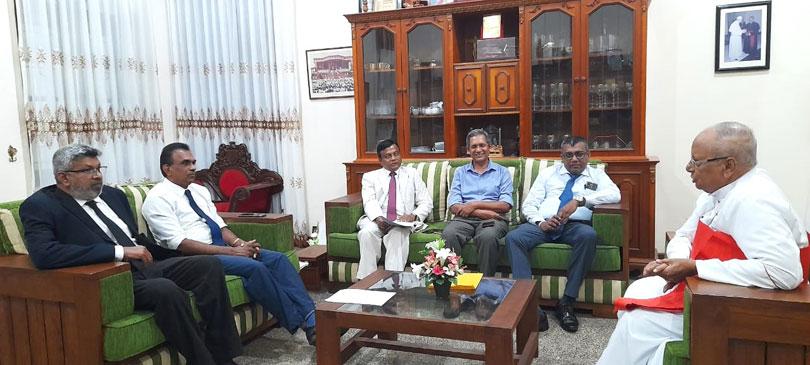
Fr. Joy Indika Perera, a representative for Cardinal Malcolm Ranjith of Colombo, told CNA in an email last week that the archdiocese plans to submit a petition to the Vatican to declare those killed in the Easter Sunday attacks “martyrs of faith.”

Fr. Perera said the archdiocese will be submitting the petition on April 21, exactly five years after the attacks took place. That is the minimum amount of time required by the Church to open a person’s canonization cause.

The petition will be submitted to the Vatican’s Dicastery for the Causes of Saints.

Eight suicide bombers targeted two Catholic churches, one evangelical church, three luxury hotels, and other locations on April 19, 2019, killing an estimated 269 people and injuring more than 500.

Perera said that 216 Catholics from two different churches, St. Sebastian and St. Anthony, “were massacred in cold blood” in the attack.

Shortly after the attacks, the Islamic State claimed responsibility for the bombings. The Sri Lankan government determined the attack to have been carried out by a local radical Islamist group known as National Thowheeth Jama’ath, with the assistance of foreign groups.

Out of fear of additional attacks, in-person Masses were suspended and Catholic schools were closed in the archdiocese for several weeks.

Speaking on behalf of the cardinal, Fr. Perera criticized the government’s response to the massacre, accusing it of still doing its best to “hide” information about the attacks and those responsible.

“Cardinal Ranjith has been always insisting on the discovery of [the] truth behind these attacks as there are clear indications that it was a deliberate act of political manipulation by some interested parties who made use of the Islamic extremists for their diabolical plot,” Perera said.

“Up to now no serious investigation has taken place in order to find out the real cause of this massacre,” he added.

Maithripala Sirisena, who was president of Sri Lanka at the time, created a five-person commission to investigate the attacks. In October 2020, five suspects arrested in connection with the attacks were released by the government, citing a lack of evidence.

The trial of 25 of the men accused of preparing the attacks began in November 2021 but was adjourned in January 2022.

In January 2023 a seven-judge panel from Sri Lanka’s Supreme Court found Sirisena and four other high-ranking government officials liable for the massacre because they possessed but failed to disclose credible information warning of the attacks. The court ordered Sirisena to pay victims’ families a total of $273,000 from his personal funds while other officials were similarly disciplined.

In April 2022, Pope Francis urged the government of Sri Lanka to take greater action to identify the perpetrators and bring justice for the victims and their families. “Please and for the sake of justice, for the love of your people, may it be clarified definitively who was responsible for these events. This will bring peace to your conscience and to the nation,” the pope said.

Perera said the cardinal is prioritizing opening the Easter martyrs’ canonization because he is convinced they died for their faith.

He “believes that since they were exercising an act of faith by coming to the church to participate in the liturgy of the risen Lord and to take part in spiritual activities of their own free will, and they had to lay down their lives for having done that, this fact itself is a cause good enough to promote them to the level of Servants of God and martyrs of the faith,” Perera said.

Perera said the archdiocese hopes to receive approval from the Holy See and that “once this approval is given, we will work on the process of beatification and consider them Servants of God.”

Source: Catholic News Agency (CNA)

Posted in Uncategorized

Keheliya resigns as Environment Minister

SLPP MP Keheliya Rambukwella, who is currently in remand custody, has tendered his resignation as the Minister of Environment.

Accordingly, he had submitted his letter of resignation as the Minister of Environment to President Ranil Wickremesinghe, who has accepted the resignation.

The former Health Minister was remanded on 03 February, following his arrest by the Criminal Investigation Department (CID) on 02 February, in connection with the procurement of substandard human intravenous immunoglobulin (IVIG).

Later that day he was admitted to the Prison Hospital on medical recommendation.

The arrest came hot on the heels of pressure from civil society activists and health sector trade unionists, who called for the immediate apprehension of the lawmaker.

Prior to the apprehension of Rambukwella, seven arrests had been made in connection with the drug procurement scam. But the fifth accused was later released on bail.

As such, the former Health Secretary, the Director of the Health Ministry’s Medical Supplies Division (MSD) and three other officials of the same division, as well as the owner of the company, which is said to have supplied the substandard batch of immunoglobulin vials, now remain in custody on remand.

In October 2023, the NMRA revealed that forged documents were found to have been submitted for Customs clearance to procure a batch of 22,500 vials containing human immunoglobulin, an antibody produced by blood plasma cells, which later failed the quality tests.

The product, which was said to have been manufactured by Livealth Biopharma Pvt Ltd. India and imported by a local medicine supplier called Isolez Biotech Pharma AG (Pvt) Ltd. However, the India-based manufacturer has denied having a hand in this fraudulent activity and communicated to the NMRA that it has neither manufactured, supplied nor exported these products to any party.

After the human immunoglobulin scandal came to light, Rambukwella was stripped of health ministerial portfolio and was appointed as the Environment Minister in a Cabinet reshuffle in October. Dr. Ramesh Pathirana was appointed as the Health Minister in addition to his current portfolio as Minister of Industries.

Trinco Oil Tank Farm open for investment

The Ministry of Power and Energy will call for Expressions of Interest (EOIs) internationally from interested strategic investors for the joint development of the Trincomalee Oil Tank Farm in partnership with the Trinco Petroleum Terminal Ltd. (TPTL).

Speaking to The Sunday Morning Business, Ceylon Petroleum Corporation (CPC) and Ceylon Petroleum Storage Terminals Ltd. (CPSTL) Chairman Saliya Wickramasuriya revealed that within the next few weeks, the Ministry of Power and Energy would call for EOIs internationally for the development of the 61 oil tanks of the Trincomalee Oil Tank Farm held by TPTL.

The TPTL is a joint venture between the Lanka Indian Oil Company (LIOC) and the CPC.

“The TPTL will be the lead partner because it owns the oil tanks, but the investment required to develop the oil tank farm may come from a third-party strategic partner, depending on the modalities of the agreement. We are testing the market to test what kind of interest there is. Since there are 61 tanks, it’s a large investment project,” he said.

Commenting on the possible commercial applications for the oil tank farm, he stated that it could be used for commercial storage, where it could be rented out while a part could be used as a strategic reserve to store cargo.

Addressing the current status of the TPTL, he said: “The company has been incorporated; we have completed the Articles of Association and we are in the process of obtaining approval from the Board of Investment (BOI). While both parties contributed an initial investment to cover the incorporation costs and the initial site survey, no further investment has been carried out so far.”

The Trincomalee Oil Tank Complex Development Project was approved by the Cabinet of Ministers on 4 January 2022. Accordingly, it was decided that 24 of the 99 tanks would be given to the CPC, 14 tanks to the LIOC, and 61 tanks to the TPTL – the latter on a 50-year lease, with CPC having the majority stake in the subsidiary.

Consequently, LIOC and CPC entered into an agreement on 6 January 2022 for the joint development of the 61 tanks held by Trinco Petroleum Terminal as a Joint Venture (JV). CPC holds a 51% stake in the company while LIOC holds a 99% stake.

The Trincomalee Oil Tank Farm, built by the British as a refuelling station during World War II, is located on 850 acres of land and originally contained 101 tanks, each with the capacity to hold 12,100 MT of oil.

Out of the original 101 tanks, two were destroyed in a kamikaze attack during a Japanese air raid on Trincomalee on 9 April 1942 and when a Royal Ceylon Air Force plane crashed in the early 1960s.

Jaishankar meets AKD; Affirms Strong Ties with Sri Lanka

Indian External Affairs Minister Dr. S. Jaishankar met with Anura Kumara Dissanayake, the leader of Sri Lanka’s Jathika Jana Balavegaya (JJB) and Janatha Vimukthi Peramuna (JVP), on Monday morning.

The meeting focused on bilateral relations between the two countries and Sri Lanka’s current economic challenges.

Dr. Jaishankar expressed his satisfaction with the discussion, highlighting the “mutual benefits” of further strengthening the India-Sri Lanka relationship.

He also acknowledged Sri Lanka’s economic difficulties and offered support, stating that “India, with its Neighbourhood First and SAGAR policies, will always be a reliable friend and trusted partner of Sri Lanka.”

NPP Leader Anura Kumara Dissanayake Engages in Talks with Indian National Security Adviser Ajit Doval

Anura Kumara Dissanayake, the leader of the National People’s Power (NPP) party, held discussions with the National Security Adviser of the Government of India, Mr. Ajit Doval, at Sardar Patel Bhavan yesterday afternoon (05).

The meeting, which took place at the prestigious venue in New Delhi, focused on matters of regional security and bilateral relations between Sri Lanka and India. Anura Kumara Dissanayake, a key figure in Sri Lankan politics, engaged in dialogue with Ajit Doval to explore avenues for cooperation and collaboration in addressing shared security concerns and strengthening ties between the two neighboring nations.

Comrade Vijitha Herath, a National Executive Member of the National People’s Power, was also present at the meeting, adding depth and perspective to the discussions.

Posted in Uncategorized

Jaffna Youth Congress was the first to demand “Poorana Swaraj” for Ceylon By D.B.S.Jeyaraj/DailyFT

Sri Lanka known formerly as Ceylon gained independence from British rule on 4 February 1948. The Island nation celebrates the 76th anniversary of her “tryst with destiny” on Sunday. Events marking freedom day festivity are scheduled for the week-end.

Even as the greater part of the Island is enveloped in a melodious mood, a discordant note is struck in the Tamil dominated Northern province and the Tamil Majority Eastern Province. The Jaffna University Students Union and organizations representing the families of disappeared persons have proclaimed 4 February 2024 as a ”Kari Naal”( black or dark day) and declared it as a day of mourning.

It has been announced that “Kavana Eerppu Poaraattangal”(Attention drawing demonstrations)would be held in the five districts of the North and three districts of the east. Several Sri Lankan Tamil nationalist parties and civil society organizations have endorsed and lent support to the call for observing freedom day as a black day.

It is not clear at the time this article is being written as to whether a “Hartal” or shutdown will take place but it appears that black flags would be flown in the Tamil areas of the North and East on Independence day. The Undergrads have announced that a huge “Black Day” protest march will be held on February 4th .

Being free of colonial bondage is refreshingly liberating. Independence Day would therefore be a day of joy and happiness. But that has not been so for the Ilankaith Thamizhar of Sri Lanka for many, many years. This does not apply to Tamil hardliners alone but to a very large number of the Tamil people.

Many Tamils are not part of the freedom day festivity emotionally and spiritually. Lots of Tamils remain estranged and alienated from the Sri Lankan State still. The resentment manifested currently towards Independence Day is illustrative of that black mood.

Despite the current mood, it is a fact that the Tamils played an important role in the freedom struggle against the UK. Tamil perspectives towards Independence have changed from time to time depending on prevailing political circumstances.

However, Post-Independence political problems should not blind us to the fact that a significant section of Tamils was in the vanguard of the freedom struggle against the British in the past.

Sir Ponnambalam Arunachalam

Sadly, the pioneering role played by Tamils in the 20th century quest for Independence is now forgotten. It was Sir Ponnambalam Arunachalam’s famous lecture on “Our Political Needs” which laid the foundation for the National Congress . Also the activities of the Jaffna Youth Congress, ave been praiseworthy efforts in this regard.

The south after the heroic and historic 1818 and 1848 rebellions was generally quiet during British rule. The dominant Sinhala political class preferred to cooperate and negotiate with rather than confront the British. Only the Leftists engaged in anti-colonial struggle through protests such as the Suriyamal movement and the Bracegirdle Affair.

There was also much trade union activity and strikes. A very large number of Tamils were associated with their Sinhala comrades in these Left-leaning anti-colonial “Aragalayas”.

Trade Union Pioneer A.E. Goonesinghe in his more radical days founded the Young Lanka league to protest British rule. However, the political path adopted by prominent leaders such as D.S. Senanayake, Sir Baron Jayatilleka and Sir Oliver Goonetilleka was different. They worked for self-rule through negotiation rather than agitation.

As a result, this nation never had an anti-colonial struggle as what was conducted in India by Mahatma Gandhi through non-violence , or militarily by “Netaji” Subash Chandra Bose.

Jaffna Youth Congress

The nearest to an anti-British, pro-freedom struggle, in the country came from the north. It emanated from the now forgotten Jaffna Youth Congress led by the likes of Handy Perinbanayagam, ‘Orator’ Subramaniam, J.V. Chelliah, M.Balasundaram, S.Kulendran, K. Nesiah and C. Ponnambalam.

It was the Jaffna Youth Congress which called first for “Poorana Swaraj” or complete self-rule from the British and rejected the limited reforms proposed by the Donoughmore Commission.

It is recorded that hundreds of Jaffna youths ran about the streets of Jaffna town shouting out loudly “Swaraj, Swaraj” after listening to an inspiring lecture by the famous female freedom fighter of India Kamaladevi Chattopadhyay.

Fired by the ideals espoused by Mahatma Gandhi the Youth Congress demanded Poorana Swaraj (Complete Independence) and urged a boycott of the first State Council elections in support.

The Jaffna Boycott

When the first State Council elections were held in 1931, there were no candidates from Jaffna. The four seats allocated to Jaffna remained unfilled until 1934.However, the 1931 boycott was observed only in Jaffna. The rest of the country did not follow suit and the boycott ultimately ended in failure.

British scholar Jane Russell compared the Jaffna boycott to parallel developments during the Indian freedom struggle and observed that it was like the turkey-cock trying to imitate the dance of the peacock. The metaphor was derived from a poem by the poetess Auvaiyaar “Kaana Mayilaadak Kandiruntha Vaankoali”…….

Later, southern historians tried to distort the boycott call and depicted it as a communal cry. Some conflated H.A.P. Sandrasagara’s threat to Ulsterize Jaffna – stated in a different context -with that of the Youth Congress boycott call. That, however, was untrue.

The Youth Congress boycott was inspired by nobler motives. So forceful was the impact of the Youth Congress, that Philip Gunewardena, the Father of Marxism in Sri Lanka’ and the father of Prime Minister Dinesh Gunewardena, wrote glowingly in the Searchlight journal that Jaffna had given the lead and asked the Sinhalese to follow suit.

Prof. Wiswa Warnapala reviewing the book written by Santhaseelan Kadirgamar on the Jaffna Youth Congress expressed his admiration of the Jaffna Youth Congress openly and chastised Sinhala political leaders of the colonial period as Bootlickers of Imperialism.

Prince of Wales

Two noteworthy feats of the youth congress were the boycott of a visit to Jaffna by the then Prince of Wales and the hoisting of the Nandhi flag in place of the Union Jack.

The forerunner of the Youth Congress was the Student Congress of Jaffna formed in 1920 within the precincts of Jaffna College, Vaddukkoddai.

King George the Fifth was reigning then. The Prince of Wales who subsequently mounted the throne as King Edward the Eighth and later abdicated visited Ceylon in 1921. His visit was boycotted in Jaffna due to the efforts of the Jaffna Student Congress which was re-named the Youth Congress a few years later.

Furthermore the Youth Congress in a symbolic gesture of defiance hoisted the erstwhile Jaffna Kingdom’s Nandhi flag instead of the Union Jack on Empire Day.

Gandhi and Nehru

The Youth Congress also conducted several meetings and Satyagrahas, in support of freedom. They invited Indian political leaders to the peninsula and held mass rallies and processions. Mahatma Gandhi, Jawaharlal Nehru, C. Rajagopalachariar, Sarojini Nayudu and Kamala Devi Chattopadhyay were some of these.

The Youth Congress also invited several Sinhala personalities ranging from P de S Kularatne to SWRD Bandaranaike to Jaffna for lectures to promote inter-racial amity and unity.

Donoughmore Commission

The political climate of Ceylon/Sri Lanka underwent transformation with the advent of the Donoughmore Commission. A four-member team headed by Lord Donoughmore was appointed by Whitehall to hear representations and propose a new constitutional arrangement for Ceylon.

The Donoughmore Commission spent four months in the island from 18 August 1927 to 18 January 1928. The commissioners held 34 sittings and interviewed over 140 persons from various delegations. Several petitions and appeals in writing were also accepted.

The Donoughmore Commission released its report on 28 June 1928.

The Tamils of Sri Lanka lacked an effective leader when the Donoughmore Commission arrived in 1927. Sir Ponnambalam Arunachalam had passed away in 1924. His elder brother Sir Ponnambalam Ramanathan revived the Tamil League formed by Arunachalam and made representations before the Donoughmore Commission. Other Tamil organisations also followed suit. The Tamil representation spearheaded by Sir Ponnambalam Ramanathan neither sought secession nor federalism. Instead it asked for greater political representation for the Tamils. Ramanathan opposed territorial representation and supported the communal representation principle.

The Tamils did not think of a federal arrangement for the north-east but argued for communal representation based on greater weight for the Tamils. The Sri Lankan Tamils were aiming at seats in the envisaged legislature on a ratio of two to one. They wanted one third of seats to be allocated for the Tamils and two-thirds for the Sinhalese.

The Donoughmore Commission rejected communal representation as a “cancer eating into the body politic” and ushered in territorial representation. This provided the Sinhala people a greater advantage in obtaining more representation. A disappointed Ramanathan who was to die in 1930 lamented loudly, “Donoughmore means Tamils no more”. Ramanathan’s emerging political successor G.G. Ponnambalam described the Donoughmore Constitution as a “political windfall” for the Sinhalese.

Soulbury Commission

With World War II drawing close to an end, the prospects of freedom from British colonial bondage loomed large on the political horizon.A commission of inquiry headed by Viscount Soulbury was sent in 1944 by Whitehall to engage in consultations with all sections of the population and compile constitutional reform proposals. This was known as the Soulbury Commission.

The advent of the Soulbury Commission saw Sri Lankan Tamils forming the All Ceylon Tamil Congress (ACTC). G.G. Ponnambalam became the ACTC President while S. Sivasubramaniam was the party General-Secretary. The primary objective of ACTC at that point of time was to argue the case for its “fifty-fifty” demand before the Soulbury Commission.

The Tamil Congress wanted a scheme of balanced representation popularly called “fifty–fifty.” According to this proposal, 50% of seats were to be allotted to the Sinhala majority and 50% for all the other minority ethnicities including Tamils. They wanted a scheme where the minority community representation was to be given weightage so that non–Sinhala communities together could counter-balance perceived Sinhala domination. This was rejected by the Soulbury Commission which refused to create an “artificial majority out of a minority.”

Dominion Status

The Soulbury Commission report was incorporated as a “White Paper” and made public in October 1945. The report formulated a scheme awarding ‘dominion’ status for Ceylon and envisaged full independence to follow thereafter. The Ceylonese board of ministers accepted it with reservations.

Subsequently, it was submitted in the form of a motion in November 1945 for approval of the legislature known as the State Council. If the motion were defeated, then the State Council set up under the Donoughmore Constitution would continue and self-government leading to full independence under a Dominion Constitution would have been a distant dream.

The All Ceylon Tamil Congress held a special meeting where it was decided to reject the Soulbury report. It also resolved that all minority community members in the State Council should vote against the White Paper motion. Tamil Congress leader G.G. Ponnambalam went to London in a desperate last minute effort to thwart the Soulbury Constitution being adopted.

D.S.Senanayake

The State Council motion was moved by D.S. Senanayake and seconded by S.W.R.D. Bandaranaike. Understanding the anxiety, doubts and fears of minority communities, particularly Sri Lankan Tamils of being dominated and suppressed by the Sinhala majority in an “independent” Ceylon, D.S. Senanayake who became known later as the “father of the nation” made an eloquent appeal. DS stated thus: “I do not normally speak as a Sinhalese, and I do not think that the leader of the council ought to think of himself as a Sinhalese representative; but for once, I should like to speak as a Sinhalese and to assert with all the force at my command that the interests of one community are the interests of all. We are one of another, whatever our race or creed.”

Urging Tamils and other minority communities to accept the Soulbury Constitution, DS reached out to them in this manner: “Do you want to be governed from London or do you want, as Ceylonese, to help govern Ceylon? On behalf of the congress and on my own behalf, I give minority communities the sincere assurance that no harm need you fear at our hands in a free Lanka.”

While G.G. Ponnambalam was in the UK, the State Council motion was put to the vote. It was passed by fifty-five votes to three. The trio who voted against the motion comprised one Sinhalese and two Indian Tamils. They were Wijayananda Dahanayake who later became a Prime Minister and up-country Tamil trade unionists Natesa Iyer and I.X. Pereira. All Sri Lankan Tamil, Muslim, Malay, Burgher and European State Councillors voted for the Soulbury Commission. The minorities including Sri Lankan Tamils had trusted Sinhala leader D.S. Senanayake and acceded to his appeal. This was a huge blow to the Tamil Congress in general and its leader G.G. Ponnambalam in particular.

Parliament Elections

The State Council was dissolved on June 4, 1947 and the general elections for the envisaged House of Representatives (Parliament) was scheduled for August 23 and continued until September 20, 1947. There were to be ninety–five elected and six appointed MPs. There would be eighty-nine electorates. Of them, a few like Colombo Central were multi-member constituencies electing more than a single MP. There was also to be an upper-house consisting of 30 senators. Parliamentary elections were duly held and results announced. The newly-formed United National Party (UNP) led by D.S. Senanayake won 42. The Lanka Sama Samaja Party (LSSP) led by Dr. N.M. Perera won 10. The Tamil Congress led by G.G. Ponnambalam won 7. The Ceylon Indian Congress (as Ceylon Workers’ Congress was known then) led by Saumiyamoorthy Thondaman got 6. The Bolshevik Leninist Party of Dr. Colvin R. de Silva got 5. The Communist Party led by Dr. S.A. Wickramasinghe won 3 seats. The Labour Party got one with its founder-leader A.E. Goonesinghe being elected from Colombo Central. There were also 21 MPs who had contested as independent candidates and won.

All Ceylon Tamil Congress

The All Ceylon Tamil Congress contested eight of the nine electorates in the Northern Province and one out of the seven electorates in the Eastern Province. The party also supported some independent candidates in the electorates it did not contest. The following were elected as MPs from the Tamil Congress; G.G. Ponnambalam – Jaffna; S.J.V. Chelvanayagam – Kankesanthurai; C. Vanniyasingham – Kopay; V. Kumarasamy – Chavakachcheri; T. Ramalingam – Point Pedro; K. Kanagaratnam – Vaddukkodda1 and S. Sivabalan – Trincomalee.

The Tamil Congress was jubilant at the results. GG Ponnambalam smarting from the Soulbury Constitution debacle had cleverly utilised the elections to take revenge on Tamil State Councillors who had voted for the Soulbury constitution. Ponnambalam told Tamils that voting for the Tamil Congress would demonstrate to the UK that Tamils had rejected the Soulbury Constitution arrangements and instead required an electoral system based on the balanced representation principle. He called upon the Tamil people to reject those who voted for the SoulburyConstitution as Tamil traitors and also all Tamil candidates of the UNP at the polls.

The prominent three among the former State Councillors who voted for the Soulbury Constitution and contested parliamentary polls lost. Sir Arunachalam Mahadeva and S. Natesan were defeated by Ponnambalam and Chelvanayagam in Jaffna and Kankesanthurai respectively. J. Thiyagarajah lost to a Tamil Congress backed independent C. Sittampalam in Mannar.

GG Ponnambalam

An elated GG Ponnambalam cabled the Colonial Office in Britain stating that election results vindicated the Tamil Congress’ stance on balanced representation. The Tamil Congress leader made an unreasonable demand that the Soulbury Constitution should be rejected outright and fresh elections under a different electoral system should be held.This was ruled out by Whitehall.

The first Ceylonese parliamentary elections had resulted in a hung Parliament. The D.S. Senanayake led UNP had only obtained 42 of the 95 elected MP seats. Nevertheless , D.S. Senanayake aided by Sir Oliver Goonetilleka engaged in a rare display of political statecraft by enticing 12 independent MPs and AE Goonesinghe to form the first parliamentary government of Ceylon/Sri Lanka in September 1947.

Among the cabinet ministers were Two Tamils and a Malay. Among the Parliamentary secretaries or Junior ministers were Two Muslims, two Burghers and a Tamil. Thus despite GG Ponnambalam’s objections, DS Senanayake was able to convince Whitehall that his Govt was truly national and that the Country should be granted early independence.

This was done very soon. On 4 February 1948 Ceylon gained independence from the UK. Adhering perhaps to the saying “If you cant beat them,join them”, GG Ponnambalam himself joined the DS Senanayake cabinet one year later in September 1948 as minister of Industries,industrial research and Fisheries. He justified this turnaround by saying it was based on the policy of responsive cooperation.

Federal Party

However GG Ponnambalam’s action resulted in the Tamil Congress fracturing.. MPs SJV Chelvanayafam, C.Vanniasingham and Senator EMV Naganathan split and formed the Ilankai Thamil Arasuk Katchi(ITAK)known in English as the Federal Party(FP)

De-citizenized and Disenfranchised

Sadly one of the first acts of Ceyon’s first post-independence Govt was to target the then second largest community in the Island -the Indian Tamils. They were de-citizenised and disenfranchised through cruel Parliamentary legislation.Hundreds of thousands of people were de-humanized as stateless persons and persecuted as “Kallathonis”.

(D.B.S.Jeyaraj can be reached at dbsjeyaraj@yahoo.com)

Posted in Uncategorized

SJB to take disciplinary action against SF?

Taking an offensive stance against Field Marshal Sarath Fonseka, Leader of the Opposition and Samagi Jana Balawegaya (SJB) leader Sajith Premadasa said he will not hesitate to take displinary action against those who criticise decisions taken by him and his party.

This offensive remark by Premadasa came just a few days after MP Fonseka criticised the decision made by Premadasa to appoint former Army Commander, General (Retired) Daya Ratnayake as Senior Advisor to the SJB.

“No one should call me and tell me whom I should give party membership to. I will ignore such people who try to advice me. I will not hesitate to take bold decisions to take disciplinary action against those who criticize the party,” Sajith Premadasa told a gathering in Galle over the weekend.

“It is the duty of SJB members to safeguard the party and see that it emerges victorious at future elections. Those who cannot carry out that duty should get out,” he added.

“Some people try to draw a similarity between my father and me. However, I only accept my father’s development model. Therefore, there are differences between me and my father,” he also said.

Cardinal slams Sri Lanka’s Independence Day parade

Cardinal Malcom Ranjith slammed Sri Lanka’s Independence Day parade held at Galle Face at a time when some people in the country are hungry with no food.

The Cardinal said that holding a parade for some foreign dignitaries to see disrespects the people living in hunger.

He also asked if Independence Day in Sri Lanka was for politicians or the people.

The Cardinal noted that Sri Lanka was today facing an economic crisis, 76 years after independence from British rule.

Sri Lanka celebrated its 76th National Independence Day with the main event being held at Galle Face in Colombo with the participation of President Ranil Wickremesinghe and the Prime Minister of Thailand, Srettha Thavisin.

The ceremony included a 21-gun salute followed by a vibrant Independence Day parade featuring the Tri-forces, Police, Civil Defence Force and National Cadet Corps, showcasing Sri Lanka as a sovereign state.

The parade highlighted the strength and magnanimity of the nation, featuring personnel from the Army, Navy, Air, Police, Civil Security Department and the National Cadet Corps.
The parade also featured combat vehicles from the three armed forces, with 22 retired officers and 29 disabled soldiers participating. The cultural parade added musical splendor to the event.

Protest in Jaffna against Independence Day celebrations, five arrested

Police fired tear gas and water cannons to disperse a group of Jaffna University students and political leaders of the North, who staged a protest in Iranamadu, Kilinochchi calling the Independence Day a ‘black day’.

Five university students were taken into police custody during the protest for unruly behaviour.

The protesters claimed that there is no proper situation in the country to celebrate Independence Day due to various reasons such as restrictions to media freedom and enacting Acts restricting freedom of speech.

Ilankai Thamil Arasu Kachchi leader S. Sridharan, Parliamentarian Charles Nirmalanathan and civil activists participated in this protest.

Posted in Uncategorized

JVP delegation to make official visit to India

A delegation of the Janatha Vimukthi Peramuna (JVP), a Marxist–Leninist communist party which led an anti-India campaign in 1987-90 against the Indo-Lanka Accord, will on Monday (05 Feb.) start on an official visit to India.

“The delegation of JVP, the largest party under the broad entity National People’s Power (NPP), is to leave Colombo tomorrow (Monday) for India on an official invitation of the Indian government,’’ a statement from the party said.

The delegation to India comprises JVP leader Anura Kumara Dissanayake, senior legislator Vijitha Herath, Secretary Nihal Abeysinghe and executive committee member Prof Anil Jayantha, the statement said.

The Indo-Sri Lanka Peace Accord, signed in Colombo on July 29, 1987, between Indian Prime Minister Rajiv Gandhi and Sri Lankan President J. R. Jayewardene, was expected to resolve the Sri Lankan Civil War by enabling the Thirteenth Amendment to the Constitution of Sri Lanka.

Under the terms of the agreement, Colombo agreed to a devolution of power to the provinces, the Sri Lankan troops were to be withdrawn to their barracks in the north and the Tamil rebels were to surrender their arms.

The JVP has continuously led in at least one public opinion poll while the NPP broader front has led in surveys, leaving the island nation’s main parties trailing.

The surveys claim that in the post-economic crisis phase since 2022, the NPP has gained significantly in public support, particularly in anti-corruption perceptions.

Dissanayake has already declared his candidacy for the next presidential election to be held later this year.

Analysts, however, remain sceptical if the party could raise its current three percent vote base to 50 percent plus one vote required to win the presidency.
The JVP has a checkered record having led two bloody rebellions in 1971 and 1987-90.

Source – PTI