Chinese vessel visits will be a persistent geopolitical challenge to Sri Lanka -The Morning

Sri Lanka’s recent decision to enact a moratorium on foreign Marine Scientific Research (MSR) vessel visits to the strategically placed island nation in the Indian Ocean Region (IOR), is a short-term solution to what will become a bigger headache in the coming years.

The moratorium essentially buys Sri Lanka some breathing space to navigate around geopolitical rivalry and diplomatic pressure in 2024, which is a crucial year for the island, in terms of economic and political stability, with the possibility of multiple elections on the horizon.

However, Sri Lanka needs to formulate a robust strategy to deal with MSR visit requests, which will likely increase in the coming years, as tensions between India – China – and the United States are likely to continue to complicate situations for the littoral states of the IOR.

India, the United States and others have exerted significant diplomatic pressure on Sri Lanka regarding the high frequency of Chinese MSR visits to the island nation.

Sri Lankan policymakers and those who craft foreign policy, need to fully grasp that China has long-term designs for the IOR, and that Chinese presence in the “Indian Ocean” will only grow in the coming years. China, seems to be borrowing a page from the British Empire, US and Soviet “Cold War” period playbooks, and has begun “patrolling” and seeking basing options for the PLA Navy along its lengthy lines of communication (supply routes).

With a significant tonnage of China’s energy supply, raw materials, and exported goods traversing through the Indian Ocean, China is clearly trying to ensure that its supply chain vulnerabilities are reduced.

While China is now pushing hard to expand its maritime science boundaries and build expertise, the kind of joint research they have collaboratively carried out thus far with local institutions, are yet to deliver significant scientific results which have global implications.

Further, China’s track record of playing by the international rule book when it comes to maritime matters, is problematic. China’s reaction to international law and verdicts about its claim to disputed maritime territories in the South China Sea, paints a poor picture.

In what may be indicative of what’s in store for the future, China recently began to refer to the IOR as the “China-Indian Ocean Region” (CIOR), at a recent conference on “Boosting Sustainable Blue Economy to Build Together a Maritime Community with a Shared Future,” which was held in the Yunnan Province of China, in early December, 2023.

The United States several years ago ‘re-envisaged’ the Indian Ocean as the ‘Indo-Pacific’ to suite its strategic aims. The re-designation of the IOR as China-Indian Ocean Region indicates China’s ambitions, and how it views the world, where a rising China wants to become a “superpower”.

Such re-envisioning of the IOR along with projects like the Belt and Road Initiative (BRI), will see China shift focus towards the Indian Ocean in the coming years.

The Chinese long-range fishing fleet, and MSR’s equipped with unmanned and autonomous systems will increase their visits to the IOR. Already, several Chinese MSR’s have been flagged by some South East Asian countries for operating with their Automatic Ship Identification (AIS) tracking systems shut off, in what is termed as “going dark”, deifying international law.

Further, several such vessels have been accused of deploying autonomous undersea and surface craft to collect scientific data in coastal waters and in the Exclusive Economic Zones (EEZ) of Southeast Asian Countries to collect data, which also have military applications, without the expressed permission of such countries.

As such, Sri Lanka needs to move swiftly to formulate well thought-out foreign policy measures to deal with what could be an escalation of the Chinese inroads to the IOR, though these have been mostly legitimate under international law to date.

It is said that the Government is reviewing its foreign policy, in tandem with a defence review which is also said to be ongoing. With both “reviews” lacking transparency, or Parliamentary oversight, let’s hope that they are actually taking place, with the competent subject matter experts being consulted, and would not end up like many other “reviews” which have in the past only rubber-stamped the ideas which a few politicians and their advisors deem fit for the nation.

It is also incumbent on the Government and policymakers to ensure that such key policy matters are not “shelved” due to 2024 being an “election” year. Given the weak economic state Sri Lanka finds herself this year, the state and policymakers cannot afford to be distracted by an “election fever” and become complacent regarding critical foreign policy challenges.

Posted in Uncategorized

SLFP stalwart Dayasritha Tissera joins SJB

Former Parliamentarian of the United People’s Freedom Alliance (UPFA) Dayasritha Tissera has joined the alliance of the Samagi Jana Balawegaya (SJB).

Tissera, who met with Opposition Leader Sajith Premadasa, has vowed to support the SJB’s political program.

Furthermore, the Opposition Leader has appointed Tissera as the SJB’s Organizer of the Naththandiya electoral district.

Pakistan’s Defence Secretary calls on Sri Lankan President

Lt. Gen. Hamood Uz Zaman Khan (Retired), the Secretary of Pakistan’s Defence Ministry, called on President Ranil Wickremesinghe on Wednesday (Jan.03).

Mr. Khan is in Sri Lanka to attend the fourth Sri Lanka-Pakistan Bilateral Defence Dialogue at the Defence Headquarters Complex in Sri Jayawardenepura, Kotte.

President Wickremesinghe warmly welcomed the Pakistani Defence Secretary and engaged in a brief discussion.

The meeting was attended by Minister of State for Defence Premitha Bandara Tennakoon, Senior Adviser to the President on National Security, and Chief of Presidential Staff Sagala Ratnayaka, as well as Secretary of the Ministry of Defence General Kamal Gunaratne (Retired).

Following this, the Defence Secretary of Pakistan had a separate discussion with President’s Senior Adviser on National Security and Chief of the Presidential Staff, Mr. Sagala Ratnayaka.

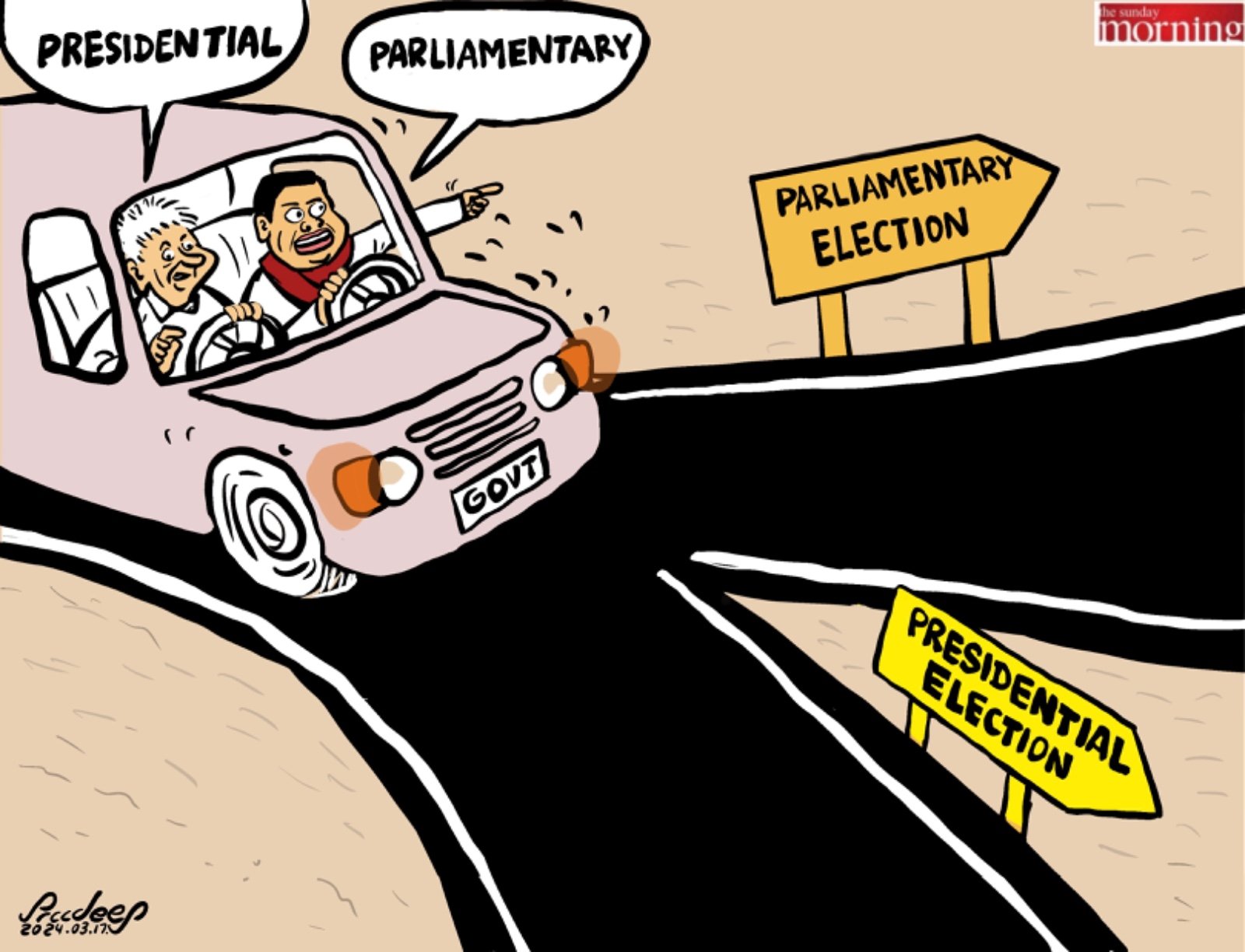
Prez poll must be held before 16 Oct.

Claiming that there is no possibility of not holding the Presidential Election which is scheduled to be held this year, the Election Commission (EC) stated that it must, however, be held before 16 October, and expressed their trust in receiving relevant financial provisions.

Although President and National Policies Minister Ranil Wickremesinghe recently said that both the Presidential and Parliamentary Elections would be held during the course of this year, certain parties – in particular opposition groups – have claimed that the Government may attempt to postpone the said elections in a similar manner to the Local Government (LG) Elections.

However, EC Chairman R.M.A.L. Rathnayake told The Daily Morning that the Presidential Election must be held before 16 October as per the relevant provisions of the Constitution. “There is no way to postpone the Presidential Election. There is a clear date on or before which it should be held. We have requested the allocation of relevant funds, and Rs. 10 billion have been allocated for this purpose. It will be given to us in due time and we will hold the election.”

Opposition Parliamentarian Prof. G.L. Peiris recently claimed that the current Government led by President Wickremesinghe had resorted to seeking to implement several programmes such as revising the parliamentary electoral system, abolishing the office of the executive president, and amending the Constitution without electing a new Parliament, in order to avoid holding elections, adding however that the Government had no mandate to do so.

Having entered Parliament through the United National Party’s (UNP) National List, and initially functioning as an Opposition Parliamentarian, Wickremesinghe, in mid-2022, was appointed as Prime Minister in the face of massive public protests against the then-President Gotabaya Rajapaksa. He was thereafter elected as President in a parliamentary vote held following the resignation of Rajapaksa from the Presidency in July 2022.

UNP Chairman, Government MP Wajira Abeywardana had recently said that it was best for a referendum to be held instead of a Presidential Election in order to extend the tenure of Wickremesinghe, a statement that saw great criticism.

SLPP dissident group, too, breaks up

The largest SLPP dissident group led by Dullas Alahapperuma too has split over the call made by the Samagi Jana Balawegaya (SJB) to form a wider alliance against the Wickremesinghe-Rajapaksa government, political sources said.

Prof. G. L. Peiris, Dilan Perera and Dr. Nalaka Godahewa have pledged their support to the SJB whereas the others led by Dullas Alahapperuma have decided to operate as a separate group. Prof. Peiris, Perera and Godahewa have already addressed the media at the Opposition Leader’s Office, pledging their support for SJB leader Sajith Premadasa.

Initially, the group of dissidents led by Alahapperuma consisted of 13 MPs.

The Opposition Leader has also secured the support of SLFPer Shan Wijelal de Silva, who also contested the last general election on the SLPP ticket.

Posted in Uncategorized

Still searching for justice – 18 years on from Trinco 5 killings

On this day 18 years ago(02-Janauary 2006), five Tamil students were summarily executed by Sri Lanka’s Special Task Force, whilst they spent an afternoon on the beach in Trincomalee.

To date, no one has been held accountable for the murder.

The case – known as the ‘Trinco 5′ – remains one of the highest-profile killings in Sri Lanka to receive international attention, listed in 2014 by the then UN High Commissioner for Human Rights’ report on the island as one of four ‘emblematic cases’ of the government’s failure to ensure accountability and having been raised repeatedly in international forums.

In June 2019, 13 Special Task Force members who were suspected of executing the five Tamil youth were acquitted. Fifteen charges were filed against suspects and they were released due to the lack of evidence.

“Sri Lankan authorities have proven unable to obtain justice for the murders of five young people and the resulting coverup despite the considerable evidence available,” said Meenakshi Ganguly, South Asia director at Human Rights Watch. “The failure to convict anyone in this emblematic case after 13 years demonstrates the need for a court with international participation that can properly protect victims and witnesses.” President of USTAG, Seetharam Sivam said, “Sri Lanka has perfected the art of protecting its security forces and the political leadership by creating a complex maze of lies, deceit, distrortions, fear and intimidation.” “In such an environment, Tamil victims receiving justice in an exclusively Sri Lankan judicial system is next to impossible,” he added.

In February 2018, then High Commissioner for Human Rights, Zeid Ra’ad Al Hussein told the 37th session of the UN Human Rights Council that the killings were among several on the island that demonstrate ongoing impunity. His report said,

“As mentioned in the previous reports of the High Commissioner, the failure to show major progress in these emblematic cases strengthens the argument for the establishment of a specialized court to deal with the most serious crimes committed by State actors… staffed by specialized personnel and supported by international practitioners.”

No such accountability mechanism has yet been set up, despite numerous resolutions passed by the UN Human Rights Council.

Promises of accountability through domestic mechanisms have borne little fruit and the struggle for justice for the Trinco 5 has stalled. To this day, it remains an inescapable reminder of the prevalence of impunity and the long arduous struggle for justice on the island.

The five slain students, who were all 20-years-old when killed, are:

Manoharan Ragihar (22.09.1985)

Yogarajah Hemachchandra (04.03.1985)

Logitharajah Rohan (07.04.1985)

Thangathurai Sivanantha (06.04.1985)

Shanmugarajah Gajendran (16.09.1985)

18 years on from the killings, we re-examine the events of that fateful day, its widespread impact and the long continuing struggle for justice.

An evening by the beachfront

“The last time I heard from my son, Ragihar, was a mobile phone text message,” said Dr Kasippillai Manoharan, recalling the details of that evening. “It just said: “DAD”

“That was 2 January 2006. He had been on the beach with four of his friends in Trincomalee, Sri Lanka, near our home.”

The spot where the students had gathered was a popular location on Trincomalee’s Dutch Bay beachfront, where a statue of Mahatma Gandhi sits amidst a backdrop of the ocean. Ragihar had left home that evening to pray at the nearby temple, and on his way back had met with some friends from his high school, the Koneswara Hindu College. Whilst the group sat and talked on the concrete seats facing the waves, at approximately 7:35pm a green auto rickshaw rode towards the group.

“Suddenly a grenade was thrown and fell near my feet,” said Yoganathan Poongulalon, a survivor of the massacre. “I ran about 10 metres south and fell down injured.” At least four others had also been hurt. “The auto rickshaw from which the grenade was thrown went towards the Fort,” he added, referring to Fort Frederick, where the Sri Lankan Army Headquarters was based. After passing both the Pansala army and police checkpoints, witnesses state that the rickshaw drove into the base.

The students on the beachfront frantically began searching around for help. Immediately after the rickshaw had sped off though, navy personnel had closed off all exits to the beach – no one was allowed in or out. Instead a military jeep rolled closer, with 10 to 15 uniformed armed men shouting in Sinhalese. The men, later identified as members of Sri Lanka’s police Special Task Force (STF), proceeded to assault the students with their rifle butts.

Meanwhile, at his home on St Mary’s Road near the beach, Dr Manoharan heard the grenade explode. “I knew it was a bomb blast,” he said. “I had previously lived in Jaffna for a number of years and I have learnt from experience to recognise the difference between a gunshot sound, bomb blast and firecrackers.” His other two sons had returned home, but Ragihar was yet to be seen.

Minutes later, Ragihar rang Dr Manoharan’s phone. “Daddy,” he said, “the forces are around me.”.” “He meant the security forces,” explained Dr Manoharan. “That was all he said. After that, I got the text – my last contact with my son.”

He rushed towards the beachfront, a few hundred metres from the family home. As he made his way, three navy troops stopped him at a checkpoint. “I can’t allow anyone to go inside,” said the soldier in Sinhala. Exasperated, Dr Manoharan continued to argue with the soldiers, telling them that he was searching for his son. “I don’t know what I can do doctor, I am under orders not to let anyone in,” replied one of them. He could go no further.

“I was not able to see anything unusual at that time because of the light,” he recalled. The lights which normally illuminated the Gandhi statue had unusually been switched off. “Visibility was approximately 50 – 75 metres and I could only see soldiers, not civilians, moving around and vehicles.” Amidst the mass of vehicles and soldiers that Dr Manoharan could see, one stood out.

A grey unmarked pick up vehicle had been sat parked further ahead, watching whilst events were unfolding. Inside sat SP Kapila Jeyasekera.

By this point, parents of the other students too had attempted to reach the area. Ponnuthurai Yogarajah, the father of Hemachandran, was also stopped by Sri Lankan troops at a nearby checkpoint. Mr Yogarajah though, was received a much rougher treatment. He told UTHR-J of how he was struck by military personnel who forced him to the ground. “One man pointed the gun at us and shouted aloud in Sinhalese, “All are Tigers and must be shot”,” continued Mr Yogarajah. “I fell down and lay with my chest down. I saw 20 to 25 persons there in that condition.” Soon after masked men, possibly belonging to the STF, arrived and began to beat him. The rest of Hemanchandran’s family desperately tried to get in contact with his friend Lohithathasan Rohan. They tried ringing his phone, but twice the call was cut. The third time a stranger picked up, speaking Sinhala. The male voice that answered asked the family for their names and addresses, and then assured them that Rohan was with them. He then hung up the phone.

Flashes of gunfire

“I spent a long time talking and arguing with the soldiers at the check-point trying to get through,” said Dr Manoharan. “And then I heard voices crying in Tamil: “Help us! Help us!”.”

“Suddenly there was gunfire. I looked toward the Gandhi statue and saw with my own eyes flashes of gunfire, pointing down toward the ground, the firing was rapid bursts of fire – automatic fire.”

The shots had rang out across the area and were heard by Mr Yogarajah too, who was still lying face down on the ground. “I heard gunshots, he said. “They were not shots fired upwards, but had the distinct pound of shots fired at the ground. I realised that a tragedy had taken place.”

The students had been pushed on to the road. They had then been forced to lie face down and shot.

Poongulalon and Pararajasingham Kokularaj, the only other survivor of the massacre, managed to escape by feigning death. Kokulraj later told a court that as he lay on the ground, he saw his friend Rohan being shot. He felt cold in his stomach and passed out.

The cover up

An anxious Dr Manoharan, still stuck at the checkpoint, demanded to know what was happening. He saw SP Jayasekera’s pick up unmarked truck leave the area. “I saw that there were about six or seven armed soldiers being carried in the open backed rear section,” he described. “They were wearing full-face masks, which we call ‘monkey masks’ – only holes for the eyes.”

“If you are looking for your son you should go to the hospital and check for him there,” the navy soldier at the checkpoint told him.

Mr Yogarajah had already frenetically made his way there and was waiting at the hospital entrance as the military jeeps pulled up. “I went near and peeped inside,” he said. “I saw two bodies and nothing else at the back… I turned the bloodstained faces to see if either was my son. My son was not there.” As he sat more military vehicles began arriving, carrying bodies. “In the third, I saw one, which from the features and the dress I recognised as my son. I began screaming.”

A few minutes later, Dr Manoharan arrived, seeing SP Jayasekera’s vehicle parked outside whilst armed men in camouflage uniforms were patrolling the hospital corridors. “This could only happen in Sri Lanka,” he commented, as police officials attempted to stop him from entering. After forcing his way through, a nurse suggested that Dr Manoharan visit the mortuary. “When I entered the first sight was the body of my dear son Ragihar,” he said. Ragihar’s pockets had been pulled out. His wallet, chain, ID cards and some petty cash had all been taken from him. “His eyes were wide open and blood was coming out of an ear. There was a gaping hole of 2 to 2 ½ inches at the back of his head.”

Three uniformed police officers and six or seven masked men with guns approached him. They demanded that he sign a statement admitting his son was an LTTE cadre who had been killed in an explosion. An angry Dr Manoharan refused. He left the hospital and later returned with the head of the Sri Lanka Monitoring Mission (SLMM) in the Trincomalee district Arthur Tveiten. The SLMM chief exclaimed, “This is murder, these boys have not been killed by explosion these are gunshot wounds”.

Yet, in the days following the killing the Sri Lankan military maintained the students were LTTE cadres. Sri Lanka’s Army Commander for Trincomalee Major General Tissa Jayawardena said they had plotted to attack a security checkpoint and accidentally exploded bombs they were carrying. An army website carried the same story, whilst BBC Sinhala published an article just two hours after the incident, claiming that five LTTE cadres had been shot dead by security forces. “It appears the Navy briefed BBC Sinhala,” said UTHR-J.

The funeral of one of the slain students.

‘We know the STF did it’

The killings came a month after then Sri Lankan President Mahinda Rajapaksa assumed office and the island began to slide towards all-out war. As tensions escalated in the North-East, a special Defence Ministry advisor and JHU senior member H.N.G.B. Kotakadeniya, reportedly allocated a squadron of STF commandos to Trincomalee, with an order to crack down on dissenting activity. The move was approved by the president’s brother and infamous Defence Secretary Gotabhaya Rajapaksa.

The unit of STF troops present on the day were overseen by SP Jayasekera, the officer who sat in his vehicle as events unfolded that evening. Vas Perera, part of the STF contingent sent to Trincomalee and Udawatte Weerakody a navy officer with criminal affiliations and linked to potentially supplying the weapon that was used in the killings, have also been named as key individuals linked to the crime.

Looking back, Dr Manoharan became increasingly convinced that the killing had been planned in advance. With tensions growing in Trincomalee, the arrival of the STF unit added to pressure in the area. Locals had already warned him on the day not to let his children out that evening, he recollected. As his third son was coming home that evening, certain roads had already been cordoned off he said, before any explosions had reportedly occurred.

The STF’s involvement in the murder was confirmed in a leaked US Embassy cable from Colombo in October 2006, after the then US Ambassador to Sri Lanka Robert O. Blake met with Sri Lankan Presidential Advisor Basil Rajapaksa.

The cable stated,

Speaking with surprising candor, Rajapaksa explained the GSL’s efforts to prove that members of the Security Task Force (STF) murdered five students in Trincomalee in January:

“We know the STF did it, but the bullet and gun evidence shows that they did not. They must have separate guns when they want to kill someone… We know who did it, but we can’t proceed in prosecuting them.”

Witness intimidation

The killings sparked outrage amongst Tamils, with a near-continuous hartal declared in Trincomalee.

However, the widespread call for the killers to be brought to justice, did little to spur the state into action. Instead, it brought increased pressure from the military on witnesses and relatives of those killed, as intimidation ramped up. After Dr Manoharan gave evidence before a magistrate a week after his son’s death, the family home was pelted with stones and he received death threats over the phone. Armed men would frequently visit his house, and the unmarked pick-up truck of SP Jeyasekera was once seen parked outside.

Weeks later, Dr Manoharan would receive an anonymous letter in broken Tamil warning him against giving further evidence.

“We shot your five sons because they are supporters of the Tigers who are attempting to link our Eastern Province with the North,” the letter read. “This land (the East) belongs to the Sinhalese. All Tigers, Tiger supporters and besides Tamil loyalists (pattalarkal) will soon be evicted or killed.”

The letter, which was also sent to the families of all the murdered students, was signed off by “The Vigilant group for the Elimination of the Enemy”.

Whilst military personnel intimidated Dr Manoharan, Sri Lanka’s minister for human rights Mahinda Samarasinghe tried a different tact. He called the doctor and offered him a “nice house Colombo for you and your family” in exchange for dropping pursuit of the perpetrators. “We can find a nice school for your children,” said Mr Samarasinghe, a politician who would go on to represent Sri Lanka at the UN Human Rights Council in Geneva.

Dr Manoharan refused. “Of the crowd of people on the seafront that night, Ragihar’s father was the only one prepared to speak out,” said Amnesty International’s Secretary General, Salil Shetty in 2012. “Others were too scared.”

The harassment of his family continued and he eventually suspended his medical practice and his children stopped attending school. He was forced into exile.

He was not the only person who had to flee. A year later and thousands of miles away, a 20-year-old asylum seeker being held on Christmas Island described how he was a witness to the events that evening. He was beaten, imprisoned and eventually forced to leave.

More deadly consequences followed for others. Weeks after the murders, Sudar Oli journalist Subramaniyam Sugirdharajan was shot dead. He had accompanied Dr Manoharan to the mortuary and published photos showing the bodies with point-blank gunshot injuries, disproving government claims that they were killed by a grenade explosion.

The family of Subramaniyam Sugirdharajan mourn besides his body after he was gunned down in Trincomalee

Mr Yogarajah would suffer another loss just months later. His other son Kodeeswaran, was murdered in Muttur – one of 17 relief workers with the French non-governmental organisation agency Action Against Hunger (ACF) shot dead by Sri Lankan security forces.

“A Buddhist priest who publicly condemned Ragihar’s murder was also killed,” said Dr Manoharan, speaking on the death of leading Buddhist monk, Handungamuwe Nandarathana. The monk, who spoke Sinhala and Tamil, had worked towards peace and had attended both a memorial for the slain students, as well as Pongu Thamil events. He was shot dead by Sinhala speaking gunmen. “This shows how far the authorities were willing to go to hide the truth about what they had done to my son,” added Dr Manoharan.

Buddhist monk Handungamuwe Nandarathana at a memorial service for the slain students.

Still searching for justice

“I have no doubt that Mr Kapila Jeyasekera is responsible for killing my son” said Dr Manoharan, seven years after the murder.

In 2015, 12 people, including an Assistant Superintendent of Police, were remanded over the killings. However to date, none have been brought to trial. Instead, 2013 saw Kapila Jayasekara, who reportedly spearheaded the executions, promoted to DIG in the Amparai district.

The case has continued to become a rallying point for activists demanding justice for human rights violations, with over 700 activists in New York demanding justice for the killings in 2012 and condemnation from human rights organisations across the world.

Despite Dr Manoharan’s courageous and tireless efforts, justice has still not been delivered for the killings.

Speaking at the UN Human Rights Council in Geneva, Dr Manoharan told member states,

“With all the pain of losing my son Ragihar, I seek your help and that of the Human Rights Council to move the investigation of the murder of the five young men in Trincomalee to the international level because I have no hope for justice in Sri Lanka”.

Last year, Mrs Manoharan – the mother of Manoharan Ragihar – passed away. “Despite the prolonged struggle and injustices that the victims and their families have endured, the fact that the families have not been granted a fair trial and justice against those implicated in the killings, brings us great sadness,” said the Tamil National Alliance. “The long list of our people that are dying following years of relentless pursuit for justice is sad. Mrs Manoharan’s passing without witnessing justice for her son’s murder, has brought us great sorrow.”

The OHCHR Investigation on Sri Lanka (OISL) subsequently determined that “there are reasonable grounds to believe that security force personnel, including STF personnel, killed the five students”. “This case demonstrates again the challenges in pursuing accountability for such alleged crimes at the domestic level in the context of Sri Lanka,” it continued.

“The Trinco five massacre is not such a difficult case,” commented James Ross, Human Rights Watch’s Legal and Policy Director. “The ability of the government to prosecute it has broader implications for justice in Sri Lanka.”

“Many things can be buried on a white sandy beach. The memory of five students should not be one of them.”

_____

This report was compiled with testimonies collected by Together Against Genocide (see here), UTHR-J (see here) and Amnesty International (see here).

Posted in Uncategorized

Amarapura Nikaya rejects Himalaya declaration

The Amarapura Nikaya has rejected the Himalaya declaration unveiled last month.

However, instrumental in its compilation was Anu Nayake of that same Nikaya’s Ambagahapitiya chapter Dr. Madampagama Assaji Thera, together with the Global Tamil Forum.

It was handed over to president Ranil Wickremesinghe on 08 December.

The President’s Media Division said at the time the declaration promotes a pluralistic Sri Lanka that prioritizes the well-being of the community.

It also encourages learning from historical mistakes and stresses the importance of accountability measures, said the PMD.

Now, assistant registrar of Amarapura Nikaya’s Maha Sangha Sabha, Ven. Ambalangoda Sumedananda Thera said in a statement that the declaration did not have their consent.

It contains the personal opinions of a few Buddhist monks only, said the statement.

‘Joint Himalayan Declaration’ is Wickremesinghe’s Plan-B – (Kusal Perera)

“That in the opinion of this House, the Ceylon [constitution] Order-in-Council be amended forthwith to provide for the Sinhalese and Tamil languages to be state languages of Ceylon with parity of status throughout the Island……. Mr Speaker, I want in the first instance to ask this question: What are we aiming at? What is the objective we have in mind for this Country? Do we want a united, strong and an integrated Nation or not?…. If democracy is to be treated as an arithmetical concept that whatever majority decides it must be accepted merely because they have got superiority in members, that is not democracy….. The test of a democratic decision is the morality of the law…. There is no reason why they should separate unless we force them to separate by making Tamil a regional language confirmed to the Northern and Eastern provinces. That is what we are driving them to, that is what people who are advocating Sinhalese as the only official language do not seem to realize.” – (Dr. N.M Perera moving a motion on language in House of Representatives – October 19, 1955)

What’s all this present hype about six (06) sentences called the “Joint Himalayan Declaration”? A supposed “declaration” signed almost 08 months ago on 27 April in Nagarkot, Nepal. Signed between a few lesser representative Buddhist Sangha chapters or “nikayas” and the “Global Tamil Forum” (GTF). A depleted organisation that no more represents the Tamil Diaspora as it did a decade and a half ago at its founding.

Far more serious and in-depth discussions than what is bluffed in this declaration have taken place since the Bandaranayake – Chelvanayakam Pact signed in 1957, backtracked by PM Bandaranayake with the UNP galvanizing Sinhala protests and Buddhist monks threatening a sit-in at the private residence of PM Bandaranayake. The next compromise worked out as the Dudley – Chelvanayakam Pact in 1965 was abrogated again in 1968 due to street protests by SLFP, LSSP and CP that led to the unfortunate death of young novice monk Dambarawe Rathanasara thero from police shooting. Past 50 plus years would have seen over a dozen direct and mediated peace initiatives, all stalled due to ethno-racial opposition in Southern politics.

In January 1984 President Jayawardene chaired an All Party Conference (APC) held in Colombo with political parties in Sinhala South and democratic Tamil political parties participating. At this first APC, leader of the TULF Appapillai Amirthalingam presented a written statement that traversed the long history of Sri Lanka’s National Conflict.

In his written statement Amirthalingam says, “They (Sinhala racists) seem to forget that 5th June 1956 marked the first mob violence against Tamils.” An organised mob attacked the “Sathyagraha” organised by ITAK at Galle face green against the Sinhala Only Act with sticks, poles and stone throwing. The most saddening quote from Amirthalingam’s statement is, “….and when I walked into Parliament with a handkerchief tied round my head and my clothes soaked in blood, the then Prime Minister (Bandaranayake) quipped ‘honourable wounds of war’….” Bandaranayake thus implied that thuggery against a peaceful protest had his blessings. Amirthalingam then goes on to ask, “Can anyone who values truth say that this was the result of the Tamils resorting to violence? Or because the Tamils demanded a separate state?” There was no LTTE nor armed Tamil politics then in 1956 nor a demand for a “separate” Tamil State. But as Dr. N.M. Perera said in 1955, The Sinhala racists were pushing them for “separatism”.

Thereafter bi-lateral discussions in Thimpu, Bhutan were held in 1985 July with all armed groups attending. Thimpu discussions established the concept of the “Tamil Homeland” as North and East and as a non-negotiable demand in any future negotiation.

Elected president in December 1988, Premadasa initiated direct negotiations with the LTTE in Colombo as the sole representative of Tamil people beginning April 1989 that continued in staggered form till June 1990 and an APC with LTTE as an observer at BMICH in August 1989 attended by mainstream political parties in Sinhala South. The SLFP participated in the first two meetings and withdrew thereafter. In 1994 October President Chandrika Kumaratunge initiated direct talks with the LTTE that carried extremely high hopes for peace but ended as a hopeless event, with Chandrika not taking the LTTE seriously to negotiate with.

Thereafter, with Norwegian facilitation, negotiations with the LTTE began in 2002 August. At the third session in Oslo on 05 December both parties agreed on a federal system of power sharing. The Norwegian government thus issued a statement that announced “…. the parties have agreed to explore a political solution founded on the principle of internal self-determination in areas of historical habitation of the Tamil speaking peoples, based on a federal structure within a united Sri Lanka.”

What is this 2023 “Joint Himalayan Declaration” about? This GTF initiated declaration is as old as the Indo-Lanka Accord of 1987 July that led to the 13 Amendment. Thus, the GTF manipulated Joint Himalayan Declaration will once again reduce negotiations to 13 A “Plus” with “faithful” implementation of provisions of present constitution proposed as “temporary” with no timeframe proposed

Surprisingly, Tamil Diaspora groups have not raised the Oslo Declaration as binding on the GoSL. The Oslo Declaration is not a legal agreement between the GoSL and the LTTE. It is a political pledge by the GoSL to provide Tamil people with the Constitutional right to govern themselves within a federal system in a unitary, undivided country. Democratic Tamil leadership since the defeat of the LTTE has principally stood for a “federal solution” within a “united, undivided and an indivisible Sri Lanka” as Sampanthan has been always saying. The irony is no political leadership in the North and South campaign for a federal system of government as the democratic answer to the unresolved conflict.

What kept this national issue unresolved and festering? GoSL agreed to enact 13 A in July 1987 and established PCs. Agreed for a federal system in 2002 December in front of international media. Why does the conflict still remain unresolved? Simple reason is, these were not political positions governments came to, on their own political understanding and convictions. They were positions governments were pushed into by other external factors with geo-political interests within a global economy.

With all negotiated settlements sabotaged since 1957 by Sinhala-Buddhist racism, every new round of negotiations demanded more authority for Tamil areas to make certain they would not be robbed of power. Therefore, from the Regional Councils agreed upon with the B-C Pact of 1957, through PCs within a Unitary State in 1987, the GoSL in 2002 had to agree for a federal system of governance.

Yet no government and no Southern political leadership engaged people in discussing these proposals to have their consent for implementation. Gradually reducing themselves to be Southern Sinhala political parties, they feared they would lose their Sinhala-Buddhist vote base if the proposed devolution for North-East. In the South, all political parties have been competing to be more “Sinhala nationalist” than the other to gain Sinhala-Buddhist votes. Therefore, with a dominant Sinhala-Buddhist social psyche established, close-door negotiations and open politics are two different and contradicting approaches in the South, except when political leaderships feel divisions in the South require some additional votes from North-East to go beyond what South could deliver to form a government. There again its mere manipulations to retain the Sinhala-Buddhist image as large as possible.

Classic case is the present interest President Wickremesinghe shows in settling the Tamil National issue. With the Southern mainstream political parties gearing up for elections, President Wickremesinghe knows he needs traction in the North-East to remain a decisive factor in post-election politics. His Plan-A was to initiate discussions with Tamil political parties. He spoke about improving PCs with more powers provided and closing the chapter of conflict and animosity. His rhetoric could not hold Tamil leaders in dialogue. They withdrew saying President Wickremesinghe is not serious and sincere and nothing more than “strengthening PCs” is offered.

Wickremesinghe therefore needed a Pan-B that comes with a vague declaration the GTF offers as the Joint Himalayan Declaration in collaboration with few Buddhist monks. The “Joint Himalayan Declaration” was presented to President Wickremesinghe and was discussed with the Speaker and members of parliament. It is being played out with subtle tact, GTF leader Suren Surendiran promising the Sinhala audience they do not stand for “a separate Tamil State”. This out in the clouds initiative is being carried to elite Sinhala-Buddhist representations for publicity.

Meanwhile President Wickremesinghe as the Finance Minister used the budget speech to project himself as a convinced Buddhist. He told parliament his budget 2024 is based on the Buddhist concept of “Samjeewikatha” and set aside allocations for a Buddhist University and a Buddhist Library for Anuradhapura and a Buddhist heritage museum to Kandy. He also promised a new opening for cultural tourism based on Buddhist heritage. He perhaps believes he could build on his Southern vote with that Sinhala rhetoric and have the GTF initiative for power devolution to collect more votes from the North-East.

Riding two horses all at the same time in two different directions, one in the North-East and the other in the South definitely proves its plain foxy politics, deceptive in every way. Fact remains they are not seriously and politically challenged by any in the public domain. They have to be challenged on Southern ground with extremely serious proposals with logical answers to both the post war issues and to the issue of power sharing. If the Tamil leadership is serious in driving for lasting answers, which is also doubtful, there are two extremely well drafted comprehensive documents idling since 2010 that should be brought for social discussions.

First is the LLRC Report that addresses the most important issue of de-militarising the North-East and establishing an effective civil administration which is now valid for the South as well. It also accepts, power sharing is democratising society that should be positively adopted nationally. The second is Prof. Tissa Vitharana chaired APRC Final Report. That provides for a novel restructuring of the State for provincial autonomy within a “united, undivided and indivisible Sri Lanka.” Most importantly this APRC Final Report is the only proposal yet for serious power sharing that has consensus from most extreme Sinhala-Buddhist campaigners in the South.

Now who would say Mahinda Rajapaksa is anti-Sinhala-Buddhist to have them compiled so comprehensively? Together, they provide the best alternative the Tamil leaders should demand immediate implementation. Himalayan Declaration in fact is mere crap compared to what these two documents offer as redress and as a political solution.

Truth, Unity, and Reconciliation Comm. Bill gazetted

The Bill to establish the Commission for Truth, Unity, and Reconciliation, the proposed truth seeking mechanism, has been gazetted.

The Commission shall consist of no less than seven members and not more than 21 members, all of whom shall be Sri Lankan citizens. The composition of the Commission shall reflect the pluralistic nature of Sri Lanka, including gender, and all members shall be persons of integrity and credibility, appointed on the basis of their knowledge and practical experience in the disciplines relating to the law, human rights, and humanitarian law, history, the social sciences, psychology, investigations, post-conflict studies and reconciliation. The members of the Commission shall be appointed by the President on the recommendation of the Constitutional Council.

The Commission shall investigate, inquire, and make recommendations in respect of complaints or allegations or reports relating to the damage or harm caused to persons or property, the loss of life or the alleged violation of human rights anywhere in Sri Lanka, which were caused in the course of, or reasonably connected to, or consequent to the conflict which took place in the Northern and Eastern Provinces during the period from 1983 to 2009, or its aftermath.

The mandate of the Commission includes the following: Establishing a truthful, accurate, impartial, and complete record of the above; to investigate and make recommendations in respect of the causes of the above; to help restore the dignity of aggrieved persons by providing an opportunity for them to give an account of the above; providing the people with a platform and opportunity for truth telling and relating their narratives; recommending the ways and means of effective remedies for aggrieved persons and diverse reparation measures in respect of them, including by the referral of matters to the Office for Reparations; making recommendations with regard to institutional, administrative and legislative policy and resource allocation measures that should be taken or introduced to prevent, and ensure the non-recurrence of the above; investigating and making recommendations in respect of the above allegations including acts or omissions that resulted in the arbitrary deprivation of human life or any attempt thereto, extrajudicial killings, assassinations and mass murders, acts of torture, cruel, inhumane and degrading treatment, sexual violence, and the abuse and exploitation of persons, abduction, hostage taking, and enforced disappearances, arbitrary or unlawful arrests or detentions, fact finding in respect of the alleged corruption and the intentional misuse of equipment and financial resources in relation to the conflict which took place in the Northern and Eastern Provinces that contributed to the loss of life or the grave risk of the loss of life of persons, fact finding in respect of the incidence of the recruitment of children into armed groups connected with the conflict which took place in the Northern and Eastern Provinces or its aftermath, fact finding in respect of the allegations of the forcible transfer or displacement of persons or populations within Sri Lanka, fact finding in respect of the allegations of the arbitrary or unlawful deprivation of property, whether temporary or permanent, inquiry into the existence, if any, of practices that have led to discriminatory treatment or the violations of individual rights based on religion, ethnicity, gender, place of origin, political opinion, language or caste, inquiry into whether any of the alleged violations and abuses referred to above were committed as a part of systemic crimes, and making findings in regard to those responsible for the commission of the alleged violations and abuses referred to above including those who advised, planned, directed, commanded or ordered such atrocities, making recommendations regarding schemes to empower affected communities by providing peace building and conflict transformation and livelihood training opportunities by those qualified to do so, and making recommendations regarding the non-recurrence of, and addressing the root causes.

The Commission’s recommendations shall not be deemed to be a determination of the civil or criminal liability of any person. Notwithstanding anything to the contrary in the Code of Criminal Procedure Act, No. 15 of 1979 or any other law, it shall be lawful for the Attorney General to institute criminal proceedings in a designated court of law in respect of any offence based on the material collected in the course of an investigation or inquiry or both, as the case may be, by the Commission established under this Act. The Parliament may take cognisance of the recommendations of the Commission and pass such a resolution it may consider necessary to promote national unity and reconciliation.

Provisions for victims and witnesses including reparations, and medical and psycho-social support have also been included.

Within one month from the date of publication of the first interim report or the making of the interim recommendations by the Commission, the President shall establish a monitoring committee to monitor and facilitate the implementation of the recommendations of the Commission.

Posted in Uncategorized

Investor sought for Trinco oil tanks development

A proposal to select a prospective investor for the first phase of the development of 61 fuel storage tanks in the Upper Tank area of the China Bay Harbour in Trincomalee was approved at the meeting of the Cabinet of Ministers held on Monday (1).

Accordingly, the Cabinet approved the relevant procurement process tabled by Minister of Power and Energy Kanchana Wijesekera.

The Cabinet meeting held on 3 January 2022 marked a significant decision as the Sri Lankan Government granted approval to lease 61 fuel container tanks in the Upper Tank area of the China Bay Harbour, Trincomalee. The lease, spanning 50 years, is aimed at facilitating the strategic development of these fuel tanks. Following the decision, Trinco Petroleum Terminal (Private) Limited is set to undertake the lease, initiating the project with a comprehensive feasibility study.

The proposed development plan outlines a phased approach, spanning 16 years and seven phases. Under the initial phase, nine productive tanks will undergo renovation, a pipeline extending approximately 1.75 kilometres will be laid, and essential supporting facilities will be constructed.

The entire project is structured under a build-operate-transfer model, allowing for efficient implementation.