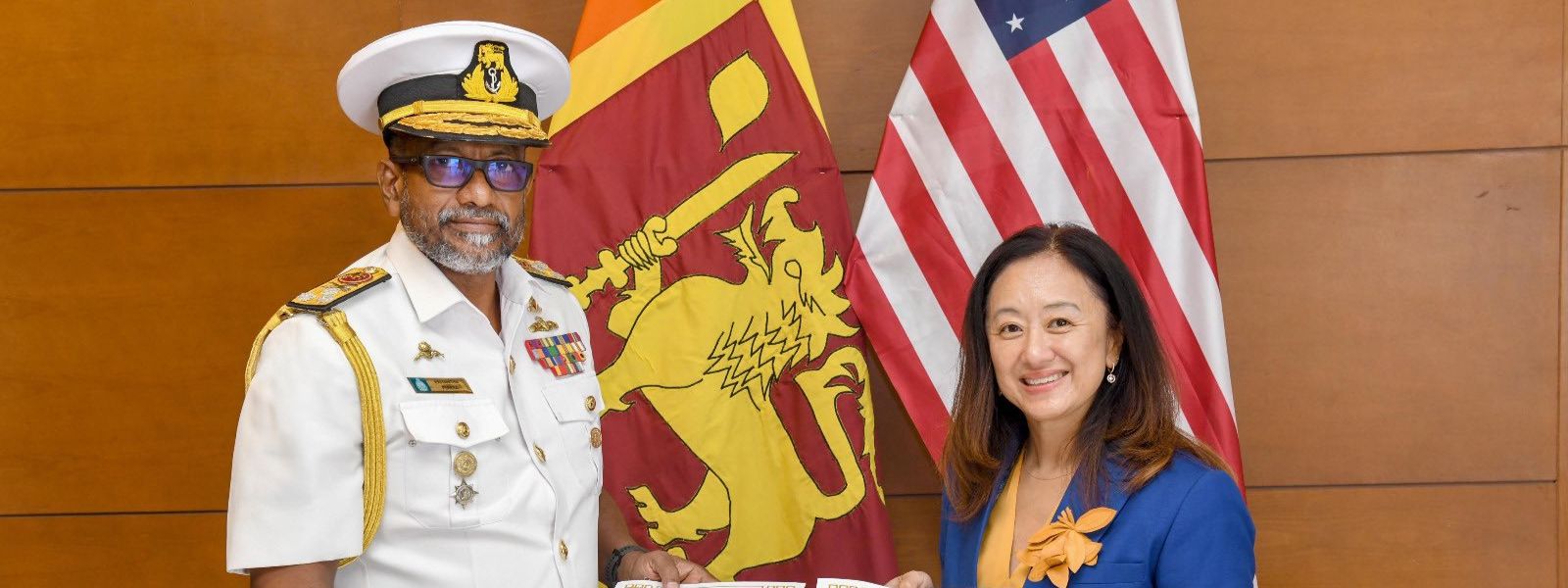
New Indian envoy Santosh Jha presents his credentials to President Wickremesinghe

Mr. Santosh Jha presented his credentials to Sri Lankan President Ranil Wickremesinghe on 22 December at a ceremony held at the Presidential Secretariat and assumed charge as the High Commissioner of India to Sri Lanka.

A senior Indian diplomat, High Commissioner Jha was India’s Ambassador to the European Union, Belgium & Luxembourg before taking up his assignment in Colombo.

He had earlier served as Ambassador of India to Uzbekistan from 2019-2020, and as the Deputy Chief of Mission at the Indian Embassy in Washington DC from 2017-2019.

He has held key positions in the Ministry of External Affairs in New Delhi, including as head of Division for Human Resources and Management Affairs, Division for relations with Western Europe and the European Union, and the Policy Planning Division.

High Commissioner Jha had also served in Colombo from 2007-2010 as Counsellor at the High Commission, handling work related to commercial and economic matters. During this period, in particular, he was pivotal in building the architecture of India-Sri Lanka development cooperation.

He is married to Smt. Tanuja Jha and has a daughter and a son.

Posted in Uncategorized

Indo-Lanka grid connectivity: Two countries agree on submarine cable

Sri Lanka and India have agreed on a submarine cable to connect the power grids instead is laying overhead transmission lines, a top official said.

The official said the CEB and the Power Grid Corporation of India Ltd finalized the technical report to be forwarded to the joint working group headed by the secretaries of the line ministries of the two countries to work out modalities for the implementation of the grid connectivity project.

The official who wished to remain anonymous said the CEB had a virtual discussion with the Indian authorities earlier this week and completed the technical report with the agreement on an undersea cable to connect the two grids. He said overhead transmission lines involves additional costs for maintenance in the future. Also, he said there are difficulties involved in the construction of pylons mid-sea.

The business modality is yet to be worked out for the execution of the project.

Russia Floats Potential JV with India to Operate Sri Lanka’s Mattala

Russian Ambassador to Sri Lanka, Levan S. Dzhagaryan, signaled Russia’s potential interest in a joint venture with India to operate Mattala Rajapaksa International Airport.

While not confirming imminent involvement, Dzhagaryan acknowledged ongoing discussions and underscored the importance of Russian tourism for Sri Lanka.

“There were different ideas, different proposals, and just to also express ours, it’s under consideration,” Dzhagaryan stated, emphasizing Sri Lanka’s ultimate decision-making authority.

He highlighted the significant number of Russian tourists visiting Sri Lanka, citing it as a key factor in their interest in Mattala’s potential.

Dzhagaryan noted Russia’s position as Sri Lanka’s second-largest source of tourists, following India, with expectations of up to 1.2 million Russian visitors in 2024.

The Mattala Rajapaksa International Airport, located in Hambantota, has struggled to attract regular traffic since its opening in 2013. The proposed joint venture with India and Russia presents a potential opportunity to revitalize the airport and boost tourism in the region.

President, Tamil MPs discuss Sri Lanka refugees in India

The plight of Sri Lankans in Indian refugee camps was discussed during a meeting between the president and leaders of the North and East, at the Presidential Secretariat on Thursday (21).

ITAK Members of Parliament R Sampanthan,ITAK S Rasamanickam,TELO G Karunakaran,ITAK T Kalaiarasan and EPDP Kulasingham Dileepan were present at the discussion which focused on the provision of land rights for the people in the Northern and Eastern Provinces, the implementation of laws related to resettlement and reconciliation, and issues concerning district development, in addition to the challenges faced by Sri Lankans in refugee camps in India.

Though Sri Lankan politicians have pledged to address the larger concerns pertaining to Tamil populations, such as reconciliation, resettlement, and rehabilitation in the past, the matter of Sri Lankan Tamil refugees in Indian camps has yet to be addressed by a Sri Lankan head of state.

Successive Sri Lankan administrations have had differing repatriation and reintegration plans. Direct concerns over safety, lands, housing, livelihood, and reconciliation have been reported as reasons why refugees refuse to return to Sri Lanka.

Protests, political declarations, and calls for the Indian central government to be more aggressive in safeguarding the safety and well-being of Sri Lankan Tamils in India and Sri Lanka have occurred in the past.

However, interventions and actions taken by the Tamil Nadu government regarding Sri Lankan refugees have been sporadic and influenced by political dynamics, with changes in leadership, and the evolving relationships between India and Sri Lanka.

Since 2022, Sri Lanka has experienced its worst economic crisis as a result of a number of issues including the COVID-19 pandemic, dwindling tourism, the fuel crisis, a shortage of basic commodities, and soaring debt.

This has led to a rise in migration with illegal methods including ferries being used by migrants to get to Dhanushkodi in Tamil Nadu, which has become a viable destination.

The federal government has given Sri Lanka financial assistance totaling 3.5 billion dollars since the crisis and has allotted financial aid of 80 crore in 2021 and 2022 for welfare of Sri Lankan Tamils in refugee camps, along with cash assistance, subsidised rice and free clothes.

Posted in Uncategorized

The Dilemma of the UNP and the SLPP BY M.S.M .Ayub

The solitary member of the United National Party (UNP) in Parliament, Vajira Abeywardena seems to be clever in grabbing and holding media attention but sometimes in wrong ways – in most occasions damaging his own image.
In recent months, he had made statements – all in respect of the next Presidential Election – for which the media had given wide coverage. In April this year, he said, since possible rival candidates of President Ranil Wickremesinghe could not even think of how to resuscitate the economy and make Sri Lanka a country to be reckoned with in the global context, Wickremesinghe should be elected uncontested for another term.

Meanwhile, Abeywardena suggested at a district conclave of the UNP in the south on June 14, to conduct a referendum in place of the next Presidential Election requesting the people’s approval for his leader to run the country for 12 more years. To justify his suggestion, he reminded that Sri Lanka’s first and only referendum in 1982 was also held in order to postpone a national level election.

Again, on October 24, the UNP Chairman stated that the estimated cost of a Presidential Election, which amounts to Rs. 13 billion could be directed towards reducing electricity tariffs and providing much needed relief to the people, if a national consensus is reached to name President Wickremesinghe as the sole candidate for the position. Abeywardena suggested that individuals who plan to run for the Presidential Election should abstain from submitting their candidacy applications (nominations) as they lack the ability to lead the country’s rebuilding efforts.

All these suggestions on being elected uncontested, holding referendums and withdrawing nominations were aimed at avoiding the Presidential Election, apparently for fear of defeat. And this is sometimes not his own line of thinking, as his leader has been using him to test the public response to these ideas. However, he boasted last Monday that President Wickremesinghe will win the next Presidential Election with 100 lakhs (10 Million) votes. “I am saying this because we are confident of the place this country will be in April with the economic policies of President Wickremesinghe.” He further said, the people should give Mr. Wickremesinghe to govern the nation for 12 more years from 2024, predicting that Sri Lanka would become a powerful country if he is allowed to do so.
Has the UNP which obtained less than 300,000 votes island wide and failed to win a single seat at district level at the General Election three years ago become so popular for its leader to obtain 10 million votes at the next Presidential Election, as Abeywardena observes? The party’s continued hesitation to hold the Local Government Election which had been scheduled to be held on March 9 indicates the opposite.

Besides, in a survey – “Sri Lanka Opinion Poll Survey” – conducted in October by the Institute of Health Policy (IHP), the UNP leader could secure only 13 percent of votes, while Anura Kumara Dissanayake of the National People’s Power (NPP) and Samagi Jana Balawegaya (SJB) leader Sajith Premadasa were predicted to obtain 51 percent and 30 percent of votes, respectively. The outcome of the survey might not be realistic numerically, but it seems to be not so far from the situation on the ground, given the sufferings the ordinary people undergo and the social media trends.

The leaders of the UNP and the SLPP attempt to convince the people that the country that was engulfed in the worst economic crisis in its history is now out of the woods, and the people endorse the government’s current policies and activities.

Needless to say, with fresh loans from the International Monetary Fund (IMF), World Bank and the Asian Development Bank (ADB) and strict import control rules under a programme sponsored by the IMF, the government has been able to ease some of the harshest effects of the recent economic crisis such as miles-long and days-long queues for fuel and cooking gas. However, to portray that situation as economic recovery or progress is unrealistic and self-deceptive, since people still suffer from the effects of the crisis.

To put the gravity of the situation in simple terms, the income of the majority of people has halved while the expenses have gone threefold up compared to the early period of the COVID 19 pandemic. Ruined lives and shattered dreams have not been restored. The statistics of the Central Bank or any other state institution do not matter for the people who gauge the situation from what they encounter. And the crisis has unprecedentedly severed people’s traditional political affiliations which had thus far ridiculously undermined their own sufferings. They now look for remedies from the government, and especially from the President in power failing which they turn to others. Thus the JVP/NPP is capitalizing on the situation, as shown by the above survey.

In about a week, the recently adopted Value Added Tax – VAT (Amendment) Act will come into force impacting every aspect of life, and people might respond to it politically at elections, as protests are being crushed. People are not seen divided along party lines on economic issues such as the new VAT amendments, as the case had been during the pre-crisis period.

Against this backdrop, it would be very difficult for the UNP to win an election unless it forms a coalition with strong contenders. Teaming up with seeming powerhouses, the NPP and the SJB is out of the question, as they have rejected the idea, but the UNP and the SLPP are two parties that are on the same wavelength on economy, governance and human rights. And there are several SLPP ministers who have become very close to the President. Yet, SLPP, according to the recent opinion polls is far behind even the UNP. Besides, the general perception that the SLPP is highly corrupt and responsible for the destruction of the economy has further been validated in the minds of the people by the recent Supreme Court ruling on the economic crisis.

Along with these drawbacks, the visible physical weakness of aging SLPP leader Mahinda Rajapaksa seems to have contributed to such a leadership crisis in that party. Secretary Sagara Kariyawasam announced this week that they were considering four names to be their Presidential candidate, including renowned Business tycoon, Dammika Perera. Does this indicate that the SLPP is not prepared to consider Wickremesinghe as their candidate? They might not be happy with him as he did not budge despite their continued heavy pressure to offer ministerial portfolios to some of their district leaders. They failed to keep him under their control, in spite of them being his political strength in the government. It is justifiable if they fear that the SLPP would ultimately be swallowed by the UNP if the government is under him with their support, for another five years.

Now, Mahinda Rajapaksa is attempting to hold the so-called Yahapalana Government responsible for the economic crisis, forgetting that they made Wickremesinghe the President claiming that only he can save the country from the current economic mess. Also, this week, he had criticized Wickremesinghe’s tax policy, including the VAT (Amendment) Act, amusingly after he and his party having adopted the VAT (Amendment) Bill in Parliament, days ago.
It is against this backdrop the country is going to face a national level election – Presidential or Parliamentary. Since the country is still reeling from the economic crisis and the resultant political uncertainties it is difficult to read all undercurrents yet.

Posted in Uncategorized

New Indian High Commissioner Santosh Jha arrives in Colombo

Ambassador Santosh Jha arrived in Colombo on Wednesday and took charge at the Indian High Commission here. After presentation of credentials, he will assume his new responsibilities as High Commissioner of India in Sri Lanka.

He had served in Colombo earlier as Counselor Economic Affairs.

More Tamil diaspora organisations speak out against GTF’s ‘Himalayan Declaration’

More Tamil diaspora organisations have spoken out against a declaration signed by the Global Tamil Forum (GTF) and Sinhala Buddhist clergy, stating it gives Sri Lankan president Ranil Wickremesinghe an “opportunity to hoodwink the international community”, as backlash continues to grow this week.

The GTF had met with Wickremsinghe in Colombo last week, where the group handed over a ‘declaration’ it had signed with several Sinhala Buddhist monks.

A statement signed by British Tamils Forum (BTF), Centre de Protections des Droits du Peuple Tamoul-France, Irish Tamils Forum (ITF), Solidarity Group for Peace and Justice (SGPJ – South Africa), Swiss Tamil Action Group (STAG) and Tamil Movement Against Genocide (Mauritius), said the move by GTF last week caused “skepticism and dismay among the Tamil people whether this meeting was political motivated to deceive Tamil people and the international community”.

“To add to fuel to Tamil peoples’ concern the whole process of this ‘declaration’ had been kept secretive without any consultation process,” said the statement.

“It is paramount that any declaration such as ‘Himalayan Declaration’ should have been consulted with the victims and brought to the public domain prior to the meeting. This did not occur.”

Several of the organisations that signed the statement condemning the move had previously been part of the GTF.

The GTF was a major Tamil diaspora umbrella organisation at its formation in 2009, however its membership now consists of only the Canadian Tamil Congress (CTC) and Norwegian Tamil Forum (NTF), as well as individual members.

The organisations said that the GTF had already been involved in “a similar process in 2015 with the then President Maithiripala Sirisena when Ranil Wickremasinghe was the Prime Minister and that failed miserably as expected”.

“It took over 5 years for GTF to realise the entire process was an illusion conveniently crafted by the Sri Lankan government led by Maithiripala and Ranil Wickremasinghe aiming to drag the UNHRC process and manage the increasing call to restructure the state to ensure nonrecurrence of past violence.”

“Knowing Ranil Wickremasinghe’s past of manipulating matters to his advantage, GTF’s meeting will provide Ranil an opportunity to hoodwink the international community to sweep Tamils’ outcries under the carpet in the guise of success in talking with Tamil diaspora organisations and to promote support for the proposed Truth and Reconciliation Commission (TRC) model for the resolution internally,” it continued.

Posted in Uncategorized

Declining power and challenges before SLPP

Re-elected leader of the Sri Lanka Podujana Peramuna (SLPP) Mahinda Rajapaksa (MR) and its founder Basil Rajapaksa (BR) declared last week that the party would definitely win the next national election. The boastful prediction was made at the second convention of the party held at the Sugathadasa Indoor Stadium on Dec 15, two days after the SLPP voted for President Ranil Wickremesinghe’s (RW) Budget for 2024, presented on Nov 13, in his capacity as the Finance Minister. But it might become a reality if they put forth RW as their candidate as the Opposition is certainly in disarray with so many contestants with no real direction.

The Third Reading of the Appropriation Bill was passed by a majority of 41 votes. Accordingly, the 2024 Budget was passed with 122 votes in favour of the Bill, while 81 MPs voted against it. Having declared that the people couldn’t be further burdened by the increase in Value Added Tax (VAT) from 15% to 18% and including nearly 100 items a fresh in the VAT list, MP Namal Rajapaksa skipped the vote. The MP owe an explanation why he didn’t vote against or asked his party to reconsider its contentious decision to support RW.

BR emphasized that whatever the election held first the SLPP would win. The former Finance Minister who had been among several persons faulted by the Supreme Court for the ruination of the economy, leading to the declaration of bankruptcy status, urged members and supporters to get ready to form the next government. The Supreme Court on Nov 14 delivered what can be easily called a landmark judgment that sent shockwaves through the ruling party.

Perhaps the most important point stressed by BR was the need for a strong government that could face any challenge. The former lawmaker didn’t mince his words when he found fault with the way his brother Gotabaya Rajapaksa, in his capacity as the President, had handled the public protest campaign. BR declared they would retaliate in case a similar situation arose again.

However, it would be pertinent to point out that the US-backed protest campaign got the excuse to go on the rampage after the SLPP carried out a well-organized attack on protesters at Galle Face, probably out of sheer frustration, as the armed forces and police failed to control the growing menace, with American Ambassador Julie Chung, in particular, urging them not to use force against peaceful protesters. The SLPP should never forget that those who had carried out the first strike walked out of Temple Trees on May 09 morning after having reiterated their commitment to the then Premier Mahinda Rajapaksa.

That attack carried out in the presence of the Colombo police, and the resultant mayhem, compelled the then President Gotabaya Rajapaksa (GR) to invite RW to take over the premiership after Samagi Jana Balawegaya (SJB) leader Sajith Premadasa (SP) squandered the same opportunity offered to him. In spite of being with the main Opposition, with over 50 elected and appointed members, SP backed out of accepting the reins of the premier. Instead, he declared prerequisites for SLPP-SJBV partnership and thereby paved the way for RW. The UNP leader never looked back.

Both MR and BR acknowledged the continuing challenge posed by social media while the former bitterly complained about the ongoing attempts to condemn the SLPP over the economic ruination.

Two former UNP Ministers, Gamini Lokuge and Johnston Fernando, respectively, proposed and endorsed MR as re-elected leader of the SLPP, at the event also attended by Premier Dinesh Gunawardena, leader of the MEP, and EPDP leader Douglas Devananda. A notable absentee was GR, who never took the SLPP membership before the party declared him as its candidate at the Nov 2019 presidential election. GR didn’t bother to take the membership during his short tenure as the President nor did the party ask him to do so.

Outspoken SLPP General Secretary Sagara Kariyawasam, MP, attacked those who accused MR/the Rajapaksas of corruption, one of the primary allegations that led to the change of government in January 2015.

Another notable absentee was former President Maithripala Sirisena, who entered Parliament on the SLPP ticket at the last general election. His opportunistic love/hate relationship with the Rajapaksas might have cost him an invitation. Sirisena caused himself irreparable damage by perpetrating a constitutional coup in Oct 2018 to accommodate MR as the Yahapalana premier, at RW’s expense. The SLFP leader has been reduced to a political nonentity and, as a result, most of his MPs, also elected on the SLPP ticket, have switched allegiance to RW, who now commands a comfortable majority in Parliament.

Unprecedented crisis

In spite of the SLPP declaring confidence in definitely forming the next government, the party needs to examine the daunting challenges it faces. Having won a staggering 145 seats (including 17 National List slots out of 29) at the last general election in Aug 2020, the SLPP has lost over 20 members.

Of the coalition partners, only the MEP with three members (Dinesh Gunawardena, Yadamini Gunawardena and Sisira Jayakody) remains, whereas Wimal Weerawansa’s National Freedom Front (six MPs), Pivithuru Hela Urumaya (one MP) and other smaller parties formed Uththara Lanka Sabhagaya (ULS).

In addition to them, a dozen SLPPers, including its first Chairman and Dullas Alahappremuma have grouped together as Nidahasa Jathika Sabhawa whereas there is another four-member group led by Anura Priyadarshana Yapa.

A series of ill-fated decisions, beginning with the abolition of a slew of taxes and sharp reduction of some, including VAT from 15% to 8%, set the stage for the economic crisis. The SLPP never bothered to examine the consequences, especially against the backdrop of the Covid-19 pandemic.

Then the sudden ban on agro chemicals and a row over shipment of Chinese organic fertiliser caused further destabilization. Trouble erupted in Sept., 2022 when the GR government refused to accept 20,000 tonnes of fertiliser, worth $6.9 million, ordered from China’s Qingdao Seawin Biotech Group. Regardless of Sri Lanka refusing to accept the consignment on the basis of it contained harmful bacteria, the government was compelled to pay for same in the first week of January, 2022.

In the same week GR sacked the then State Minister of Education Reforms and Open Universities Susil Premajayantha following his criticism of the government over the handling of the economy. In the first week of March GR sacked NFF leader Wimal Weerawansa and Udaya Gammanpila in the wake of them, along with Vasudeva Nanayakkara, moving Supreme Court against the deal with a US-based firm over the Kerawalapitiya thermal power station.

The SC didn’t ever bother to hear their case. By then, GR, regardless of his promise not to accommodate Basil Rajapaksa in Parliament, as he enjoyed dual citizenship, brought his brother to Parliament and appointed him the Finance Minister. BR promoted the US energy deal at the expense of the coalition, a move that received the backing of the government. GR’s media team (by then Kingsley Ratnayake and Sudewa Hettiarachchi of Sirasa and Swarnawahini, respectively, led the operation) strongly defended the US energy deal as the government deteriorated.

Central Bank Governor W.D. Lakshman was replaced by Ajith Nivaad Cabraal in the second week of Sept, 2021, as the government reiterated it could overcome the developing crisis without seeking the IMF’s intervention. BR functioned as the Finance Minister, having replaced brother Mahinda Rajapaksa in June 2021.

The SLPP simply ignored warnings issued by coalition members. Kingsley Ratnayake, who served as GR’s spokesperson, declared that Ministers Weerawansa and Gammanpila were removed in terms of the constitution. The SLPP never realized that the US backed the massive public build-up against the government leading to the March 31, 2022, protest outside GR’s private residence at Mirihana, and the subsequent launch of a continuous protest campaign at Galle Face.

Instead of addressing the issues at hand, an influential section of the SLPP launched a high profile project to save MR’s premiership. That project culminated with the attack on the Galle Face protesters on May 09, 2022. The counter attack, most probably premeditated, stunned the government. MR announced his resignation immediately. The government had to fly him out of Colombo to the Trincomalee Navy base where he took refuge. Two months later, GR had to flee Colombo. Unlike MR, GR had to be saved by a warship, moving him from Colombo to Trincomalee.

Last Friday’s SLPP gathering in Colombo was the first since the May 09 gathering at Temple Trees where a section of the party ordered the attack on Galle Face protesters. That decision opened the doors for RW, now at the helm and widely expected to receive the backing of a significant section of the SLPP at the next presidential poll.

RW-SLPP coalition

The SLPP is jubilant over the successful conclusion of the second convention held under trying circumstances. The top leadership (read the Rajapaksas) cannot ignore the declaration of support for RW by individual members of the party.

Several members of the Cabinet and State Ministers have already accepted RW as the government’s presidential candidate. In early April this year Power and Energy Minister Kanchana Wijesekera declared that the majority of the SLPP parliamentary group is of the view RW should be re-elected. Wijesekera was among those present at the SLPP’s second convention.

In July last year, the SLPP MPs elected RW to complete the remainder of GR’s five-year term won at the Nov 2019 presidential election. The next presidential election has to be held by Oct 2024 to ensure that the swearing in of the new president can take place in the following month.

The SLPP’s next challenge is to prevent another crisis over whom the party should support at the next presidential election. Whatever the political parties say, a tough decision awaits the SLPP as RW is certain to seek a five-year term. In other words, the SLPP will have to decide whether to back RW or field a candidate of its own.

In case the party decides to field a candidate, a major breakup is inevitable as a significant and an influential section of the party seemed to have decided on RW’s candidacy.

Having voted for RW’s Budget, claiming that the SLPP didn’t want to rock the boat in view of the ongoing USD 2.9 bn IMF bailout package, can the same party adopt a strategy contrary to that position? In fact, in terms of the agreement with the IMF, the loan is divided into nearly equal eight tranches spread over a period of four years. Therefore, the IMF agreement that had been finalized with the Wickremesinghe-Rajapaksa government sort of tied up the SLPP with RW regardless of whatever political posturing. That is the ground reality.

Both State Finance Ministers are SLPPers, namely Ranjith Siyambalapitiya and Shehan Semasinghe. Those who complain about RW’s revenue proposals, particularly the VAT, have conveniently forgotten Siyambalapitiya and Semasinghe are among the staunchest defenders of RW’s economic strategy or agenda. So, the SLPP will have to engage in serious internal discussion involving the parliamentary group. Rhetoric won’t help the party, especially against the backdrop of RW’s ignoring the SLPP’s request made in July last year to expand the Cabinet. Instead, RW has refrained from at least accommodating new members in place of two Cabinet Ministers removed – Nazeer Mohamed removed by the Supreme Court, and Roshan Ranasinghe unceremoniously sacked by the President. RW’s much smaller Cabinet is packed with SLPPers. The vast majority of State Ministers, too, are SLPPers.

MR seems to have ignored this reality when he declared at the second convention that SLPP members served the government without receiving ministerial portfolios. Those who now enjoyed ministerial perks seemed to be satisfied with RW’s leadership and way the UNP leader addressed issues.

The developing situation should be examined taking into consideration RW seeking to consolidate the Tamil vote by participating in a dialogue with the Global Tamil Forum (GTF) though some Tamils believe the grouping no longer wielded the influence it had a few years ago. However, the GTF initiative drew heavy flak with a collective of Tamil organizations labelling the initiative as treacherous. The grouping declared: “The treacherous initiative by a few individuals from the GTF and its colluders is a despicable attempt to shield Sri Lanka from the international community and UNHRC scrutiny under the pretense of negotiating with imposters.”

Many an eyebrow was raised over the GTF delegation’s meeting with former President Mahinda Rahapaksa. But, whatever the criticism, no one can dispute the fact that the Tamil community, living in the Northern and Eastern Provinces at the 2010 presidential poll, overwhelmingly voted for war-winning Army Commander, the then General Sarath Fonseka. That happened at the behest of the TNA less than one year after the military brought the war to a successful conclusion by delivering a crushing defeat to the LTTE in the battlefield.

As expected the US has thrown its weight behind the latest GTF project while in a separate move RW boosted SJB’s Vadivel Suresh’s image among the plantation community. The plantation vote will be crucial at the forthcoming presidential poll. Obviously RW feels Vadivel Suresh, in his new capacity as an advisor to the President, can play a significant role in his presidential campaign, though CWC’s Jeevan Thondaman is in his Cabinet.

Subsequently, RW appointed Vadivel Suresh as the Co-Chairman of the Divisional Coordination Committees in the Divisional Secretariat Divisions of Passara and Lunugala in the Badulla District.

The UNP leader’s moves will seriously undermine the SJB overall strategy in the upcountry region. The SJB seems to be in a bind as the MP concerned has indicated he is not worried at all about disciplinary action. And it would be a grave mistake on the part of the SJB to even think that the deterioration can be arrested by disciplinary measures.

Likely scenario

The UNP leader seems to be operating on the premise that general election can be advanced in the wake of his victory at the presidential election. In terms of the Constitution, the presidential election will have to be conducted and the new president elected by Nov, 2024 and the general elections next year. In case RW secures the backing of the SLPP MPs (regardless of the party fielding a candidate), the dissident group will contest the general election under RW’s leadership.

Unless the Opposition forms the widest possible coalition, consequences will be devastating and irreversible. Unfortunately, the Opposition, divided on a common platform against the RW-led government seems to be struggling to cope with the challenge.

Regardless of big boasts, the JVP-led Jathika Jana Balawegaya lacks the anticipated support to win at the next presidential. Both JJB’s Anura Kumara Dissanayake and SJB’s Sajith Premadasa have declared their candidature at the next presidential, whereas Field Marshal Sarath Fonseka, too, is widely believed to be interested in throwing his hat into the ring.

Speculation is still rife that businessman Dhammika Perera (National List, SLPP) may be the ruling coalition’s choice though some believe the majority of the parliamentary group prefer to go with RW. At the SLPP convention, Dhammika Perera sat next to Namal Rajapaksa, MP, who is engaged in a campaign to win public confidence. Skipping the vote on Budget seems to be part of that strategy.

SLPP says no finality on Presidential candidacy

Sri Lanka Podujana Peramuna (SLPP) General Secretary Sagara Kariya-wasam yesterday claimed that prominent businessman and MP Dhammika Perera has requested the party to name him as its Presidential Candidate.

Addressing a press conference, Kariyawasam said the party has not officially named Perera as its candidate for the upcoming poll but he was being considered along with three to four other nominations. “But he is definitely among these names. He has also expressed his interest. He will not be disregarded,” he said.

Kariyawasm made this statement in response to a question posed regarding media reports which claimed the party had picked Perera to contest at the Presidential Election under the SLPP ticket after he was seen attending the party’s National Convention on 15 December. Perera was seen seated a mere two seats down from SLPP leader Mahinda Rajapaksa.

Rumours were also fuelled by reports indicating that the National Organiser post of the party, formerly held by Basil Rajapaksa, remained vacant while all other office bearer positions were filled recently.

“I cannot say these reports are either true or false. The reason is that as a party we are yet to decide who the Presidential Candidate will be,” he said.

According to Kariya-wasam, the party will name a candidate who it believes will be capable of rebuilding the country and taking it forward. “We will inform the public when it is decided,” Kariywasam said.

According to Kriyawasam, the formal declaration of the party’s selected candidate for the 2024 Presidential election is anticipated to be disclosed closer to the election date.

I did inform former President not to appoint Ali Sabry as Justice Minister: Cardinal

Archbishop of Colombo Cardinal Malcolm Ranjith today said he did inform former President Gotabaya Rajapaksa not to appoint Ali Sabry as the Minister of Justice in his cabinet.

“I did inform former President Gotabaya Rajapaksa not to appoint Ali Sabry as the Minister of Justice in his cabinet. I did this after a Buddhist monk cautioned me about the move by the former President to appoint Sabry as the Justice Minister,” Cardinal Ranjith told a press conference.

“We were disturbed about the appointment initially as we thought that the Easter Sunday attacks were done by a certain religious group which could influence Sabry. However we changed our stance when it was found out that there is another conspiracy behind the attack,” the Cardinal added.

“My trust on Gotabaya Rajapaksa was lost when he appointed a subcommittee to relook at the report of the presidential commission which probed Easter Sunday attacks,” he also said.

Cardinal said the church is not prepared to meet incumbent President Ranil Wickremesinghe as the latter had told Indian journalists. “We want the government to carry out a probe on the matters revealed by the Channel 4 and the presidential commission, to involve the officers who carried out the initial probe on Easter Sunday attacks on the fresh probes. We also want any future probe done under international monitors,” he also said.

Referring to celebration of Christmas, the Cardinal urged all Catholics to give a meal to the needy. “ I am going to request all Catholic Churches in the Archdiocese to give a meal to the poor. I am also going to give a meal to the poor and spend Christmas with them,” he said in this regard.