‘I stand with Eelam Tamils’ – US Congressman Davis calls for solution based on self-determination

US Congressman Don Davis called on his colleagues “to recognize and address the ongoing oppression of the Tamil People” today, as he spoke out against genocide and called for “a permanent solution based on their right to self-determination” in the region.

Speaking at the US House of Representatives, Davis said “I stand with the Eelam Tamils in Sri Lanka”.

“Following the British departure in 1948, the unification of these kingdoms under a Sinhalese-dominated Sri Lanka led to the marginalization of the Tamil people,” he continued. “This process disregarded the Tamils’ right to self-determination.”

“State-sponsored discrimination and violence against Tamils sparked a tragic 30-year ethnic conflict, resulting in the 2009 Tamil Genocide.”

He went on to condemn the “recent arrests of Tamils for participating in peaceful events under the Prevention of Terrorism Act, ” which he labelled as “deeply troubling”.

The arrests of Tamils last month, as they attempted to commemorate Maaveerar Naal, sparked international condemnation.

“Therefore, I call upon my colleagues in Congress to recognize and address the ongoing oppression of the Tamil People,” Davis concluded.

“We must support a permanent solution that ensures stability and peace in this vital part of the Indo-Pacific. And we must honor our commitment to human rights and democracy.”

Posted in Uncategorized

Santosh Menon interviews the outgoing Indian High Commissioner Gopal Baglay

The Indian High Commissioner in Sri Lanka, Gopal Baglay, who practices diplomacy as a fine art, will be leaving Colombo soon for his next posting in Canberra after a very successful stint in which he won laurels as the man who coordinated with the Sri Lankan and Indian governments to deliver life saving vaccines during the pandemic and then vital assistance to the tune of US$ 4.5 billion to help Sri Lanka overcome an unprecedented economic crisis. Here is a video interview which Santosh Menon did with Mr.Baglay:


Sri Lanka Approves Nuclear Power Plant Construction With Russia as Top Contender

Russia has emerged as one of the strongest contenders to build nuclear power plants in Sri Lanka, according to a media report published on Tuesday.

According to the report, a high-level delegation from Russia recently visited the island nation and discussed proposed cooperation in the nuclear energy sector with the Sri Lankan authorities.

Sri Lanka currently imports most of its energy needs, including oil, coal and hydrocarbons. To ease the economic burden, the island nation aims to generate 70% of its electricity from renewable sources by 2030.

Chairman of the Sri Lanka Atomic Energy Authority (SLAEA) Prof. S.R.D. Rosa briefed the Russian delegation on the status of Moscow’s proposal to develop an offshore or onshore nuclear power plant in Sri Lanka.

He said his office had in principle given its approval for nuclear power to enhance Sri Lanka’s energy mix and it had been sent to the Ministry of Foreign Affairs for approval.

“We can implement this project only if the Intergovernmental Agreement (IGA) is signed between Sri Lanka and Russia. That is now pending,” he added.

Many countries, including the US, Denmark and China, have expressed interest in investing in nuclear power plants in the island nation after the SLAEA gave the green light to nuclear power.

Why Russia Is Foremost Contender?

Russia has taken a leading position in building nuclear power plants in South Asian countries. It has demonstrated its efficiency and understanding of the region by building plants in countries such as Bangladesh, China and India.

In addition, recently, Russia signed a memorandum with Burkina Faso, a country in West Africa, to construct a nuclear power plant.

Meanwhile, earlier speaking with Sputnik, Sergey Pikin, director of the Energy Development Fund, a Moscow-based think tank, said Russia can support them as it is also a supplier of technology, help them (Sri Lanka) while constructing the station, and with other requirements, including finances.

“I think the choice of Sri Lanka is obvious,” Pikin said, adding, “Russia is a global leader, and Colombo should move forward with Russia”.

In July, media reports quoted Wijesekera saying that Sri Lanka is assessing nuclear power plant offers from Russia and other countries.

Sri Lanka, a country of 22 million people, secured a $2.9 billion bailout loan from the International Monetary Fund to end its worst economic crisis since the end of colonial rule in 1948.

According to media reports, Sri Lanka’s electricity generation in 2020 was heavily reliant on fossil fuels (10 TWh) and hydropower (5 TWh), with small contributions from wind and solar. The CEB’s long-term energy plans include nuclear power from 2030.

In 2022, a team of IAEA experts assessed Sri Lanka’s readiness for a nuclear power programme through an Integrated Nuclear Infrastructure Review. This review was part of the IAEA’s Milestones Approach, designed for countries introducing nuclear energy.

Sri Lanka parliament passes 2024 budget aiming to implement IMF reform agenda

Sri Lanka parliament passed the 2024 budget with key measures to implement a reform agenda agreed with the International Monetary Fund (IMF) by 41 majority votes on Wednesday.

The budget of President Ranil Wickremesinghe, also the finance minister, was approved with 122 legislators voting in favour, against 81 in the 225-member parliament.

The budget included measures to increase revenue through taxes, having tax files mandatory, and salary increase for public sector employees.

“We have no option other than this,” President Wickremesinghe told the parliament before the last day budget debate was started.

“Under this option we had to seek IMF assistance and restructure the debts. We have done both. If we don’t go in the path, we would bankrupt again.”

“Successive governments have not water tariffs for 11 years. The electricity tariff has not been increased for many years. We always managed with foreign debts for day-to-day spending.”

Wickremesinghe separately raised the Value Added Tax (VAT) by 3 percent to 18 percent and the revoked exemptions for many goods including fuel. The Cabinet this week approved to reduce the threshold for VAT to 60 million rupees from 80 million.

Already people have been grumbling against higher taxes while government servants including some politically motivated trade unions have been protesting against lower than expected salary hike of 10,000 rupees.

Wickremesinghe’s budget has set a fiscal deficit target of 2.85 trillion rupees in 2024, or 9.1% of the GDP, higher than the revised 8.5% of GDP in the current year. The original target for this year was 7.9%.

Posted in Uncategorized

IMF urges recapitalization after Sri Lanka DDR busts central bank finances

The International Monetary Fund has asked for a recapitalization plan for the central bank after an extension of maturities of central bank held Treasuries to meet the lender’s gross financing need (GFN) targets led to valuation losses.

“The government needs to advance without delay the modalities of the CBSL recapitalization,” an IMF report issued after the latest review said.

“After assessing the impact of the DDO on the CBSL’s balance sheets, done in close consultation with external auditors and IMF staff and by applying good accounting standards and valuation frameworks, the government should stand ready to inject capital into the CBSL, as soon as fiscal buffers allow it, so as to reach positive equity from 2025, which would increase to 2 percent of GDP by 2031.”

Based on longstanding principles before inflation and peacetime currency collapses became routine from the last century with the defeat of sound money by state-run central banks running on Anglo-American post-Keynesian inflationist doctrine, note-issue banks typically bought 90 to 95 day bills, generally known as the ‘bills only policy’, analysts say.

The bills only reduces credit risks, interest rate risks and also liquidity risks at exit.

Sri Lanka’s central bank also usually buys Treasury bills to ‘print money’ and mis-target the policy rate and trigger currency crises, though rule had been partly broken during the post-war currency crises to mis-target gilt yields, critics have shown earlier.

When rates are corrected to stop the crisis, maturing bills are rolled over at a profit, and are easily sold down to the market, in the private credit collapse that follows, to rebuild foreign reserves, usually in a falling interest rate environment.

However, the re-structure of bills to meet gross financing needs target, with coupons lower than market, results in book losses to the central bank, which may turn into actual losses if the securities are sold at market rates.

“The swap of CBSL T-bills holdings for long-term T-bonds reduces the government’s near-term GFNs and refinancing risks at the cost of reducing CBSL capital,” the IMF report said.

“In estimating the capital impact, staff cautioned against valuing the T-bonds using a discount rate that is disconnected from the current market yield curve (such as the theoretical risk-free discount rate).

“To avoid undesirable implications such as weaker demand for CBSL liabilities (e.g., cash in circulation), higher inflation risk premia, and rising dollarization risks, which could ultimately undermine CBSL independence and effectiveness of monetary policy, staff emphasized the urgency of recapitalizing the CBSL.”

According to published data the central bank has re-stated its September balance sheet.

The monetary authority was initially sitting on large profits with equity of 723 billion rupees in August which was reduced to 493 billion rupees by September.

Related Sri Lanka central bank makes Rs234bn loss in Sept amid DDR

The number was later re-stated at 72 billion rupees.

The IMF report said a buffer of 0.5 percent GDP has been reserved for the recapitalization of the central bank in 2024 which was assessed “as sufficient to bring CBSL equity to positive levels based on IMF staff’s estimate of CBSL’s NPV loss from DDO and its equity position at the time of bond exchange in September 2023.”

A soft-pegged or flexible exchange rate central bank earns interest on its domestic assets as well as foreign reserves.

Under the old monetary law, the central bank was barred from transferring profits if it acquired large holdings of bills to trigger instability.

Posted in Uncategorized

Tamil Nadu CM writes to Centre to prevail upon Sri Lanka to secure release of 45 fishermen

Tamil Nadu Chief Minister M K Stalin requested the Centre on Thursday (14 Dec.) to immediately take up through appropriate diplomatic channels the apprehension of fishermen from the state with Sri Lanka and secure the release of 45 fishermen and 138 boats.

Expressing “a deep sense of anguish” on yet another incident of apprehension of six Indian fishermen by the Sri Lankan Navy on 13 December, he said this was the third such occurrence in a week.

“Six fishermen from Jegathapattinam fishing harbour, Pudukkottai district, who ventured for fishing in a mechanised fishing boat were apprehended by the Sri Lankan Navy along with their fishing boat,” the Chief Minister said in a letter to Union External Affairs Minister C Jaishankar, a copy of which was made available to the media here.

He said the Sri Lankan Navy continued to infringe upon the traditional rights of our fishermen, and their frequent arrests have jeopardised the livelihoods of the fishermen and have instilled fear and panic in the fishing hamlets.

In addition to the above fishermen, 137 boats and 39 fishermen were still under Sri Lankan custody. “I therefore request you to take this up urgently with the Sri Lankan government through appropriate diplomatic channels to immediately secure the release of 45 fishermen and 138 fishing boats in the custody of Sri Lankan authorities,” Stalin said in the letter.

Source – PTI

Sajith-Ranil equation, Opposition alliance, Tamil question and foreign policy By Dr.Dayan Jayatilleka

Sajith Premadasa has declared that he will not reunite with Ranil, nor will the SJB realign with the UNP. (https://www.ft.lk/front-page/Sajith-dismisses-future-alliance-with-Ranil/44-756217)

That makes perfect sense. The electricity price hikes, VAT shock, hollowing of public health and education, and mounting hunger will cumulatively obliterate Ranil’s presidential prospects. If he stalls the election, a social firestorm will obliterate much more.

Why should Sajith and the SJB buy tickets on that Titanic? If they do so, the irresistible public compulsion to “throw the rascals out” will include them, and the protest vote will have only one channel. As in 1970, 1977 and 2019-2020 a unipolar or one-party-dominant outcome will ensue, wrecking the democratic system’s equilibrium.

Lines of demarcation

That said, Sajith must explain why he says ‘no’, beyond the banality of “Ranil is with the Rajapaksas who ruined the country”. What if Ranil and the UNP are willing to swap the Rajapaksas and the SLPP for Sajith and the SJB?

Sajith must draw the line of demarcation between him and Ranil, the SJB and the UNP, in substantive terms of economic and social strategy, policy paradigm, developmental program, and political ideology. That is possible only if he stands firmly on the foundation of President Premadasa’s development philosophy which includes “economic, political and social democracy”.

Sajith must guarantee that his economic team doesn’t ‘unite’ or ‘align’ with Ranil’s program and ideology. If the SJB looks like the UNP, walks like the UNP and quacks economics like the UNP, it is a twin, an avatar or extension of Ranil’s UNP.

The SJB economic platform represents policy continuity with Ranil, not change. The Harsha-Eran economic model has 5 pillars which make it morphologically Ranilian:

(1) Renewed access (through an IMF rubber-stamp) to the foreign money markets, i.e., a return to the original addiction.

(2) A castrated Central Bank incapable of state intervention to offset external shocks i.e., do a Mahathir.

(3) Unilateral rewriting of the Social Contract in favour of foreign and local big capital, by scrapping labour and land reform laws.

(4) Unfettered, maximum—not optimum—privatisation and foreignisation of the economy, deleting the state and cooperative sectors.

(5) Retention of the 2017 foreign exchange law which facilitates outflow and loss to the country of hard currency earnings.

Weighed-down by the albatross of Harsha’s Economic Blueprint, Sajith is handicapped in 2024 in his ability to compete with the JVP-NPP by losing the liability of a UNP profile as Ranasinghe Premadasa so easily did in 1988.

On economics and external affairs, SJB ideologues are set to resume the 2015-2019 Ranil-Mangala-UNP project and policy trajectory. This positions the SJB as part of the problem, not the solution; part of the old elitist Establishment, not the agency of progressive change. Thus, during the post-Aragalaya period and the Ranil presidency, SJB has failed to enthuse the public imagination.

Wickramaratne’s warped worldview

I read with a mix of interest and incredulity, ex-banker Eran Wickramaratne’s profound pronouncements in Parliament on Sri Lanka’s foreign policy.

“…We belong to the non-aligned movement, which is a platform only. Our Foreign Policy must be multi-aligned with nations and global agencies which are currently yielding global power,” he said…He opined that the foreign policy strategy and engagement must have economic diplomacy at the core of its policy formulation…”

(https://www.ft.lk/news/SL-s-passport-ranking-reflective-of-its-foreign-policy-Eran/56-756124)

‘Multi-alignment’ was custom-tailored for India. It suits Delhi’s membership of the Quad and its close friendship with Russia. This policy is affordable by a country as vast, wealthy, populous and powerful as is India. Significantly, even middle-powers and fellow members of BRICS such as Brazil and South Africa have not renounced nonalignment in favour of ‘multi-alignment’.

The stance of most states in the global South in relation to the Ukraine war has been described by US scholars as ‘the new nonalignment’ and as confirmation of Shivshanker Menon’s conceptual commendation a few years ago of ‘Non-Alignment 2.0’.

Multi-alignment for India and Sri Lanka would mean two vastly different outcomes. It reminds me of the tale of two friends, a hen and a pig, walking down the road looking hungrily for a place to eat. They spot a place with a board that announces ‘Open for Breakfast! Bacon and Eggs!’ “Let’s go in, I’m starving” the hen says to the pig. The pig replies “No way! You go in, it would be easy for you, but for me it would mean a total commitment”.

For a small island such as Sri Lanka, ‘multi-alignment’ would mean inviting the power-projection by and the presence of contending Great Powers or their equivalent of an ‘East India Company’, carving out our compact space into spheres of influence.

Given our axiomatic geopolitical location, this would nullify Sri Lanka’s independence, sovereignty, territorial integrity and unity. We would lose whatever multi-directional (multi-vector) autonomy we have in the world arena.

Given American military enabling of Israel’s Gaza bombing, the two US carrier battle-groups backstopping Israel, and the appalling US veto at the UN Security Council of the resolution calling for an immediate ceasefire in Gaza, what stance would a ‘multi-aligned’ rather than a ‘non-aligned’ Sri Lanka adopt on the Gaza war?

How could we be multi-aligned to both the USA and China in the context of sharp competition and contention? Sri Lanka’s national interest is better served by remaining ‘nonaligned between’ rather than ‘multi-aligned with’ contending Great Powers.

An increasingly frequent term in international discourse, including that of Prime Minister Modi as Chairman of G20, is the ‘Global South’. While straying into the realm of foreign policy, Eran Wickramaratne and Harsha de Silva have conspicuously avoided any acknowledgement of Sri Lanka’s identity as belonging to the Global South, which must surely anchor our foreign policy in an ontological sense. Similarly conspicuous by its absence in their discourse is a commitment to a multipolar world.

Meanwhile “economic diplomacy” is crucial but is certainly not “the core” of [foreign] “policy formulation” as Wickramaratne supposes. Kissinger would have been shocked to his core.

Alliance impeded

A 2024 version of the 2015 Yahapalanaya strategy will lack its most essential component: a credible dissident faction of the centre-left, at the time personified by Maithripala Sirisena, the popular General-Secretary of the SLFP. Today’s equivalent would be an alliance in which the main partnership would be between the SJB and the FPC led by Dullas Alahapperuma, i.e., a Sajith-Dullas ticket or as close to one as our presidential system which has no Vice-Presidential spot can get. This would balance an SJB-led bloc and give Sajith a capacity for outreach to disaffected MR-SLFP-SLPP voters.

As our Sunday sister-paper spotlighted in its Politics column, the main obstruction to an Opposition alliance seems to be the SJB’s commitment to its para-Ranilist/para-UNP Economic Blueprint.

“…One was a heated debate last Wednesday among parliamentarians of the Freedom People’s Congress (FPC), a breakaway group from the Sri Lanka Podujana Peramuna (SLPP), to form a common front with the main opposition Samagi Jana Balavegaya (SJB). For months now, the FPC has been talking to SJB leadership but has not been able to reach an understanding on an acceptable economic policy. At a meeting this week, the majority view was that they should agree to a political tie-up only based on a set of mutually acceptable terms…It was agreed that the FPC has another meeting with SJB leader Sajith Premadasa to further determine future action.” (https://www.sundaytimes.lk/231210/columns/constitutional-council-the-crisis-continues-541856.html)

Roshan Ranasinghe, a decent enough young Pohottuwa politician, just doesn’t have Dullas Alahapperuma’s and Charitha Herath’s heft and the FPC’s market-niche. Without the FPC as main partner, the SJB’s alliance will look like an old-fashioned ‘UNP plus minority parties’ bloc, albeit with Sajith’s sporadic sprinkling of populism as thin overlay. If Dullas’ FPC partners with the SJB on an economic platform of a liberal market character rather than a new, progressive-centrist Common Program, it will splinter as well as lose its vote-base as Sirisena’s SLFP did in alliance with Ranil’s UNP.

That the stumbling block of the (Advocata-advised) economic platform hasn’t been removed by Sajith even in the pragmatic interests of clinching a deal with the FPC and catapulting a broad progressive alliance as Presidential Election Year 2024 commences, is evidence of the extent of ideological capture by the party’s neoliberal right-wing, and the degree to which it looks set to dominate policy in a Sajith administration. These rightist policy ideologues will do the same damage to a possible Sajith presidency that Ranil-Chandrika-Mangala did to the Sirisena presidency and its social base.

Tamil question, political solution

The Oct 7th Hamas attack and Israel’s monstrously evil war on the Palestinian people of Gaza –75% of those slaughtered being women, children and elderly, says the UN– prove conclusively that problems which are political at the root, require political solutions or political settlement.

In the case of Israel/Palestine the obvious framework was a two-state solution as agreed upon in Oslo. It has since been rendered inoperable by Israel’s slicing away of territory through an aggressively annexationist settlement policy. Meanwhile a one-state solution is blocked by Israel’s apartheid model.

If there are territorial swaps, the two-state solution may still be salvageable. If the apartheid system is abandoned or overthrown, a one-state solution is possible. For now, the situation is bloodily, tragically intractable.

Sri Lanka is lucky that way.

Ours was never an issue of invasion of neighbours, settlements, annexation, and Occupation as condemned by resolutions of the UN Security Council, i.e., international law.

Nor is there is internal apartheid, especially after the re-enfranchisement of the hill country Tamil people. All citizens have a right to vote and each and every minority can punch its electoral-demographic weight, especially under the electoral system of proportional representation.

The military dimension was decisively deleted and a UN Human Rights Council endorsement decisively won (May 2009).

Unlike the 1993 Oslo Accords, the 1987 political settlement is intact, though inoperative because of the opportunistic chicanery of the Yahapalanaya UNP-TNA in 2015-2017.

That political settlement is the system of elected Provincial Councils created by the 13th amendment in the wake of the Indo-Sri Lanka Accord.

The Global Tamil Forum’s Suren Surendiran has always been impressively intelligent and it is a pity he won’t contest Sri Lanka’s parliamentary election. However, President Wickremesinghe played it more cannily when talking to the GTF. He scrolled the political calendar, beginning with the Presidential election, saying that the constitutional changes or change of Constitution would have to follow the elections. This left the door open for him to tempt Tamil voters while pre-empting a backlash.

The Provincial Councils cannot be unfrozen as long as Wickremesinghe is in office, not merely because he was the PM who sabotaged them, but also because he cannot be seen to spend on a PC election (primarily) for the North and East before holding the constitutionally dictated Presidential election 2024.

Which post-Ranil dispensation will be most conducive to a settlement of the ethnic issue? Certainly not the one that promises the Tamils the most generous solution, but rather the one that is more likely to be capable of delivering a sustainable solution.

Throughout the island’s political history, an Oppositional or governing alliance with a minoritarian profile has been the worst for the defence and advancement of minority rights and autonomy. This has been proved from 1956 to 2019.

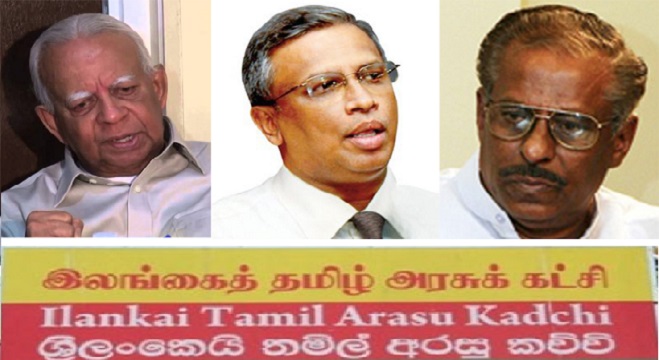
In the formation of an Opposition Alliance, the pressure will be on the SJB to commit to the 2015 Constitutional change package. That pressure will come from the TNA in the process of forming an Opposition alliance at the beginning of Presidential Election year 2024. The SJB’s Eran Wickramaratne will support the TNA’s MA Sumanthiran in that effort. Sumanthiran himself will be more stridently insistent than usual because the succession struggle in the TNA is underway.

A TNA hard-sell will prove problematic for Sajith Premadasa and the SJB, but not because they will be open to chauvinist criticism from the NPP-JVP, which doesn’t display a trace of Sinhala- Buddhist chauvinism and is quite decided in its critique of discrimination, commitment to pluralism and retention/reactivation of the existing Provincial Council system. The threat to the SJB is that the NPP-JVP’s modernist, inclusive, moderate stance will be more in consonance with the vast majority of post-Aragalaya Sinhala voters, than will an SJB-TNA bloc with its 2015 Mangala Samaraweera designed, revealingly minoritarian profile.

If Sajith promises a return to the 2015-2019 process of a new Constitution, he will run for the presidency with a quasi-federalist ball-and-chain on his left leg, accompanying the Economic Blueprint ball-and-chain on his right leg.

If an SJB administration attempts a TNA-driven Constitution, the required Referendum will be a fast-track for the Sinhala Far Right.

If a Referendum is ought to be bypassed as urged by the 2015-2019 Constitutional change advisors, then an accursed cycle will repeat itself, beginning with a replay of JR Jayewardene’s March to Kandy against the Bandaranaike-Chelvanayakam pact of 1957. The ex-Gotabaya camp will swing into action, especially in the Eastern province where GR engaged in neo-Netanyahu-ism through his handpicked Governor and presidential Eastern Task Force.

Buddhist card

The problem cannot be addressed by burnishing Sajith’s genuine Buddhist credentials. The Senanayake UNP had a Sinhala-Buddhist profile as befits a conservative-liberal party. It sought to weaponise Sinhala-Buddhism against the Left. Piety and philanthropy didn’t save the UNP from the Hartal of 1953 and the landslide electoral defeats of 1956 and 1970.

Ranasinghe Premadasa, a Sinhala Buddhist who achieved a great deal as Minister of Buddha Sasana while simultaneously practising a multi-religious policy even more pronounced than Sajith’s, made it unambiguously clear that the broad-basing of a government, specially a UNP government, and buffering it against an ethnic majoritarian backlash to which the UNP was prone, resided not so much in the Senanayake formula of Sinhala Buddhist traditionalism but precisely in the domain of progressive socioeconomic policy, i.e., of equitable growth and rapid social upliftment. President Premadasa countered ethnoreligious majoritarianism with socioeconomic majoritarianism in which he firmly anchored his multi-lingual, multi-religious, multi-ethnic, multi-cultural pluralism.

As a parallel track (not a Track B), the Tamil and Muslim parties should open a serious dialogue with Anura Dissanayake and the NPP-JVP. The Left may prove a better delivery-vehicle because it is less vulnerable than the SJB with its neo-UNP, or not-quite-post-UNP vibe.

Intellectual sophistication

I was amused to read in the pages of an influential mainstream newspaper, the pronouncement of a popular young columnist, economic liberal and right-winger, that “the JVP…doesn’t have intellectual sophistication”.

I would love to watch a television debate of any 6-member panel of the UNP, SJB, SLPP or a combination, face off against a JVP-NPP panel of Anura Dissanayake, Bimal Ratnayake, Sunil Handunetti, Prof Hiniduma Sunil Senevi, Prof. Liyanage Amarakeerthi and Dr. Harini Amarasuriya. It is the Establishment’s good fortune and the JVP-NPP’s flawed tactics that deprive AKD’s camp of the formidable Pubudu Jayagoda, Duminda Nagamuwa and Wasantha Mudalige.

Anura and the NPP-JVP could find themselves electorally thwarted, not by their foes but by unrecognised complexity of terrain and time. Uneven development and intermediate strata make united fronts and alliances imperative. AKD and the NPP-JVP aren’t Gramscian enough, yet.

Posted in Uncategorized

More Tamil diaspora organisations speak out against GTF’s ‘Himalayan Declaration’

More Tamil diaspora organisations have spoken out against a declaration signed by the Global Tamil Forum (GTF) and Sinhala Buddhist clergy, stating it gives Sri Lankan president Ranil Wickremesinghe an “opportunity to hoodwink the international community”, as backlash continues to grow this week.

The GTF had met with Wickremsinghe in Colombo last week, where the group handed over a ‘declaration’ it had signed with several Sinhala Buddhist monks.

A statement signed by British Tamils Forum (BTF), Centre de Protections des Droits du Peuple Tamoul-France, Irish Tamils Forum (ITF), Solidarity Group for Peace and Justice (SGPJ – South Africa), Swiss Tamil Action Group (STAG) and Tamil Movement Against Genocide (Mauritius), said the move by GTF last week caused “scepticism and dismay among the Tamil people whether this meeting was political motivated to deceive Tamil people and the international community”.

“To add to fuel to Tamil peoples’ concern the whole process of this ‘declaration’ had been kept secretive without any consultation process,” said the statement. “It is paramount that any declaration such as ‘Himalayan Declaration’ should have been consulted with the victims and brought to the public domain prior to the meeting. This did not occur.”

Several of the organisations that signed the statement condemning the move had previously been part of the GTF. The GTF was a major Tamil diaspora umbrella organisation at its formation in 2009, however its membership now consists of only the Canadian Tamil Congress (CTC) and Norwegian Tamil Forum (NTF), as well as individual members.

The organisations said that the GTF had already been involved in “a similar process in 2015 with the then President Maithiripala Sirisena when Ranil Wickremasinghe was the Prime Minister and that failed miserably as expected”.

“It took over 5 years for GTF to realise the entire process was an illusion conveniently crafted by the Sri Lankan government led by Maithiripala and Ranil Wickremasinghe aiming to drag the UNHRC process and manage the increasing call to restructure the state to ensure nonrecurrence of past violence.”

“Knowing Ranil Wickremasinghe’s past of manipulating matters to his advantage, GTF’s meeting will provide Ranil an opportunity to hoodwink the international community to sweep Tamils’ outcries under the carpet in the guise of success in talking with Tamil diaspora organisations and to promote support for the proposed Truth and Reconciliation Commission (TRC) model for the resolution internally,” it continued.

Several diaspora organisations have already spoken out against the GTF declaration, and reiterated their commitment for Sri Lanka to be referred to the International Criminal Court for genocide and for an international monitored referendum to be conducted in the Tamil homeland.

In the North-East too, the leader of the Tamil National People’s Front (TNPF) told the Tamil Guardian that he has refused to meet with the GTF, labelling the initiative a “whitewash”, whilst the Tamil Eelam Liberation Organisation (TELO), a constituent party of the Tamil National Alliance (TNA), denounced the Sri Lankan government-backed as “irresponsible” and one that “misdirects our entire political aspirations”.

Police recording ethnicity of residents in Colombo, other areas

The Police are recording information of residents in Colombo, and other areas, including their ethnicity, Parliament was informed today.

Public Security Minister Tiran Alles told Parliament that recording the details of residents in Colombo and other parts of the country was a continuing process and was nothing new.

He denied claims the religion of the public were being recorded by the Police.

The Minister was responding to concerns raised by opposition MP Mano Ganesan.

The MP alleged that Tamils in Colombo were once again the target of a Police operation to record their details.

However, Alles insisted that not just Tamils but the details of even Sinhalese people were being recorded.

He said this was being carried out as a security measure to identify any criminals who have moved to other parts of the country.

Chinese company was given a chance to open 250 petrol sheds to sell fuel. Is it an investment? Is it an intake of technology or capital?

Claiming that China’s Sinopec project to open 250 petrol sheds is not an investment, NPP MP Anura Kumara Dissanayake said today that even local businessman Dudley Sirisena could have done the same if he was given a chance.

He told Parliament that a real investment must bring technology and capital to the country.

“The Chinese company was given a chance to open 250 petrol sheds to sell fuel. Is it an investment? Is it an intake of technology or capital? Even Dudley Sirisena could have opened 250 petrol sheds. It is not an investment,” he said.