US Special Representative for Racial Equity and Justice to visit Sri Lanka

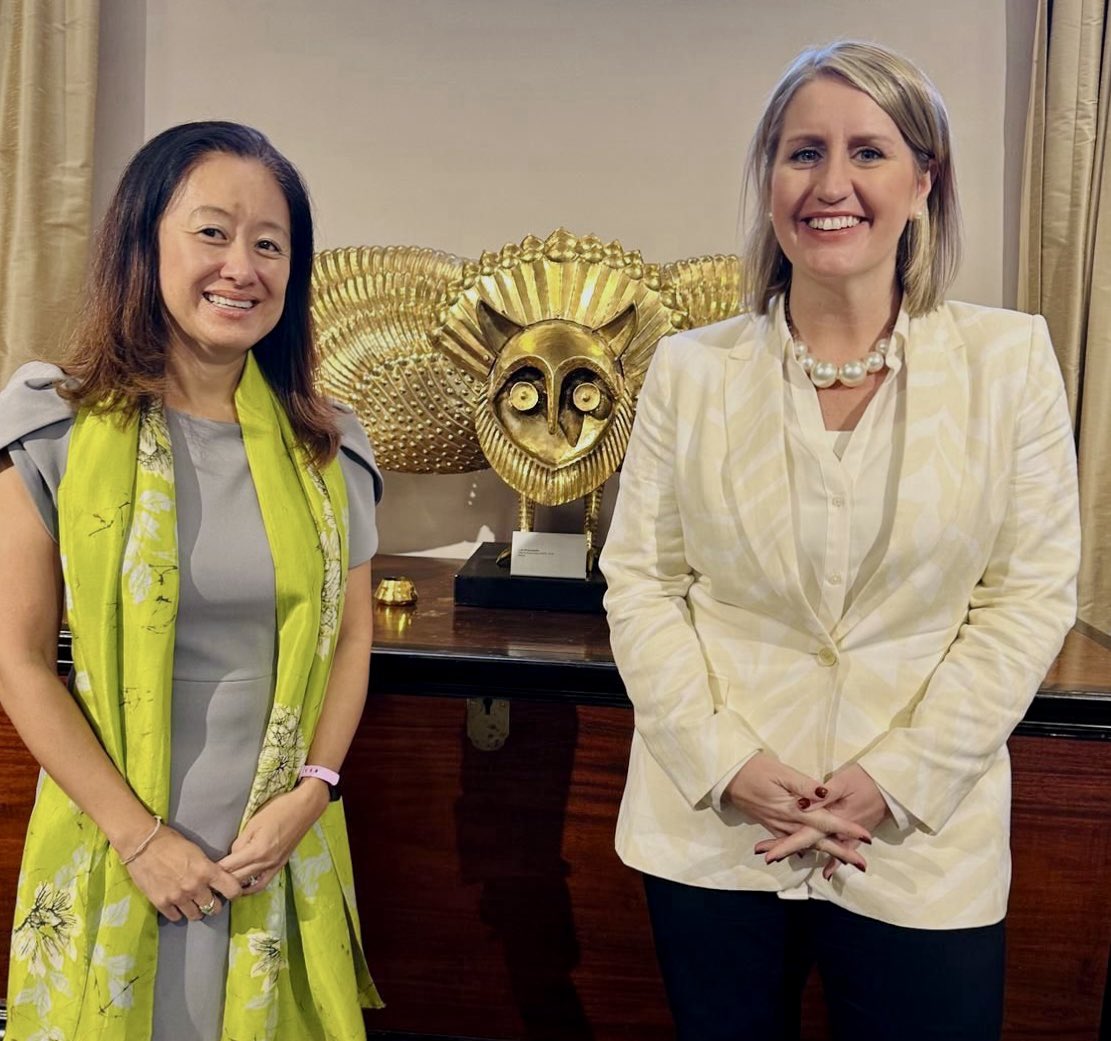
Desirée Cormier Smith, the U.S. Special Representative for Racial Equity and Justice, is set to embark on her inaugural journey to South Asia, with Sri Lanka as a focal point.

From December 11 to 15, she will traverse the cultural landscape of Colombo, Nuwara Eliya, and Kandy, engaging with diverse communities to bolster the U.S. government’s commitment to advancing human rights and equality in Sri Lanka.

During her week-long visit, Special Representative Cormier Smith will engage in crucial meetings with Malaiyaha Tamils, civil society groups, and government officials. The discussions will emphasize the U.S. government’s unwavering support for initiatives aimed at uplifting marginalized ethnic communities in Sri Lanka.

A highlight of her visit will be the launch of the U.S. Embassy’s English Access Scholarship Program in Nuwara Eliya. This State Department-funded global initiative focuses on providing English language skills to bright, economically disadvantaged students. Special Representative Cormier Smith’s presence at the launch underscores the United States’ commitment to fostering education as a tool for empowerment and inclusion.

In a bid to empower the youth of the Malaiyaha Tamil community, Special Representative Cormier Smith will present awards to 25 students who have successfully completed an intensive three-month bootcamp dedicated to content creation. This innovative program aims to equip young individuals with valuable job skills, enhancing their economic prospects and contributing to their community’s overall development.

GTF does not fully capture the “unified voices of the organizations that collectively represent our community.”

Six global organisations representing the Tamil diaspora have called for broader representation of their community pertaining to initiatives that foster dialogue and collaboration for a harmonious and inclusive Sri Lanka.

This was in response to recent discussions the Global Tamil Forum (GTF) and a group of esteemed Buddhist monks had with President Ranil Wickremesinghe.

During the discussions, the Joint Himalayan Declaration, a collaborative effort between the GTF and the Buddhist delegation which advocates for a pluralistic Sri Lanka that actively promotes the well-being of all its communities, was presented to President Wickremesinghe.

Issuing a joint statement, the Australian Tamil Congress (ATC), Federation of Tamil Sangams of North America (FeTNA), Ilankai Tamil Sangam, Tamil Americans United PAC, United States Tamil Action Group (USTAG) and World Thamil Organization noted that the GTF, which now represents only a few individuals of the Tamil diaspora, does not fully capture the “unified voices of the organizations that collectively represent our community.”

Pointing out that the GTF no longer holds the representation it once did, they called for wider engagement with organisations representing the Tamil diaspora.

Full text of the statement by the six Tamil diaspora organisations is found below.

“As representatives of the Tamil Diaspora, we have learned through media sources about the recent initiative by a section of the Sinhala-Buddhist clergy and southern civic society. It is unfortunate that these groups have begun discussions with a selected and limited representatives of the Tamil Diaspora.

This engagement, primarily with the Global Tamil Forum (GTF), which now represents only a few individuals of the Tamil Diaspora, does not fully capture the unified voices of the organizations that collectively represent our community.

It is important to note that the GTF no longer holds the representation it once did. Since its formation in September 2009 in Paris, France, the majority of the original 14 countries / Tamil-organizations, including 10 from Europe, have dissociated from the GTF.

Additionally, organizations such as the British Tamil Forum, Australian Tamil Congress, and United States Tamil Action Group (USTAG), formerly known as USTPAC, have also left the GTF.

As a result, any outcomes from this engagement lack the support of the majority of the Tamil Diaspora and thus, are of limited significance and credibility.

It is imperative to acknowledge that the key organizations listed below within the Tamil Diaspora, which closely align with the views of the Tamil people in the North-East, have developed their position through extensive dialogues with members of the grassroot community.

These discussions have involved civil society leaders, religious figures, families of the disappeared, and academic communities, including those from the Universities of Jaffna and Batticaloa. The cardinal principles widely accepted during these discussions by the Tamil Civil Society and Diaspora include:

An internationally conducted and monitored Referendum that allows people living in the north-eastern region of the island of Sri Lanka prior to 1948 and their descendants to find a democratic, peaceful, permanent political solution that meets Tamils’ legitimate aspirations.
An interim International Protection Mechanism to be established in the north-eastern region of the island due to existing excessive military presence and occupation.
The Repeal of the Sixth Amendment to the Sri Lankan Constitution to provide freedom of political rights to the people.
The referral to the International Criminal Court with respect to genocide, crimes against humanity and war crimes, and investigation and legal action before the International Court of Justice under the Convention on the Prevention and Punishment of the Crime of Genocide and the Convention against Torture.
We appeal to the Sinhala-Buddhist clergy and southern civic society to understand, acknowledge and embrace these aspirations.

Such a progressive step would demonstrate a significant shift towards reconciliation among all communities and contribute to finding a just and lasting resolution to the Tamil National question, paving the way for a stable, secure and prosperous Sri Lanka.”

Posted in Uncategorized

Sri Lanka opposition leader rubbishes reports of reunion with president

There will never be an alliance between Sri Lanka President Ranil Wickremesinghe and opposition leader Sajith Premadasa, the latter has told parliament, denying reports of a coming team-up of the two rivals.

“Some organisations that propagate falsehoods have gotten together, having taken money perhaps from the government, and are saying Ranil and Sajith are teaming up. Ranil and Sajith will never come together,” Premadasa said speaking parliament Monday December 11 morning.

“I’m saying this right here in parliament. I wish to tell these unscrupulous media organisations to not make these false statements,” he added.

Premadasa was responding to a purported report that President Wickremesinghe’s United National Party (UNP) and Premadasa’s Samagi Jana Balawegaya (SJB), which broke off from the UNP, are considering burying the hatchet and reuniting to contest next year’s elections as one party.

There has been some speculation that senior members of the SJB, whose centre-right politics is not ideologically far removed from that of Wickremesinghe, are not opposed to the idea of working under the president.

For his part, President Wickremesinghe continues to reiterate his calls for the SJB to support him in his International Monetary Fund (IMF)-backed reform agenda. He has repeatedly extended an open invitation to his erstwhile UNP colleagues to join him.

Wickremesinghe’s administration currently comprises predominantly the Sri Lanka Podujana Peramuna (SLPP) whose MPs — 134 of them — voted to make him president following the resignation of his predecessor Gotabaya Rajapaksa.

The SJB and other opposition groups have accused Wickremesinghe of “protecting” the Rajapaksa family that controls the SLPP in exchange for their support, an allegation that Wickremesinghe’s defenders chalk up to realpolitik.

At least three prominent members of the SJB have so far switched their loyalty to Wickremesinghe: Tourism Minister Harin Fernando, Labour & Foreign Employment Minister Manusha Nanayakkara, and MP Vadivel Suresh who was named an advisor to the president just last week.

Tamil Nadu Chief Minister demands release of Indians detained in Sri Lanka

Tamil Nadu Chief Minister M K Stalin on Monday urged the Centre in India to ensure the early repatriation of the Indian fishermen arrested in Sri Lanka recently.

He pointed out that the attacks on the fishermen have been on the rise of late and have had serious repercussions on the lives and safety of the Indian fishermen.

“Therefore, I request you to direct the Indian mission in Sri Lanka to initiate urgent measures to repatriate the apprehended fishermen and their boats,” the Chief Minister said in a letter addressed to Union External Affairs Minister S Jaishankar.

As many as 12 fishermen who set out for fishing from Nagapattinam harbour and 13 others who went fishing from Karaikal were apprehended by the Sri Lankan Navy on December 9. Another fishing boat was damaged by the patrol vessel of the Sri Lankan Navy, he said in the letter.

(Press Trust of India)

Posted in Uncategorized

MP Mano Ganesan Raises Concerns Over Tamil Persons’ Registration in Police Jurisdictions, Questions Necessity in Post-War Sri Lanka

Member of Parliament Mano Ganesan raised critical questions regarding the ongoing registration of Tamil persons within specific police jurisdictions in Sri Lanka.

Ganesan queried the necessity of such registrations, emphasizing the absence of war and terrorism in the country. He questioned the ownership of the police force, asking whether it belongs to Tiran Alles, Ranil Wickremesinghe, or Deshabandu Tennakoon.

Ganesan’s remarks sparked discussions about the need for transparency and the protection of individual rights in the post-war era.

The registration process in police areas, including Kirulapone, Wellawatta, Dehiwala, Bambalapitiya, Narahenpita, Kotahena, Mattakkuliya, and Modara, has raised concerns among citizens and policymakers alike, prompting a closer examination of the motivations behind this initiative.

Posted in Uncategorized

Parliament passes VAT (Amendment) Bill

The Third Reading of the Value Added Tax (Amendment) Bill was passed in Parliament with amendments on Monday evening (11 Dec.).

The Bill was passed with a majority of 45 votes, with 100 MPs voting in favour, and 55 voting against the Bill.

Accordingly, the House approved a hike in VAT up to 18% from the current 15%, ahead of the International Monetary Fund (IMF) preparing to approve the second tranche of a $2.9 billion bailout for the crisis-hit country.

Earlier today, the Second Reading of the Bill was passed in Parliament with a majority of 57 votes.

A total of 98 MPs had voted in favour of the Bill, while 41, including former Minister and SLPP MP Roshan Ranasinghe and the opposition, had voted against it.

The debate on the Value Added Tax (Amendment) Bill commenced this evening (11 Dec.), after a proposal to debate the Value Added Tax (Amendment) Bill was passed in Parliament earlier today.

The Bill was initially scheduled to be taken up for debate on Sunday (10 Nov.), however, the parliamentary session was adjourned by Deputy Speaker Ajith Rajapakshe due to a lack of quorum.

The debate on the Second Reading of the Value-Added Tax (Amendment) Bill and the Finance Bill was taken up in the House last morning, during which State Minister of Finance Ranjith Siyambalapitiya said VAT would be imposed on 97 out of the 138 goods that were previously freed from the tax, in a bid to boost state revenue.

Speaking further, the State Minister said that Short Message Service (SMS) in fixed telephone networks will also be subjected to VAT, given the increased number of text messages sent.

However, medicines, equipment used by disabled persons, rice flour, wheat flour, vegetables, fruits, liquid milk, and the ‘Suwaseriya’ ambulance service will not be subjected to VAT, the state minister assured.

Posted in Uncategorized

Sri Lanka will be secured if India is secured – Gopal Baglay

The Indian High Commissioner to Sri Lanka Gopal Baglay says that India has never responded to a crisis or supported a country in crisis with the swiftness and strength that it did during the unprecedented crisis in Sri Lanka.

Joining the “At Hydepark” current affairs programme on Ada Derana 24, the outgoing Indian diplomat in Colombo also discussed the vision for the advancement in bilateral relations between Sri Lanka and India, with the anticipated economic growth of India.

“India played the role bilaterally, as well as internationally to support Sri Lanka. The leadership of India is very clear and committed to a strong India – Sri Lanka relationship”, said the Indian Diplomat.

In response to a question regarding the India’s concerns on the visit of Chinese vessels to Colombo, Gopal Baglay pointed out that both India and Sri Lanka are located in the Indian Ocean, adding that assuring the freedom of navigation is a shared responsibility of India and Sri Lanka. He further expressed that the maritime challenges which arise must be addressed together.

“There can be prosperity and peace, when there is security and stability. Ensuring the security of the region in which we both are situated is a shared responsibility. In that sense I would say that the security of India and the region is mutual and indivisible”.

Commenting on the matter, Baglay also stressed that the security of Sri Lanka would be secured if India is secured. “When India is secured Sri Lanka is secured, and when Sri Lanka is secured, India is secured”, he added.

Expressing his views on the India’s vision of positioning itself in future, High Commissioner Baglay pointed out that India is currently the fifth largest economy of the world, highlighting that soon it will be within the top three.

“India is the most populated country and the largest democracy of the world. In 2047, India aims to achieve an economy of USD 30 trillion.”

The Indian envoy assured that Sri Lanka will be a key beneficiary of its prosperity as India’s leadership is committed to a stronger bond with Sri Lanka.

“We would like the region to grow together, because it is our fundamental belief that prosperity of the region is in the best interest of India. What is good for Sri Lanka is good for India.”

“We consider the world is our family and in that family, neighbourhood is the first”, he mentioned.

Posted in Uncategorized

The growing role of mercenaries in warfare By P.K.Balachandran

With volunteers from Sri Lanka and Nepal joining the Russian or Ukrainian armies for money, the use of foreign mercenaries in war has again come under the international spotlight.

Earlier, the Russian Wagner Group was under the spotlight, for its role in the Ukraine war and wars in Africa, the way it rebelled against President Vladimir Putin and finally gave in to him.

Defence writers tend to dwell on standing armies of nation-states, neglecting the mercenaries, though the use of mercenaries is both widespread and has been a major feature in military history.

In his 2019 paper Mercenaries and War: Understanding Private Armies Today, Dr.Sean McFate of the US National Defence University (NDU) defines a mercenary as an armed civilian paid to do military operations or impart military training in a foreign conflict zone. A mercenary is not a member of a regular national armed force but is an auxiliary.

Sri Lankans who had joined the Ukrainian Foreign Legion (UFL) are mercenaries. While the UFL as such is an official body, the participation of Sri Lankans in it in the absence of a bilateral treaty between Ukraine and Sri Lanka, makes it a private affair. Like the Sri Lankans in UFL, the Nepalese joining the war on the Russian side are also mercenaries.

Companies which supply mercenaries are profit-maximizing entities. They are structured as businesses, and some of the large private military corporations have even been traded on Wall Street and the London Stock Exchange, such as DynCorp International and Armor Group, McFate points out.

Mercenary groups may be big or small. According to the Indian magazine Outlook, there are five major mercenary groups in the world, the Wagner group, Olive group, Academi, G4S Security, and Erinys.

The Carnegie Endowment for International Peace says that the Wagner Group is a vehicle the Kremlin uses to recruit, train, and deploy mercenaries, either to fight wars or to provide security and training to friendly regimes abroad. Controlled by Yevgeny Prigozhin, the Wagner Group has been used in Africa and Ukraine.

The Olive group has protected oil firms from suicide bombers and other attackers in Iraq since 2003. It recruits mainly from members of UK’s Special Air Service (SAS) at high wages. Started by Harry Legge-Burke, the Olive Group is a member of the International Peace Operations Association.

Formerly known as Blackwater, Academi was found in 1996 by an ex-US Navy man. Blackwater is most known for its involvement in the killing of 17 Iraqi citizens in the Nisour Square massacre in Baghdad. The group boasts an army of 20,000 men and a base in North Carolina to boot.

G4S is the biggest private military group in the world, with around 620,000 employees. It boasts of operations in over 120 countries providing routine support to airport security, night-time patrolling, and so on. It does not involve heavy combat.

Erinys is a UK firm in operation since the beginning of the Iraq War. One of the primary tasks of the firm is to guard the oil pipelines and energy assets in over 280 countries but mainly in post-war Iraq. In its fair share of controversy, Erinys was accused of torturing prisoners in custody. The group also maintains a presence in Africa, Outlook says.

Robert Lawless, writing in the website of the Lieber Institute West Point in March 2022 says that as many as 200 Russian irregular fighters (mercenaries) were killed in combat in February 2022. Another report asserts that more than 40,000 Syrians were registered to join the Russian side in the conflict in 2022.

“Russia reportedly is relying on irregular forces in part as a matter of operational necessity. According to US intelligence officials, Russia faces a significant shortfall in military personnel, exacerbated by perceived operational failures,” Robert Lawless says.

Huge Role in History

The taboo against mercenaries is only a few hundred years old, McFate says. Earlier, mercenary work was considered honourable and was thought to be equivalent to regular soldiering.

“The word mercenary comes from the Latin merces (wages or pay) and is no different than the solde or pay due to fighters, from which the word “soldier” is derived. For much of the past, mercenaries and soldiers were synonymous,” McFate points out.

He further says that much of military history is about mercenaries. The reason is simple: Renting a force is cheaper than owning it. A standing army means regular payment and perhaps even paying life-long pension and giving living quarters and other facilities. “Why invest in your own expensive standing army when you could just rent one?” McFate wonders.

Military history bristles with mercenary involvements. When Alexander the Great invaded Asia in 334 BC, his army included 5,000 foreign mercenaries, and the Persian army he faced contained 10,000 Greeks. Rome used mercenaries throughout its 1,000-year rule. In 18 th.Century India, James Skinner, a Eurasian freelancer, raised the Skinner’s Horse, a cavalry regiment which fought for any ruler who could pay.

The Portuguese, the Dutch and the British in Ceylon used mercenaries recruited both locally and from India. They were called Lascarines. The Lascarines were ad hoc fighters recruited for particular campaigns and were discharged upon the conclusion of the campaigns. The Dutch East India Company in Ceylon (VOC) used the Regiment de Meuron, a body of Swiss mercenaries, to fight their wars against the British and Lankan kings. After the British took over from the Dutch, they found it more convenient to use the Regiment de Meuron than requisitioning troops from India.

As Lankan historians, W.I.Siriweera and Sanath de Silva point out in Warfare in Sri Lanka, the Sinhalese kings also recruited mercenaries both locally and from India. While the locals were paid in land, the foreigners were paid wages.

Recent Use

Recent years have seen major mercenary activity in Yemen, Nigeria, Ukraine, Syria, and Iraq, McFate says. Many of these for-profit warriors outclass local militaries, and a few can even stand up to America’s most elite forces, as the battle in Syria shows,” he points out.

“Kurdistan is a haven for soldiers of fortune looking for work with the Kurdish militia, oil companies defending their oil fields, or those who want terrorists dead. The capital of Kurdistan, Irbil, has become an unofficial marketplace of mercenary services.”

“The United Arab Emirates secretly dispatched hundreds of special forces mercenaries to fight the Iranian-backed Houthis in Yemen. Hailing from Latin American countries like Colombia, Panama, El Salvador, and Chile, they were all tough veterans of the drug wars, bringing new tactics and toughness to Middle East conflicts. The Emirates hired 1,800 of them, paying two to four times their old salaries,” McFate says.

African mercenaries are also fighting in Yemen for Saudi Arabia. They come from Sudan, Chad, and Eritrea.

Rewards

McFate says that Syria rewards mercenaries who seize territory from terrorists with oil and mining rights. Russian company Evro Polis employed the Wagner Group to capture oil fields from the Islamic State (IS) in central Syria. Ukrainian oligarchs also hired mercenaries. Billionaire Igor Kolomoisky employed private warriors to capture the headquarters of oil company UkrTransNafta in order to protect his financial assets, according to McFate.

Nigeria hired mercenaries to tackle the deadly Boko Haram. The mercenaries arrived with special forces and Mi-24 Hind helicopter gunships and drove out the Boko Haram in a few weeks. The Nigerian military could not achieve this task in 6 years!

Even terrorists hire mercenaries. Malhama Tactical is based in Uzbekistan. It works only for Jihadi groups. McFate warns that Jihadis may hire mercenary special forces for precision terrorist attacks.

Humanitarian groups and Non-Governmental Organizations (NGOs) such as CARE, Save the Children, CARITAS, and World Vision are increasingly turning to the private sector security companies to protect their people, property, and interests in conflict zones, McFate says. Large military companies like Aegis Defense Services and Triple Canopy advertise their services to NGOs.

SLFP to vote against VAT Bill tomorrow

The Sri Lanka Freedom Party (SLFP) announces that it will vote against the Value-Added Tax (Amendment) Bill, which is scheduled to be debated in the Parliament tomorrow (Dec. 11).

Issuing a statement, Publicity Secretary of the SLFP Thisara Gunasinghe highlighted that the party’s stance is to oppose the bill in the parliament tomorrow.

30,000 desert security forces since 2021: COPF reveals

Around 30,000 have deserted tri forces since 2021, the Committee on Public Finance (COPF) revealed yesterday.

This was revealed when they took up the supplementary estimate for Rs 16.5 billion which is to be used to settle outstanding payments for suppliers of food to the forces.

The security forces officers who participated in the COPF meeting informed that one member of the security forces needs food which can give them 3400 kilo calories per day. They had informed COPF that it is difficult to purchase food to provide necessary nutrition for security forces. COPF Chief Harsha de Silva stressed the need to ensure that the funds are utilized effectively.

COPF also approved a Salary increase for the Chairman of the Bribery Commission. However, Dr. De Silva said the salary paid to the Bribery Commission Chairman should be similar to that of appeal court judges.

In addition COPF requested Customs to come up with a procedure where it could release 263 un- cleared vehicles with minimum loss to the government.

Posted in Uncategorized