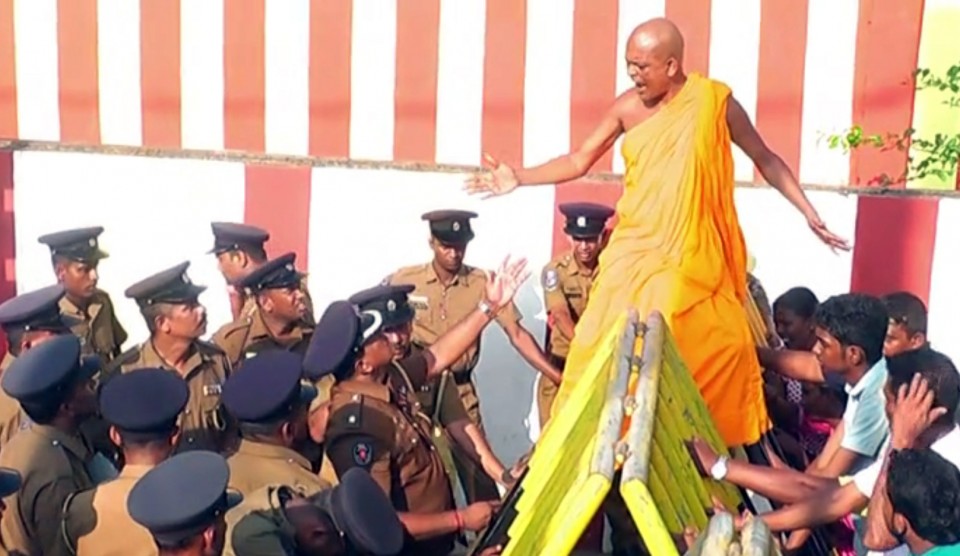
NPP politicians attend remembrances for Sencholai massacre victims

Remembrances have taken place in Jaffna and the Wanni to remember victims of aerial bombings on a children’s home at Vallipunam in Mullaitivu 19 years ago that claimed the lives of 61 Tamils, including 54 schoolgirls.

Regional leaders of the NPP too, attended the events.

The attack that has come to be known as the Sencholai massacre on 14 August 2006 also left more than 150 injured, some disabled for life.

A remembrance event took place at the site, where relatives offered floral tributes and lit lamps and candles to victims’ photographs.

ITAK MP Thurairaja Raviharan was among those present.

Parallel events took place at the University and also the Municipal Council in Jaffna, where NPP MPs stood up as lamps were lit for the dead.

TNPF leader Gajendrakumar Ponnambalam and others held a remembrance at Vallipunam.

The Air Force bombing of the facility occurred as a first aid and disaster workshop was taking place for the girls.

The then government spokesman Keheliya Rambukwella defended the attack by saying the place had been identified as an LTTE training camp. Ceasefire monitors, UN and relief agencies that visited the scene later confirmed no military training had taken place there.

Posted in Uncategorized

Buddhist clergy offer Mahinda Rajapaksa a home

National Organiser of the Sri Lanka Podujana Peramuna (SLPP) MP Namal Rajapaksa says that several senior Buddhist monks have pledged to intervene and provide accommodation for former President Mahinda Rajapaksa should his official privileges be withdrawn under a proposed new law.

Rajapaksa said that prominent members of the Buddhist clergy had assured him they would not allow the former leader to be left without shelter. “They told me that if his privileges are taken away, they will make sure he has a house,” Rajapaksa said.

A proposed bill by the ruling National People’s Power (NPP) government aims to scale back state-provided benefits for former Presidents and their spouses, including official residences.

Interviews begin to register new political parties, 47 shortlisted

The National Election Commission (EC) states that interviews for new political parties applying for registration for the year 2025 have commenced.

Commissioner-General of Elections Saman Sri Ratnayake noted that 47 political parties have been selected for preliminary interviews.

Applications for registering political parties for this year were called in February, during which a total of 83 applications were submitted.

Out of these 83 applications, 36 were rejected due to failure to meet the basic requirements, according to Commissioner-General Ratnayake.

Accordingly, preliminary interviews are currently being conducted for the remaining 47 applications.

Political parties selected from these initial interviews will be invited to a second round of interviews.

Following the second round, those parties that qualify will be officially registered as new political parties for the year 2025, the Election Commission confirmed.

At present, there are 86 recognized political parties in Sri Lanka.

OHCHR: Sri Lanka unlikely to ratify Rome Statute

Sri Lanka is unlikely to ratify the Rome Statute of the International Criminal Court (ICC) at this time, according to Ministry of Foreign Affairs Spokesperson Thushara Rodrigo, despite renewed international pressure for the Government to do so.

Speaking to The Sunday Morning, Rodrigo stated that the Government’s primary focus was on domestic reconciliation and democratic reform.

“The High Commissioner had a very amicable visit to Sri Lanka, and his activities were very transparent and open to public questioning at a press briefing also. The Government also worked closely with the High Commissioner and continues to do so,” he said.

“Wherever concerns were raised, the Government cooperated and provided positive responses in the best interests of the country. What I can say is that we are willing to work with the United Nations (UN), but it needs to happen within a constitutional framework,” he added.

Rodrigo stressed that accountability and reconciliation remained central to the Government’s agenda, but would be pursued through domestic mechanisms.

“Those who have broken the law must be held accountable, but through proper judicial mechanisms in the country. As a sovereign State, accountability must be pursued through sovereign institutions,” he said.

His comments come just days after the Office of the UN High Commissioner for Human Rights (OHCHR) presented its latest report on Sri Lanka to the Human Rights Council.

The report urged the Government to implement sweeping reforms to end entrenched impunity and to deliver justice to victims of war crimes and human rights violations committed during and after the country’s armed conflict.

Among its central recommendations, the OHCHR called on Sri Lanka to accede to the Rome Statute of the ICC. The UN High Commissioner for Human Rights argued that joining the ICC would provide an “enabling environment for transitional justice” by ensuring impartial accountability for international crimes, particularly given the persistent failures of domestic mechanisms.

The report noted that despite multiple pledges, Sri Lanka had failed to adequately investigate emblematic cases, prosecute perpetrators of enforced disappearances and torture, or bring justice to victims of conflict-related sexual violence.

It further highlighted that the Office on Missing Persons (OMP) had clarified the fate of only 18 individuals out of more than 15,000 cases filed, eroding trust among affected communities.

The High Commissioner warned that unless Sri Lanka joined international frameworks such as the Rome Statute, these accountability gaps would continue.

Accession, he stressed, would complement domestic reforms by subjecting alleged crimes of genocide, war crimes, crimes against humanity, and the crime of aggression to impartial scrutiny when national courts fail to act.

The OHCHR also linked Rome Statute accession with broader reconciliation measures, including the release of long-term detainees under the Prevention of Terrorism Act, halting military land seizures in the north and east, and ensuring impartiality in institutions such as the OMP.

These steps, it argued, would help build trust among victimised communities and demonstrate the Government’s willingness to genuinely address past abuses.

Rodrigo, however, insisted that while the Government was committed to strengthening democratic institutions and working with the UN, it could not allow external mechanisms to override national sovereignty.

Posted in Uncategorized

HRW says UN rights report details security force abuses

The United Nations Human Rights Office’s report on Sri Lanka details entrenched and systemic rights violations—including arbitrary detention, torture, and deaths in custody—under President Anura Kumara Dissanayake, Human Rights Watch said.

The new report by the UN High Commissioner for Human Rights, Volker Türk, also describes the misuse of draconian laws to silence families and activists campaigning for justice and says that continued international engagement through the UN Human Rights Council is “essential.”

The Human Rights Council should renew existing UN mandates on Sri Lanka at its 60th session, which begins September 8, 2025. Amid near-complete impunity for past atrocities and ongoing violations against members of minority communities in Sri Lanka, the council over the years has adopted a series of resolutions stemming from the widespread abuses linked to the 1983-2009 civil war between the government and the separatist Liberation Tigers of Tamil Eelam. Since 2021, the council has mandated regular UN reporting on human rights in Sri Lanka and established the UN Sri Lanka Accountability Project to collect, analyze, and preserve information and evidence of serious crimes to support future prosecutions.

“President Dissanayake’s election campaign pledges to deliver justice have resulted in few real changes,” said Meenakshi Ganguly, deputy Asia director at Human Rights Watch. “The UN Human Rights Council should take note of the human rights chief’s finding of enduring security agency abuses and take action.”

During his 2024 election campaign, Dissanayake pledged to repeal the draconian Prevention of Terrorism Act (PTA), which enables torture and prolonged arbitrary detention; amend the Online Safety Act, which threatens freedom of expression; and establish an independent public prosecutor to promote accountability. The government failed to implement these pledges, and instead the high commissioner found that “the structural conditions that led to past violations persist.”

The continued use of the counterterrorism law is particularly concerning. The high commissioner reported increased use of the Prevention of Terrorism Act, from 38 cases in all of 2024 to 49 during the first five months of 2025. The law is typically used against members of the Tamil and Muslim communities. The high commissioner also describes “routine use of torture and other forms of ill-treatment” and multiple cases of deaths in police custody, as well as “a lack of effective investigation into these cases.” The Human Rights Commission of Sri Lanka told Human Rights Watch in July that it reviewed 736 torture complaints last year.

The high commissioner found that “the surveillance apparatus, especially in the north and east, has remained largely intact, with minimal oversight or direction from the central government,” leading to continued patterns of “intimidation and harassment of families of the disappeared, community leaders, civil society actors, especially those working on accountability for enforced disappearances.” Among those targeted are families of victims who have engaged with the Human Rights Council.

The government continues to suppress the activities of nongovernmental organizations and human rights activists. Many groups face limitations on their funding, while officers from the Terrorism Investigation Division often summon activists for questioning or visit their homes or offices.

The report emphasized the importance of justice for victims of the civil war as well as the thousands of victims of enforced disappearance, torture, and extrajudicial killing during the 1987-1989 uprising in southern Sri Lanka by the Janatha Vimukthi Peramuna (People’s Liberation Front or JVP), the formerly militant leftist party that is now the largest constituent of the Dissanayake government. The high commissioner reported that about 20 mass graves have been discovered in Sri Lanka, of which five are currently being investigated. The government should seek international support to ensure sufficient financial, human, and technical resources to ensure preservation and conduct exhumations in line with international standards, Human Rights Watch said.

However, numerous emblematic cases illustrate the “unwillingness or inability of the State to prosecute and punish alleged perpetrators,” according to the high commissioner. Regarding the 2019 Easter Sunday bombings of churches and hotels that killed over 250 people, the high commissioner noted that successive governments “have failed to provide a comprehensive account of the circumstances that enabled those attacks, particularly regarding the role of the security establishment.”

The high commissioner noted that since Dissanayake took office last September, the authorities have made some progress in pursuing corruption cases but, like preceding governments, have failed to acknowledge the government’s responsibility for abuses, particularly the role of the military and other security forces in serious international crimes. In particular, survivors of conflict-related sexual violence experience “fear of retaliation, social stigma, and lack of trust in justice mechanisms.”

Ongoing abuses highlight the importance of continued Human Rights Council support for the UN Sri Lanka Accountability Project, as well as the UN’s ongoing monitoring and reporting, Human Rights Watch said. The council should call on the government to end the surveillance and harassment of victims’ families and human rights activists and impose a moratorium on the Prevention of Terrorism Act.

“After a year in office, President Dissanayake has not significantly improved Sri Lanka’s terrible human rights record,” Ganguly said. “Continuing engagement by the Human Rights Council and renewal of the accountability project is crucial so long as the government fails in its obligation to respect and protect the rights of all Sri Lankans.”

Posted in Uncategorized

India’s 79th Independence Day celebrated in Sri Lanka

The 79th Independence Day of India was celebrated with great fervour in different parts of Sri Lanka.

The main event in Colombo was held at ‘India House’, the official residence of High Commissioner of India.

High Commissioner of India to Sri Lanka Santosh Jha hoisted India’s National Flag and inspected the Guard of Honour. He also read excerpts of the address by Hon’ble President of India to the nation on the eve of the 79th Independence Day.

Several cultural events added vibrancy to the celebrations, with the Sri Lanka Navy Band delivering melodious tunes embodying valour and patriotism, while students of the Swami Vivekananda Cultural Centre performed famous patriotic songs.

High Commissioner and officers of High Commission of India also paid homage at the Indian Peace Keeping Force (IPKF) Memorial to the memory of the Indian soldiers of IPKF who made the supreme sacrifice defending peace and unity of Sri Lanka.

Special events were organized by the Assistant High Commission in Kandy, Consulate General in Jaffna and Consulate General in Hambantota as well on the momentous occasion.

Later in the day, a grand cultural evening titled “Bollywood & Beyond”, featuring Global Violin Icon Dr. L. Subramaniam and Multi-Platinum Playback Singer Kavita Krishnamurti Subramaniam, had been organised to celebrate the 79th Independence Day of India.

To further mark the celebrations, Havelock City Mall, in collaboration with the Swami Vivekananda Cultural Centre and the High Commission of India in Colombo, will host India Fest 2025, a vibrant three-day festival from August 15–17, 2025, that will showcase Indian fashion, handicrafts, cuisine, live performances, film screenings, and cultural activities, offering the public an immersive experience of India’s rich heritage.

Provincial Council Elections Planned For First Six Months Of Next Year

Minister of Transport, Highways, Ports, and Civil Aviation Bimal Rathnayake says that preparations are underway to hold the provincial council elections during the first six months of next year (2026).

The Minister said that steps have already been taken to resolve existing legal issues related to the election process.

He emphasized that the government is prioritizing the provincial council elections, aiming to hold them before broader constitutional reforms are introduced.

While constitutional changes remain part of a wider political process, the immediate focus is on addressing legal obstacles to ensure the elections proceed as planned, he added.

Posted in Uncategorized

Lanka to borrow US$500 mn in yuan to cover CEP1 cost

President Anura Kumara Dissanayake has sought Cabinet approval to borrow the equivalent of US$500 million in renminbi (RMB) from the EXIM Bank of China and to separately disburse US$438 million of Sri Lankan government funds to complete the long-delayed first section of the Central Expressway (CEP 1).

This means that Sri Lanka, which has no RMB income, will have to convert its US dollar reserves to repay the loan. It additionally necessitates an amendment to the original commercial contract agreement, for which Cabinet approval has also been sought. The change in currency from USD to RMB is at the request of China EXIM.

Earlier this month, a committee appointed to analyse outstanding financial claims from the Metallurgical Corporation of China Ltd (MCC), the contractor for the 37.1 km stretch from Kadawatha to Mirigama, recommended settling the multibillion-rupee payments and negotiating with the same company to build the remainder of the road.

The China Exim Bank-funded project is stalled at a mere 36.38 per cent physical progress since construction started in September 2020. Recent delays were largely attributed to Sri Lanka’s economic crisis, which caused the suspension of loan disbursements from the Exim Bank and a lengthy debt restructuring process.

The Sri Lanka Government and the EXIM Bank of China entered into a preferential buyer’s credit agreement as early as March 2019 to finance CEP 1. An amendment to that contract was signed in June 2024 under Sri Lanka’s external debt restructuring process.

In April this year, Sri Lanka’s Finance, Planning and Economic Development Ministry—which comes under President Dissanayake—communicated to China EXIM the Government’s willingness to continue CEP 1 with EXIM Bank financing. EXIM requested a change in currency. Discussions were subsequently held regarding the loan currency and amount, interest rate, etc., and agreement was reached on an interest rate cap and floor of 2.5% to 3.5%.

The original EXIM Bank concessional loan was US$989 million, of which just US$51.5 million was disbursed before its suspension. While the remainder is US$938 million, EXIM, post-debt restructuring, has now only committed to lending US$500 million in RMB. Consequently, the Sri Lanka Government has undertaken to fork out the remaining US$438 million.

With the continuation of the contract, the Government must pay the contractor around US$200 million in claims and interest. A proposal by five of Sri Lanka’s largest construction companies to cancel the 2015-16 direct contract granted to MCC and to call for fresh, competitive, open tenders—on the basis that this proposition would cost the country far less and also lead to a speedier conclusion of the road—has been disregarded.

Hartal aimed at jolting govt. into addressing unresolved issues: Tamil political parties

Several Tamil political parties have planned to stage a hartal today (18) in the Northern and Eastern provinces demanding the repeal of the Prevention of Terrorism Act, holding provincial council elections, and resolving land disputes affecting the Tamil community.

Batticaloa District ITAK leader MP Shanakyan Rasamanickam told The Island that the hartal would be led by leaders of three Tamil and three Muslim parties, representing the region in Parliament.

Rasamanickam said that the protest aimed to present demands peacefully. He said that ordinary residents of the Northern and Eastern provinces faced numerous difficulties, including military control over lands, schools and all aspects of civilian life. The military’s agricultural activities had caused economic hardships to local residents, he said,

Rasamanickam also mentioned an incident on 7 August in the Muthu Ayankattu in Oddusuddan, Mullaitivu, where Edirmanasingam Kabilraj, a 32-year-old youth had died allegedly at the hands of the army.

Rasamanickam said that his party had formally raised the issues with President Anura Kumara Dissanayake and is calling for solutions through the hartal. He said that although talks had been held with the President in December last year regarding disaster situations, follow-up discussions on the Tamil community’s broader grievances have not been held.

Upcountry People’s Front Leader V Radha Krishnan said that the hartal would cripple all administrative and commercial activities in the Northern and Eastern provinces, with full cooperation from local trade union leaders. Many Tamil party leaders have publicly extended support for the protest.

Radha Krishnan said that the Ceylon Workers Congress had pledged to back the hartal, stressing that without local support, resolving these issues would be difficult.

The SLMC has also announced its support for the hartal. In a statement, the SLMC condemned the killing of Kabilraj in Mullaitivu. “This brutal act is yet another reminder of the deep crisis of law and order within the very forces that are tasked with protecting the public.”

Kabilraj’s body was recovered from the Muttaiyankattu Tank on 9 August, two days after he and four others had reportedly been summoned to a nearby army camp and assaulted.The SLMC further charged that the government’s failure to hold members of the armed forces accountable for such incidents has eroded public trust and endangered the safety of civilians.

by Chaminda Silva and Samanthi Weerasekera ✍️

US combat ship to arrive in Colombo after visits of Indian navy tanker, destroyer

Sri Lanka will see the visit of the Independence-variant littoral combat ship USS Santa Barbara (LCS 32) to the Port of Colombo this weekend over a port call, the US Embassy in Colombo said days after the visit of Indian Navy’s INS Jyoti (Fleet Tanker) and INS Rana (Destroyer) earlier this week.

India and the United States have increased the frequency of their naval ship visits to Sri Lanka as part of a broader strategic response to growing Chinese influence in the island nation’s ports and economy.

The US Embassy in Colombo said the visit of Santa Barbara was underscoring the strength of the US–Sri Lanka partnership and our shared commitment to a secure, prosperous, and free Indo-Pacific.

“It also reflects the longstanding ties between our navies and the close cooperation that defines our relationship. Colombo will serve as a brief stop for the ship to take on fuel and supplies before continuing its mission,” the US Embassy said in its statement.

The USS Santa Barbara is a part of the US 7th Fleet which commands the world’s largest forward-deployed fleet with the primary mission of providing operational control and planning for its forces in the Western Pacific and Indian Oceans, while promoting regional stability and maritime security through engagements with allies and partners, it said.

“The arrival of the USS Santa Barbara to Sri Lanka is a powerful symbol of the US–Sri Lanka partnership in action. As part of the US 7th Fleet—the Navy’s largest forward-deployed fleet—this visit reflects our shared commitment to maritime security, regional stability, and a free and open Indo-Pacific,” US Ambassador to Sri Lanka Julie Chung was quoted as saying.

“We’re proud to stand alongside Sri Lanka as we work together to promote peace and prosperity across the region.”

The USS Santa Barbara is an Independence-variant Littoral Combat Ship designed to operate in near-shore environments and support forward presence, maritime security, sea control, and deterrence missions.

The Santa Barbara conducts regular Indo-Pacific patrols to deter aggression, strengthen alliances and partnerships, and advance future war fighting capabilities, the US Embassy said.

The Santa Barbara’s visit comes while this Indian Navy’s INS Jyoti (Fleet Tanker) and INS Rana (Destroyer) are in Sri Lanka for the 12th Edition of annual Indian Navy (IN) – Sri Lanka Navy (SLN) bilateral maritime exercise SLINEX-2025.

SLINEX-2025 has been aimed at enhancing inter-operability, improve mutual understanding and exchange best practices/ procedures in multi-faceted Maritime operations between both Navies.

Over the past decade, China has made significant inroads into Sri Lanka through major infrastructure investments, most notably the controversial 99-year lease of the Hambantota Port and large-scale loans for projects under the Belt and Road Initiative (BRI).

These developments have raised alarm in New Delhi and Washington, both of which view Sri Lanka as a key node in the Indian Ocean’s maritime security architecture.

Frequent naval engagements, joint exercises, and port calls by Indian and US vessels are seen as efforts to reaffirm military ties, maintain strategic balance, and ensure freedom of navigation in the region, security experts say.

By strengthening defence cooperation with Colombo, India and the US aim to counterbalance China’s expanding footprint and keep vital sea lanes secure from potential geopolitical coercion, they say.