We need strictly fixed time frames for elections By M.S.M Ayub

In spite of allegations by the Opposition parties about the government’s repeated efforts to amend the election laws including the appointment of a ten-member commission by President Ranil Wickremesinghe last month, indeed there is a genuine need for electoral reforms.

What is lacking in the government’s efforts is consistency which provokes suspicion among the people.
The need for electoral reforms arises out of provisions in laws including in the Constitution about elections – national as well as local – which have been proven to lead to corruption and situations against a level playing field during elections.

All remedial measures that have been taken to address the flaws in laws thus far have created new sets of flaws, primarily owing to chicanery and lack of political will to eradicate corruption in politics, on the part of the leaders of the governments of the day.

For instance, the Constitution states “President may, at any time after the expiration of four years from the commencement of his first term of office, by Proclamation, declare his intention of appealing to the people for a mandate to hold office, by election, for a further term.”
The very provision was brought in by former President J.R. Jayewardene through the 3rd Amendment to the Second Republican Constitution in August 1982 in order for him to contest the Presidential election in the absence of his main rival, Ms Sirima Bandaranaike, who had then been stripped of her civic rights for seven years by him.

This provision was then used by several other Presidents as well – even those who opposed that Amendment – to hold Presidential elections at a time when they thought favourable to them. Thus Chandrika Kumaratunga and Mahinda Rajapaksa called Presidential elections in 1999 and 2010 respectively. We do not have strictly fixed time frames for elections.

Provincial Councils could be dissolved by the government in power, through the respective governors to hold elections for them at a time they wish.

Thus, seven Provincial Councils outside the Northern and Eastern Provinces were dissolved by the governors in 1993 before them standing dissolved after their terms ended, as the then United National Party (UNP) government under President D.B. Wijetunge wanted to hold elections for them early.

Local Government elections can also be postponed at any time as the current government did last year, despite the law stipulating a term for them with a specific time frame. And the current stalemate concerning LG polls points to how toothless the Election Commission is before the powers of the Executive.

The government refused to provide funds for the Commission to hold elections on March 9 as it had declared, despite the Supreme Court having ordered not to withhold funds. Now those elections are out of sight.

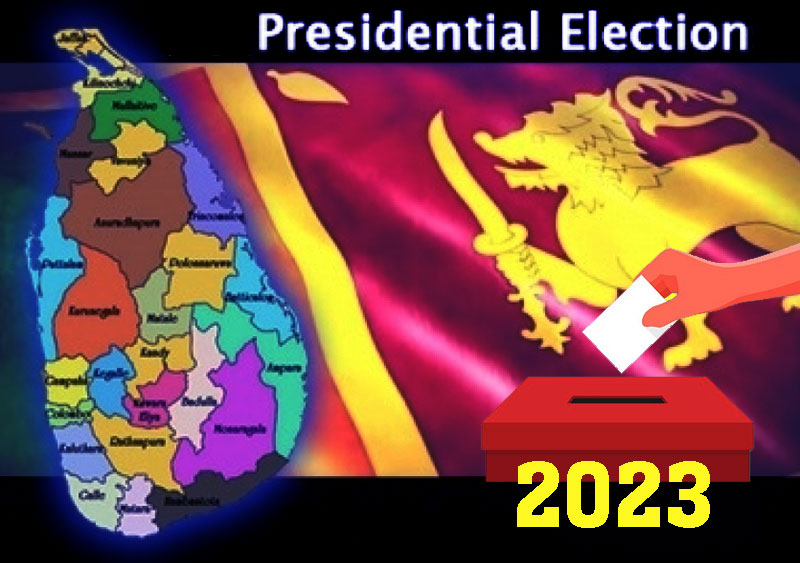
President Wickremesinghe during the convention of his party, the UNP on October 21 announced that the Presidential and Parliamentary elections would be held next year followed by the Provincial elections in early 2025. The next Presidential election as per the Constitution has to be conducted between September 18 and October 18 next year, since President Gotabaya Rajapaksa assumed office on November 18, 2019.

However, the Elections Commission is empowered to conduct the General Election, unless the President prematurely dissolves the Parliament, only between June and July 2025. And the dissolution of the House could only be done four years and six months after the first session of the current Parliament, meaning only in February 2025. Parliament could be dissolved by a resolution passed by itself, but that too with two-thirds of majority votes being cast in favour of the resolution.

Therefore, it is not clear how the President predicted the General Election also being held next year. The government can do so only by amending the Constitution, but again with a special majority vote. We see throughout recent history governments in power, instead of the Elections Commission, deciding the time for elections, despite the law providing for the Commission to hold elections at specific intervals spelt out by the law.

This is unfair, unethical and against democracy. We need strictly fixed time frames for elections like those in the US which cannot be overridden by the Executive or the government.

Posted in Uncategorized

Former TNA leader Rajavarothiam Sampanthan under pressure to retire

Jaffna District Illankai Thamil Arasu Kadchi (ITAK) MP M. A. Sumanthiran has said that former Tamil National Alliance (TNA) leader Rajavarothiam Sampanthan should retire from Parliament without further delay as the 90-year-old politician finds it extremely difficult to function as a lawmaker.

Sumanthiran, PC, said the Trincomalee District MP had not been able to attend Parliament regularly since the last general election conducted in August 2020 or address vital issues due to ill health.

The ITAK won 10 seats at the 2020 general election. It has 16 seats in the previous Parliament. Mavai Senathiraja received the appointment as the ITAK leader in Sept 2014 in the run-up to the 2015 presidential election.

Sumanthiran said so when The Island sought his response to Eelam People’s Democratic Party (EPDP) leader Douglas Devananda’s declaration that both the TNA and the MP concerned suffered as a result of the latter’s failure to solve the problems faced by the community. Fisheries Minister Devananda, who also represents the Jaffna District, questioned Sampanthan holding on to the party leadership.

Emphasising that Sampanthan should resign, Sumanthiran pointed out that a controversy had erupted in the Tamil media a few weeks back over his response to an issue raised in ‘Face the Nation’ on TV 1, anchored by Shameer Rasooldeen.

“A viewer posed a question regarding spending taxpayers’ money on the TNA leader, who was not present in Parliament most of the time. As this particular live programme dealt with corruption, the viewer queried whether such spending on an MP unable to perform his duties, too, could be categorised as corruption. He asked my stand on the issue at hand,” Sumanthiran said over the weekend.

“I could not sidestep the issue,” MP Sumanthiran said, adding that the ITAK had in September formally requested the TNA leader to step down. He quoted Sampanthan as having told the ITAK delegation that he wouldn’t quit as the people had voted for him at the last general election.

Sampanthan has led the TNA since 2001, the year he recognised the LTTE as the sole representative of the Tamil speaking people. He first entered Parliament in 1977.

During the Yahapalana administration, Sampanthan functioned as the Opposition Leader. The TNA under his leadership won 22 seats in 2004 with the backing of the LTTE.

MP Sumanthiran said all politicians should realise that they could not remain in active politics forever. “We’ll have to make a decision on this issue soon.”MP Sumanthiran said that the ITAK was keen to settle the issue as soon as possible to prevent various interested parties from causing unnecessary trouble.

Hamilton Reserve Bank requests US Court to deny SL’s cross-motion

Plaintiff Hamilton Reserve Bank Ltd., (HRB) has recently filed a ‘Memorandum of Law in Response to the Statement of Interest and AMICUS Brief’ opposing the cross-motion to stay the defendant Government of Sri Lanka requested from US District Court, Southern District of New York.

In its Memorandum of Law, the HRB requests that the court deny the cross-motion to stay Sri Lanka wants, whereas, for decades, courts in the respective District have denied stay orders to defaulting sovereign debtors. The amicus brief of two other creditors, the Republic of France and the United Kingdom, filed in support of Sri Lanka, helps a stay request on the basis that entering judgment now could impede Sri Lanka’s voluntary debt restructuring with other creditors. But disagreeing with the amicus brief and stay request, the plaintiff held “the arguments remain wholly speculative, and fail to make out a clear case of hardship or inequity in being required to go forward.”

“First, both submissions ignore that a stay is unnecessary because this litigation is not impeding Sri Lanka’s restructuring in any way. Sri Lanka’s own State Minister of Finance stated on 11 August 2023, that its restructuring will be completed ‘without major concern’ from this litigation. Recently, Sri Lanka’s largest creditor, China, agreed to restructure $ 4.2 billion in debt, and the Ad Hoc Bondholders Group made its own restructuring proposal to Sri Lanka. The restructuring process is thus proceeding apace. And the Ad Hoc Bondholders Group’s restructuring proposal is structured as an exchange offer, meaning participation is purely voluntary; like other private creditors, Plaintiff is free not to participate and to seek full repayment on its Bonds. For these reasons, no stay is necessary,” held the Counsel for Plaintiff, Jenner & Block LLP in its Memorandum of Law.

The memorandum further argued that a stay is also unwarranted because the remaining challenges are complex geopolitical issues unrelated to this litigation and outside Plaintiff’s control. Highlighting two recent developments illustrating the complexity, the Counsel held in the memorandum, “In September 2023, the IMF denied Sri Lanka its second tranche of funding because it failed to meet its economic reform commitments, while concluding that Sri Lanka has ‘systematic and severe governance weaknesses and corruption vulnerabilities across state functions.’ The fact that Sri Lanka failed to secure IMF funding for reasons entirely unrelated to this lawsuit counsels against a stay supposedly necessary to protect such funding.”

“Recent reports also demonstrate that China, not Hamilton or any other private bondholders, has been a major roadblock to Sri Lanka’s restructuring. China is Sri Lanka’s largest creditor with $ 7.3 billion in loans and reportedly would not negotiate with other creditors, such as India, to maximise its leverage. The Economist reported on 28 September that IMF ‘officials flew back from Colombo without releasing a dollar,’ and ‘the problem was two-fold: Sri Lanka’s tiny tax take and China, which is the country’s biggest creditor’. By refusing to take a haircut on its debts, China is holding up Sri Lanka’s restructuring, as it is in other indebted countries, too. There was no mention of Hamilton. China’s position is due in part to its strategic competition with India for influence in Asia. And as Sri Lankan President Wickremesinghe stated, we are caught in a geopolitical rivalry. While recent reports that China has agreed to restructure $ 4.2 billion in debt indicate progress, Plaintiff’s legal ‘rights cannot be put on hold pending geopolitical developments that may or may not come to pass, and which courts are ill-equipped to assess,” it added.

As the second and the third arguments, it is held that no actual holder of Sri Lanka’s International Sovereign Bonds has supported a stay or taken issue with this case. “If Hamilton truly were a cog in the wheel, other ISB holders would have supported a stay. And the other holders include sophisticated parties (such as Fidelity and BlackRock) who surely are aware of this lawsuit and know how to make their voices heard. By contrast, France and the United Kingdom are official creditors who do not hold ISBs and speak only for themselves. Far from being aligned with private creditors, these official creditors simply seek to delay this litigation and cannot deny that, as a competing class of creditors, it is in their economic self-interest to do so. The United States’ support for a stay breaks with four decades of precedent without any factual support, and thus should be accorded the lowest level of deference.”

For decades, the Second Circuit has cautioned courts against granting stays to foreign sovereign litigants based on indeterminate debt restructuring proceedings in the face of clear United States policy allowing creditors to recover on foreign debts. Although the United States advocates negotiations to effect debt reduction and continued lending to defaulting foreign sovereigns, it has long been the law that creditor participation must be on a strictly voluntary basis and debts must remain enforceable throughout the negotiations.

“There is no factual basis to depart from this precedent. The United States simply asserts in

conclusory fashion that a ‘stay would facilitate an orderly and consensual sovereign debt restructuring’, but offers no showing that Plaintiff has impeded Sri Lanka’s restructuring in any way or that entering judgment would do so. Nor does the United States show that any general interest in supporting a restructuring should outweigh Plaintiff’s specific, material interest in timely enforcing its Bonds. Because the United States’ position is based on the ‘identical, erroneous premise’ advanced by Sri Lanka, that a judgment could complicate a restructuring, despite no evidence that it will ‘considerably less deference is owed.’ Indeed, this Court has rejected similarly evidence-lacking arguments where, as here, the United States did not ‘contend that the lawsuit is frustrating or will frustrate United States foreign policy,” the Plaintiff’s Counsel asserted.

Further, in the past, the United States has argued that respecting private creditors’ contractual rights is critical to support future growth of indebted nations, and it does not explain how this time is different. As it cautioned in 1984, for the courts to try to dictate the terms of contractual agreements between debtors and private creditors would jeopardise the cooperation of private creditors in the future, which is critical to the economic growth of debtor countries. “Sri Lanka will surely need new financing to grow. But when Sri Lanka seeks to re-enter the international capital markets, what investor would lend to Sri Lanka if its debt cannot be timely enforced? Delaying the enforcement of Plaintiff’s contractual rights will simply increase Sri Lanka’s cost of capital and undermine New York’s status as a global financial centre,” the memorandum added.

Sri Lanka was sued in the United States by a bondholder after the government defaulted on its debt for the first time in history while struggling to stop an economic meltdown where HRB, owns over $ 250 million in principal amount of $ 1 billion worth of Sri Lanka’s 5.86% International Sovereign Bonds (ISBs) issued in 2012, filed the lawsuit in June last year in a New York federal court seeking full payment of principal and interest. The Bonds matured on 25 July 2022. Hamilton alleged that due to Sri Lanka’s default, it is owed $ 250.19 million in principle and $ 7.35 million in accrued interest (before accounting for pre-and post-judgement interest). Sri Lanka in mid-April announced a moratorium on foreign debt repayments, including the Bonds and since then has made no payments on the Bonds. The government of Sri Lanka filed a motion in September 2022 to dismiss on the grounds that the plaintiff lacks contractual standing.

China seeks another research ship visit approval from Sri Lanka – sources

China has sought approval from Sri Lankan authorities for another research ship in early next year, but the approval is yet to be granted, two government sources said amid rising objections from the island nation’s neighbour, India, over the region’s security concern.

The sources, however, said unlike the earlier approved requests, the latest has come without a local partner and the research area being decided by Beijing.

“The approval has not been granted yet and China has requested approval for this research ship to come around February,” one source, a top Sri Lankan government official, told EconomyNext.

Foreign Ministry spokesman Kapila Fonseka said he is unaware of a request by China, while the Chinese embassy in Colombo did not comment despite efforts by EconomyNext.

Beijing has already sent two research ships in the last 14 months despite concerns raised by India, which has consistently said the vessels are for “spying” in the Indian Ocean.

Chinese research ship Shi Yan 6 arrived in Sri Lanka last week, citing for “geophysical scientific research” in collaboration with the island nation’s National Aquatic Resources Research and Development Agency (NARA)

The new move is likely to add to neighbouring India’s concerns about China’s growing influence in the Indian Ocean.

In August last year, Chinese navy vessel Yuan Wang 5 docked at Hambantota in southern Sri Lanka.

Posted in Uncategorized

‘Not decided on helping any party’: CBK

Former President and one-time Sri Lanka Freedom Party (SLFP) Leader Chandrika Bandaranaike Kumaratunga on 4 November stressed that she has not decided to support any political party for politics.

Addressing an event to grant scholarships for schoolchildren, Kumaratunga denied reports that she had asked for a special position within the SLFP to return to active politics.

Late last week, the media had reported that Kumaratunga had decided to make a political comeback by joining the SLFP, and supporting its affairs again.

When contacted by The Daily Morning to inquire about the matter, the Acting General Secretary of the SLFP, MP Sarathi Dushmantha said that they were currently in discussions with several parties including Kumaratunga and other political parties regarding the SLFP’s future programme.

In response to media reports that there are preparations to separate the post of SLFP Chairperson and Leader so that Kumaratunga could be offered one of those positions, he said: “Kumaratunga is currently the Patron of the SLFP. There has been no discussion to the extent of having to amend the Party’s Constitution, and introduce new portfolios, but we are all of the view that she is a great strength to us, and we should therefore receive her support.”

However, speaking to the media at an event organised by the Anura Bandaranaike Memorial Foundation to grant scholarships to schoolchildren of low-income families, Kumaratunga said that she had not decided to support any political party, as reported by certain media organisations. “The media reports state that I have asked for a post, which is totally false. It was the SLFP Leader who came to me and pleaded for my support, but I have not decided to support any party.”

Following former president Mithripala Sirisena, in his capacity as SLFP Chairman, deciding to suspend the party membership of Kumaratunga and several other SLFP members in 2022, they were at loggerheads, and seen criticising each other on several occasions. It was against that backdrop that they saw a reunion at a recent event to commemorate the slain and late Prime Ministers S.W.R.D. Bandaranaike and Sirimavo Bandaranaike, and the late Speaker Anura Bandaranaike in Horagolla.

Posted in Uncategorized

SLPP’s 4 requests to president for immediate implementation

The Sri Lanka Podujana Peramuna (SLPP) has submitted four proposals to president Ranil Wickremesinghe for immediate implementation.

A continuation of the ‘Samurdhi’ allowance and the fertilizer subsidy, reintroduction of decentralized budgets for MPs and no job losses in the restructuring of state entities are the requests.

SLPP general secretary Sagara Kariyawasam has made them in writing, especially noting that it was inappropriate to replace the Samurdhi, terming it as the best mechanism to eliminate poverty.

Mood of the Nation: Approval of government falls to 9% in October – Verité Research

The approval rating of the government fell to 9% in October 2023 from 21% in June 2023, according to the latest round of the Gallup style ‘Mood of the Nation’ poll of Verité Research.
The survey showed that satisfaction with the state of the nation also dropped by half to 6%, from 12% in June 2023. The economic confidence score also fell from negative (-) 44 in June to negative (-) 62.

The Mood of the Nation poll is conducted three times a year and is based on an island-wide, nationally representative sample of responses. The survey sample and methodology are designed to limit the maximum error margin to under 3% at a 95% confidence level.

Government approval: To the question “Do you approve or disapprove of the way the current government is working?”, 9% said they approve (with an error margin of ± 1.93%). Further, 7% said that they do not have an opinion. The present approval rating is close to the 10% that it was in January and October 2022, and February 2023.

Sri Lanka satisfaction: To the question, “In general, are you satisfied or dissatisfied with the way things are going in Sri Lanka?”, only 6% said they were satisfied (with an error margin of ± 1.66%). This rating was as low as 4% in February 2023.

Economic confidence

The economic confidence score worsened to negative (-) 62 in October from negative (-) 44 in June. However, this was better than 2022 levels, when the economic confidence score ranged between negative (-) 96 and negative (-) 78.

Multiple choice questions on the condition and trajectory of the economy are used to generate the economic confidence score. The score can range from negative (-) 100 to positive (+) 100.
A score above zero means more people see the economic conditions positively rather than negatively. If everyone thinks that the economy is in poor condition (instead of good or excellent), and everyone also thinks it is getting worse (rather than better), then the score will be a (-) 100.

Survey implementation

The Mood of the Nation survey is designed to assess the approval, satisfaction, and confidence of the nation in relation to the government, the country, and the economy. The poll is based on an island wide nationally representative sample of responses from 1,029 Sri Lankan adults, conducted from 21 to 29 October 2023.

The poll is conducted as a part of the syndicated survey instrument of Verité Research with the polling partner Vanguard Survey (Pvt) Ltd. This instrument also provides other organisations the opportunity to survey the sentiments of Sri Lanka.

Posted in Uncategorized

How Sri Lankan hurdles can hamper connectivity projects to India By N Sathiya Moorthy

By seeking to escalate the long-term fishers’ issue at a time the two nations are resuming the forgotten ferry service after four decades, Sri Lanka’s Fisheries Minister Douglas Devananada may be torpedoing the larger connectivity project of his President, Ranil Wickremesinghe.

The minister’s reiteration of an earlier demand for an UN intervention to ‘prevent the large Indian fishing fleet from poaching in Sri Lankan waters’ at a second such meeting in the past months, with the UN Resident Coordinator Marc-André Franche in Colombo has the potential for non-Establishment Indian stake-holders to challenge the 1974 ‘Katchchativu Accord’, at the ICJ or such other fora, whatever their locus standi. Equally important is the potential for Minister Devananda’s initiative to torpedo the multi-nation Colombo Security Conclave (CSC) on Indian Ocean security, starting with non-traditional security in these waters, where the two nations have a lot to share between themselves and with other signatory-nations in the region.

Considering that it is an international initiative, it is unclear if Devananda had Cabinet clearance and/or the President’s approval for approaching the UN directly, over the head of the Foreign Ministry, which alone is known to handle such matters all along. All along the Foreign Ministry has been handling the issue, and at the bilateral level. Yes, the Fisheries Ministry has been the ‘line ministry’ in the matter, but then it had not acted unilaterally. As such, any deviation from the known and/or approved course will have larger bilateral consequences.

Alternatively, it has to be assumed that the Cabinet and/or the President have/has given approval for Minister Devananda to rake up the issue at the ‘international level’. This has an entirely different set of interpretations and consequences at multiple levels. It is again unclear if it is so, and if so, the decision-makers have taken a closer look at issues.

What more the current ministerial initiative seeking extra-stake-holder intervention, even if by the UN, comes at a time when Sri Lanka has named former Foreign Secretary Kshenuka Seveniratne as the next High Commissioner to India at New Delhi. Until recently, Sri Lanka’s Permanent Representative (PR) at the UN Headquarters, Amb Seneviratne is well-versed with the fisheries’ issue, she having headed governmental delegations for talks with India, when she was Additional Secretary in the Foreign Ministry.

Reviving a dream

The ferry service – this one, between Nagapattinam in southern coastal Tamil Nadu Kankesanthurai (KKS) in Sri Lanka’s Northern Province — has had a chequered career before being shut down at the commencement of the ethnic war in Sri Lanka. It had begun as the prestigious Boat-Mail train-cum-boat service between the Tamil Nadu capital of Chennai, then Madras and Colombo, the capital of Sri Lanka, then Ceylon. Both nations were then separate colonies of the British Crown, though issues involving the ownership of the tiny Katchchativu Islet had remained.

The boat-link between Danushkodi in Rameswaram further down Nagapattinam, and Talaimannar in northern Ceylon was lost when the 1964 ‘Rameswaram Cyclone’ washed away Danushkodi Island and also the rail assets in the vicinity. Though reviving the ferry service, this time with higher-speed vessels had captured the imagination of leaders in both Colombo and Delhi since the conclusion of the ethnic war in Sri Lanka, it has been an article of faith for President Ranil Wickremesinghe, as a part of his ‘Connectivity Projects’ between the two South Asian neighbours.

Thus, when he mooted the idea of a land-bridge between the two countries when he was Prime Minister in 2004 Wickremesinghe had visualised as an agency for connecting Sri Lanka, its people and businesses not just with the south Indian State of Tamil Nadu, but the southern Indian region as a whole. In a larger perspective, his connectivity dream extended all the way up to the entire Eurasian land-mass, though he did acknowledge that political issues on either land-wings of India would require time to resolve, for the full potential to be achieved.

Not many people in the two countries remember it, but during an official visit to Delhi as Prime Minister, Wickremesinghe had signed an MoU with Indian counterpart Atal Behari Vajpayee, for undertaking technical studies on a land-bridge. If it could not be pursued, it owed to objections from Tamil Nadu’s then AIADMK chief minister Jayalalithaa, who saw the land-bridge as a ‘security risk’ when the LTTE was still around, even if not as active during those years of cease-fire agreement (CFA) with the Sri Lankan Government (2002-06).

Way with waywardness

The larger idea of greater connectivity between the two countries got a new and urgent fillip during President Wickremesinghe’s delayed yet maiden Delhi visit earlier this year, when the two governments signed a series of agreements to increase flight-frequency, resume the ferry service and revive the hopes of a land-bridge. Though academic doubts do exist about the economic viability of such a massive boost to bilateral connectivity on multilateral spheres, the current Sri Lankan dispensation especially is more hopeful than most.

Inside Sri Lanka especially, there has been unconvincing opposition to the land-bridge especially, with some stray voices claiming that it would lead to the nation becoming yet another State of the Indian Union. Such motivated and at times unreasonable critics of the projects seldom look at the prospects of India having to face multi-strata criticism from across present-day Sri Lanka to any such proposal for ‘unification’, which has never ever happened in history, including when the common British colonial power was lording over both countries, as if they were independent nation-States.

These critics are almost always short on facts. They do not want to acknowledge that if India had designs on Sri Lanka, it would not have to ‘give away’ Kachchativu without contesting Colombo’s claims, which were at best contestable. They seldom remember that even the ‘Kachchativu controversy’ has had its origins when the two nations were under the same colonial master but could resolve it, that too in smaller Sri Lanka’s favour, close to a quarter century both had acquired Independence. They often refer to the IPKF operations as a part of the failed Indo-Sri Lanka Accord, aimed at ending Sri Lanka’s ethnic war early on, as New Delhi’s attempt to have Indian boots on the island-nation, but again forget very many facts in the matter.

One, the IPKF came to Sri Lanka at the written request of wily President J R Jayewardene, who made Indian soldiers fight the LTTE as if by proxy, and give up their lives for a cause that was exclusively Sri Lanka’s, if not of the Sinhala majority, better still ‘majoritarians’ in the country. They do not want to remember that the IPKF left the country, bag and baggage, when Ranasinghe Premadasa as JRJ’s elected successor, wanted them out.

Whether or not the IPKF had a premonition that Premadasa would fall prey to the LTTE’s bicycle-bound suicide-bomber, but they most definitely knew that his leadership was diverting previous war-material meant for his own armed forces, yes, to the LTTE, of all. Unfortunately, no successor government or even the leadership of the armed forces has ordered a probe into the murky dealings of those days, which made not just Premadasa the man and leader, but also the nation’s armed forces, sitting-ducks for the LTTE, for a lot more time to come.

And long after the IPKF’s disastrous relations with the Sri Lankan government (but not their own counterparts), India continued to send in its forces, this time exclusively on a humanitarian mission, post-tsunami, end-2005. The alacrity and pace with which India handled what was Sri Lanka’s situation, that too when coastal south India and the Andaman Islands, including the tri-forces command HQ, too, were badly hit by the tsunami, should have spoken volumes even to lesser mortals. Once again, Indian troops left once the immediate rescue and relief operations were over. Yet, the Sinhala-Buddhist majoritarians have a way, even with their waywardness…

Joint vision

Mr. Wickremesinghe said hailed it an important step in improving connectivity between the two nations, and recalled how people of both countries have travelled across the Palk Strait for many years. Indian PM Modi, again in a video-message, reiterated his statement after the meeting with President Wickremesinghe in Delhi, and said that the ferry service will help strengthen cultural, commercial, and civilisational ties between the two nations. Connectivity is the central theme of the ‘joint vision’ of the India-Sri Lanka economic partnership, he said adding that India will take steps to resume the Rameswaram-Talaimannar ferry service as well. In his video message, India’s External Affairs Minister (EAM) S Jaishankar called it a “truly big step for people-to-people contacts between India and Sri Lanka…. And it was so recognised by Prime Minister Modi and President Ranil Wickremesinghe,” Jaishankar said.

Though the initial plan was to revive the original Rameswaram-Talaimannar route, but it would have meant a further delay as civil works needed to be taken up at both ends. Various alternatives were considered in India, like Karaikal and Puducherry, but Nagapattinam was found to be fast and feasible. Because it was all done in a hurry, as the two governments wanted to launch the service before the cyclone-prone north-east monsoon sets in this month (October), there was not much preparation or pre-launch publicity or guarantee for regularity.
The up-and-down daily trips thus have since been reduced to alternate days until 23 October, the last day before monsoon holiday, after which the ferry service would reopen in January in a full-fledged manner. The current run, where there were only a few passengers on board – but included some excited western tourists – would help the authorities to fix operational problems, if any, before the full commercial launch. By the time, there is also the hope of a better, larger vessel being pressed into service, as for what could now be called the ‘trial run’, India had temporarily diverted Hindustan Shipping Corporation’s ‘HSC Cheriyapani’, which was one of the three speed boats doing the inter-island routes in the Lakshadweep group.

Addressing India’s federal Shipping and Ports Minister Sarbananda Sonowal, who was present at the launch-function, Tamil Nadu’s Ports Minister E V Velu wanted the one-way ticket price to be reduced from the current INR 7,670 (LKR 30,000 appx). That way, Sri Lanka’s Transport, Shipping and Ports Minister, Nimal Siripala de Silva was on hand at Kankesanthurai, to receive the first batch of travellers.

Cause for concern

It is in the overall background, ill-advised initiatives like Minister Devananda’s, that too coinciding with the ferry re-launch, becomes a greater cause for concern than meeting the eye. It is to be noted that every Government in New Delhi since the signing of the ‘Katchchativu Accord’ in 1974 and a modified IMBL Accord in 1976, has conceded that Indian fishers, especially from southern Tamil Nadu and Karaikal enclave of the Puducherry Union Territory, were violating the IMBL on occasions.

Despite the continuing all-round opposition in Tamil Nadu, where it is a sensitive political issue, New Delhi has repeatedly proclaimed that Kachchativu remained a part of Sri Lanka, as outlined in the 1974 Accord. It has also been underscoring the fact that the livelihood of fishers in both nations cannot be interfered with.

It is Indian fishers in the case of their Tamil brethren from northern Sri Lanka, and by the Sri Lanka Navy and lately, Sri Lankan Tamil fishers, in the case of the other. In recent weeks and months especially, there have been constant reports of local fishers from Sri Lanka’s North independently raiding the Indian fishers’ vessels and looting their catch and gears, just as they have all along been complaining about bottom-trawlers from across the Palk Strait destroying theirs all along. Then, of course, there are continual reports of the Sri Lanka Navy (SLN), in the name of curbing poaching by Indian fishers, arresting them and their vessels, under relatively new laws in that country, and freeing only the former after governmental intervention but letting the boats and gears to rot under the open sky.

Greater sensitivity

Bilateral cordiality being what it is now, and the national governments’ joint desire is to fast-track all connectivity projects so that Sri Lanka would not have to risk another economic melt-down as happened last year, there is need for greater sensitivity in both nations towards the ferry service on the one hand and the land-bridge and other projects on the other. Yes, the connecting waters of the Palk Strait cannot be made murky where they are not, and murkier where they already are.

This is because the safety of ferry travellers initially and also pleasure and adventure tourists, not to mention Buddhist, Hindu, Muslim and Christian pilgrims using the cheaper ferry service, compared to air travel, would be compromised if the fishing waters are to be troubled more than already – and continues to be so in the weeks and months after resumption in January.
In between, the heightened fishers’ issue in the region, including the frequent harassment and subsequent arrest of fishers from Nagapattinam region especially (but not exclusively so) in Sri Lankan waters could have consequences for the ferry service, which when resumed full-scale. With the ferry service on, and connecting train services too facilitated in due course, it can interest southern Sri Lanka tour-operators to use the route for aged pilgrims visiting Buddhist religious centres like Bodh Gaya and Saranath in north India.

This is not to leave out Hindu, Muslim and Christian pilgrims from both sides to travel to the other – and also small-time traders in Sri Lanka’s North and the East especially to use the ‘free luggage’ quota to buy products in Tamil Nadu, which they have been lugging by flight, paying higher transport costs. The same, of course, goes for normal tourists from one country to the other, who are keen as much on shopping as seeing places and people.

(The writer is a policy analyst & political commentator, based in Chennai, India. Email: sathiyam54@nsathiyamoorthy.com)

Ousted President Gotabhaya Makes Appearance at SLPP Headquarters During Pirith Ceremony

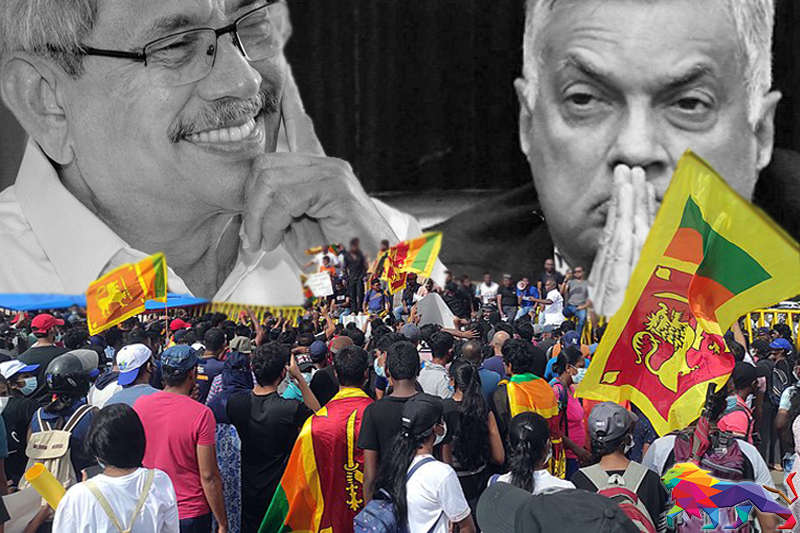
Former President Gotabaya Rajapaksa and former Prime Minister Mahinda Rajapaksa made a notable appearance at the Sri Lanka Podujana Peramuna (SLPP) headquarters in Battaramulla.

The occasion was the celebration of the 7th anniversary of the party’s founding.

This public gathering marked one of Gotabaya Rajapaksa’s rare appearances since his removal from power amidst a wave of public protests.

The pirith ceremony was organized under the oversight of prominent party officials, including Basil Rajapaksa and Sagara Kariyawasam.

SLPP reaping what it sowed BY M.S.M Ayub

The SLPP leaders are unlikely to accept this challenge as it is very clear to anybody conversant with the relevant Constitutional provisions that defeating the budget would be counterproductive to the SLPP

President Ranil Wickremesinghe has been attempting or pretending to be attempting to fully implement the 13th Amendment to the Constitution, apparently keeping the Tamil votes in mind

While speaking to the media on Monday, Transport, Highways and Mass Media Minister Dr Bandula Gunawardena who is also an economist ruled out any possibility of meeting the trade union demand, unless taxes are further imposed or increased

Are we witnessing another Yahapalana Government, not in its literal sense, but in its political sense? One would recollect that the Yahapalana Government was a cart pulled back and forth by two horses.
President Maithripala Sirisena ran one government while Prime Minister Ranil Wickremesinghe was running another. Ultimately, one sacked the other in 2018, but the Supreme Court saved the latter.
However, there is a difference between then and now; the two leaders of the Yahapalana Government were digging each other’s graves whereas leaders of the two parties of the current government do not seem to go to that extent, they are just each other’s throat, really or ostensibly.

President Ranil Wickremesinghe has been attempting or pretending to be attempting to fully implement the 13th Amendment to the Constitution, apparently keeping the Tamil votes in mind.
However, the Sri Lanka Podujana Peramuna (SLPP), the real political strength of the President within the government is not in favour of it. Some of its leaders have been agitating against the idea arguing that Wickremesinghe has been appointed just to run the office for the remaining period of the term of President Gotabaya Rajapaksa who did not have any mandate to fully implement the 13th Amendment.

After the President made various promises from resolving the ethnic problem before the 75th Independence Day to fully implementing the 13 A within two years and convening all-party conferences and negotiations with the Tamil political parties since November last year, the ethnic problem now seems to have been put on the backburner again.

Now the government is attempting to shift the attention of the people from the ethnic problem to electoral reforms, though it had come to the fore intermittently after Gotabaya Rajapaksa assumed office as President in 2019. In the latest move in this regard, President Wickremesinghe has appointed a nine-member commission under the chairmanship of former Chief Justice Priyasath Dep on
October 16.

However, our sister paper The Sunday Times reported that Prime Minister Dinesh Gunawardena had got to know about the Commission only while he was presiding over a discussion two days later with Opposition political parties for the same purpose.

Interestingly, the same paper had also reported that Justice Minister Wijeyadasa Rajapakshe at the time had submitted a concept paper to the Cabinet on amending the Parliamentary Election Law in order to elect 160 members under the First-Past-the-Post system while appointing another 65 members as per the district and national proportion of votes each political party gets.
Things seem to be not planned in one place and thus haphazardly handled.

The divisive approach of the two groups within the government, the Sri Lanka Podujana Peramuna (SLPP) and the United National Party (UNP) towards important issues concerning governance is manifested again in their response to the agitations by the public sector trade unions for Rs 20,000 salary hike.

While speaking to the media on Monday, Transport, Highways and Mass Media Minister Dr Bandula Gunawardena who is also an economist ruled out any possibility of meeting the trade union demand, unless taxes are further imposed or increased.

State Minister for Finance Ranjith Siyambalapitiya also on the same day had stated that a huge amount of money would be needed if the government is to increase the salaries of 1.4 million State workers and payments for 600,000 pensioners, at least by Rs 100.

Both the Minister and the State Minister, particularly the Mass Media Minister who is supposed to inform the masses of the government’s plans, mainly those that were politically gainful to the ruling parties must have been flabbergasted later in the same day evening when President Ranil Wickremesinghe told the Cabinet that government workers’ salaries would be increased through the
upcoming budget.

The Mass Media Minister who previously argued against a pay hike had to inform the people about the President’s announcement the next day. What an irony!

These differences between the President and the ruling party turned into an open conflict as the President in a surprising move made a mini-Cabinet reshuffle involving only three Ministers and a State Minister on October 23.

The health portfolio was removed from Minister Keheliya Rambukwella who faced a no-confidence motion in Parliament last month over allegations of corruption, mismanagement and deaths of patients purportedly caused by substandard drugs and offered to Dr. Ramesh Pathirana in addition to the industries portfolio he has been holding.

The responsibility of plantation industries which was under Dr. Pathirana was given to Mahinda Amaraweera who would also retain the Agriculture Ministry that was already under him. State Minister for Finance Ranjith Siyambalapitiya was appointed as non-Cabinet minister of Plantation Enterprises in addition to what he had been earlier.

Despite the removal of the Health Ministry from Rambukwella being the issue that drew the interest of most of the people, the ruling Sri Lanka Podujana Peramuna (SLPP) was concerned most about Amaraweera being entrusted with the plantation industries portfolio.

They do not see the appropriateness of two similar subjects – Agriculture and plantation industries – coming under the purview of one minister but angrily protesting against a subject that was under a member of their party being assigned to a Sri Lanka Freedom Party (SLFP) member.
Some of the infuriated SLPP leaders, such as its General Secretary Sagara Kariyawasam and Namal Rajapaksa had gone to the extent of making veiled threats to defeat the budget that is to be passed next month.

Some young SLPP leaders had questioned the President’s knowledge about coalition politics. The mini-cabinet reshuffle might have irked the SLPP leaders for another reason as well. The President had ignored their demand to include more of their members in the Cabinet for the past year. They seem to be of the view that their demand should have been met at least to some extent with this latest Cabinet reshuffle.

A group of SLPP dissidents are organizing themselves as separate faction under the leadership of Nimal Lanza MP who is maintaining a close relationship with the President.

The group, it was rumoured was functioning from the Presidential Secretariat, until they found a separate office outside. It is natural for the SLPP leaders to consider this as the President encouraging dissidence within their party.

Adding fuel to the fire, Lanza, on October 26 threw a challenge at Kariyawasam and Namal Rajapaksa to defeat the budget, if they can. In fact, the SLPP leaders are unlikely to accept this challenge as it is very clear to anybody conversant with the relevant Constitutional provisions that defeating the budget would be counterproductive to the SLPP.

The Constitution provides for the President to appoint a new Prime Minister and a Cabinet if a budget is defeated. A hostile President is likely to offer more room for the SLPP dissidents in the Cabinet in such an event, while repeated defeats of the budget by the SLPP at a time when the country is reeling under an unprecedented economic crisis would also politically serve the President.

The current situation may be somewhat humiliating for the SLPP, but it would continue to offer them – at least a section of them – opportunities for corruption and protection as well as perks and privileges as a ruling party until at least the next Presidential election is held in 2024. After all, it was the SLPP that voted Wickremesinghe into power.