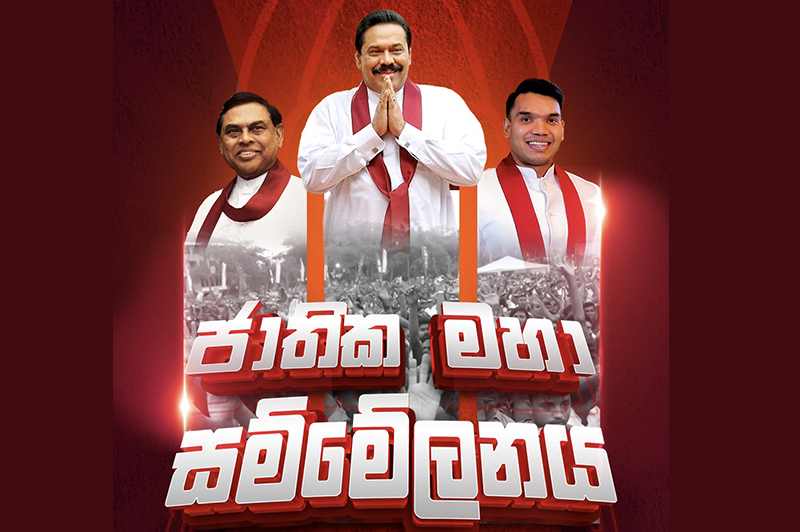
Re-elected leader of the Sri Lanka Podujana Peramuna (SLPP) Mahinda Rajapaksa (MR) and its founder Basil Rajapaksa (BR) declared last week that the party would definitely win the next national election. The boastful prediction was made at the second convention of the party held at the Sugathadasa Indoor Stadium on Dec 15, two days after the SLPP voted for President Ranil Wickremesinghe’s (RW) Budget for 2024, presented on Nov 13, in his capacity as the Finance Minister. But it might become a reality if they put forth RW as their candidate as the Opposition is certainly in disarray with so many contestants with no real direction.
The Third Reading of the Appropriation Bill was passed by a majority of 41 votes. Accordingly, the 2024 Budget was passed with 122 votes in favour of the Bill, while 81 MPs voted against it. Having declared that the people couldn’t be further burdened by the increase in Value Added Tax (VAT) from 15% to 18% and including nearly 100 items a fresh in the VAT list, MP Namal Rajapaksa skipped the vote. The MP owe an explanation why he didn’t vote against or asked his party to reconsider its contentious decision to support RW.
BR emphasized that whatever the election held first the SLPP would win. The former Finance Minister who had been among several persons faulted by the Supreme Court for the ruination of the economy, leading to the declaration of bankruptcy status, urged members and supporters to get ready to form the next government. The Supreme Court on Nov 14 delivered what can be easily called a landmark judgment that sent shockwaves through the ruling party.
Perhaps the most important point stressed by BR was the need for a strong government that could face any challenge. The former lawmaker didn’t mince his words when he found fault with the way his brother Gotabaya Rajapaksa, in his capacity as the President, had handled the public protest campaign. BR declared they would retaliate in case a similar situation arose again.
However, it would be pertinent to point out that the US-backed protest campaign got the excuse to go on the rampage after the SLPP carried out a well-organized attack on protesters at Galle Face, probably out of sheer frustration, as the armed forces and police failed to control the growing menace, with American Ambassador Julie Chung, in particular, urging them not to use force against peaceful protesters. The SLPP should never forget that those who had carried out the first strike walked out of Temple Trees on May 09 morning after having reiterated their commitment to the then Premier Mahinda Rajapaksa.
That attack carried out in the presence of the Colombo police, and the resultant mayhem, compelled the then President Gotabaya Rajapaksa (GR) to invite RW to take over the premiership after Samagi Jana Balawegaya (SJB) leader Sajith Premadasa (SP) squandered the same opportunity offered to him. In spite of being with the main Opposition, with over 50 elected and appointed members, SP backed out of accepting the reins of the premier. Instead, he declared prerequisites for SLPP-SJBV partnership and thereby paved the way for RW. The UNP leader never looked back.
Both MR and BR acknowledged the continuing challenge posed by social media while the former bitterly complained about the ongoing attempts to condemn the SLPP over the economic ruination.
Two former UNP Ministers, Gamini Lokuge and Johnston Fernando, respectively, proposed and endorsed MR as re-elected leader of the SLPP, at the event also attended by Premier Dinesh Gunawardena, leader of the MEP, and EPDP leader Douglas Devananda. A notable absentee was GR, who never took the SLPP membership before the party declared him as its candidate at the Nov 2019 presidential election. GR didn’t bother to take the membership during his short tenure as the President nor did the party ask him to do so.
Outspoken SLPP General Secretary Sagara Kariyawasam, MP, attacked those who accused MR/the Rajapaksas of corruption, one of the primary allegations that led to the change of government in January 2015.
Another notable absentee was former President Maithripala Sirisena, who entered Parliament on the SLPP ticket at the last general election. His opportunistic love/hate relationship with the Rajapaksas might have cost him an invitation. Sirisena caused himself irreparable damage by perpetrating a constitutional coup in Oct 2018 to accommodate MR as the Yahapalana premier, at RW’s expense. The SLFP leader has been reduced to a political nonentity and, as a result, most of his MPs, also elected on the SLPP ticket, have switched allegiance to RW, who now commands a comfortable majority in Parliament.
Unprecedented crisis
In spite of the SLPP declaring confidence in definitely forming the next government, the party needs to examine the daunting challenges it faces. Having won a staggering 145 seats (including 17 National List slots out of 29) at the last general election in Aug 2020, the SLPP has lost over 20 members.
Of the coalition partners, only the MEP with three members (Dinesh Gunawardena, Yadamini Gunawardena and Sisira Jayakody) remains, whereas Wimal Weerawansa’s National Freedom Front (six MPs), Pivithuru Hela Urumaya (one MP) and other smaller parties formed Uththara Lanka Sabhagaya (ULS).
In addition to them, a dozen SLPPers, including its first Chairman and Dullas Alahappremuma have grouped together as Nidahasa Jathika Sabhawa whereas there is another four-member group led by Anura Priyadarshana Yapa.
A series of ill-fated decisions, beginning with the abolition of a slew of taxes and sharp reduction of some, including VAT from 15% to 8%, set the stage for the economic crisis. The SLPP never bothered to examine the consequences, especially against the backdrop of the Covid-19 pandemic.
Then the sudden ban on agro chemicals and a row over shipment of Chinese organic fertiliser caused further destabilization. Trouble erupted in Sept., 2022 when the GR government refused to accept 20,000 tonnes of fertiliser, worth $6.9 million, ordered from China’s Qingdao Seawin Biotech Group. Regardless of Sri Lanka refusing to accept the consignment on the basis of it contained harmful bacteria, the government was compelled to pay for same in the first week of January, 2022.
In the same week GR sacked the then State Minister of Education Reforms and Open Universities Susil Premajayantha following his criticism of the government over the handling of the economy. In the first week of March GR sacked NFF leader Wimal Weerawansa and Udaya Gammanpila in the wake of them, along with Vasudeva Nanayakkara, moving Supreme Court against the deal with a US-based firm over the Kerawalapitiya thermal power station.
The SC didn’t ever bother to hear their case. By then, GR, regardless of his promise not to accommodate Basil Rajapaksa in Parliament, as he enjoyed dual citizenship, brought his brother to Parliament and appointed him the Finance Minister. BR promoted the US energy deal at the expense of the coalition, a move that received the backing of the government. GR’s media team (by then Kingsley Ratnayake and Sudewa Hettiarachchi of Sirasa and Swarnawahini, respectively, led the operation) strongly defended the US energy deal as the government deteriorated.
Central Bank Governor W.D. Lakshman was replaced by Ajith Nivaad Cabraal in the second week of Sept, 2021, as the government reiterated it could overcome the developing crisis without seeking the IMF’s intervention. BR functioned as the Finance Minister, having replaced brother Mahinda Rajapaksa in June 2021.
The SLPP simply ignored warnings issued by coalition members. Kingsley Ratnayake, who served as GR’s spokesperson, declared that Ministers Weerawansa and Gammanpila were removed in terms of the constitution. The SLPP never realized that the US backed the massive public build-up against the government leading to the March 31, 2022, protest outside GR’s private residence at Mirihana, and the subsequent launch of a continuous protest campaign at Galle Face.
Instead of addressing the issues at hand, an influential section of the SLPP launched a high profile project to save MR’s premiership. That project culminated with the attack on the Galle Face protesters on May 09, 2022. The counter attack, most probably premeditated, stunned the government. MR announced his resignation immediately. The government had to fly him out of Colombo to the Trincomalee Navy base where he took refuge. Two months later, GR had to flee Colombo. Unlike MR, GR had to be saved by a warship, moving him from Colombo to Trincomalee.
Last Friday’s SLPP gathering in Colombo was the first since the May 09 gathering at Temple Trees where a section of the party ordered the attack on Galle Face protesters. That decision opened the doors for RW, now at the helm and widely expected to receive the backing of a significant section of the SLPP at the next presidential poll.
RW-SLPP coalition
The SLPP is jubilant over the successful conclusion of the second convention held under trying circumstances. The top leadership (read the Rajapaksas) cannot ignore the declaration of support for RW by individual members of the party.
Several members of the Cabinet and State Ministers have already accepted RW as the government’s presidential candidate. In early April this year Power and Energy Minister Kanchana Wijesekera declared that the majority of the SLPP parliamentary group is of the view RW should be re-elected. Wijesekera was among those present at the SLPP’s second convention.
In July last year, the SLPP MPs elected RW to complete the remainder of GR’s five-year term won at the Nov 2019 presidential election. The next presidential election has to be held by Oct 2024 to ensure that the swearing in of the new president can take place in the following month.
The SLPP’s next challenge is to prevent another crisis over whom the party should support at the next presidential election. Whatever the political parties say, a tough decision awaits the SLPP as RW is certain to seek a five-year term. In other words, the SLPP will have to decide whether to back RW or field a candidate of its own.
In case the party decides to field a candidate, a major breakup is inevitable as a significant and an influential section of the party seemed to have decided on RW’s candidacy.
Having voted for RW’s Budget, claiming that the SLPP didn’t want to rock the boat in view of the ongoing USD 2.9 bn IMF bailout package, can the same party adopt a strategy contrary to that position? In fact, in terms of the agreement with the IMF, the loan is divided into nearly equal eight tranches spread over a period of four years. Therefore, the IMF agreement that had been finalized with the Wickremesinghe-Rajapaksa government sort of tied up the SLPP with RW regardless of whatever political posturing. That is the ground reality.
Both State Finance Ministers are SLPPers, namely Ranjith Siyambalapitiya and Shehan Semasinghe. Those who complain about RW’s revenue proposals, particularly the VAT, have conveniently forgotten Siyambalapitiya and Semasinghe are among the staunchest defenders of RW’s economic strategy or agenda. So, the SLPP will have to engage in serious internal discussion involving the parliamentary group. Rhetoric won’t help the party, especially against the backdrop of RW’s ignoring the SLPP’s request made in July last year to expand the Cabinet. Instead, RW has refrained from at least accommodating new members in place of two Cabinet Ministers removed – Nazeer Mohamed removed by the Supreme Court, and Roshan Ranasinghe unceremoniously sacked by the President. RW’s much smaller Cabinet is packed with SLPPers. The vast majority of State Ministers, too, are SLPPers.
MR seems to have ignored this reality when he declared at the second convention that SLPP members served the government without receiving ministerial portfolios. Those who now enjoyed ministerial perks seemed to be satisfied with RW’s leadership and way the UNP leader addressed issues.
The developing situation should be examined taking into consideration RW seeking to consolidate the Tamil vote by participating in a dialogue with the Global Tamil Forum (GTF) though some Tamils believe the grouping no longer wielded the influence it had a few years ago. However, the GTF initiative drew heavy flak with a collective of Tamil organizations labelling the initiative as treacherous. The grouping declared: “The treacherous initiative by a few individuals from the GTF and its colluders is a despicable attempt to shield Sri Lanka from the international community and UNHRC scrutiny under the pretense of negotiating with imposters.”
Many an eyebrow was raised over the GTF delegation’s meeting with former President Mahinda Rahapaksa. But, whatever the criticism, no one can dispute the fact that the Tamil community, living in the Northern and Eastern Provinces at the 2010 presidential poll, overwhelmingly voted for war-winning Army Commander, the then General Sarath Fonseka. That happened at the behest of the TNA less than one year after the military brought the war to a successful conclusion by delivering a crushing defeat to the LTTE in the battlefield.
As expected the US has thrown its weight behind the latest GTF project while in a separate move RW boosted SJB’s Vadivel Suresh’s image among the plantation community. The plantation vote will be crucial at the forthcoming presidential poll. Obviously RW feels Vadivel Suresh, in his new capacity as an advisor to the President, can play a significant role in his presidential campaign, though CWC’s Jeevan Thondaman is in his Cabinet.
Subsequently, RW appointed Vadivel Suresh as the Co-Chairman of the Divisional Coordination Committees in the Divisional Secretariat Divisions of Passara and Lunugala in the Badulla District.
The UNP leader’s moves will seriously undermine the SJB overall strategy in the upcountry region. The SJB seems to be in a bind as the MP concerned has indicated he is not worried at all about disciplinary action. And it would be a grave mistake on the part of the SJB to even think that the deterioration can be arrested by disciplinary measures.
Likely scenario
The UNP leader seems to be operating on the premise that general election can be advanced in the wake of his victory at the presidential election. In terms of the Constitution, the presidential election will have to be conducted and the new president elected by Nov, 2024 and the general elections next year. In case RW secures the backing of the SLPP MPs (regardless of the party fielding a candidate), the dissident group will contest the general election under RW’s leadership.
Unless the Opposition forms the widest possible coalition, consequences will be devastating and irreversible. Unfortunately, the Opposition, divided on a common platform against the RW-led government seems to be struggling to cope with the challenge.
Regardless of big boasts, the JVP-led Jathika Jana Balawegaya lacks the anticipated support to win at the next presidential. Both JJB’s Anura Kumara Dissanayake and SJB’s Sajith Premadasa have declared their candidature at the next presidential, whereas Field Marshal Sarath Fonseka, too, is widely believed to be interested in throwing his hat into the ring.
Speculation is still rife that businessman Dhammika Perera (National List, SLPP) may be the ruling coalition’s choice though some believe the majority of the parliamentary group prefer to go with RW. At the SLPP convention, Dhammika Perera sat next to Namal Rajapaksa, MP, who is engaged in a campaign to win public confidence. Skipping the vote on Budget seems to be part of that strategy.