The Freedom People’s Congress (FPC), a breakaway group of the Sri Lanka Podujana Peramuna (SLPP), is on the verge of a breakup.
A section wants to leave and join the Samagi Jana Balavegaya (SJB) led by Opposition Leader Sajith Premadasa. They are not happy about the long-drawn dialogue the Congress has been holding with the SJB leadership. As revealed in these columns last week, Congress leaders are seeking a change in SJB’s economic policies, an electoral arrangement, and a possible accommodation of their representative in the leadership structure.
Issues came to the fore on Friday at a stormy FSC Political Bureau meeting chaired by the group’s leader Dulles Allahapperuma. All 13 parliamentarians, who walked away from the SLPP, are members of this Bureau. The meeting began with an appeal by G.L. Peiris, a former Cabinet minister in successive governments, wanting to suspend all items for discussion and take up the subject of talks so far to join the SJB. He wanted Allahapperuma to first make a statement on talks held days earlier.
The SJB team for the talks was led by its leader Sajith Premadasa, and included General Secretary Ranjith Madduma Bandara. The FPC was led by Dullas Allahapperuma and included G.L. Peiris and Channa Jayasumana. They met in the Parliament complex where the budget debate was then under way.
Allahapperuma told the meeting that the talks were not productive and there was no successful outcome. He said the FPC would not go into alliance with any political party or group until there was a clear-cut arrangement. His views were supported by parliamentarians Charitha Herath and Gunapala Ratnasekera.
Four other members – G.L. Peiris, Channa Jayasumana, Nalaka Godahewa and Dilan Perera – said they should join the SJB without any pre-conditions. They said they would consult their respective electorate leadership regarding their proposal. The meeting that began at 5 p.m. continued till 9 p.m. After the four-hour session had ended, the four MPs adjourned to the Narahenpita residence of Dr Peiris to continue discussions. Two more FPC members joined in. They were K.P.S. Kumarasiri and Wasantha Yapa. Discussions about joining the SJB, even by forming another political group, were the subject. However, the question remains whether the SJB leader Premadasa will accept such a grouping.
A source familiar with the latest developments said that Premadasa had to contend with pressure from his own SJB members when it came to heeding demands from those wanting to form alliances. The position he has taken is for those wanting to back the SJB to join it as members. “That helps him maintain a balance,” says the source. Just this week, Premadasa deftly avoided a direct question about G.L. Peiris and his group joining in. When asked by a party member, he replied, “A total of 65 MPs are keen on joining us. We are still talking.” There is no confirmation from other quarters about the figure. Arguably with such a number adding to the existing SJB strength, they could have defeated a vote against the government in Parliament.
SLPP MPs Dullas Alahapperuma, G.L. Peiris, Dilan Perera, Dr. Nalaka Godahewa, Prof. Charitha Herath, Prof. Channa Jayasumana, K.P.S. Kumarasiri, Dr. Gunapala Rathnasekara, Udayana Kirindigoda, Dr. Upul Galappatti, Dr. Thilak Rajapaksa, Wasantha Yapa, and Lalith Ellawala are the members of the Freedom People’s Congress. If six depart to join the SJB, either as a group or individually, it will only leave seven with leader Allahapperuma.
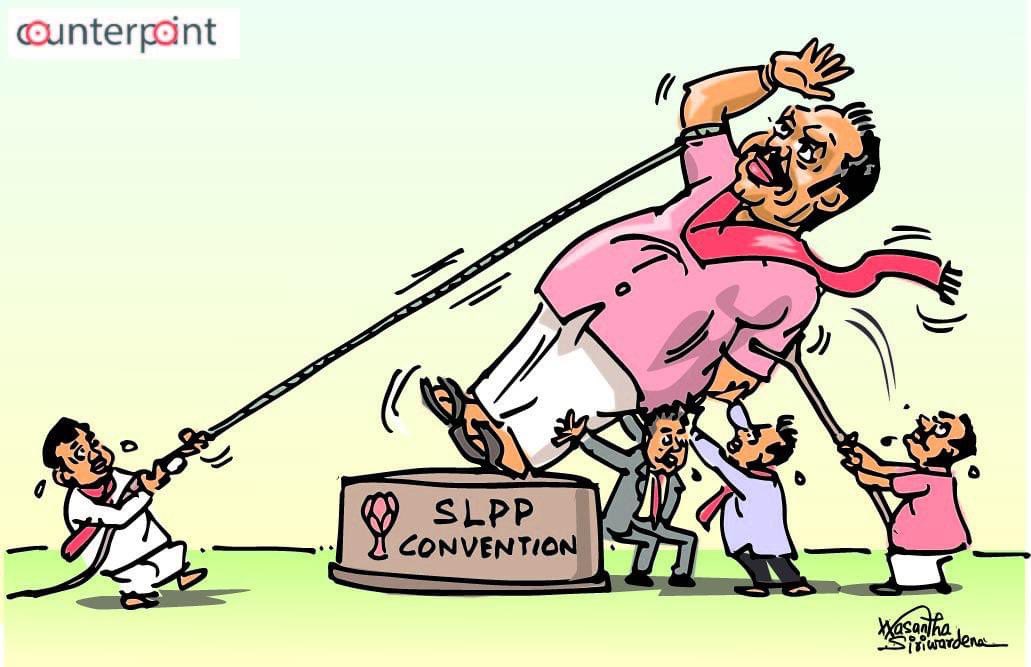
Another group that broke away from the SLPP has formed the Supreme Lanka Coalition. A few others are backing the New Alliance formed by Puttalam District parliamentarian Nimal Lanza. Nevertheless, Basil Rajapaksa, the founder and ideologue of the SLPP, is busy strengthening the SLPP for both the presidential and parliamentary elections next year. The SLPP had its second annual convention at the Sugathadasa Indoor Stadium on Friday afternoon. An estimated 5,000 members from different parts of the country took part in the event.
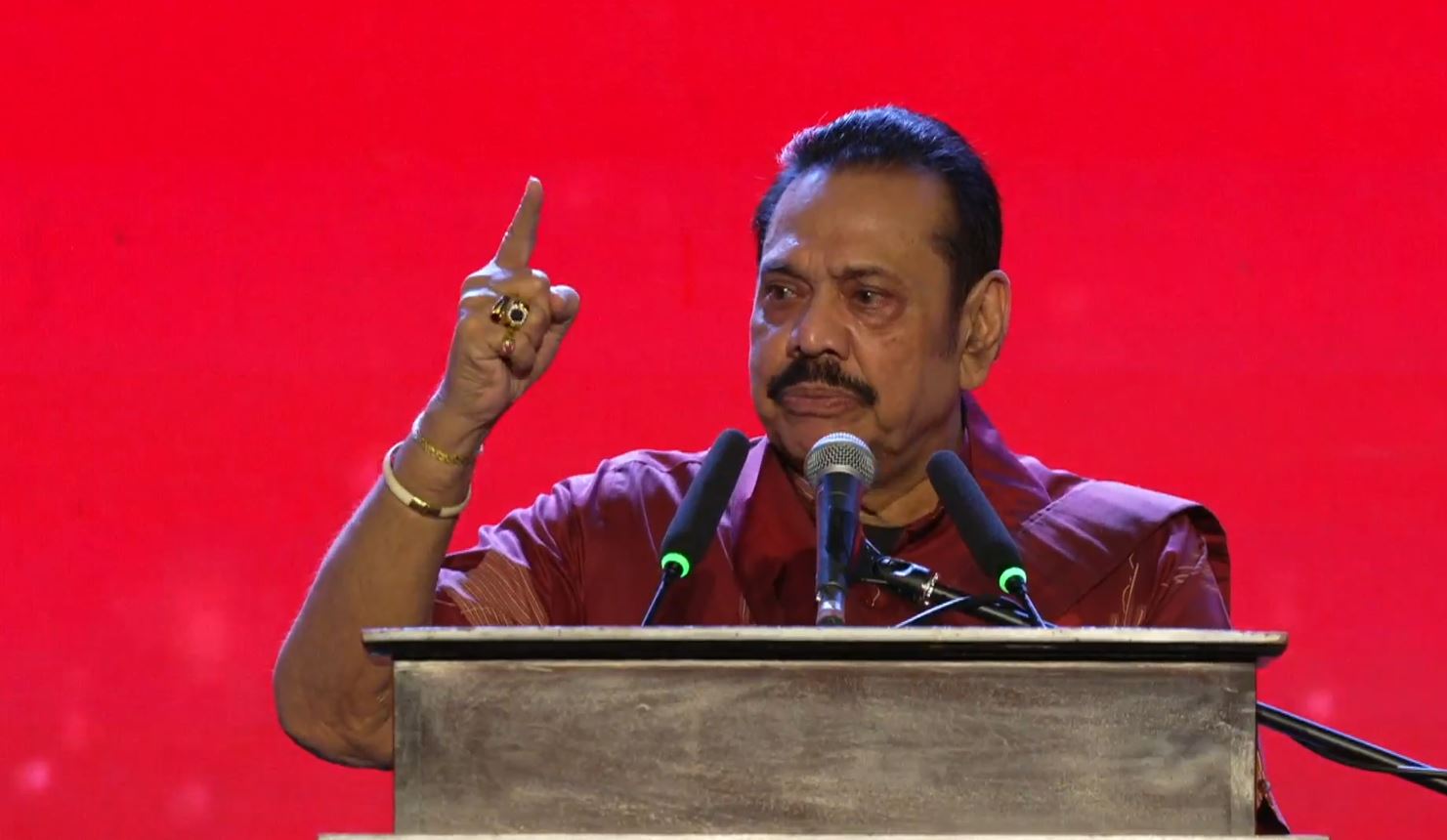
Former President Mahinda Rajapaksa was re-appointed as the SLPP leader after the name was proposed by Gamini Lokuge and seconded by Johnston Fernando. The name was endorsed by the gathering.
Ahead of the event, flags bearing the Photottuwa symbol were put up in main towns, but rival groups had hung up bundles of grass with notices placed around that it was for the “cows’ heading for the convention.
The live telecast via a YouTube channel appeared to be closely followed by the supporters of the JVP with regular comments coming up in favour of the JVP.
Besides party leaders, Present were Prime Minister Dinesh Gunawardena, Douglas Devananda, Sivanesathurai Chandrakanthan, and Dhammika Perera who is set to enter the political field.
In a notable feature, only former President Mahinda Rajapaksa and former Minister Basil Rajapaksa addressed the gathering besides the welcome address by party Secretary Sagara Kariyawasam. The convention event was packed with more music, dancing events and a documentary of the achievements of the former Rajapaksa government.
Former President Mahinda Rajapaksa vowed that the SLPP was set to make a comeback and face any election in the future. He said, “The SLPP will start a new journey according to the country’s needs. We call on the Sinhala, Tamil, Muslim, and Burger people to join with us to create a new country. With the strength of everyone, we will win any election. We will show that we can win any election.”
“We can do this, let’s get together and embark on that journey together. There are many parties awaiting our invitation to embark on that journey. Many will join us.
“Some of our party members were assaulted under the guise of the ‘Aragalaya’. Some were assaulted and others had their houses burned down. Still, there has not been justice served. One of the MPs was killed at the roadside, I believe that a commission should be appointed, and an investigation should be done into that. That is my personal belief, even the police did not catch the ones who were behind that. Real culprits roam free. The masks of those people have already been removed.
“We will settle these issues in a just manner at a future date. We would create a genuine political culture instead of false politics. Let’s work until the work and the effort we take are written in history. The SLPP invites everyone to join it to fulfill the hopes of this country. We are ready to start again from the place we missed to take this country forward to the world as a proud country.
“Some have already prepared suits to obtain power. However, they were not ready to take charge when the people faced hardship. They did not put on the suit as there were more loans to be paid. Some said they could not stay for long if they took power now. They had many excuses. Such leaders are seeking power. Are you ready to hand over this country to them? We are not ready to give away the county to such leaders.
“Whatever forces are there, the SLPP is the party that would create the strongest force. Our camp would be the strongest in the upcoming election. We call on all the people and political parties to keep aside caste, ethnicity, and religion and join the SLPP to develop the country. Today, the people also try to link corruption with the Rajapaksa name, we know some who are slinging mud at us. We do not touch that mud. We do not even linger in places where mud is thrown at us.
“During the near-30-year war, any leader has not been able to fight it with Prabakaran face to face. Some leaders even gave weapons to Prabhakaran, in a bid to stop the war. I will not say who did it. Prabhakaran shot our war heroes with the same weapons. They killed our soldiers and innocent people, and we never left the war to be completed by another leader. The youth don’t remember the fear of death that their parents felt. We are also forgetting that. We cannot blame the youth, yet some groups are misleading the youth to fulfill their political goals. They are the ones who disregard the war heroes who ended the war. They have been coughing to local and foreign pressure groups and damaging our own country.
“The ‘Kaiyyanayakas,’ (persons who are good in talking) don’t know this information; they only know to circulate lies; they can’t do work. However, they also have some capabilities, one such ability is to burn down houses, but they cannot douse fires. They are like kittens who can climb trees but don’t climb down. Due to foreign investments, we were able to create factories, develop roads and carry out agricultural development. With that development, the country was getting benefits. During such a time, some wanted change, and that change cost us our economic development as the change brought the economic development rate of minus 0.2. The largest amount of loans was obtained during the 2015 to 2019 period. People have now forgotten this, but decisions taken without considering the future have led the country to a difficult period.
“We believed that we could take on and improve the economically collapsed country, COVID-19 came unexpectedly. We only had the option of making decisions. We stopped people from dying during the war and saved lives during the pandemic, even though we triumphed over COVID, we exerted tremendous effort to come out of the economic withdrawal faced during previous years. It was during such a time that the movements started to anger people.”
Basil Rajapaksa said, “The first political party was created in 1935, that was 88 years ago. Our party was only seven years old by last November. The SLPP faced three elections after being established. We won all three. In the future, we will also win any election regardless of the time that the election is held. We need to strengthen the SLPP. Our leader Mahinda Rajapaksa taught us not to be revengeful, and we will be peaceful as our leader says but we are not scared. We are ready to face any situation. He was the only leader who put an end to post-election violence. Whenever he won an election, he never allowed violence afterwards. We should practise his teaching in the future.
“We would focus our attention on the ministers, members and supporters who did not obtain compensation for property damage caused when their houses were burned and damaged. We thank Prime Minister Dinesh Gunawardena for providing relief to some of the MPs and other members. We will win any election if it is held. That is what would happen next. We would work towards the victory of the SLPP.”
Amidst these developments, Namal Rajapaksa MP told a news conference that the SLPP would have to re-think its role in the government. He said he would continue to oppose the introduction of an increased VAT. He said, “It is very clear that the VAT is too high. I believe that the taxing system should be simplified and the tax policy should be that the people should be able to bear the taxes. There is no purpose in increasing taxes without increasing the tax network. However much the taxes are increased in terms of the International Monetary Fund’s (IMF) requirements, the people will not gain benefits.
On the other hand, Gotabaya Rajapaksa and Mahinda Rajapaksa who reduced taxes are being pushed to a situation where they will lose their civic rights. The most regrettable situation is that those who signed petitions calling to take away civic rights of President Mahinda Rajapaksa for reducing taxes are now saying the VAT is too high. However, taxes should not be used for political gains, and we should have a national policy on taxes. The taxes should be reasonable for the people.
As Sri Lanka enters an election year in 2024, how the SLPP positions itself would be significant. Delegates coming from different parts of the country saw hay being foisted on sticks. The SLPPers accused an opposition party of placing them in different places. The message was to say that only those who eat hay would attend the SLPP annual sessions. No doubt, the mood is being set.