Rs. 11 billion for EC to conduct presidential poll next year

Appropriation Bill 2024 to be presented this month in Parliament;Rs. 203 billion rise in state expenditure

With presidential elections expected next year, the Election Commission has been allocated Rs. 11 billion through the 2024 Appropriation Bill that is due to be presented to Parliament this month.
Constitutionally, the presidential election must be concluded by October next year. President Ranil Wickremesinghe was elected by Parliament on July 20 last year, following the resignation of former President Gotabaya Rajapaksa. As such, Mr. Wickremesinghe is presently serving out the remainder of
Mr. Rajapaksa’s term of office.

United National Party (UNP) General Secretary Palitha Range Bandara told the Sunday Times that the President’s term would be completed in September and elections would be called around that period.

As per the Appropriation Bill 2024, the expenditure of the government is estimated at Rs. 3,860 billion. This is an increase of
Rs. 203 billion compared to 2023, when the estimated expenditure was Rs. 3,657 billion.

The Ministry of Public Administration, Home Affairs, Provincial Councils and Local Government has been given the biggest allocation in the upcoming bill, with Rs. 886 billion, an increase from 2023, when it received Rs. 856 billion. This is followed by the Ministry of Finance, Economic Stabilisation, and National Policies with Rs. 723 billion. This is a significant increase compared to 2023, when it was allocated Rs. 614 billion.

The Ministry of Defence comes in third with Rs. 423 billion, while the Health Ministry has been given Rs. 410 billion. The Defence Ministry received Rs. 410 billion in 2023, and the Health Ministry received Rs. 322 billion.

The Ministry of Transport and Highways has been allocated
Rs. 403.6 billion in the 2024 Bill.

Among other ministries, the Ministry of Education has been given Rs. 237 billion, and the Ministry of Public Security
Rs. 140.7 billion. The Ministry of Agriculture will get Rs. 100 billion, while the Ministry of Irrigation will be given Rs. 84 billion.

The Office of the President, meanwhile, has been allocated
Rs. 6.6 billion through the Appropriation Bill 2024.

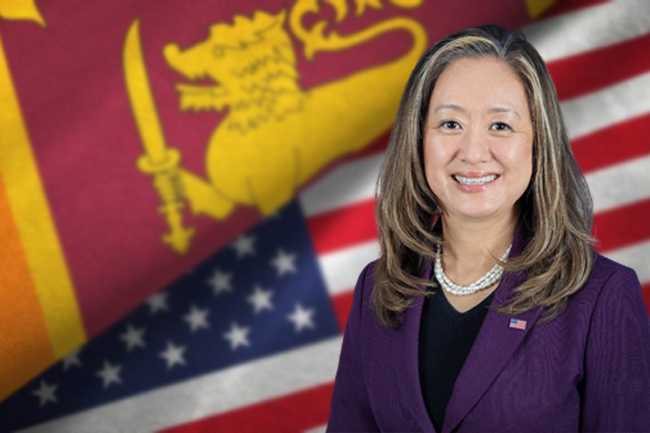
“Fundamental Rights are Non-negotiable”: Ambassador Julie Chung’s Comments on Government’s Two Controversial Bills

The United States Ambassador to Sri Lanka, Julie Chung, has issued a stern call to action regarding two contentious pieces of legislation in the country. Ambassador Chung’s remarks focused on Sri Lanka’s Online Safety Bill and its anti-terrorism legislation, urging the government to prioritize fundamental freedoms and align its laws with international standards.

Ambassador Julie Chung emphasized the critical need for the Sri Lankan government to seek input from diverse stakeholders as it deliberates the Online Safety Bill. She underscored the importance of involving the tech sector, civil society, and experts in the legislative process to strike a balance between online safety and the preservation of freedom of expression. The Ambassador unequivocally stated that freedom of expression is a fundamental right that must be safeguarded without compromise.

The Online Safety Bill has been a subject of significant debate in Sri Lanka, with concerns raised about its potential impact on free speech and online privacy. Ambassador Chung’s call for inclusivity and international best practices echoes the sentiments of many who have been advocating for a more balanced approach to addressing harmful online content.

Furthermore, Ambassador Chung addressed Sri Lanka’s anti-terrorism legislation, emphasizing the importance of revising it in alignment with international standards and practices observed in democratic nations. She called on the Sri Lankan government to honor its pledge to revise this legislation, stressing that Sri Lankans deserve both security and fundamental freedoms.

The Ambassador’s remarks highlight the delicate balance that countries must strike between security concerns and upholding individual liberties. Effective legislation, in her view, should enable lawful freedom of assembly while empowering law enforcement to address threats effectively.

Posted in Uncategorized

Four ex-presidents at China’s anniversary celebration in Colombo

Chinese ambassador in Colombo Qi Zenghong has promised his country’s uninterrupted support for Sri Lanka to escape from the poverty trap and achieve development.

He was addressing a function on Thursday night (28) to mark the 74th anniversary of the founding of the People’s Republic of China.

Politicians including prime minister Dinesh Gunawardena and former presidents Chandrika Kumaratunga, Mahinda Rajapaksa, Maithripala Sirisena and Gotabaya Rajapaksa, the US ambassador and other diplomats attended.

Ambassador Zenghong said China’s friendly policy towards all political parties and people of Sri Lanka in the past few decades would continue.

He said his country extended fullest support during the economic challenges faced by the island last year by way of emergency assistance and in dealing with the debt crisis.

Cabinet Minister “Deeply Troubled” by Mullaitivu District Judge’s Resignation: Pledges to Raise the Issue at Cabinet Meeting

Cabinet Minister Jeevan Thondaman has voiced deep concern and consternation over the recent resignation of Judge T. Saravanaraja, who resigned from the post due to “continuous threats and harassment.”

His resignation, attributed to threats and pressures following his verdict on the Kurunthoormalai case, has ignited serious apprehensions regarding the state of the justice system in Sri Lanka.

Minister Thondaman, in a tweet, emphasized the crucial role that judges play in upholding the rule of law and stressed that any threats directed at them constitute a grave challenge to justice and democracy. He underlined that safeguarding the judiciary’s independence is a collective responsibility, and it is imperative to protect and support judges who administer justice impartially and fearlessly.

In light of these disconcerting developments, Minister Thondaman has echoed the calls for a comprehensive and impartial inquiry into the circumstances surrounding Judge Saravanaraja’s resignation. He emphasized the importance of revealing the truth behind the allegations, not only for the Kurunthoormalai case but also to ensure the continued integrity and independence of the Sri Lankan judiciary.

Minister Thondaman pledged to bring this issue to the attention of the Cabinet and engage directly with the President and the Minister of Justice.

Posted in Uncategorized

BASL calls on govt. to investigate sudden resignation of Mullaitivu District Judge

The Bar Association of Sri Lanka (BASL) has called on the government to investigate the sudden resignation of Mullaitivu District Judge and Magistrate T. Saravanarajah.

Issuing a statement, the BASL has expressed its deep concern regarding the recent resignation of the Mullaitivu District Judge whose decision to step down was purportedly prompted by threats.

“The BASL is committed to upholding the rule of law and ensuring the safety and well-being of all members of the judiciary”, the statement mentioned, adding that “we strongly believe in maintaining an environment where judges can discharge their duties without fear or intimidation”.

In light of this, the BASL calls on the government to initiate a thorough impartial investigation into the matter, highlighting that it is crucial to ascertain the veracity of these threats.

The BASL has further stated that such actions, if found to be true, not only undermine the independence of the judiciary but also erode public trust in the justice system.

“The resignation of Judge T. Saravanarajah may raise serious questions about the safety of judicial officers in Sri Lanka”, it added.

“BASL vehemently condemns and discourages any type of threats and violence to members of the judiciary.”

Furthermore, the BASL, in its statement, said it believes that safeguarding the judiciary is essential for the preservation of the rule of law and the protection of the fundamental rights of all citizens.

Posted in Uncategorized

China pledges steadfast support to Sri Lanka

China will continue to firmly support Sri Lanka in pursuing a development path that suits its own national conditions, getting rid of the “poverty trap” and the “trap of non-development”, and safeguarding its independence, sovereignty, territorial integrity and national dignity, Ambassador Qi Zhenhong said at the 74th National Day Reception of the People’s Republic of China on Thursday.

Given below are excerpts of the Chinese Ambassador’s speech: “Right now, changes of the world, of our times and of history are unfolding in ways like never before, which leads to rapidly growing uncertainty, instability and unpredictability.

In view of these global challenges, President Xi Jinping has put forward three crucial global initiatives, namely the Global Development Initiative, the Global Security Initiative and the Global Civilization Initiative. We urge all countries to respect each other, seek common ground while reserving differences, and work together to meet the challenges of our times and build a community with a shared future for mankind.

“This year also marks the 10th anniversary of the Belt and Road Initiative proposed by President Xi Jinping. Over the past 10 years under the BRI cooperation, more than 150 countries, including Sri Lanka, and 32 international organizations, have made great progress in connectivity, infrastructure, trade, and investment, with about 3,100 joint projects bringing tangible benefits to the world. As the Chinese Ambassador to Sri Lanka, I am more than happy to highlight the major projects between our two countries, such as the Katunayake Expressway, the Southern Expressway, the CICT, the Hambantota Port and the Port City Colombo, etc.

“No matter how the world changes, China and Sri Lanka are good neighbours with mutual respect and trust, good partners with mutual benefit, and good friends who help each other. China’s friendly policy towards Sri Lanka is for all political parties and all people of Sri Lanka and maintains continuity and stability. In the past decades, many landmarks, such as the BMICH, the Supreme Court Complex, the Nelum Pokuna Theatre, the Polonnaruwa Kidney Disease Hospital and the National Hospital Out-Patient Department Building, have been gifted by the Chinese people to the Sri Lankan people.

Since the outbreak of the COVID-19, especially when Sri Lanka was faced with the economic challenges last year, China has been supporting Sri Lanka to the best of its ability. It includes not only providing emergency assistance from all walks of life in China, but also being the first to reach out to Sri Lanka to properly deal with its debt issues.

More importantly, China will continue to firmly support Sri Lanka in pursuing a development path that suits its own national conditions, getting rid of the “poverty trap” and the “trap of non-development”, and safeguarding its independence, sovereignty, territorial integrity and national dignity.”

Posted in Uncategorized

How and why Azad Maulana fled to Europe

The first part of this article was published in the Daily Mirror of 16 September 2023 under the heading Who is Hanzeer Azad Maulana the Whistleblower on Channel 4?. The focus of that piece was Mohammed Mihilar Mohammed Hanzeer alias Azad Maulana who appeared in a documentary aired on September 5, 2023, by the UK’s Channel 4 TV. A lot of details about the man who identified himself as Hanzeer Azad Maulana in the film were disclosed in the first part of this article.

Hanzeer Azad Maulana was the main whistleblower featured in the Channel 4 documentary. Azad Maulana made some startling revelations against former President Gotabaya Rajapaksa, State Intelligence Service head Maj-Gen Suresh Sallay and Rural Road Development State Minister Chanthrakanthan known widely as Pillaiyan. Gotabaya, Suresh and Pillaiyan have denied the allegations.

Maulana has been accused of concocting a false story to help him gain political asylum abroad. He reportedly fled Sri Lanka more than a year ago and sought asylum in a European country. In this second part, the focus will be on how and why Azad Maulana left Sri Lanka and became a refugee in the West.

It must be emphasised at the outset that all allegations made by Azad Maulana are yet to be verified and authenticated. Moreover, they have been denied as falsehoods by those whom the allegations were levelled against especially Maj-Gen Salley. The charge made against Sallay by Maulana hinges around an alleged meeting at Karadippooval in Puttalam between the intelligence chief and Zahran Hashim the National Thowheeth Jamaath (NTJ) leader and livewire behind the Easter bombings.

Maulana’s allegation as stated in the documentary is essentially conjecture and inference based on that meeting.

However, it must be said in fairness to Suresh Sallay that he has denied being in Sri Lanka at the time the meeting allegedly happened. If that is substantiated by Sallay, Azad Maulana’s main allegation would become a “terminological inexactitude”. His credibility would be eroded thereafter.

It is against this backdrop that this column delves into the reasons for Azad Maulana to flee from Sri Lanka and the mode he adopted in seeking refuge abroad. I have not been able to converse with Azad Maulana so far but have been communicating with several informed sources ranging from residents of his village Maruthamunai to activists from International non -governmental organizations familiar with all aspects of his case.

I have also read extracts of a lengthy statement reportedly made by Maulana to several NGOs and selected media personnel.

This article’s second part- therefore is pieced together from information provided by multiple sources. Again it must be noted that this is basically Azad Maulana’s version of what transpired. This narrative goes against the grain of positions adopted by persons like Suresh and Pillaiyan.

Pillaiyan’s Indispensable Aide

As stated earlier in the first part of this article, Mohammed Hanzeer alias Azad Maulana had bourgeoned into being an indispensable aide to Pillayaan. He was Pillayaan’s personal secretary as well as spokesperson of the TMVP. Maulana being reasonably proficient in Tamil, English and Sinhala was the interpreter cum translator on whom the monolingual Pillaiyan relied upon when dealing with certain political leaders, Govt officials, and security and intelligence services.
Pillaiyan trusted the “Muslim” Hanzeer more than several of his “Tamil” deputies. This was resented by some.
When the Sri Lankan intelligence was paying Rs 35 lakhs every month to the TMVP, it was Maulana who collected it regularly on behalf of the TMVP. Large sums of TMVP money were also deposited at times in Hanzeer’s personal bank account.
When Pillaiyan was incarcerated for more than five years over the killing of Batticaloa MP Joseph Pararajasingham, it was Azad who visited Pillaiyan every Saturday with Court permission. Maulana conveyed what was happening within TMVP circles to Pillaiyan and also passed on Pillayaan’s instructions to party members. Maulana also coordinated all legal work regarding Pillayaan’s case.
Hanzeer is married to Fathima, a relative of his from Panadura. They have a daughter Ayesha and a son Mubarak. The family resided in Ebenezer Place, Dehiwela.
In addition to his duties as Pillayaan’s aide, Maulana also dabbled in commercial pursuits like cycle assembling and wholesale distribution of drinking water. Utilising his political connections, Azad was also a “peddler of influence”. Maulana’s monthly income was reportedly in seven digits.
Everything was hunky-dory for Hanzeer until the fateful Easter Sunday bombings of April 2019. According to Maulana’s testimony, he was remorseful when it became known that Zahran and other NJT operatives were responsible for the heinous attacks on Churches and Tourist Hotels.
As Hanzeer claimed in the Channel 4 film, he had purportedly arranged a first meeting between Sallay and Zahran. He also claimed that Suresh Sallay had telephoned him on the day of the bombing and asked him to transport someone from the Taj Samudra Hotel. Hanzeer could not do so as he was in Batticaloa then. It was learnt later that the person at Taj Samudra was the bomber who died in the Dehiwela hotel explosion.
When he met Pillaiyan in jail after the bombings, the TMVP Leader had supposedly told him to keep quiet about all this and to speak to no one about it.
In 2019 November Gotabaya Rajapaksa was elected President. In the aftermath of the bombings, the electorate yearned for a strong man to keep the country safe.

Suspected Links

In the aftermath of the April 2019 Easter bombings, the political grapevine had been buzzing about suspected links between the National Thowheed Jamath bombers and high officials in Sri Lanka’s intelligence services. Popular gossip was about a possible nexus between Govt officials and the Islamic bombers. It was rumoured that the Easter attacks were a conspiracy to bring Gota to power. Conspiracy theories are galore in Sri Lanka and there were few takers for this then.
In March 2021 during a debate in Parliament opposition MPs Anura Kumara Dissanayake (JVP) and Manusha Nanayakkara (SJB) made several allusions about top intelligence officials being implicated in the Easter bombing conspiracy. In April 2021 the then SJB Parliamentarian Harin Fernando made several sensational disclosures in Parliament about the alleged involvement of a high intelligence officer in the April 2019 attacks.
Harin Fernando was careful not to mention names explicitly, but it was inferred that the references were to Major-General Suresh Sallay the head of the State Intelligence Service (SIS). Sallay had been earlier the chief of Military Intelligence. He served as Minister Counsellor in Sri Lanka’s High Commission in Malaysia after the Sirisena -Wickremesinghe Govt gained power in 2015. In 2019 Suresh Sallay went to India for a course in Defence studies and was in New Delhi when the Easter bombings took place.

In October 2021 there was an international webinar held over Zoom about the Easter Sunday attacks, The Catholic Archbishop of Colombo Cardinal Malcolm Ranjith and the well-known catholic Clergyman Fr. Cyril Gamini participated in the discussions. Some of the comments made alluded to the alleged involvement of Maj-Gen Suresh Sallay in the bombings. Subsequently, Gen. Sallay filed a defamation lawsuit against Fr. Cyril Gamini alleging that some of the remarks made by the clergyman had tarnished his (Sallay’s) reputation.

Video Clips

Some days after the Webinar, Gen. Sallay telephoned Hanzeer Azad Maulana and wanted to meet him. According to Maulana, Sallay had played video clips of the Parliamentary speeches by Harin Fernando and other opposition MPs to Hanzeer. He had also shown clips of the Webinar comments by Malcolm Cardinal Ranjith and Fr. Cyril Gamini.
The SIS director had then allegedly told Hanzeer “Only you, I and Pillaiyan know about my meeting Zahran and other NTJ members. Did you reveal this to others? Why are the MPs and Catholic priests making these accusations linking me with the bombers?”
According to Hanzeer, he had denied telling anyone else about the Puttalam meeting. Sallay had then checked Hanzeer’s cell phone. After about three hours of verbal interrogation, Sallay allowed Hanzeer to leave.

Azad Maulana says he was deeply disturbed and distressed by this ordeal. He had never seen Suresh Sallay being so angry and tough. Hanzeer telephoned Pillaiyan in Batticaloa and told him of what had happened. The TMVP leader had told him not to worry and that he was coming to Colombo the following day and would meet Sallay and sort it out. Pillaiyan arrived in Colombo the next day.
It had been the usual practice for Hanzeer to accompany Pillaiyan when he went to meet Sallay. But on this occasion, Pillaiyan met Sallay without Hanzeer. It was through Pillaiyan’s driver Amalan that Hanzeer got to know Pillaiyan had met Sallay. Pillaiyan later told Hanzeer that Suresh Sallay was suspicious of him (Hanzeer) for leaking information about the purported Zahran meeting.
After a few weeks, Pillaiyan had asked Azad Maulana to come to Batticaloa for a meeting. Before his departure, Hanzeer says he got a call from a Muslim friend in an intelligence unit. He had warned Maulana that there was a plot to kill him through a bogus “accident” in Batticaloa and advised him not to go.

Maulana had told Pillaiyan that he had fallen sick suddenly and could not come to Batticaloa.

Escape from Sri Lanka

Azad Maulana was now worried about his life being in danger from the TMVP and/or intelligence. He decided to escape from Sri Lanka. Realizing that delaying his departure from Sri Lanka could endanger his life, Azad Maulana went to India first.
His intention was to seek a humanitarian visa from Switzerland. Switzerland grants humanitarian visas to individuals on the following grounds.

* The individual’s life and physical integrity are directly, seriously and tangibly endangered in their home country or country of origin.
* The individual is clearly in direct danger and not merely at risk because they belong to a potentially endangered group.
* The individual no longer has any other options and their situation requires the urgent intervention of the Swiss authorities.

Mohammed Hanzeer alias Azad Maulana flew to Europe and sought political asylum. It is learnt that an international human rights organization based in Geneva, a Sri Lankan journalist cum human rights activist living in Europe and a self-exiled former Sri Lankan Govt official were of great assistance to Azad Maulana in relocating to Europe.
A Sri Lankan Muslim doctor now living in Pakistan also helped.

OHCHR

After moving to Europe Azad Maulana went to the Office of the UN High Commissioner for Human Rights (OHCHR) and made a detailed statement to a panel from the OHCHR Sri Lanka Accountability project. He took five days to testify. The Project mandate is “to collect, consolidate, analyse and preserve information and evidence and to develop possible strategies for future accountability processes for gross violations of human rights or serious violations of international humanitarian law in Sri Lanka, to advocate for victims and survivors, and to support relevant judicial and other proceedings, including in Member States, with competent jurisdiction”.
Apart from the OHCHR, Maulana has also made statements to several other Human rights organizations and international NGOs. He has also been interviewed by many law enforcement institutions and intelligence agencies.
It is learnt that though Maulana fled from Lanka in a hurry he took along with him much “material evidence” relating to several war crimes, crimes against humanity and human rights violations. What was revealed in the Channel 4 film was only the tip of the iceberg.

Impressed with evidence

A senior NGO official who had interviewed Maulana told this column that he was impressed by him.
“I can tell you I am very impressed with the evidence that Hanzeer has. I met and interviewed him and find him very credible, though, of course, we need to verify and seek more corroboration,” he said.

D.B.S. Jeyaraj can be reached at dbsjeyaraj@yahoo.com

Posted in Uncategorized

What compelled a Sri Lankan judge to resign?

Mullaitivu District Judge and Magistrate T. Saravanarajah has resigned from his posts and directed his letter of resignation to the Judicial Services Commission.

Multiple legal battles that made headlines in the recent past were taken up in court in the presence of Justice T. Saravanarajah.

The case filed over the Kurundi Viharaya, as well as the preliminary examinations over the discovery of human skeletal remains from Kokkuthuduwai, took place in the presence of Justice T. Saravanarajah.

Several local newspapers had reported on the resignation of Justice T. Saravanarajah.

According to the Daily Mirror, Mullaitivu District Judge T. Saravanarajah has tendered his resignation from his posts due to threats on his life and a lot of stress.

The Daily Mirror added that his resignation letter was sent to the secretary of the Judicial Services Commission on September 23.

The BBC Sinhala Service also reported that Justice T. Saravanarajah has tendered his resignation from his posts due to threats on his life and a lot of stress.

The BBC Sinhala Service had made an inquiry from Justice Minister Dr. Wijeyadasa Rajapakshe in this regard.

The Minister had told the BBC Sinhala Service that Mullaitivu District Judge and Magistrate was named as a respondent in five separate cases filed with the Court of Appeal.

The Minister had also noted that the Mullaitivu District Judge and Magistrate had voluntarily met with the Attorney General for advise, and had done so as he was named as a respondent in the those cases.

The Justice Minister had also told the BBC Sinhala Service that if there was a threat to his life, as a judge, the Mullaitivu District Judge and Magistrate had the ability and power to issue the necessary warrants.

The Justice Minister had told the BBC Sinhala Service that upon making inquiries over the resignation of the Mullaitivu District Judge, it was revealed that Justice T. Saravanarajah had visited Colombo a week ago, and sold his car, and also met with the ambassadors of two western countries.

Was the security detail provided to the judge reduced?

Police Spokesperson SSP Nihal Thalduwa said that the security provided to Mullaitivu District Judge and Magistrate T. Saravanarajah was never changed, and was maintained.

Justice T. Saravanarajah made headlines in recent months over the incident surrounding the Kurundi Viharaya.

What is this incident?

On the 4th of July 2023, Justice T. Saravanarajah engaged in an observation tour to the Kurundi Viharaya.

At the same time, a group accompanied MP Sarath Weerasekera to the premises.

Thereafter, on the 7th of July, the MP made a statement to Parliament criticising the conduct of the Magistrate.

Lawyers in the North and Easter engaged in a Harthal campaign on the 11th of July against the statements made by MP Weerasekera.

On the 25th of August, lawyers in the north and east once again protested against this statement.

Proposed Online Safety Bill an assault on freedom of expression – ICJ

The International Commission of Jurists (ICJ) states it is concerned that the newly proposed Online Safety legislation, if adopted in its present form, would serve to crush free expression and further contract an already shrinking civic space in Sri Lanka.

On 18 September 2023, the Ministry of Public Security gazetted a bill titled “Online Safety” intended to dramatically regulate the content of online communication, including by the general public.

Issuing a statement, the ICJ says it considers that several provisions of the bill would serve to undermine the exercise of human rights and fundamental freedoms in the country, including freedom of information and expression. Of particular concern are provisions related to the setting up, appointment and functions of an Online Safety Commission and other experts, the vague and overbroad wording of conduct designated as punishable offences and unnecessary and disproportionate punitive sanctions.

“While the spread of online hate-speech and disinformation need to be tackled, this bill is deeply flawed in its design and would be open to abuse by the Sri Lankan government, which has persistenty failed to uphold freedom of expression,” said Ian Seiderman, ICJ’s Legal and Policy Director. “It risks being used to suppress important public debate regarding the conduct of the government and matters of public policy,” he added.

The Bill would establish an “Online Safety Commission” that would act to: “prohibit online communication of certain statements of fact; prevent the use of online accounts and inauthentic online accounts for prohibited purposes; make provisions to identify and declare online locations used for prohibited purposes in Sri Lanka and to suppress the financing and other support of communication of false statements,” as well as other unspecified matters.

The Bar Association of Sri Lanka has called for the immediate withdrawal of the bill and for the adoption of a process of meaningful consultations with all relevant stakeholders prior to gazetting bills which ‘have a serious impact on the community at large.’

“The current draft fails to adhere to the principles of legitimacy, necessity and proportionality required for any State activity that restrict rights. It must be withdrawn or amended to be brought in line with Sri Lanka’s international human rights obligations guaranteeing freedom of expression, opinion, and information.” Seiderman added.

The ICJ considers that the Bill should not be evaluated in a vacuum, but instead must be read in conjunction with existing and proposed legislation that threaten human rights. Such laws include the extremely misused ICCPR Act of 2005, the Prevention of Terorrism Act (PTA), the Bureau of Rehabilitation Act, and the proposed Anti-Terrorism law which seeks to replace the PTA. This body of legislation, taken together, fosters a chilling effect on the exercise of fundamental freedoms restricting civil society while unduly expanding the reach of the security state.

Article 14 (1) (a) of the Sri Lankan Constitution gurantees the freedom of speech and expression. Article 19 of the International Covernant on Civil and Political Rights, to which Sri Lanka is a party, affirms the right to freedom of expression and opinion.

In July 2018, the UN Human Rights Council adopted by consensus a resolution affirming that “the same rights that people have offline must also be protected online, in particular freedom of expression, which is applicable regardless of frontiers and through any media of one’s choice, in accordance with articles 19 of the Universal Declaration of Human Rights and the International Covenant on Civil and Political Rights.”

British woman trapped in Sri Lanka for 13 months losing hope

A Brit trapped abroad in Sri Lanka after sharing videos of a civil uprising says she is ‘out of hope’ following 13 months hiding from the country’s oppressive Government.

Kayleigh Fraser, 35, had her home in the south Asian island nation raided in August last year by immigration officials who claimed that she was visiting the country on an invalid visa and seized her passport.

But St Andrews woman Ms Fraser, who was visiting the country to study botanical medicine, said this was only brought to her attention after she began sharing videos of the ‘Aragalaya’ (‘Struggle’ in Sinhalese) protests on her Instagram.

Sri Lanka’s supreme court upheld a deportation order issued by officials – but Ms Fraser says she is afraid to surrender to them amid fears that she will be unlawfully detained under the country’s notorious anti-terror laws, which allow individuals to be detained for causing ‘religious, racial, or communal disharmony’.

Later today, North East Fife MP Wendy Chamberlain will meet with Foreign Office officials in the hope of eking out written reassurances from the Sri Lankan government that Ms Fraser will be guaranteed safe passage out of the country.

Until such guarantees are given, Ms Fraser says she cannot come out of hiding.

Speaking to MailOnline, Ms Fraser said: ‘I’m just existing, surviving out here, waiting for something to change. I have no options at all and I’m practically out of hope.

‘Just ensuring I have somewhere to sleep and something to eat are the priority.

‘Internet is a luxury that I’m incredibly thankful to have had decent access to this past month or so.

‘I don’t recognise this as life – it’s existence. It feels like the entire world has abandoned me at the mercy of these madmen in power here.’

Sri Lankans rose up against their government in early 2022, amid spiralling inflation that saw food prices rise by more than 80 per cent. The country still contends with the aftermath of its 25-year civil war, which ended in 2009.

Citizens demanded the resignation of president Gotabaya Rajapaksa, who fled the country in mid-July last year. But his replacement, incumbent prime minister Ranil Wickremesinghe, then ordered a crackdown on civil resistance.

Protesters and media were attacked by police at a protest village in the capital city of Colombo days after Mr Wickremesinghe took power, and others have been arrested without charge under the country’s oppressive Prevention of Terrorism Act.

Amnesty International, along with other human rights groups, have accused the Sri Lankan government of engaging in ‘the harassment and intimidation by state agencies of conflict-affected people, human rights defenders and activists’.

And two weeks later, Ms Fraser’s home in Malabe, a suburb of Colombo, was raided by immigration officials, plunging her into a year of hiding underground, with a trusted network of friends and supporters keeping her safe.

Attempts to discuss the case with the British High Commission in the capital have, she claims, been fraught with issues.

Officials are understood to have told her that they have no further options because she refuses to surrender to the country’s immigration authorities.

But she fears being arbitrarily detained or being charged with a litany of false crimes in order to make an example of her for speaking up.

Nihal Thalduwa, a spokesperson for the Sri Lankan police, told national newspaper The Morning last year that Ms Fraser had been sharing ‘negative content’ on her Instagram.

He said: ‘It is not right for a foreign national to be in our country and share such mass negative content. She is not a journalist either, to be covering the protests.’

Ms Fraser added: ‘I need some kind of assured safe passage via the UK government and their physical presence and assistance to get safely on a plane and off this island.

‘I spoke up for people who were being horrendously abused by those who were entrusted to look after them. So why do I sit here rotting?’

For over a year, human rights lawyer Nagananda Kodituwakku has been fighting Ms Fraser’s case in the courts, seeking the overturning of the deportation order and the return of her passport.

This week, he discussed the case with North East Fife MP Wendy Chamberlain ahead of her meeting with Foreign Office officials.

Mr Kodituwakku told MailOnline: ‘Sri Lanka is a pseudo-democracy where nobody respects the sovereignty of the people and the rule of law.

‘Kayleigh is an upright British national who was very much concerned with the blatant right violations. She used her social media pages to highlight these cases and brought them to the attention of the international community.

‘And she was branded as a foreigner who brought the government of Sri Lanka into disrepute and was issued with an unjustified and unlawful deportation order denying her any right to defend herself.’

Lib Dem MP Ms Chamberlain said: ‘It is clear that Kayleigh wants to come home and I’m working with the Foreign Office to make that happen.

”What I’m seeking is a reassurance from Sri Lankan authorities that she will be able to leave forthwith.

‘The British High Commission has been supporting her for some time but her anxieties, her experiences with Sri Lankan authorities mean her trust is very low.

‘The Foreign Office has said they have had assurances verbally that she will be safe but we want to get them in writing. It’s a distressing time so just getting that clarity will help her get what she wants to happen.’

A Foreign, Commonwealth and Development Office spokesperson said: ‘We are providing assistance to a British woman in Sri Lanka and are in contact with the local authorities.’

MailOnline has contacted Sri Lanka’s Department of Immigration and Emigration for comment.

Sri Lanka says it is making progress on human rights, but observers including the United Nations Human Rights Office say the country’s treatment of its citizens is far from where it needs to be.

Volker Türk, UN High Commissioner for Human Rights, said earlier this month: ‘More than a year ago mass protests demanded better governance and an inclusive vision for Sri Lanka – in short, a renewal of the social contract.

‘But the potential for a historic transformation that would address long-standing challenges is far from being realised.’

(MailOnline)

Posted in Uncategorized