Tamil National Heroes Day

40th anniversary of Welikada prison massacre commemorated

The 40th anniversary of the Welikada prison massacre was commemorated at Valvettithurai, Jaffna. The massacre which resulted in the murder of 53 political prisoners was instigated during the Black July pogrom by prison officials.

The memorial was held under the leadership of Tamil MP M K Sivajilingam.

Among the victims were:

Selvarajah Yogachandran alias Kuttimani(TELO), Nadarajah Thangavelu alias Thangadurai(TELO), Nadesathasan(TELO), Jegan Alias Sivarasa(TELO), Dhevan, Sivan Anpalagan(TELO), A. Balasubramaniam, Surash Kumar, Arunthavarajah, Thanapalasingham, Arafat, Anpalagan Sunduran, P. Mahendran, Ramalingam Balachandran, K. Thillainathan, K. Thavarajasingham, S. Subramaniam, Mylvaganam Sinnaiah, G. Mylvaganam, Ch. Sivanantharajah, T. Kandiah, S. Sathiyaseelan, Kathiravelpillai, Easvaranathan, K. Nagarajah, Gunapalan Ganeshalingam, S. Kularajasekaram, K. Krishnakumar, K. Uthaya Kumar, R. Yoganathan, S. Sivakumar, A. Uthayakumar, A. Rajan, G. Amirthalingam, S. Balachandran, V. Chandrakumar, Yogachandran Killi, Sittampalam Chandrakulam and Master Navaratnam Sivapatham.

On the 25th July 1983 Nadarajah Thangavelu alias Thangadurai, Sellarasa “Kuttimani” Yogachandiran, leader of the Tamil Eelam Liberation Organisation (TELO) and Ganeshanathan Jeganathan, a political writer, had their eyes gouged out in mockery before being killed by Sinhalese inmates at the high security Welikada prison in Colombo. A total of 37 Tamil prisoners were murdered the same day, and 18 more were killed two days later.

Posted in Uncategorized

Indian Navy’s indigenously built Khukri-class Missile Corvette Khanjar to be in Trincomalee from July 29 to 31

The Commanding Officer of the Indian Naval Ship, Commander NVS Phani Kumar will be calling on Commander Eastern Naval Area. Further, various professional interactions will be conducted on VBSS, Gunnery and Missile Operations. A reception is planned to be hosted onboard for senior officials from Military and Civil administration. Before departure a Maritime Partnership Exercise with Sri Lanka Navy Ship off Trincomalee is planned on 31 July.

In order to further people-to-people connect and familiarize the people with Indian Navy and its capabilities, the ship will be open for a visit by school children. In addition, public will have the opportunity to visit the ship on 30 July 2023 at Trincomalee Port. The ship will also carry out a Yoga Session, Beach Cleaning and Special School in Trincomalee.

The visit of the Indian Naval Ship Khanjar, a Khukri-Class Corvette, is also significant in view of the potential for cooperation between India and Sri Lanka for augmenting capabilities of Sri Lanka Navy for efficiently addressing shared challenges for maritime security in the region.

It may be recalled that Indian Naval Submarine Vagir had earlier visited Colombo from 19-22 Jun 2023 for celebrating the International Day of Yoga (IDY-2023). Visits by Indian Navy vessels to Sri Lanka further strengthen the camaraderie and interoperability between the Navies of the two neighbours, in keeping with India’s SAGAR (Security and Growth for All in the Region) doctrine and ‘Neighbourhood First’ policy.

The never ending talks on ethnic issues By M.S.M Ayub

The All-Party Conference (APC) held on Wednesday (26) was the second one to be called so and convened by President Ranil Wickremesinghe with a professed view of finding a lasting solution to the ethnic problem in the country. It must be recalled that he convened another “All Party Conference” on December 13 last year for the same purpose.

Interestingly, Wednesday’s conference was not another session of the conference held in December. Although the December conference resulted in several follow-up meetings between the President and the north-based Tamil political parties, they ended with Tamil parties expressing disappointment over the government’s failure to keep its promises made during the December 13 meeting.

Another interesting factor is that both the “All-Party” conferences did not happen to be “all-party conferences” in their essence, as one or more influential political parties had boycotted them. The National People’s Power (NPP) led by the Janatha Vimukthi Peramuna (JVP) did not attend Wednesday’s meeting, claiming that the government was going to hoodwink the country and divert people’s attention from the economic crisis by convening this conference.

President Wickremesinghe met several Tamil political parties on the day before his two-day visit to India which commenced on July 20 and informed them that he was prepared to implement the 13th Amendment to the Constitution without granting Police powers to the Provincial Councils.

That was a stand-alone meeting and it is got nothing to do with the so-called APCs held on December 13 and last Wednesday. Neither did the President announce at that meeting that he would call an APC after his India visit.

Hence, one has to conclude that Wednesday’s “APC” has been decided during or after that visit, owing to the mood of the Indian leaders over the President’s announcement that the Police powers would not be granted to Provincial Councils.

Going by this history of talks leaders of the government and the Tamil community seem to hold talks for another two or three decades or eternally on the subject
This argument is being vindicated by the fact that Wednesday’s meeting was announced to the media first by Foreign Minister Ali Sabry and not by the President or Prime Minister Dinesh Gunawardena, who handles the subject of provincial councils.

Police and Land Powers that are not being enjoyed by the Provincial Councils since the institution of those councils in 1988 have in fact been devolved (granted) to them from the beginning.

However, they can enjoy those powers only when the President formulates the relevant mechanisms for it which are provided for by the 13th Amendment. That is, the President has to create Provincial Police Divisions under Deputy Inspectors General of Police (DIGs), in order to implement police powers in full while a land commission has to be appointed in respect of land powers.

None of the Presidents including J.R. Jayewardene during whose tenure these powers among others were devolved to Provincial Councils formulated those mechanisms.

Chandrika Kumaratunga who demanded these mechanisms be created when she was the Chief Minister of the Western Province in 1994 too did not think it fit to do so when she assumed Presidency in the same year.

Despite the merits and demerits of provincial councils enjoying Police Powers, President Wickremesinghe’s statement that Police Powers would not be awarded to the Provincial Councils was a clear U-turn from his earlier stance.

He, during the budget debate in December last year, stated that a solution to the ethnic problem would be found before the 75th Independent Day which fell on February 4, this year. Then the Tamil parties threw a challenge to him to implement the 13th Amendment in full and hold the provincial council elections before January 31 which he accepted.

The Tamil parties demand that the 13A be implemented fully before finding a lasting solution to the ethnic problem and the President’s positive response to it indicates both parties’ agreement that the solution so suggested is something beyond the 13A.

The Tamil parties demand that the 13A be implemented fully before finding a lasting solution to the ethnic problem and the President’s positive response to it indicates both parties’ agreement that the solution so suggested is something beyond the 13A
Also by acknowledging the full implementation of 13A, the President takes the responsibility to empower provincial councils to enjoy all powers devolved to them including police and land powers.

Then, addressing a gathering on this year’s National Thai Pongal Day (January 15) ceremonies in Jaffna Wickremesinghe said that 13A would be implemented within the next two years.

Subsequently, again he changed his plan by claiming that he would agree with the Tamil parties on the solution to the ethnic problem, during his speech at the May Day rally of his party, the United National Party (UNP).

Since these mind changes had not divorced Police Powers from the Provincial Councils, his announcement about 13A sans Police Powers on the day before his India visit would have been a bombshell for the Tamil parties.

The irony of Wednesday’s ‘All Party Conference’ is that it was held against the backdrop of hundreds of discussions the government held with the Tamil Parties, Tamil armed groups, especially with the LTTE and with Indian leaders as well as deliberations within all party conferences and Parliamentary Select Committees (PSC) since the 1950s for the same purpose.

Several important pacts and accords were also agreed upon during some of these meetings.

After the failed Bandaranaike – Chelvanayagam pact of 1957 and Dudley – Chelvanayagam pact of 1965, President J.R. Jayewardene convened a round Table conference in 1984 amidst growing hostilities between the armed forces and the Tamil armed groups.

When it failed Indian government arranged a meeting between the representatives of the government and Tamil parties as well as armed groups in the Bhutanese Capital Thimphu in 1985 which also collapsed with its second round. Jayewardene convened another all-party meeting famously called the “Political Party Conference” (PPC) in 1986.

Against this backdrop, India imposed the Indo-Lanka Accord of 1987 on Sri Lanka, after several rounds of negotiations with the Sri Lankan government and the Tamil groups which resulted in the creation of provincial councils. When the LTTE reneged on the accord the other Tamil groups except for the EPDP also attempted to find new solutions.

Hence, President Ranasinghe Premadasa initiated talks with the LTTE and convened another All-Party Conference in 1989 where the representatives of the LTTE also participated in. Opposition parties boycotted the conference after the first meeting of it, as the agenda had only a speech by the President. Everything collapsed when the LTTE resumed fighting in June 1990.

President Chandrika Kumaratunga again started talks with the LTTE in 1994 which also failed in July 1995, when the LTTE resumed their Eelam war. And a Parliamentary Select Committee was also appointed in 1997 to find a solution to the national question. After about 60 meetings it ended without a final report being produced. Kumaratunga presented a new draft Constitution as well in 2000, focusing on the solution to the ethnic problem. Ranil Wickremesinghe as Prime Minister initiated talks with the LTTE with international mediation in September 2002 and both sides agreed upon a federal mechanism in December.

President Mahinda Rajapaksa in 2006 appointed an All-Party Representative Committee (APRC) the interim report of which was presented in 2008 was never published.

The Yahapalana Government in its turn presented a report through a Constitutional Assembly and it was rejected by Sinhalese nationalist parties as well as some influential Tamil parties.

The Prime Minister of that government, Ranil Wickremesinghe, now holding meetings for the same purpose. Going by this history of talks leaders of the government and the Tamil community seem to hold talks for another two or three decades or eternally on the subject.

Visiting Japanese Foreign Minister meets with President Ranil Wickremesinghe

Japanese Foreign Minister Yoshimasa Hayashi, who is in Sri Lanka on two-day official visit, paid a courtesy call on President Ranil Wickremesinghe on Saturday morning (29).

Later, he also held bilateral discussions with Sri Lankan Foreign Minister Ali Sabry.

Minister Yoshimasa is scheduled to meet with Prime Minister Dinesh Gunawardena this evening.

The Japanese Foreign Minister and his delegation were welcomed by State Minister of Foreign affairs Tharaka Balasuriya, at the Bandaranaike International Airport on Friday night (28).

Posted in Uncategorized

India bolsters military and economic ties with the US and Europe amidst China’s aggression in Indo-Pacific

Asian security experts argue that China’s aggressive behavior and ambitions in the Indo-Pacific region have led India to strengthen its military and economic ties with the United States and Europe. China’s actions, such as testing India’s borders and threatening Taiwan’s democracy, have significantly influenced India’s strategic calculations, according to experts who spoke at a recent online event hosted by the Brookings Institution.

Garima Mohan, a senior fellow at the German Marshall Fund’s Indo-Pacific program, identifies China as India’s “consequential challenge.” Previously, Indian governments considered the United States as a “spoiler,” but now, according to Tanyi Madan, Director of the India Project at the Project on International Order and Strategy, India views the US as an “enabler.”

While India remains committed to retaining strategic autonomy, it is open to forming alliances and partnerships with other countries, says C. Rajua Mohan, a senior fellow at the Asia Society Policy Institute in New Delhi. India shares major power ambitions with the US and desires a multi-polar Asia rather than one dominated by a single nation.

China’s bullying and threats have set a new tone for India’s relations with the United States and Europe, creating a template for cooperation. Both India and the US have mutual interests in establishing a better order in trade, development, and security within the Indo-Pacific region.

The “Quad,” an informal alliance between India, the United States, Japan, and Australia, exemplifies India’s efforts to collaborate with like-minded countries on critical issues. However, a recent meeting between the Quad leaders had to be canceled as President Joe Biden returned to the US to address discussions on raising the American debt ceiling.

India faces questions about how fast and far it should partner with the US, especially considering its historical relationship with Russia. Russia remains India’s primary military weapons supplier, while France comes in second.

The growing partnership between China and Russia, labeled as a “no limits” partnership, poses a challenge for India. This alliance has progressed further with new economic agreements signed between the two countries, supporting Russia amidst sanctions following its invasion of Ukraine in February 2022.

The deepening relationship between China and Russia creates a fault line for India, as historically, India has maintained a diversified portfolio of security, trade, and economic relations with both countries since gaining independence from the United Kingdom in 1948, says Tanyi Madan.

According to Madan, there is significant convergence between India, the U.S., and France on trade, technology, and innovation. However, differences arise regarding the direction of New Delhi’s internal development and concerns over India’s relative silence on the war in Ukraine. Raja Mohan attributes these differences to India’s long-standing policy of non-interference by other nations in its internal affairs, a stance followed since 1948.

India’s economic outreach to Europe has been ongoing for years, and the European Union’s recognition of India as an important nation in 2018 has strengthened the ties further. This increased engagement has led to serious discussions about Taiwan as a security issue posed by China in Europe.

Raja Mohan also points out that India, being the largest nation in terms of population, has the potential to become the world’s third-largest economy in the near future.

As India and the United States grow closer, Madan emphasizes the need for both governments to be transparent about the importance of the relationship and explain it to their citizens instead of hiding its significance.

In the Indo-Pacific region, Prime Minister Narendra Modi has warned of confrontation amid Chinese aggression and coercive actions. During his address to the U.S. Congress, he highlighted the importance of India-US defence ties and growing partnership. He emphasized a shared vision of a free, open, and inclusive Indo-Pacific based on international law, without domination, and anchored in ASEAN centrality. The focus is on allowing all nations, regardless of size, to make their choices freely and fearlessly, promoting progress and prosperity without strategic leverage. The vision aims to build a cooperative region of peace and prosperity through regional institutions and collaboration with partners from within and beyond the region. India’s defence cooperation with the United States has evolved from being strangers at the turn of the century to becoming one of its most important defence partners today.

The Indian Ocean is undeniably one of the most strategically significant seas worldwide. Alfred Mahan, a highly influential strategic thinker from the United States, famously proclaimed that “Whoever controls the Indian Ocean will dominate Asia, and the destiny of the world will be decided on its waters.”

The importance of the Indian Ocean lies in its connection to five continents: Africa, Antarctica, Asia, Oceania, and Europe. Numerous crucial Sea Lines of Communication (SLOCs) traverse through this ocean, facilitating the movement of warships during historical conflicts like the Japanese-Russian War of 1905 and World War II. Additionally, these SLOCs play a vital role in enabling the navigation of commercial vessels carrying daily-use appliances and essential energy resources.

India holds a strategically advantageous position in the Indian Ocean Region (IOR) as it lies between crucial bottlenecks. To the west, the Straits of Hormuz and Bab-El-Mandeb are vital for oil product and merchandise trade. To the south, the “8-degree channel” between the Lakshadweep and Maldives archipelagos serves as a bottleneck for SLOCs connecting Europe, Africa, the Middle East, and Asia. Lastly, to the east, India controls the Western gateway into the Malacca Strait, which is the primary connection point between the Indian and Pacific oceans.

The significance of India’s control over the Malacca Strait becomes apparent in the context of potential US-China confrontation. In the event of an unlikely invasion of Taiwan, the Malacca Strait would be one of the first regions to witness heightened tensions. This puts India’s foreign policy at a crossroads, particularly represented by the Andaman and Nicobar islands. These islands pose a dilemma for India: whether it should enter the conflict between China and the United States and, if so, which side it should support. India’s strategic location in the IOR, along with its control of the Malacca Strait, grants it the potential to shape the geopolitical landscape of the region.

New Delhi appears neutral between the US and China but is pragmatic in choosing sides. Understanding the strategic importance of islands in the Indian Ocean is crucial. Trade, energy supplies, and force projection play significant roles for both countries.

India’s Andaman and Nicobar archipelagos act as a barrier between the Andaman Sea and the Indian Ocean. They control access to the Malacca Strait’s western entrance. The islands have historical importance and form the basis of India’s maritime strategy.

India perceives China as a threat due to border disputes and challenges to India’s influence in the region. India and the US have mutual interests and do not have territorial conflicts.

Strategically, the islands serve as an outpost for India and its allies, enhance deterrence capabilities, and provide a springboard for expanding India’s influence towards Southeast Asia.

Despite the strategic importance of the islands, India’s Navy faces budgetary constraints and border disputes, hindering its maritime capabilities.

India aims to transform its navy into a blue water force but must invest in the fleet and logistical infrastructure. India’s potential influence in the region is significant, as emphasized by Mahan’s words.

Posted in Uncategorized

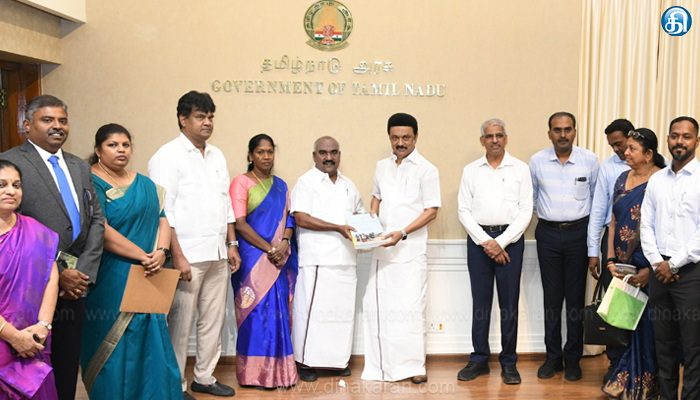
Tamil Nadu Chief Minister and Sri Lankan Minister discuss fishermen issue

Tamil Nadu Chief Minister M.K Stalin and Sri Lankan Minister Jeevan Thondaman discussed the India-Sri Lanka fishermen issue at a meeting in Chennai today.

Thondaman called on the Chief Minister and spoke about the wellbeing of Indian-origin Tamils in Sri Lanka as well as the fishermen issue.

A number of Indian fishermen have been arrested in recent days for poaching in Sri Lankan waters.

On the fishermen issue, it was noted that a solution should be reached in a manner that ensures fishermen from both countries are not affected, Minister Thondaman’s office said.

The Minister had also assured that the issue will be discussed by the Sri Lankan Cabinet.

The assistance offered by Tamil Nadu for Sri Lanka during the economic crisis was also appreciated.

SJB ally welcomes Indo Lanka land link

An Indo Sri Lanka land link will be economically beneficial to Sri Lanka to have cheaper and quicker access to the world’s fifth largest economy, leader of the Tamil Progressive Alliance (TPA), which is an ally of the Samagi Jana Balawegaya (SJB), said yesterday.

“We must agree to it but with a condition that Sri Lanka shall obtain “most favored nation” treatment while by-passing all current trade agreements with India, said TPA leader and Member of Parliament Mano Ganesan. “Sri Lankan products for the Indian market shall obtain “tax free status” similar to the GSP Plus,” he added. “India is booming. We must use our geographical location, the very close proximity to India, to get the best out of it.

Our manufacturers should be able to reach the most sought after powered middle class consumer market, especially of southern India. I have discussed such proposals with President Wickremesinghe when he was our Prime Minister in the previous government.

Later and now with Leader of Opposition Sajith Premadasa and Indian High Commisisoner Bagley. Only those “frog in the well’ phobia jokers will oppose this while creating stories of bogus “dangers”. We are an island but there are hundreds of countries with common borders and some are even land locked, like Afghanistan and Nepal,” he also said.

“The use of the Indian Rupee is a secondary matter. We already use foreign currencies unofficially and officially too,” Ganesan further stressed.

Posted in Uncategorized

New outlook needed on 13A – Victor Ivan

Senior journalist Victor Ivan has called for all to set aside racial, religious and other differences and implement the 13th amendment to the constitution if the country is to go forward.

Speaking to the media on 26 July, he said that in doing so, India could be a help and a case in point, where its states have had uneven devolution of powers.

That means devolving powers need not be even, he said, adding that as an experiment, the northern province could be given powers and the developments monitored for a few years.

If successful, other provinces too, could get powers, he noted.

“We need to have a new outlook on this. If that happens in a positive manner for the benefit of the minorities, India and other countries will not interfere in our affairs,” he said.

All parties should be involved in the talks on the devolution of powers, while raising public awareness is crucial and a study made how other countries have done it with success.

Ivan said devolving powers does not mean a division of the country, adding that at least now, this should be resolved intelligently.

China’s next overseas military base likely a Sri Lankan port – Report

China’s military is most likely to build its second overseas naval base in Sri Lanka, according to a new report that studied where Chinese commercial firms have invested most heavily in establishing harbor and port infrastructure to protect international trade in such things as consumer goods exports and imports of oil, grain, and rare earth metals.

The People’s Liberation Army Navy built its first overseas outpost in Djibouti, East Africa, in 2016, at a cost of $590 million, where up to 2,000 personnel have used the base to stifle piracy of Chinese cargo vessels sailing the waters around the Horn of Africa and the approach to the Suez Canal leading to the Mediterranean and Europe.

Sri Lanka tops this list of eight international ports where China is most likely to land its next overseas military base in a July 2023 report, titled “Harboring Global Ambitions: China’s Ports Footprint and Implications for Future Overseas Naval Bases,” written by researchers at the AidData lab at the College of William & Mary in Virginia.

To come up with the short list, researchers assessed 78 international harbors in 46 countries that are most likely to harbor ships from the PLA Navy’s fleet of approximately 500 vessels, the largest navy in the world.

AidData’s inaugural report of this kind found that Chinese firms spent about $30 billion from 2000 to 2021 to build out the 78 ports assessed.

The report assumes that China will locate its next PLA Navy base by leveraging influence built up by previous investments, as it did when the base in Djibouti was built next to the commercial port of Doraleh, which, until 2018, was part owned and operated by China Merchants Holdings, and was a major hub for livestock transshipment.

Ports assessed in the report were ranked based on their strategic location, harbor depth for naval vessels, political stability in the host country, and the host government’s tendency to vote with China in the UN General Assembly.

Hambantota, Sri Lanka:

Topping the short list in the AidData report is the port of Hambantota in Sri Lanka in the Indian Ocean. China has invested $2.19 billion in Hambantota, more than in any other port, and the government in Colombo agreed to lease majority ownership of the port to a Chinese firm in 2017.

In 2018, China gifted the Sri Lankan navy a frigate and the report notes that Sri Lankan elites and the general public have a favorable opinion of China and the Chinese people.

Western analysts speculate that in addition to Hambantota, the ports at Ream, Cambodia, Gwadar, Pakistan, and Equatorial Guinea’s Bata or Cameroon’s Kribi could host the PLA Navy.

The report’s authors said that they hoped to widen the discussion to include a broader range of possible locations better reflecting China’s ambitions for a global navy. The Pacific island Vanuatu, the port of Nacala in Mozambique, in East Africa, and Nouakchott in Mauritania, in West Africa, round out the short list.

“China has this very ambitious foreign policy, and it has this massive navy, which for sure was not built to hang around in Chinese waters,” Alexander Wooley, one of the report’s authors, told The China Project. “There’s a certain logic that these bases have to come, but China has been very restrained so far. The sheer range of options that China has hasn’t been appreciated as much previously.”

AidData’s report departs from past scholarship on China’s ambitions for overseas naval bases. In 2022, the think tank the RAND Corporation published “China’s Global Basing Ambitions: Defense Implications for the United States,” a report whose authors noted that Hambantota and Gwadar, at the mouth of the Gulf of Oman and called, by some, the crown jewel of Xi Jinping’s Belt and Road Initiative, were likely ports for PLA Navy bases. But, RAND argued, China might opt to build bases where Chinese have yet to invest heavily.

The RAND report concluded that Bangladesh and Myanmar also would make prime candidates for a Chinese naval base, despite the fact that ports in those countries have not seen the same levels of investment from China. Instead of using past investment in ports as a criteria in the analysis, RAND looked instead at Chinese investment in host countries as a whole.

While the AidData report’s data-driven approach was useful in highlighting possibilities that may have been overlooked, Harrison Prétat, the associate director at the Center for Strategic and International Studies’ (CSIS) Asia Maritime Transparency Initiative, told The China Project that political and strategic factors would be the primary drivers of Beijing’s efforts to establish overseas bases.

“I think it’s clear that the scale of Chinese investment is not a direct determinant of whether a given port is likely to be considered for military development or use by China, and that political and strategic factors remain primary,” Prétat said. “The study itself acknowledges that Ream Naval Base in Cambodia, which seems very likely to offer some level of access for China’s navy upon completion of its upgrades, had very little invested in terms of dollar amount.”

For now, China may refrain from building out bases for explicit military use, concluded a 2022 article titled “Pier Competitor: China’s Power Position in Global Ports,” in the journal International Security. The authors noted the challenges and vulnerabilities of building overseas military bases and emphasized China’s capacity to use commercial ports for military logistics and intelligence-gathering.

Getting foreign governments on board with a permanent Chinese military base abroad is also simply a tough sell, said Prétat.

“At the moment, almost no one wants a Chinese naval base on their soil, whether for domestic political concerns or their own strategic hesitations about inviting that level of Chinese presence,” Prétat said. “A deal providing for regular Chinese military access to a commercial port or a country’s own naval facilities is theoretically an easier sell that could accomplish the same goal of allowing more Chinese ships to operate further from China for longer periods.”

Wendy Leutert, one of the authors of the article in International Security and a professor at Indiana University, agreed that China will face challenges in building bases abroad.

“Any moves to develop a large, global base network would invariably face intense international pushback,” Leutert told The China Project. “This makes leveraging commercial port assets for military purposes an attractive alternative in the near term, despite this strategy’s clear limitations in wartime or crisis scenarios.”

A new dataset:

To assess the top eight international ports likely to land a new PLA Navy base, AidData drew on the third edition of its Global Chinese Development Finance Dataset, set to be released in full this fall.

The first-of-its-kind dataset compiles more than 20,000 projects financed by more than 300 Chinese state-owned enterprises from 2000 to 2023, making it the largest dataset of its kind in the world, the AidData report authors said.

“The dataset provides a holistic picture of where these Chinese-funded ports are located,” Wooley said. “The data has lots of detailed information about the actual financial agreements, the geospatial information, the project narrative, etc.

“We were personally and professionally interested in the topic of potential [PLA Navy] bases, as each new rumor in the media seems to galvanize national security types,” he added. “So we decided to see if our data could help us answer the question, or point us in the right direction.”

Source: The China Project

Sri Lanka must either implement 13A or abolish provincial councils: president

Sri Lanka must either retain its provincial councils (PCs) with powers adequately devolved as provided for by the 13th amendment to the constitution or abolish the PC system entirely, President Ranil Wickremesinghe said.

At an all-party conference (APC) called by Wickremesinghe on Wednesday July 26 to discuss the full implementation of the 13th amendment as a solution to Sri Lanka’s decades-long ethnic issue, he said as president he has no authority to pass laws and it is up to parliament to do so.

Citing common criticisms of the PC system, Wickremesinghe said provincial councils drain a lot of state funds as the central government, the PCs and even local government bodies are allocated vast amounts of money for essentially the same.

“It would be great if we can reduce this amount by 25 percent. There is a mix up here. We allocate funds to the government, to the PCs and to the local government bodies to dig ditches when it can be given to just one of them,” said Wickremesinghe.

“It has to be one of the two. We have to either keep the PCs or remove them. All political parties went into elections saying the system must be retained. So I can’t come here and say abolish it,” he said.
The president said when he proposed the full implementation of the 13th amendment, the matter of sharing police powers was raised. The fact of the matter, however, is new police legislation would need to be introduced before police powers are dissolved to the provinces, he said.

“The minister is now formulating that,” he said, presumably referring to either Public Security Minister Tiran Alles or Minister of Justice Wijeyadasa Rajapakshe.

If Sri Lanka is to continue the PC system, said Wickremesinghe, provincial councils must be maintained properly. Given the friction between the councils and the central government, he said, no adequate development activity has been carried out even in the Sinhalese-majority seven provinces either in 10 to 15 years.

“There was more work done when there were district development councils,” he said.

However, noting that provincial councils cannot be abolished just like that as the system is now well entrenched, President Wickremesinghe said he called the all party conference to discuss the full implementation of the India-backed 13th amendment, which resulted in the birth of the PC system in 1987.

“People say this is a white elephant. We must focus and give an answer. Everyone is trying to avoid this issue,” he said.

Chief ministers and opposition leaders in the seven PCs not including the northern and eastern provincial councils, said the president, has submitted a report indicating support for increased power sharing.

“If that’s not good, then they’re all traitors too who want to divide the country,” he said.

“Let’s not play this game, which we have been playing all this time,” he added.

“I have no mandate to bring these laws. It is the parliament that has the mandate to pass laws. All I can do is present them. Let’s speak the truth. Let’s decide whether we want to give this or not.

“If you don’t want this to be implemented, then remove the 13th amendment entirely. You can’t be in two minds about this saying you want this but not that,” he said, adding that the PC system is a “heavy burden” financially.

Another APC will likely be called in one month’s time, prior to which a decision must be reached, said Wickremesinghe.

“Or we’ll make draft bills and present them to parliament,” he said.

Another proposal made, according to the president, is to allow members of parliament to contest for PCs while retaining their parliamentary seat and vice versa.

“If the people want, opposition MPs can become CMs of PCs. They can come to parliament and sit in the opposition as CM. We can go for that too.”

“Like other countries, let’s devolve power to all nine provinces. The work is already done in the other seven. I can’t do this on my own. I have only one vote. You have the ultimate power,” he said.

A statement from the president’s office said on Thursday July 27 that Wickremesinghe had stressed the significance of discussing the 13th amendment with all parties, as it is a matter that affects the entire country, noting that a decision on this matter should involve input from all relevant parties.

The APC was organised to update parliament’s party leaders on the National Reconciliation Program and the North-East Development Plan, the statement said.

Shortcomings in PCs must be addressed, the president was quoted as saying, suggesting that the PCs be granted powers over subjects currently under the central government, including grassroots activities like agriculture and tourism.

The central government should formulate policies for the country, while provincial councils should provide the necessary facilities for the successful implementation of development activities in all fields. Collaboration between all parties and levels of government was crucial for progress and development, he said.

Sri Lanka’s main opposition party and a number of other parties joined the APC while a few smaller parties boycotted the event.