Ayoung man from the North, arrested and detained several times for many years under the draconian Prevention of Terrorism Act (PTA) and finally discharged from all cases, continues to receive visits from military intelligence officials, who coerce him to work as an informant for them. A mother of a disappeared person attending the 18 May memorial in Mullaitivu for those killed at the end of Sri Lanka’s civil war receives non-stop phone calls from an officer of the Criminal Investigation Department, who wants to know whether she is attending the event. A politician holding a meeting in Jaffna on the destruction of a Hindu temple and construction of a Buddhist temple in its place engages in an altercation with police intelligence officers who surveil the meeting, refuse to show identification to prove they are police, and then run away. The politician and members of his party are arrested for obstructing the police officers from performing their duty. While all these incidents happened in 2023, such occurrences are not new. The octopus-like security apparatus that grew during Mahinda Rajapaksa’s tenure as president of Sri Lanka, and the resultant surveillance and attempts to curtail the rights of local populations in extra-legal ways, has been part of the reality of the people living in the conflict-affected North and East of Sri Lanka since the end of the war in 2009.
Gotabaya Rajapaksa, Mahinda’s brother and a former army officer, who was also the secretary of the ministry of defence at the end of the war, led the post-war militarisation drive in these regions. It appeared to have three aims. One was to reward the military for defeating the separatist Liberation Tigers of Tamil Eelam (LTTE) by giving it increased space and resources, as well as power to influence governance. The second was, through the dispensation of patronage, to ensure military loyalty and military protection for the Rajapaksas. And, finally, the aim was also to curtail civil activism, political activity and dissent, particularly in the North and East.
Since the end of the armed conflict the military’s role has extended into policy-making and drafting law.
For a long time, the rest of the country ignored militarisation since it impacted mainly the North and East, and the largely Tamil population concentrated in these areas. Moreover, since the country was in the grips of nationalist euphoria after the military’s victory over the LTTE, militarisation went unnoticed among the Sinhalese community or was viewed as benign. The successful militarisation of the North and East emboldened the government and the security sector to attempt to mainstream the same tactics of repression in the Sinhala-dominated South, by embedding the military in state structures and legalising militarisation through laws such as the Bureau of Rehabilitation Act and the Anti-Terrorism Act, thereby making it a de-jure rather than just a de-facto reality. This is but the natural evolution of the process of militarisation the Rajapaksas set in motion following the end of the war.
Setting their sights
Militarisation is the common thread that connects many repressive initiatives of the state, in particular the different wars it has claimed to fight, due to which it claims it has the authority to restrict human rights. For instance, successive presidents, as well as the commander of the army and the secretary of the ministry of defence, have consistently equated the “fight against drugs” with the “fight against terrorism”, and drug eradication is often discussed as an issue of national security. After winning the war against terror, in Sri Lanka’s case against the LTTE, which the government has used as a badge of honour to deflect any criticism of its actions, that goal has now been replaced by the “war against drugs”. This is illustrated by a statement from Shavendra Silva, a former commander of the army and chief of defence staff, who has said, “The security forces, which eradicated terrorism in the country 10 years ago, have been given a new task – to combat drug trafficking. We have given instructions to all Security Forces commanders … to take speedy measures to nab drug smugglers.”
Militarisation was also one of the tools the Rajapaksas used to change social values and public perceptions of what is acceptable in a democracy.
Likewise, the treatment of persons with drug dependence is equated with the rehabilitation of former LTTE combatants. For instance, when discussing the role of the Bureau for Commissioner General of Rehabilitation in a 2020 report, the secretary of the ministry of prison reform and prisoner rehabilitation stated:
On the back of successful rehabilitation process of misguided combatants, the task of rehabilitating drug addicts and reintegrating them into society as productive citizens has been assigned to the Bureau of the Commissioner General of rehabilitation as drug addiction has become a burning social issue.
Militarisation was also one of the tools the Rajapaksas used to change social values and public perceptions of what is acceptable in a democracy. By normalising military involvement in civilian activities – ranging from civil administration to running large agricultural farms and a chain of hotels – they popularised an authoritarian and militarised form of governance.
As the military was provided increasing de-facto authority in civil governance, its view of its own role began to change and extend beyond its mandated role in a democracy. The commander of the security forces in the North stated in 2009 that they “will be engaged in a new role of developing the region”, illustrating the military’s understanding of its expanded role in post-war Sri Lanka. Since then, this perception of the military’s expanded brief has only grown. Even the Yahapalana (Good Governance) government under Maithripala Sirisena, which temporarily unseated the Rajapaksas from power, did little to demilitarise or at a minimum divest from the businesses run by the military. With Gotabaya, who drove militarisation during Mahinda’s tenure, being elected president in 2019, the military took centre stage again. This is demonstrated by a statement by Kamal Gunaratne, a retired general and currently the secretary of the ministry of defence, at a ceremony at the Sri Lanka Military Academy in 2020, where he said that “the military is also expected to engage in the nation-building campaign in keeping with the President’s vision ‘Vistas of Prosperity and Splendour’ in the drive towards a brighter and prosperous future.”
Constructing a web of repressive laws
Since the end of the armed conflict the military’s role has extended into policy-making and drafting law. For instance, in 2013, the army compiled a report regarding the recommendations of the Lessons Learnt and Reconciliation Commission, a body created by Mahinda Rajapaksa ostensibly as a truth-and-reconciliation exercise after the war. The report emphasised the need for monitoring the activities of non-profit organisations due to security concerns. It clarified that “bona fide organisations” would face no limitations on their operations, but suggested that all international organisations, international non-governmental organisations and local non-governmental organisations should face screening and oversight by the defence ministry to prevent any potential threats to national security.
Even during the relatively progressive Yahapalanaya regime, the military was part of the process of drafting the proposed Counter Terrorism Act. Its involvement was reflected in the contents of the draft law, which empowered the military to engage in policing activities and restricted and undermined constitutionally protected rights. The Anti-Terrorism Bill the current government under Ranil Wickremesinghe presented in March 2023, the contents of which are largely identical to that of the Counter Terrorism Bill is yet another attempt to legalise and legitimise the role of the military in the sphere of civil governance.
The government’s proposed new laws are insidious and dangerous as they can be used in conjunction to detain a person, or at the very least to trap them within the legal process for even several years, all without evidence.
The government’s proposed new laws are insidious and dangerous as they can be used in conjunction to detain a person, or at the very least to trap them within the legal process for even several years, all without evidence. For example, the Bureau of Rehabilitation Act can be used with the proposed anti-terrorism law to send a person to “rehabilitation” at the discretion of the attorney-general. The Anti-Terrorism Bill empowers the attorney-general to suspend and defer instituting criminal proceedings, or in instances where criminal proceedings have begun to withdraw the indictment, on certain conditions if the offence has not caused death or grievous bodily injury, nor endangered the state and people of Sri Lanka. One of these conditions is the accused persons “voluntarily” participating in a rehabilitation programme. Since the Bureau of Rehabilitation Act contains a section that says “any other person as may be identified by law as a person who requires rehabilitation” can be sent for rehabilitation, it can be used to send people arrested under the proposed Anti-Terrorism Act to rehabilitation programmes.
In the past, when the state did not have enough evidence to indict a person under the PTA, it compelled them to undergo rehabilitation by making them believe they could be indicted or would spend many years in detention. During this process, the persons had no access to the evidence against them and no knowledge of whether there were grounds for charges to be filed. These persons, who often had no legal representation and no legal knowledge, typically agreed to “voluntary” rehabilitation due to fear that the state could indefinitely detain them. Although the Anti-Terrorism Bill requires the attorney-general to apply to the High Court and obtain its sanction for the conditions imposed, the role of the judge is limited. The judge only has to notify the person of the conditions imposed, give the person a hearing and “obtain” the person’s “consent” for rehabilitation. The judge does not have the authority to decide whether there is evidence to institute criminal proceedings against the person or if such conditions should be imposed at all.
From “rehabilitation” to repression
The Bureau of Rehabilitation Act is the latest in a continuum of repressive laws enacted by successive (mainly Rajapaksa-led) governments that target specific communities by demonising and portraying them as deviant and in need of being “rehabilitated”.
The evolution of the Bureau of Rehabilitation Act can be traced to the end of the civil war, when nearly 12,000 persons were sent to “rehabilitation” as they were alleged to be former LTTE combatants. In reality, most were not combatants according to the definition of a combatant under international humanitarian law. The “rehabilitees” were persons who were employed in the offices and other structures of the LTTE, which dispensed services in LTTE-controlled areas and were often the only employment options available. Most such persons did not take part in hostilities, and many that did were forcibly recruited during the last stages of the war. Among these were persons who were recruited only a few days before the end of the war.
The intent of these rehabilitation programmes appears to be to disempower and control certain populations. This intent continues to drive lawmaking in Sri Lanka and has continued to surface in dealing with many populations, including persons with drug dependency and even protesters.
The Bureau of Rehabilitation Bill as earlier proposed was an attempt by the government to formalise and legalise the military’s involvement in the rehabilitation process. Following a Supreme Court determination, the government did not ultimately include in it several provisions empowering the military to engage in rehabilitation. Yet there remain provisions that allow the secretary to the ministry of defence to be involved in the rehabilitation process. For instance, the secretary of the defence ministry has been included in the council of the Bureau, and the secretary’s power extends to recommending the person the minister – assigned the subject of the Bureau of Rehabilitation – appoints as the commissioner-general of rehabilitation.
The bill grants the power to any member of the armed forces or coast guard to search any person, vehicle, vessel, train, or any premises or land without any prior authorisation, warrant or oversight, which can lead to the abuse of power.
Following its failure to empower the armed forces in the Bureau of Rehabilitation Act, the government has included similar powers in the proposed Anti-Terrorism Bill gazetted in March 2023. As per this bill, the armed forces have the power to arrest a person if they have “reasonable grounds to believe (a person) has committed an offence”, and they do not have to hand over the arrested person to the police immediately or even as soon as possible but are given 24 hours to do so. Moreover, the bill grants the power to any member of the armed forces or coast guard to search any person, vehicle, vessel, train, or any premises or land without any prior authorisation, warrant or oversight, which can lead to the abuse of power. Similarly, it allows members of the armed forces to take any document or article into custody.
The bill’s definition of terrorism is broad and could potentially be used to criminalise acts of civic activism. The proposed law usurps the power of the judiciary and allows for a long period of administrative detention, with judges reduced to rubber stamps without the power to decide whether a person should be detained. Instead, the power lies in the hands of deputy inspector generals of police, of which there are 50 at present. The proposed law also undermines the powers of the Human Rights Commission of Sri Lanka by establishing a parallel institution (an Independent Review Panel) to receive and inquire into complaints of alleged violations of fundamental rights during the implementation of the proposed law.
The powers of the already all-powerful president are expanded by this bill, which allows the president to proscribe organisations on the recommendation of the inspector general of police or the government, so long as the president “has reasonable grounds to believe” the organisation is engaged in an act amounting to an offence under the proposed law or is acting in “an unlawful manner prejudicial to the national security of Sri Lanka.” Proscription would impose prohibitions on recruiting members or conducting meetings and programmes. It is to be issued for one year and can be extended by a year, ad infinitum. There is no transparent process or objective criteria stipulated for such proscription, nor for evidence to be presented to justify such a step, at least for the renewal of proscription. Additionally, the president is granted the power to declare any place a “prohibited place” on the recommendation of the inspector general of police or any of the commanders of the three branches of the armed forces. There are no checks on this power and no time limit on the period for which a place can continue to be declared prohibited.
There is no transparent process or objective criteria stipulated for such proscription, nor for evidence to be presented to justify such a step, at least for the renewal of proscription.
After Aragalaya
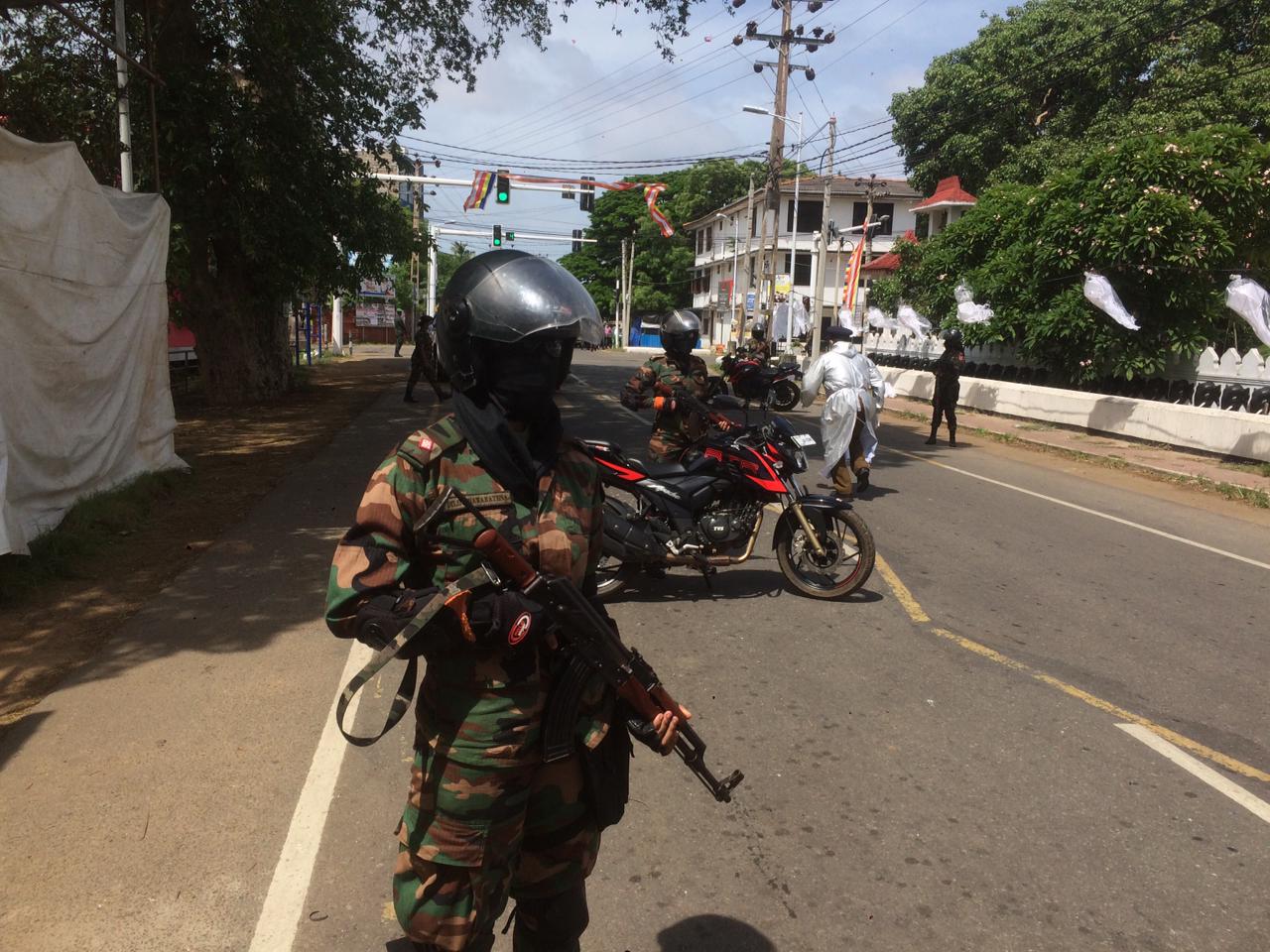
The Aragalaya, or struggle, that forced Gotabaya’s resignation as president in 2022, saw a violent state response to mass protests centred mostly in the country’s South, with the government employing the military in the manner it has long used in the North and East. Armoured personnel carriers were seen on the streets of Colombo, and the military used violence, surveillance and harassment against peaceful protesters, much as it routinely does against activists, journalists and many other groups deemed to be threats by the government, such as the families of the disappeared in war-torn regions. It was then that the Sinhala public in the South began to question the military’s role in the civil sphere, and the term “militarisation” began seeping into public discourse in the South. However, the resulting discussions were limited to the military’s bloated budget and did not extend to the militarisation of the North and East, which was accomplished through the establishment of numerous military camps after the end of the war, the on-going occupation and acquisition of private lands by the military to further expand its camps, the surveillance and harassment of civil society and increased military involvement in the civic sphere.
These issues are clearly viewed as controversial and people fear they will be subject to state scrutiny and possibly reprisals if they speak publicly about them. The expansion of the discourse on militarisation in the South and among populations earlier unaware or unconcerned about the issue can be viewed as progress – but these groups’ reluctance to address aspects of militarisation that target and impact mainly the Tamil population shows that the military’s actions in relation to the North and East remain the elephant in the room that the South does not want to address.
AMBIKA SATKUNANATHAN
Ambika Satkunanathan is a human-rights advocate. During her tenure as the commissioner at the Human Rights Commission of Sri Lanka, between 2015 and 2020, she led the first ever national study of prisons undertaken by the commission.